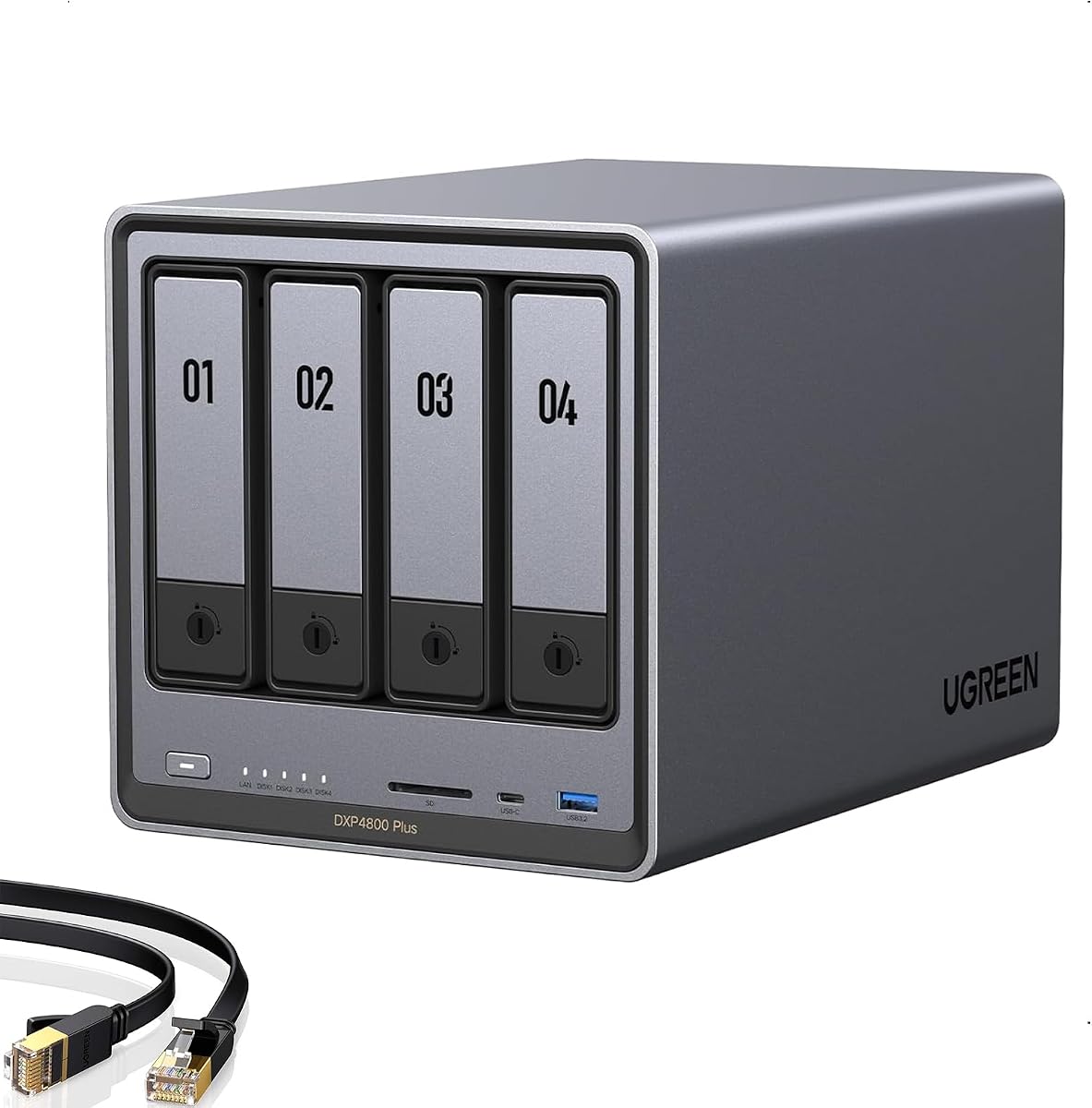
UGREEN NAS DXP4800 Plus
4.6Editor score
10GbE and 10Gbps USB
Docker and virtual machine support
Four-bay expandable storage
Our NAS for 4K Transcoding guide compares ten models for hardware transcoding, media-server compatibility, networking, expandability, storage, and ease of use.
A NAS built for 4K transcoding needs more than spacious storage. It needs a processor capable of real-time video conversion, compatible media-server software, sufficient memory, and a fast network path between clients and the library. The right system can handle direct playback, background conversions, multiple users, and large media collections without making storage the bottleneck.
This guide compares ten NAS models across CPU capability, memory, networking, drive expansion, media features, app support, and setup considerations. We considered the supplied specifications and product descriptions rather than claiming hands-on testing. The list covers compact two-bay and larger four-bay systems for families, creators, media enthusiasts, and small offices.
Each review explains where a model stands out, where compromises remain, and which type of library will benefit most. Hardware transcoding support can vary by codec, media application, and configuration, so readers should verify their preferred server and client formats before purchasing. Product availability, software features, and prices change, making current listings worth checking.
4.6Editor score

4.6Editor score

4.7Editor score
This side-by-side comparison highlights each NAS's processor, networking, expansion options, and media-oriented features. Because transcoding depends on codec and application support, buyers should treat the listed capabilities as starting points and confirm current software compatibility.




The UGREEN DXP4800 Plus is the most balanced recommendation in this guide for a NAS for 4K transcoding. It earns a 4.6 rating and combines a four-bay design, 10GbE networking, 10Gbps USB ports, Docker, and virtual-machine support. Those features make it more versatile than a simple file server and better aligned with creators who want a media library, backup hub, and self-hosted application platform in one enclosure.
We may earn a commission when you buy through this link, at no additional cost to you.
Its headline advantage is the 10GbE connection, which helps avoid a familiar 4K-media bottleneck. Large source files can move quickly over a properly configured network, while the USB 10Gbps ports provide another high-speed route for importing media from external storage. The system also supports Docker, allowing media-server applications such as Plex to run, while virtual machines add flexibility for compatible workloads. The product description states that a 1GB transfer can complete in less than a second under supported conditions, although actual performance depends on the router, CPU, drive, and file size.
The storage design is equally useful for a growing media collection. Four bays permit RAID configurations that can balance capacity, redundancy, and performance, and the advertised maximum capacity reaches 144TB with compatible drives. Centralized backups, remote access, flexible permissions, and encryption help make the NAS a practical private-cloud foundation. These are important qualities for transcoding because the original media, converted files, metadata, and device backups can all remain under local control instead of being divided among external drives and cloud accounts.
This is the right choice for a serious home media server, creator, or small team that wants more headroom than an entry-level enclosure. Buyers should plan for compatible storage drives and understand that Plex is run through Docker rather than being presented as a dedicated preinstalled experience. For shoppers prioritizing fast transfers, flexibility, and a generous four-bay layout, the DXP4800 Plus offers the strongest overall balance in the list.
The 10GbE port gives large media files a much faster path between clients and storage than a typical gigabit connection. In a home with a 10GbE-equipped computer, switch, and router, this can materially improve imports, backups, and browsing responsiveness.
Docker and virtual-machine support expand the NAS beyond basic file serving. That makes the DXP4800 Plus attractive to users who want to run compatible media servers, backup tools, and other self-hosted services from a single platform.
We may earn a commission when you buy through this link, at no additional cost to you.
The UGREEN DH4300 Plus is the value-focused choice for readers building their first 4K media NAS. It holds a 4.2 rating and offers four bays, a 2.5GbE port, 8GB LPDDR4X memory, Docker support, and 4K HDMI video output. That combination gives beginners a practical way to store media, run compatible server software, and connect a television without starting with a bare enclosure.
We may earn a commission when you buy through this link, at no additional cost to you.
Its 2.5GbE networking is a meaningful upgrade over a single-gigabit connection, helping large media files transfer more efficiently when the client and switch also support 2.5GbE. The included 8GB of memory is useful for multitasking, and the description notes that a 1GB file can transfer in about three seconds under suitable conditions. Local 4K HDMI output expands its role beyond background storage by allowing compatible media experiences to be viewed directly on a display.
The DH4300 Plus also emphasizes accessibility. Setup begins through NFC, the application supports major desktop and mobile platforms, and automatic phone backups can keep family photos and videos synchronized. AI albums can recognize people, objects, pets, and scenes, while semantic search and duplicate removal make large collections easier to navigate. Its privacy controls and automatic backups make it suitable for users moving away from cloud-only storage without requiring advanced administration.
The main compromise is that it does not support virtual machines, and its network interface is slower than the 10GbE options in this guide. It is still a capable budget pick when the goal is affordable 4K media serving, local TV access, and Docker-based flexibility. Choose the DH4300 Plus for a straightforward family setup; choose a faster or more expandable model when simultaneous transcoding, large professional projects, or intensive virtualized workloads are priorities.
The HDMI output and 2.5GbE port make this enclosure practical for a living-room media setup. It can keep the library local while providing a direct route to a compatible television and faster file access than a basic gigabit NAS.
NFC-assisted setup, automatic phone backups, AI organization, and broad platform support reduce the learning curve. This makes the system approachable for users making their first move from external drives or cloud storage.
We may earn a commission when you buy through this link, at no additional cost to you.
The UGREEN DXP2800 brings a capable Intel N100 processor and 8GB DDR5 memory to a compact two-bay enclosure. Its 4.6 rating reflects a strong specification mix for advanced home users, particularly those managing 4K video, RAW photos, Docker applications, virtual machines, and local camera recordings. It is a good choice when physical simplicity matters but the underlying computing power should exceed a typical entry-level NAS.
We may earn a commission when you buy through this link, at no additional cost to you.
The N100 quad-core CPU provides a useful foundation for media-server workloads, while 8GB of DDR5 memory gives the system room for several applications and background tasks. Dual M.2 NVMe slots allow compatible high-speed SSDs to complement the two SATA drive bays, potentially improving responsiveness or supporting cache-style workflows. The 2.5GbE network port is also a meaningful improvement over gigabit Ethernet for large media transfers.
The supplied description explicitly positions the DXP2800 for creators, media servers, and advanced applications. It supports Docker and virtual machines, and it is compatible with Plex media applications when deployed appropriately. AI features can organize photographs by recognized people, objects, scenes, and locations, while face, people, and pet detection can make locally stored camera footage easier to review.
The two-bay design is the decisive limitation. It can be ideal for a user with a focused personal library who wants fast NVMe support and modern application capability, but it offers less room to mix RAID levels, expand cold storage, or retain multiple drive types than a four-bay model. Buyers should also purchase drives separately. For a compact creator or advanced household seeking strong transcoding headroom without a four-bay footprint, the DXP2800 is a compelling pick.
The N100 processor, DDR5 memory, and NVMe slots make this enclosure feel more like a compact workstation than a traditional file server. It can serve users who want application flexibility without occupying a four-bay footprint.
AI photo organization helps manage large personal libraries, while local camera detection and recording features support a home surveillance hub. These capabilities let media and security workloads share one system.
We may earn a commission when you buy through this link, at no additional cost to you.
The UGREEN DXP4800 GT is the premium recommendation for demanding 4K workflows. Its AMD Ryzen Embedded R2514 processor provides four cores and eight threads, while 8GB of DDR4 memory is expandable to 64GB. Dual 10GbE networking, Docker, virtual machines, and SAN Manager give it the strongest combination of media, storage, and application capability among the four-bay systems reviewed here.
We may earn a commission when you buy through this link, at no additional cost to you.
The two 10GbE ports are particularly valuable. Each supports up to 10Gbps, and with compatible network equipment and link aggregation, the ports can deliver up to 20Gbps aggregate bandwidth. That theoretical 2.5GB/s ceiling is far beyond many home internet connections, but it remains relevant for local editing, rapid backups, and multiple users working from large 4K or 8K assets. The Ryzen platform is also positioned for media processing and local-like high-resolution editing.
UGOS Pro expands the platform with media and application options including Plex, Emby, Jellyfin, Home Assistant, web hosting, and other Docker-based tools. Plex runs through Docker and requires manual setup. A built-in surveillance center supports compatible ONVIF or RTSP cameras, live multi-view, PTZ control, event detection, recording, and timeline playback, allowing footage to remain stored locally.
Storage expansion is also impressive: four SATA bays, room for U.2 NVMe SSDs in two compatible bays, and two M.2 SSD positions contribute to an advertised maximum of 144TB. The caveat is that this premium platform requires careful planning, compatible media software, a suitable network, and separately purchased drives. For creators, small teams, and technically capable enthusiasts who want maximum headroom, the DXP4800 GT is the leading choice.
Dual 10GbE ports provide a major advantage when multiple editors, servers, or clients exchange large files. Link aggregation can increase aggregate throughput while adding a degree of network-path redundancy on compatible equipment.
The built-in surveillance center reduces the need to operate separate camera systems. Media libraries, self-hosted applications, and local security recordings can share the same storage and management environment.
We may earn a commission when you buy through this link, at no additional cost to you.
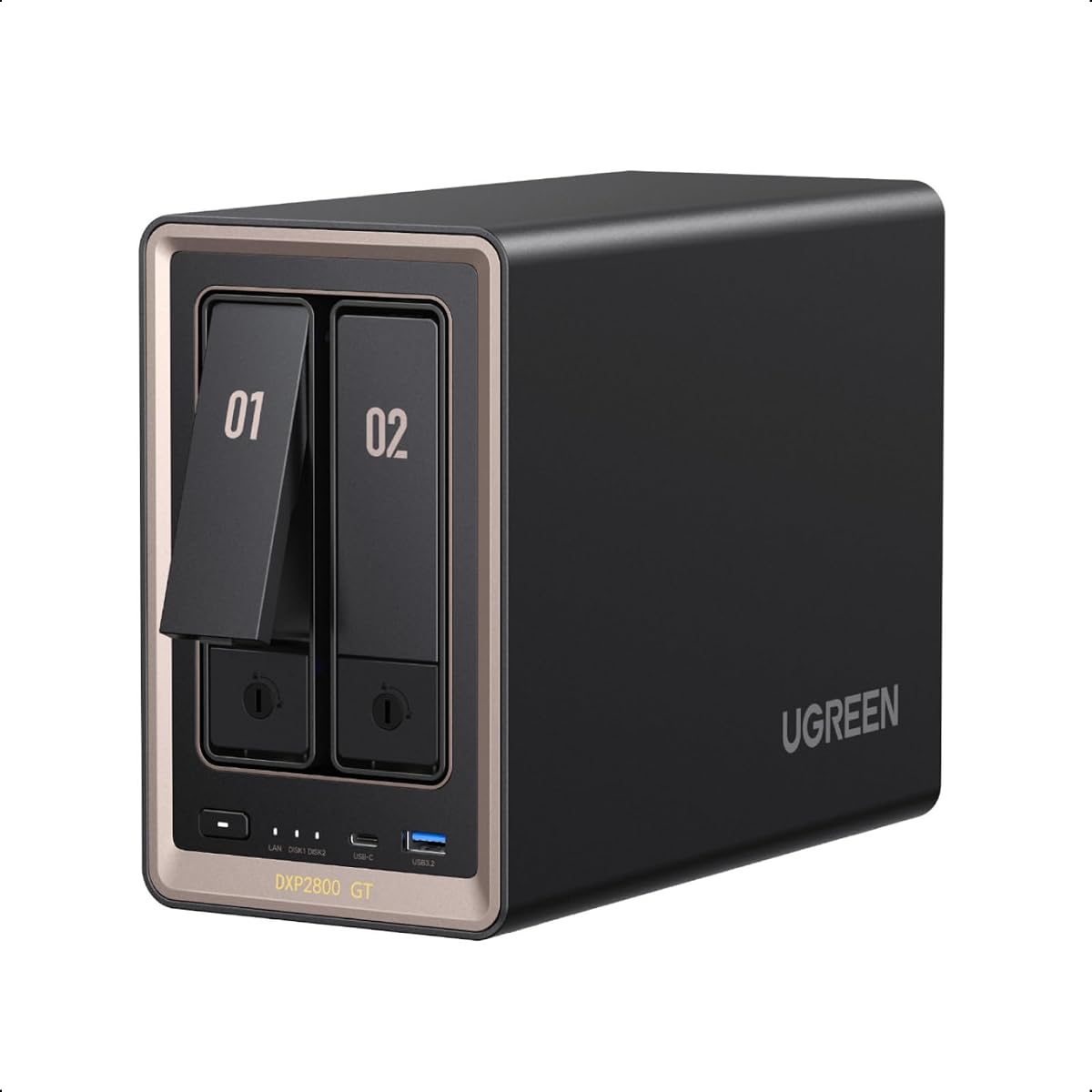
The UGREEN DXP2800 GT is a compact performance model for creators, freelancers, and smart-home enthusiasts. Its 4.3 rating is supported by a Ryzen Embedded R2514 processor, 8GB of expandable DDR4 memory, 10GbE networking, and a two-bay chassis. It delivers much of the DXP4800 GT's processing strength in a smaller format, making it attractive when fast networking matters more than maximum raw bay count.
We may earn a commission when you buy through this link, at no additional cost to you.
The Ryzen processor has four cores, eight threads, and speeds up to 3.70GHz, creating ample headroom for media-server work, Docker apps, backups, and multitasking. A 10GbE connection substantially raises the local transfer ceiling compared with 2.5GbE models. It is a particularly good fit for a creator who edits from a fast wired workstation but does not need four hot-swappable SATA bays.
UGOS Pro adds Docker, virtual machines, SAN Manager, and support for applications such as Plex, Emby, Jellyfin, and Home Assistant. The built-in surveillance center can work with ONVIF or RTSP cameras, providing live viewing, continuous recording, event review, and locally stored footage. Local account operation, TLS/SSL, RSA, AES, SHA-512, permissions, and RAID 1 support reinforce its suitability for privacy-conscious users.
The enclosure supports two SATA drives, compatible U.2 NVMe use in those bays, and two M.2 SSD positions, with an advertised maximum of 80TB. Its main limitations are the two-bay layout and the fact that installed memory is non-ECC; a compatible ECC upgrade is required for memory error correction. Choose this model for strong 4K performance in a compact system, especially if one high-speed connection is sufficient.
A single 10GbE port provides enough local bandwidth for demanding media workflows while keeping the enclosure smaller than a four-bay system. It is well suited to creators with a fast wired editing station.
Docker, virtual machines, and the Surveillance Center allow compatible media, security, and home-automation services to coexist. This makes the NAS useful as a central hub rather than a single-purpose video server.
We may earn a commission when you buy through this link, at no additional cost to you.
The Synology DS425+ is the strongest alternative for buyers who value a mature private-cloud and office ecosystem. It carries a 4.7 rating, supports media streaming, file sharing, and surveillance, and handles concurrent access from more than ten users. Its four-bay diskless design offers storage flexibility without tying buyers to a preconfigured hard-drive bundle.
We may earn a commission when you buy through this link, at no additional cost to you.
The stated throughput of up to 278 MB/s is sufficient for smooth 4K media workflows and larger shared libraries, especially over gigabit or faster local networks. The product description emphasizes team productivity, centralized repositories, granular access controls, audit logs, RAID redundancy, automated backups, and snapshots. Those features are especially relevant to small creative teams that need clear permissions and dependable recovery rather than only a media playback interface.
Surveillance support extends to 30 IP cameras with motion detection and secure remote access. This makes the DS425+ more than a living-room media appliance and gives it value for organizations combining file collaboration with camera recording. A three-year warranty and the availability of dedicated technical account management for business-critical environments add further reassurance for professional use.
The supplied information does not specify the processor or memory, so buyers seeking a specific hardware transcoding engine should verify those details against the current product listing and media-server requirements. The diskless format also means compatible drives must be selected separately. For users who want Synology's polished management environment, collaborative storage, and mature backup tools, the DS425+ is an excellent general-purpose 4K media-server choice.
Concurrent access, granular permissions, and audit logs make the DS425+ useful for offices and creative groups. Team members can work from a centralized repository without relying on consumer file-sharing accounts.
RAID redundancy works alongside automated backups and snapshot technology. Combining these layers gives administrators several recovery paths when files are deleted, changed, or damaged.
We may earn a commission when you buy through this link, at no additional cost to you.
The Synology DS925+ is a high-speed four-bay option for users who want quick data movement alongside a mature NAS software experience. Its 4.3 rating and listed sequential read/write performance of up to 522 or 565 MB/s place it well for large 4K libraries, fast local backups, and media files moving between a NAS and editing workstation.
We may earn a commission when you buy through this link, at no additional cost to you.
Dual 2.5GbE ports improve throughput and can provide redundancy when configured with compatible network equipment. That extra bandwidth is useful when several people browse a library, synchronize large projects, or access a NAS over a local network. The product also supports built-in file and photo management, data protection, virtualization, and surveillance solutions, allowing one enclosure to cover several common small-business needs.
Synology's three-year limited hardware warranty is another point in its favor. The DS925+ is diskless, so buyers must select drives from the official compatibility list. That requirement makes it important to verify both current drive support and the exact storage configuration being purchased before ordering components.
The supplied information does not identify the processor or explicitly enumerate hardware transcoding formats, so the headline storage figures should not be treated as proof of every 4K codec. For Synology users who prioritize sequential speed, flexible 2.5GbE networking, and integrated management tools, this remains a compelling high-performance four-bay platform.
The listed sequential transfer rates reduce the time required to move large media sets and backups. This is valuable when the NAS is used as an editing source rather than only a remote archive.
File management, photo tools, protection, virtualization, and surveillance support arrive within the same ecosystem. That breadth can simplify administration for households and small offices.
We may earn a commission when you buy through this link, at no additional cost to you.
The QNAP TS-264 is a strong compact option for direct 4K playback, a two-bay library, and users who want an unusual degree of output connectivity. It has a 4.7 rating, 8GB of installed memory, support for dual screen extensions, and playback suitable for 4K high-definition video. It also supports M.2 2280 NVMe SSDs or an Edge TPU as optional performance components.
We may earn a commission when you buy through this link, at no additional cost to you.
Port trunking can deliver up to 5Gbps from existing CAT5e cabling when the necessary hardware and configuration are available. That network capability is valuable for moving large media files, though actual performance depends on clients, switches, storage, and file access patterns. The 8GB of RAM also helps system responsiveness and multitasking, giving QNAP's application environment more room than many basic two-bay NAS systems.
Direct display support gives the TS-264 an advantage for a living-room or editing-office setup. Rather than relying exclusively on network playback from a television or monitor, compatible local screens can use the NAS's own video output. This can provide a simpler path to browsing media and playing files without continually routing large video streams across the network.
The two-bay design limits future capacity, and the faster trunking option requires compatible networking. Buyers should also confirm current transcoding codec and media-server support for their preferred formats. For a smaller library, strong installed memory, and convenient 4K screen output, the TS-264 delivers a compelling feature set at a competitive tier.
Local screen support can simplify direct playback from the NAS. It is especially convenient for users who want their television or editing monitor connected directly to the enclosure.
NVMe expansion can improve response times, while port trunking raises the network ceiling. Both options help active users move beyond the limitations of a basic two-bay network server.
We may earn a commission when you buy through this link, at no additional cost to you.
The 36TB version of the Synology DS224+ is a ready-made two-bay storage package for buyers who want substantial capacity without selecting every component separately. It includes two 18TB SATA hard drives according to the supplied product information, along with a Celeron J4125 quad-core processor, 6GB of DDR4 non-ECC memory, and two 1GbE LAN ports.
We may earn a commission when you buy through this link, at no additional cost to you.
As a media repository, the large drive capacity can accommodate a substantial collection of 4K films, family videos, and photographs. Synology Drive and Synology Photos indexing are described as improved over earlier generations, helping users locate files in larger libraries. Integrated security features, centralized access, and data-management tools make the package practical for households that want a private shared repository rather than a simple external drive.
Power efficiency is another consideration. The listed operational usage can be as low as 15 watts, which is useful for a NAS that remains available around the clock. The included storage also removes the need to calculate drive quantities and compatibility from scratch, although buyers should confirm the configuration details and included components in the current listing.
The principal limitation is networking. Two 1GbE ports provide redundancy options but a much lower throughput ceiling than the 2.5GbE and 10GbE models in this guide. Direct or software-based 4K transcoding may therefore be constrained by the network rather than storage. This package is best for a large library accessed by a few users, while faster-network models are better suited to simultaneous high-bitrate streams.
The two-drive 36TB configuration provides immediate usable capacity for large archives. It is a straightforward option for users who want storage delivered as a package.
A listed operating power as low as 15 watts suits a device maintained as an always-on home library. Centralized access and indexing make that capacity easier to use day to day.
We may earn a commission when you buy through this link, at no additional cost to you.
The 20TB Synology DS224+ configuration offers a balanced entry point into private NAS storage. The supplied description identifies two 10TB SATA 3.5-inch hard drives, a Celeron J4125 quad-core processor with up to 2.7GHz turbo speed, 6GB of non-ECC DDR4 memory, and two 1GbE network ports. It is a practical package for building a 4K film or family-video library without beginning with an empty case.
We may earn a commission when you buy through this link, at no additional cost to you.
The Celeron platform is well suited to the NAS's central roles, including centralized file access, backups, photo indexing, sharing, and surveillance video management. Synology Drive and Synology Photos benefit from the described indexing improvements, which can make searching through a large local collection more responsive. Integrated security features and shared access support make it useful for a household or a small group that wants more control than an external hard drive provides.
The device's listed operational power can reach only 15 watts, helping reduce the energy cost of leaving storage available for remote access. Two drive bays allow the included drives to be configured according to the user's priorities, including redundancy or a larger usable pool, depending on the NAS software and chosen RAID arrangement.
The listing notes that hard drives and memory upgrades included separately are not installed and require installation. As a result, buyers should review the package contents carefully. The 1GbE networking and lower storage total make this model less suitable for heavy multiuser 4K streaming than 2.5GbE or 10GbE alternatives. It remains a sensible choice for a smaller or mainly archival 4K collection.
Two 10TB drives provide enough room for a meaningful collection of high-resolution films and family recordings. The preconfigured package is easier for newcomers to deploy than assembling drives separately.
Integrated access controls, photo and file indexing, and centralized management make the enclosure more useful than simple external storage. These tools improve both security and day-to-day discovery of media.
We may earn a commission when you buy through this link, at no additional cost to you.
The best NAS for 4K transcoding depends on codec support, processor capability, memory, network speed, storage layout, and the media application you intend to run. Review these factors together rather than treating advertised playback, storage capacity, or transfer speed as a guarantee of transcoding performance.
Start by confirming that the NAS supports hardware-assisted transcoding for the exact codecs used by your library. The ability to play 4K HDR, HEVC, AV1, Dolby Vision, or other media depends on the processor, media-server application, client device, and bit depth or color format. A NAS may stream a file without conversion yet still need to transcode when the client requests a different format. The supplied listings mention media-server use broadly, but they do not provide complete codec matrices, so current vendor documentation is essential.
Choose a model whose processor and software combination explicitly supports your most common formats.
A faster processor gives the NAS more headroom when transcoding 4K video, running background indexing, serving multiple users, and operating alongside backups or other applications. The Ryzen R2514 models emphasize four cores and eight threads, the Intel N100 supplies four cores, and the Celeron J4125 is a lower-power four-core option. Faster silicon does not guarantee better playback in every application, but it generally provides useful capacity for simultaneous workloads and future software demands.
Prioritize processing headroom when transcoding is continuous or several services run at once.
Memory affects multitasking, application responsiveness, and the ability to run demanding services. The DH4300 Plus includes 8GB of LPDDR4X, the DXP2800 includes 8GB of DDR5, and several other models provide 8GB that can be expanded in some cases. A system running only a basic file server or media client may need less, while virtual machines, surveillance, indexing, and multiple media applications benefit from additional memory.
Choose at least the included amount and verify upgrade support if you expect to add containers, virtual machines, or many concurrent services.
A gigabit connection tops out near 125MB/s in ideal conditions, which can become restrictive with very large source files and multiple 4K streams. The DS425+ is rated up to 278MB/s, the DS925+ uses dual 2.5GbE ports, and the GT models reach 10GbE or dual 10GbE. Faster links reduce seeking delays and speed imports, but they require compatible client adapters, switches, and routers. Direct HDMI playback can avoid some network constraints entirely.
Match the NAS interface to your clients and switch rather than buying faster hardware that the rest of the local network cannot use.
Two-bay systems suit focused libraries, while four-bay models allow a more flexible mix of RAID levels, capacities, and drive purposes. Consider redundancy, usable capacity, drive compatibility, noise, heat, and the number of simultaneous users. NVMe expansion can improve application responsiveness, but it should not automatically be treated as a substitute for sufficient HDD storage. The listed maximum capacities are theoretical totals based on compatible configurations and are not usable capacities under every RAID arrangement.
Select drive bays and RAID based on realistic library growth, recovery needs, and performance priorities.
Decide whether you will run a dedicated application such as Plex, Emby, Jellyfin, or another media server, and confirm how it is installed. Several UGREEN models support Docker, allowing compatible applications to be deployed manually, while the descriptions do not indicate that they come with every media server preinstalled. Synology systems emphasize integrated file, photo, backup, and surveillance tools. QNAP and UGREEN platforms may offer more flexible app deployment but can also require more user configuration.
Choose the platform that matches your willingness to configure applications as well as your preferred playback features.
RAID is not a backup. A NAS can protect against some drive failures, but accidental deletion, ransomware, failed updates, and hardware loss still require separate recovery strategies. Look for snapshot support, automated backups, versioned files, and easy restore procedures. Synology DS425+ combines RAID, backups, and snapshots, while UGREEN models emphasize centralized and automatic backups plus RAID options. Whichever system you select should be paired with an independent copy of irreplaceable media.
Plan multiple protection layers and test that important files can actually be restored.
Some clients can play the original 4K file directly, avoiding a full transcode, while others need conversion because of unsupported codecs, bandwidth, or device limits. Local HDMI output can provide a simpler and more reliable path for compatible displays. Remote streaming also depends on upload speed and whether the remote service supports the required format. The DH4300 Plus and QNAP TS-264 explicitly mention 4K HDMI output, giving them an advantage for local-display setups.
Identify the devices that will request streams and match direct-play support, HDMI access, and network capacity to them.
Begin by installing compatible drives, connecting the NAS to a wired network, and completing the manufacturer's setup process. Create an administrator account, enable a strong passphrase, configure automatic updates, and decide on your preferred RAID arrangement before importing a large media collection. If the NAS will serve television or desktop clients, install the intended media-server application and verify that it detects the transcoding hardware and all needed codecs.
Organize media into consistent folders, then grant applications access through users, groups, and shared folders rather than using one unrestricted administrator account. Configure client-specific playback settings so compatible devices can direct-play where possible and transcode only when required. Monitor CPU load, memory, temperatures, network activity, and storage health during initial playback tests. Record a baseline for normal usage so that sustained transcoding problems can be distinguished from temporary background indexing.
Maintain the NAS by keeping its firmware and applications updated, checking drive health, and keeping adequate ventilation around the enclosure. Schedule backups to another device or location, retain an independent copy of irreplaceable files, and periodically test restores. Clean the system with power disconnected using soft, dry methods, and avoid placing the enclosure in a closed cabinet unless airflow remains adequate. If notification or surveillance features are used, verify time synchronization and recording settings after every major update.
Hardware transcoding is most valuable when clients cannot play the original file directly or when multiple users request streams at once. A smaller library viewed mainly on compatible local devices may work without heavy conversion. A capable processor remains useful for background tasks, indexing, and maintaining playback responsiveness even when direct play handles most requests.
Not always. A compressed 4K stream may fit comfortably within a fast gigabit connection, especially for one local client. However, 2.5GbE or 10GbE can reduce delays with very large files, high-bitrate masters, multiple simultaneous viewers, and large backups. The network switch and client hardware must support the selected speed for it to make a difference.
The supplied product information specifically states that Plex can run through Docker on several UGREEN models, including the DXP4800 Plus and DH4300 Plus, with manual setup required. Compatibility can change with software releases, so check the current container instructions and your desired Plex features before deployment. Other media servers such as Emby or Jellyfin may also be useful depending on your device support and library features.
No. RAID can maintain availability or recover from certain drive failures, but it does not protect every file from deletion, corruption, ransomware, or loss of the entire NAS. Important media should also be copied to another system or location, and restore procedures should be tested periodically. Snapshots and versioned backups add useful additional protection.
A four-bay model generally offers the better balance of capacity, redundancy, and drive flexibility. The DXP4800 Plus stands out for 10GbE and 10Gbps USB connectivity, the DXP4800 GT for Ryzen performance and dual 10GbE, and the DS425+ for a polished shared-storage and surveillance ecosystem. The best choice also depends on whether the library emphasizes local playback, simultaneous streams, or active transcoding.
HDDs are generally sufficient for storing large media libraries, while SSDs can improve responsiveness, indexing, and container performance. Models with M.2 or compatible NVMe expansion offer options for acceleration or application storage. Their value is greatest when many small files, databases, virtual machines, or active editing projects are involved; ordinary sequential 4K playback may place more demand on drive sustained throughput than random latency.
Several models in this guide can do both. The UGREEN GT systems include a Surveillance Center with support for compatible ONVIF or RTSP cameras, live views, event detection, recording, and playback. The Synology DS425+ supports up to 30 IP cameras, while the DS224+ line also provides surveillance video management. Camera compatibility and retention requirements should be checked before installation.
Check the processor's current hardware-transcoding support, the media server's codec list, memory requirements, direct-play behavior, and the formats used by your clients. Also review network port speeds, compatible drive types, expansion limits, surveillance capacity, and backup features. Because software and hardware support evolve, use the current manufacturer documentation and product listing before making a final decision.
The UGREEN DXP4800 Plus is the most balanced overall recommendation, combining 10GbE, 10Gbps USB, four drive bays, Docker, and virtual-machine support. The UGREEN DXP4800 GT is the premium choice for maximum processing and networking headroom, while the Synology DS425+ stands out for polished team storage, backups, surveillance, and a strong 4.7 customer rating. Each suits a different balance of performance, flexibility, and management convenience.
Prioritize confirmed codec support first, then select a processor and memory configuration that can sustain the desired number of streams. Match networking to the clients and switches in your home or office, and choose the drive layout according to real capacity and redundancy needs. Direct playback should be enabled wherever possible, but reliable transcoding remains valuable for remote and incompatible clients.
Finally, check current product listings, drive compatibility, software versions, and prices before purchasing. NAS hardware can remain in service for years, and memory, SSD, and application support may evolve. The best choice is the model that not only advertises 4K media capabilities but also has enough compute, bandwidth, storage, and recovery protection for your particular library.
