
Yamaha MGX12
5.0Editor score
18-channel digital console
Dual USB-C connectivity
4.3-inch touchscreen
Our digital mixing consoles guide compares 10 leading models for live sound, studio recording, I/O, control, effects, and ease of use for working musicians.
Digital mixing consoles combine a hardware control surface, signal routing, preamplification, processing, and recording or playback tools in one dependable package. A strong console should make mixing faster without hiding essential controls, while providing enough input flexibility, processing power, and scene recall for changing environments.
We compared these ten consoles by examining their stated channel counts, preamplifiers, output options, fader and display layouts, effects, connectivity, and workflow features. The list covers compact tablets, rack-style units, stage-oriented consoles, and professional touring models, making it useful for rehearsals, clubs, studios, churches, and mobile production.
Each review highlights the most useful features and the compromises that may affect a particular setup. Ratings reflect the supplied customer feedback, while availability and prices change frequently, so readers should confirm current specifications and terms before making a purchase.
5.0Editor score

4.7Editor score

4.2Editor score
The comparison below highlights the major differences in input capacity, physical controls, preamp availability, connectivity, and workflow design across all ten consoles.



The Behringer X32 combines a substantial 40-input, 25-bus architecture with 32 MIDAS-designed, fully programmable microphone preamplifiers, giving it unusually broad capacity for both studio and live work. Its 4.7 rating reflects a well-regarded balance of features, reliability, and operating flexibility, while the 25 motorized 100 mm faders provide a clear, physical overview of a substantial mix.
We may earn a commission when you buy through this link, at no additional cost to you.
The console's strength comes from how comprehensively it combines routing, processing, and tactile control. Sixteen XLR outputs, additional line inputs and outputs, two headphone connections, talkback, dynamic LCD Scribble Strips, and DAW-related scene management make it adaptable to rehearsals, recording sessions, and live reinforcement. Every channel and bus can be assigned and identified without relying exclusively on a small display, which is valuable when engineers need rapid visual confirmation.
There are trade-offs in choosing a surface this large. It naturally demands more desk space than compact or tablet-driven models, and a mixer with 25 faders, 40 input channels, and extensive scene control has a meaningful learning curve. Some users may also find that they need a tablet or computer for certain control tasks, although the physical console remains a complete operating center.
This is the strongest all-around recommendation for someone who wants substantial channel capacity and hands-on control without moving to the most advanced touring class. It suits engineers who work across both studio and live settings, especially when motorized faders, programmable preamps, extensive buses, and DAW integration are more useful than a very compact footprint.
The combination of 40 input channels, 25 buses, 16 XLR outputs, and a built-in talkback section supports both multitrack-style recording and live routing. Its motorized scene controls also help repeat setups become consistent and easier to recall.
Twenty-five fully automated 100 mm faders create a detailed visual map of the mix, while individual and dynamic Scribble Strips make channel identification more intuitive. The result is especially useful for users who prefer tactile feedback over touchscreen-only operation.
We may earn a commission when you buy through this link, at no additional cost to you.
The Yamaha DM3 is a compact 22-channel digital console built around a large 9-inch touchscreen, making it an attractive option for rehearsals, small venues, streaming, and mobile production. Its 4.4 rating and combination of Yamaha processing, 96 kHz operation, and 22-channel architecture place it firmly in the modern touchscreen-console category.
We may earn a commission when you buy through this link, at no additional cost to you.
The DM3 supports 16 mono inputs, one stereo input, and two stereo effects returns, with six mono or three stereo mixes, two matrixes, and one stereo bus. Its 16 professional Yamaha preamplifiers include 12 XLR and four combo connections, while eight analog XLR outputs support balanced speaker and auxiliary routing. An 18-by-18 USB audio interface and two-by-two USB recorder add direct playback and recording functions.
The primary compromise is that it does not offer the same number of onboard preamplifiers or physical faders as larger consoles. Compactness also means less immediate tactile control for users accustomed to dedicated motorized faders and channel-select buttons. Nevertheless, the prominent display can provide broad visibility and the routing architecture covers common small-to-medium production requirements.
Choose the DM3 when desk space is limited but you want more capability than a basic mixer. It is a practical recommendation for a singer-songwriter, podcast producer, worship team, or small live act that values a large touchscreen, polished Yamaha preamps, USB recording, and flexible output routing in one compact enclosure.
The 9-inch touchscreen is the centerpiece of the DM3, consolidating channel controls, routing, and settings into a focused workspace. It helps the console fit comfortably on a smaller desk without sacrificing the visibility available from a very compact panel.
The 18-by-18 USB interface and two-by-two USB recorder make the console useful beyond live mixing. Sixteen preamplifiers and multiple mix, matrix, and bus options also give smaller productions room to organize sources and monitor feeds.
We may earn a commission when you buy through this link, at no additional cost to you.
The Behringer WING targets demanding live and production environments with 48 channels, 28 buses, 24 motorized 100 mm faders, and a large capacitive touchscreen. Its 4.2 rating reflects a feature-rich premium design, particularly notable for remote I/O expansion and its touch-sensitive channel editing section.
We may earn a commission when you buy through this link, at no additional cost to you.
Eight Midas PRO microphone preamplifiers and eight Midas PRO outputs are available onboard, while three AES50 ports can support up to 144 input and output signals through remote I/O connectivity. The console's adjustable display swivel, dedicated color TFT, eleven rotary controls, and three separately configurable fader sections create a flexible, information-rich operating surface.
Its scale is the central compromise. A 48-channel, 28-bus console with a large screen and 24 faders occupies substantial space, and the extensive routing and editing options require time to understand. The eight onboard preamps also mean that a large event may still require remote preamp and input hardware, even though the digital expansion path is extensive.
The WING is a compelling choice for engineers who need premium-scale routing, remote expansion, and a high channel count. It is particularly relevant to touring, theater, worship, and large studio environments where future I/O growth, flexible physical sections, and a deep feature set justify a substantial console.
Three AES50 ports and SuperMAC connectivity allow the WING to grow through remote I/O, supporting as many as 144 input and output signals. This makes the console appropriate for events where the physical source list will exceed the onboard connection count.
Twenty-four motorized faders can be divided into three configurable sections, while the touch-sensitive editing controls provide rapid access to channel properties. Users can organize the surface around different stages of a show instead of relying on one fixed workflow.
We may earn a commission when you buy through this link, at no additional cost to you.
The Yamaha MGX12 combines an 18-channel digital mixer with a 4.3-inch touchscreen, five control knobs, and tactile faders in a format aimed particularly at accessible home production and streaming workflows. Its 5.0 rating is the highest among the supplied products, although ratings should be considered alongside the size and capabilities of the setup.
We may earn a commission when you buy through this link, at no additional cost to you.
The console includes new MGX preamplifiers with an 86 dB gain range, Bluetooth audio input, a microSD card slot, and a built-in DSP processor for professional sound and latency-free monitoring. Simple and Standard modes, Auto Gain, Clip Safe, and Scene Recall reduce common setup burdens, while the dual USB-C arrangement supports connected production workflows.
Its main limitation is physical scale. The touchscreen is considerably smaller than the DM3's, and a compact control surface cannot offer the number of dedicated faders, channel buttons, and encoders found on touring consoles. The included software bundle may also appeal more to creators already using compatible production tools than to engineers focused solely on live sound.
The MGX12 is a strong choice for streamers, podcasters, songwriters, and project-studio users who want multiple source controls, low-latency monitoring, scene recall, and USB connectivity without a large console. Its assistive features also make it approachable for users who are newer to digital mixing.
Simple and Standard operating modes, Auto Gain, and Clip Safe can reduce repetitive tasks during initial configuration. These features are useful when the operator needs to establish a dependable starting point before concentrating on detailed balance and effects.
Dual USB-C connectivity, Bluetooth audio input, microSD playback, and a USB-HDMI interface support a modern computer-based workflow. The interface can also handle 4K video capture and pass-through for compatible streaming or production setups.
We may earn a commission when you buy through this link, at no additional cost to you.
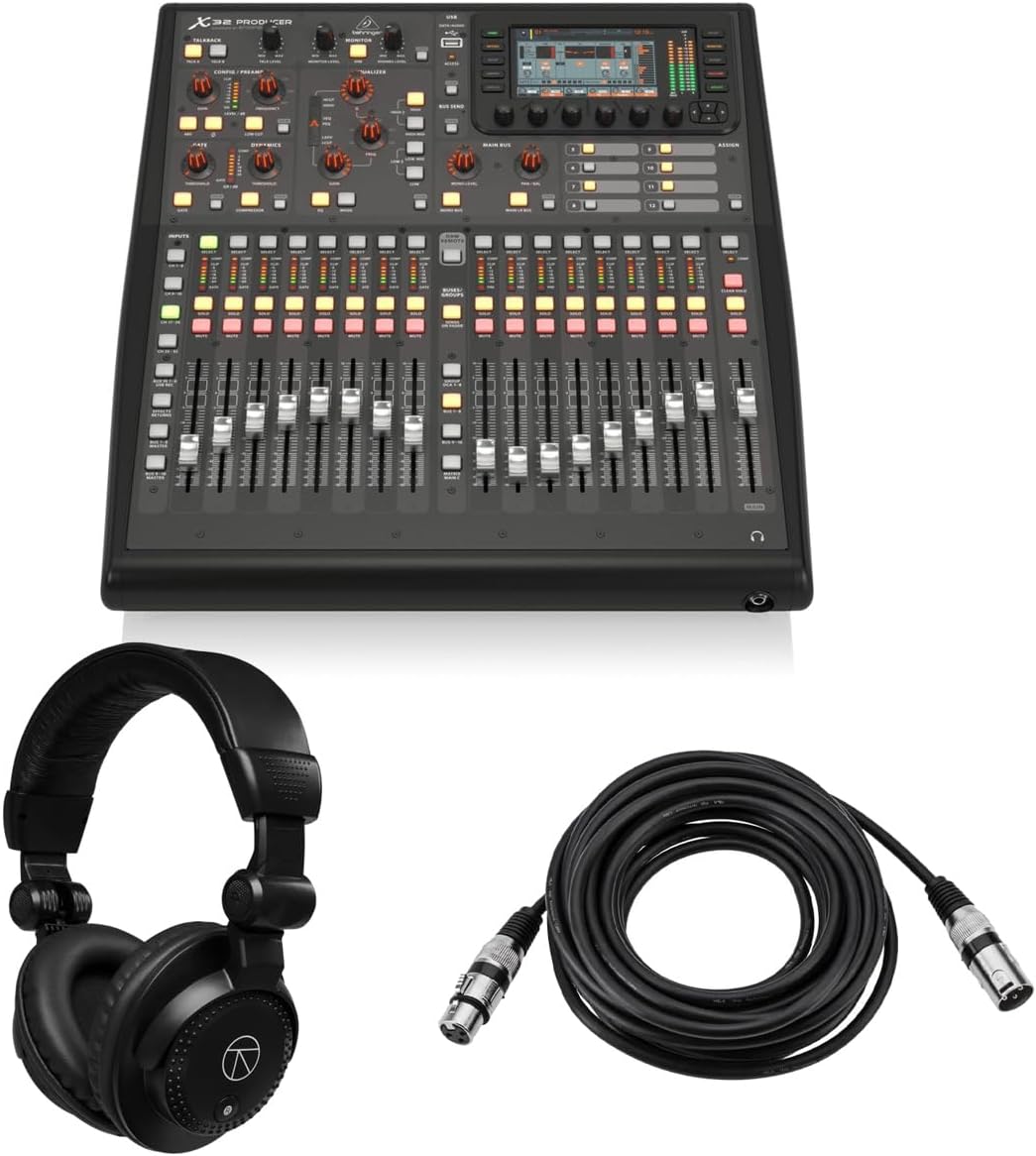
The Behringer X32 Producer preserves the familiar 40-input, 25-bus X32 architecture in a rack-mountable form, making it appealing for studio racks, mobile production cases, and control-room installations. It has a 5.0 rating and includes closed-back studio monitor headphones along with a 25-foot XLR microphone cable, providing useful accessories in the same package.
We may earn a commission when you buy through this link, at no additional cost to you.
Sixteen programmable MIDAS preamplifiers feed 24-bit, 48 kHz conversion, and the console includes 16 balanced XLR mic or line inputs, eight balanced XLR line outputs, 17 motorized faders, and a 5-inch 800-by-480 color TFT. A virtual effects rack provides eight true-stereo slots with simulations including the Lexicon 480L, PCM70, EMT250, and Quantec QRS.
Compared with the full X32, this version has fewer motorized faders and onboard XLR outputs, so it may require a different operating approach for larger live shows. The five-inch display is also smaller than the expansive displays found on the most advanced consoles. Users who rely on a large bank of dedicated physical controls may find the Producer edition less immediate.
Choose the X32 Producer when rack space, portability, and a complete accessory bundle matter more than maximum front-panel width. It is well suited to compact studios, rehearsal rooms, mobile rigs, and users who already understand X32 concepts or want a feature-rich console in a smaller physical package.
The rack-mountable enclosure helps conserve desk space and makes the console easier to integrate with outboard equipment. Seventeen motorized faders and the 5-inch TFT still provide enough local control for many production and mixing tasks.
The included closed-back headphones and 25-foot XLR cable remove the need to source basic monitoring and connection accessories separately. This is particularly convenient for new users assembling a home or project studio around the console.
We may earn a commission when you buy through this link, at no additional cost to you.
The Behringer X32 Compact delivers a 40-input, 25-bus configuration in a smaller control surface, offering a practical middle ground between a tablet mixer and a full-size touring desk. Its 4.7 rating indicates a well-received design with 16 programmable MIDAS-designed preamplifiers and 17 fully automated motorized 100 mm faders.
We may earn a commission when you buy through this link, at no additional cost to you.
Eight XLR outputs are supplemented by six additional line inputs and outputs, two headphone connectors, and a talkback section that supports an integrated or external microphone. Individual and dynamic LCD Scribble Strips appear on all channels and buses, helping users identify assignments and distinguish sources during live work or studio sessions.
The reduced fader count and eight XLR outputs may constrain larger events compared with the full X32. Users requiring many direct balanced output feeds may need to plan routing carefully or use additional equipment. As with other capable digital consoles, mastering its scene, bus, and DAW-control features also takes time.
This compact X32 is a strong fit for small venues, rehearsal spaces, mobile rigs, and studio users who want more physical control than a tablet but less desk consumption than a full console. It retains the broad 40-input and 25-bus architecture while making the working surface easier to transport and manage.
The 40-input, 25-bus layout provides considerable routing depth despite the smaller enclosure. Users can organize sources and destinations in advance, then use scene recall to move between rehearsal, performance, and recording configurations.
Individual and dynamic Scribble Strips across channels and buses make assignments easier to recognize. Combined with 17 motorized 100 mm faders, they preserve a tactile workflow that many tablet-only consoles cannot reproduce.
We may earn a commission when you buy through this link, at no additional cost to you.
The PreSonus StudioLive Classic 16.0.2 is a 16-channel USB console built for performers and recording users who want integrated effects, direct multitrack capture, and familiar PreSonus software. Its 3.9 rating is the lowest among the listed products, but the supplied feature set remains substantial for compact live and studio workflows.
We may earn a commission when you buy through this link, at no additional cost to you.
Twelve Class A XMAX solid-state microphone preamplifiers serve the input channels and talkback, while four auxiliary buses and two internal effects buses expand routing options. Every channel and bus receives three-band semi-parametric EQ, compression, downward expansion, and limiting, and the main output includes a stereo 31-band graphic equalizer. Two stereo 32-bit digital effects processors add further treatment.
The 18-in, 16-out USB 2.0 interface records all channels and the main left-right mix at 24-bit, 44.1 kHz or 48 kHz resolution, which simplifies a basic project-studio connection. On the other hand, its 60 mm faders and 12-fader layout provide less physical scale than modern motorized consoles, and the lower customer rating suggests that some buyers may have found the overall experience less compelling than the alternatives here.
Choose the StudioLive Classic 16 when direct recording, comprehensive channel processing, and compatibility with Studio One and Capture matter more than contemporary touchscreen size or motorized-fader control. It remains a capable option for rehearsal, small performances, and home or project studios built around a computer-based recording workflow.
The USB interface can record all input channels along with the main stereo mix, reducing the need for a separate basic recording interface. This makes the console a central hub for live capture and subsequent project-studio editing.
Fat Channel processing places EQ, compression, expansion, and limiting on the channels and buses, reducing the need for separate outboard processors. A dedicated stereo graphic EQ on the main bus adds another layer of control for overall system shaping.
We may earn a commission when you buy through this link, at no additional cost to you.
The Behringer XR18 places an 18-channel digital mixer inside a compact unit controlled by an iPad or Android tablet. Its 4.6 rating reflects a well-regarded alternative to a conventional desktop console, especially for rehearsals, mobile live work, and installations where physical faders are not essential.
We may earn a commission when you buy through this link, at no additional cost to you.
Sixteen MIDAS-designed programmable preamplifiers provide consistent source control, while the built-in Tri-mode Wi-Fi router allows direct operation without an external router. The 18-by-18 bidirectional USB interface supports direct recording to a tablet, and the console provides 12 mix buses plus main XLR outputs. A planned future firmware update is described for Dugan-style automatic microphone gain sharing.
Because the mixer relies on a tablet, users must account for battery life, screen size, app workflow, and the availability of a suitable controlling device. The compact hardware also does not reproduce the tactile channel overview of a motorized console. Remote operation may also be less desirable for engineers who want immediate access to every physical switch and fader.
The XR18 is a compelling pick for a band, educator, house-of-worship team, or mobile sound provider that wants a full digital mixing system without carrying a large control surface. It is particularly attractive when the operator already prefers tablet-based control and needs direct multichannel recording alongside live mixing.
The integrated Tri-mode Wi-Fi router removes the need for a separate wireless network for direct tablet control. That makes setup and transport simpler for rehearsals, small events, and mobile crews.
Sixteen programmable MIDAS-designed preamplifiers give the XR18 a substantial preamp count for its size. Combined with 18 channels and 12 buses, the console can handle a broad mix without the footprint of a large desk.
We may earn a commission when you buy through this link, at no additional cost to you.
The Allen & Heath Qu-5 is a 38-input, 24-output digital mixer designed for professional live sound, recording, and installed audio. Its 96 kHz XCVI FPGA processing, USB-C multichannel recording, SD capture, and broad remote-control support distinguish it as a serious production platform rather than a compact general-purpose mixer.
We may earn a commission when you buy through this link, at no additional cost to you.
The flexible architecture supports up to 38 inputs to mix, 12 configurable mixes, four matrix outputs, and customizable channel layers. Connectivity includes 16 XLR or TRS combi inputs, 12 XLR outputs, AES3 digital output, a 128-by-128 SLink expansion port, and a 32-by-32 USB-C multichannel audio interface. Six multi-FX engines, dedicated returns, USB-A stereo playback, and SD card capture support both live and studio workflows.
Because the supplied product data does not include a customer rating, there is no numerical feedback score to weigh against the feature set. The advanced routing, recording options, and 96 kHz processing also create a steeper learning curve than a simpler compact model. Users should be prepared to build a more deliberate workflow around scene structure, channel layers, and output management.
The Qu-5 is a strong recommendation for a studio, production facility, church, or live provider that needs high-resolution processing and comprehensive recording connectivity. It is best suited to operators who value flexible architecture, expandable I/O, and professional control more than a minimalist interface.
The 96 kHz XCVI FPGA engine provides the console's central technical foundation, with very low latency and the processing capacity to support demanding production environments. It is particularly relevant to users moving between high-resolution recording and live output workflows.
USB-C multitrack recording, USB-A stereo playback and recording, and SD card capture up to 32 channels provide multiple ways to capture audio. This flexibility can simplify a workflow that would otherwise require several separate devices.
We may earn a commission when you buy through this link, at no additional cost to you.
The QSC TouchMix-16 is a compact digital console with 20 full-function inputs, extensive channel processing, and a convenient included bag for transport. Its 4.4 rating reflects a well-regarded portable design suited to rehearsals, acoustic performances, small rooms, and situations where a dedicated mixer must be easy to carry.
We may earn a commission when you buy through this link, at no additional cost to you.
The input section includes 12 microphone connections, four XLR or TRS combo mic and line inputs, two stereo TRS line inputs, talkback, and USB two-track. Six XLR auxiliary outputs, two stereo TRS outputs, XLR main left and right outputs, cue, and monitor connections create a broad analog routing network. The TRS auxiliary outputs can directly drive wired in-ear monitors.
Every input channel includes four-band fully parametric EQ, variable high-pass and low-pass filters, a gate, and a compressor. That is a generous amount of processing for a portable console, although the 44.1 kHz format and USB two-track connection are less suitable for modern multitrack production than the 48 kHz and larger USB interfaces found on several competing models.
Choose the TouchMix-16 for mobile acoustic work, teaching, rehearsals, and compact live events where analog outputs, direct monitor feeds, and a manageable footprint matter. The included bag adds practical portability, while the detailed per-channel processing provides more control than a basic live mixer.
The wide set of XLR, TRS, combo, auxiliary, cue, and monitor outputs makes it straightforward to integrate with conventional speakers, stage boxes, and wired IEM systems. The supplied bag also supports transport between locations.
Four-band parametric EQ, variable high- and low-pass filters, a gate, and a compressor are available on every input channel. This consistent feature set helps users control sources consistently rather than relying on a few special-purpose channels.
We may earn a commission when you buy through this link, at no additional cost to you.
The right digital mixing console depends on the number of sources, type of output routing, recording needs, operator preferences, and the physical space available. These factors help narrow the field before comparing individual models.
Start with the number of simultaneous sources rather than the largest headline channel count. A console may list 18, 22, 40, or 48 inputs, but those figures can include stereo channels, digital returns, and other routable paths. Count the microphones, instruments, playback devices, talkback sources, and stereo feeds that must be available at the same time. Then examine the number of physical microphone preamplifiers, because that determines how many sources can accept analog connections directly.
Choose enough onboard preamps for your normal source count, with some room for expansion. A console with 40 logical inputs but only 16 onboard preamps may require an interface or stage box for the remaining sources.
Outputs determine how a console connects to the rest of the system. Look beyond the main left and right outputs to consider stage monitor mixes, in-ear monitor feeds, cue, talkback, recording connections, and external processing. Models offering four, six, or 12 XLR outputs can support more independent destinations without relying on splitters or converters.
Match the number and type of output connectors to the venue. Balanced XLR is common for speaker and stage feeds, while TRS can be convenient for wired monitors, control rooms, and compact installations.
Digital consoles fall into several control styles. A large console with motorized faders offers immediate visual feedback and strong scene recall. A compact touchscreen emphasizes routing and editing in a small footprint. A tablet-controlled mixer removes most of the hardware surface and can be especially convenient for mobile use. Each approach can work well, but the operator's habits and the need for tactile feedback matter.
Consider who will use the console and how often it will be programmed. A touchscreen may be efficient for one experienced operator, while physical faders can help several people work quickly, follow a show, or troubleshoot an unfamiliar mix.
For studio and streaming work, inspect the USB format carefully. Some consoles offer a large bidirectional multichannel interface capable of recording many isolated channels. Others provide stereo playback, two-track recording, or no dedicated computer audio connection at all. The supported sample rate and bit depth also matter when the goal is direct multitrack capture.
Do not assume every USB connection performs the same function. A port used for media playback may differ from one used for recording or control. Confirm the supported operating system, recording software, channel count, and driver behavior before purchasing.
Remote I/O can turn a manageable console into a much larger system. Some models include digital network ports, while others support stage boxes, digital snakes, or proprietary expansion connections. This matters for theaters, tours, large rooms, and events where a single console enclosure cannot reach every source or output position.
Look for a clear expansion path, compatible accessories, and enough physical connectivity for the intended deployment. A large advertised channel count is less meaningful if there is no practical way to bring remote inputs onto the console.
Modern consoles commonly include EQ, compression, gates, limiters, filters, and multichannel effects. Per-channel processing is especially valuable because it lets the operator shape each source consistently, while bus processing is useful for monitor control, main-output shaping, and grouped sources. Virtual effects can cover reverbs, delays, modulation, and other treatments, though external plug-ins may be preferable in some studios.
Check which processing can be assigned to channels and buses, and whether it is available for recording and live output. A broad effect selection is useful, but predictable routing matters more than simply having a large library.
Scene recall stores a complete or partial console state for fast setup changes. This is valuable for recurring shows, multi-service venues, theater productions, and studios that alternate between projects. Motorized faders and displays make it easier to see when a scene has been recalled, while partial recalls can prevent every unrelated setting from being changed.
Consider how many scenes the console can store, whether they are organized, and whether a tablet or computer can assist with programming. For a single event, scene recall may matter less than stable live control; for a touring or installation rig, it can become central to the workflow.
A technically capable console is only useful if it fits the working environment. Full-size surfaces with 24 or 25 motorized faders require substantial desk space, while compact units and tablet systems are easier to transport. Weight, ventilation, cable management, and access to a stable power source also affect repeated setup and teardown.
For mobile use, include the console, tablet or computer, accessories, and protection in the transport plan. For a permanent installation, focus on rack clearance, screen visibility, service access, and the availability of compatible connection hardware.
Begin by planning the signal path before powering up the console. List every source, required mix, recording destination, and external connection, then assign inputs and outputs accordingly. Load the appropriate factory scene if available, set preamp gain, and verify the channel labels. Saving this baseline as a separate scene creates a reliable starting point for future work.
Raise output and monitoring levels cautiously, especially when connecting unfamiliar speakers or headphones. Use the console's meter displays to establish a safe gain structure, and keep headroom available for peaks. When routing to a computer, confirm the multichannel or playback format before recording. During a live event, make label and scene changes only when the audience is not exposed to unexpected feedback or level shifts.
Keep the console in a stable, dry environment and protect its screen, controls, connectors, and ventilation openings from impact, dust, moisture, and liquids. Route cable strain away from the enclosure, secure connections before moving the unit, and avoid leaving a tablet or computer in direct heat. Back up scenes and show files to a separate location, and update any control software or firmware according to the manufacturer's guidance.
A digital mixer routes and processes audio through digital conversion and internal software-based control, while an analog mixer operates primarily through physical signal paths. Digital consoles commonly add scene recall, USB recording, remote control, virtual effects, and flexible routing. They may also require more setup knowledge, whereas analog consoles can offer a direct and immediately visible signal flow.
The required count depends on simultaneous sources rather than the total number of performers. Count microphones, instruments, stereo playback devices, and any other live feeds, then include talkback and spare channels for changes. A show with a shared vocal microphone may need far fewer preamps than a production with separate microphones for every musician and instrument.
Motorized faders are valuable when scene recall, live adjustments, and a visual overview of many channels are important. They also help confirm that the console has physically reached the stored fader positions after a scene change. A compact touchscreen or tablet system can work well for studio and small-event use, particularly for an operator comfortable with visual editing.
Some models include dedicated multichannel USB recording, while others provide stereo playback, two-track recording, or no computer audio function. Check the input and output counts, sample rate, bit depth, and compatible software before choosing. A console with an 18-by-18 or 32-by-32 USB interface can support more flexible multitrack capture than a two-track connection.
A mix is commonly a feed sent to a particular destination, such as a main output, stage monitor, or in-ear monitor system. A bus is a broader routing resource that can be used to distribute a signal or feed processing. The terminology varies among manufacturers, so review the signal-flow diagrams rather than assuming every bus is a separately adjustable mix.
More onboard preamps provide flexibility for accepting more analog microphones and instruments directly. However, they are only one part of the decision, and console quality also depends on processing, workflow, routing, outputs, and operator experience. A smaller console with enough preamps for the actual source list may be more practical than a larger model with capacity that will remain unused.
Touchscreen mixers can be highly effective in live settings because they offer flexible editing and can preserve more space for other equipment. Reliability depends on the device, control application, network or USB connection, and the operator's familiarity. Users should keep a dependable control method available and confirm that the interface supports the required connection type.
Use a suitable padded case or flight case and prevent cables from placing strain on connectors. Remove or secure any tablet, control surface, and loose accessories before moving the equipment. Store the console in a dry environment with adequate ventilation, and avoid leaving it in a hot vehicle or exposed area where moisture and temperature could cause damage.
The Behringer X32 stands out as the most balanced overall recommendation because it combines 40 inputs, 25 buses, 32 programmable preamps, 25 motorized faders, extensive routing, and DAW-oriented scene management. The Yamaha DM3 is an excellent compact touchscreen option, while the Behringer WING is the stronger premium choice for large-channel applications, remote I/O, and professional touring workflows.
Start with the source count and output requirements, then select the control style that matches the operator. A small project studio may prioritize USB recording and streamlined processing, a live venue may need several balanced monitor outputs, and a touring engineer may prioritize remote I/O, scene recall, and flexible motorized sections. Feature count alone is less useful than a console that fits the complete workflow.
Current prices, availability, accessory bundles, and software conditions can change, so verify the latest product listing and specifications before ordering. Comparing the console with the devices it must connect, the environment in which it will be used, and the number of operators who need access will help prevent an underpowered or overcomplicated choice.