
Towmate TM22G 22-Inch Wireless Tow Light Bar
4.5Editor score
Full-width 22-inch light bar
Fourteen wireless LED signals
Four-pin round transmitter
Weather-resistant construction
Magnetic tow lights provide temporary, flexible lighting for trailers, boats, RVs, and other towed vehicles. A good kit should be bright, easy to mount, compatible with your vehicle, and dependable in rain, dust, and changing temperatures. The right choice depends on your trailer, connector, and need for wireless control.
We compared all 10 products by examining their lighting functions, power systems, signal technology, mounting methods, weather ratings, and stated compatibility. The list includes wired kits for straightforward installations, wireless systems for long vehicles, compact lamp options, a full light bar, and a solar-assisted model designed for travel beyond conventional charging routes.
Each review explains the product's strongest advantages, practical limitations, and likely owner profile. The top picks highlight a budget option, an editor's choice, and a premium solution, while the full list shows the trade-offs among them. Product availability and prices can change, so confirm current specifications and compatibility before ordering.
4.5Editor score

4.6Editor score

4.4Editor score
As an Amazon Associate we earn from qualifying purchases.
The comparison below highlights the power source, lighting coverage, mounting approach, weather protection, and intended towing applications of each magnetic tow light kit, making it easier to identify the most suitable system for your vehicle.



The Agrieyes T28 combines wireless signaling with mounting flexibility, earning a 4.1 rating among customers. Its appeal comes from supporting either a rubber-coated magnetic base or screw installation, letting owners adapt the lights to a temporary or more permanent arrangement. The kit includes tail, brake, turn, license plate, and reflector functions.
We may earn a commission when you buy through this link, at no additional cost to you.
Its 2.4GHz transmission uses a built-in antenna and has a stated range exceeding 100 feet, making it suitable for longer vehicles. A standard seven-pin round to four-pin flat connector is included for broad compatibility with common truck rear sockets. This flexibility is particularly useful for owners who move between tow vehicles rather than installing dedicated trailer wiring.
The T28 is not entirely installation-free: its screw option requires basic tools, while the magnetic method depends on a suitable steel surface. The manufacturer notes that circuit variations among vehicle brands can create compatibility issues in a small percentage of cases. Owners should also avoid removing the magnets during operation because the listing states that this can affect performance.
This is a strong choice for RV, utility trailer, and longer towing applications where wireless operation, reflector coverage, and mounting choices matter. It may be less convenient than a fully sealed USB-C kit for frequent use, but its two-year warranty and broad connector support make it a practical option for temporary and varied towing duties.
The T28 can move between vehicles quickly when mounted magnetically, while the screw option offers a more consistent position for repeated towing. This makes the kit adaptable to changing trailers, temporary loads, and owners who do not want permanent wiring.
In addition to brake, tail, and turn signals, the kit provides license plate lighting and reflectors. Those additions improve visibility when parked and provide more information to other road users during active towing.
We may earn a commission when you buy through this link, at no additional cost to you.
The MAXXHAUL 80778 is a compact wired kit with a 4.4 rating and a useful combination of red brake lighting and an amber flasher. Each 4.5-inch light presents different functions on its two sides, helping create an obvious visual signal without requiring a full-width bar. It is designed for RVs, utility trailers, boat trailers, flatbeds, and other applications under 80 inches wide.
We may earn a commission when you buy through this link, at no additional cost to you.
Its magnetic base provides an 11-pound pull on clean, flat steel, giving the lights a firmer hold than many basic adhesive or suction approaches. The included 20-foot color-coded harness and standard four-flat connector simplify the connection process. Because the system draws power from the tow vehicle, owners do not need to recharge batteries or remember to activate a separate power switch.
The principal limitation is its wired design. Installation requires routing the harness and making a secure electrical connection, while the IPX4 rating protects against splashing water rather than full submersion. The listing also explicitly states that it is not intended for direct boat installation, so buyers should use it on a suitable trailer or towing setup instead.
The MAXXHAUL 80778 suits budget-conscious owners who need dependable brake and hazard indication on a relatively compact trailer. It is especially attractive when a four-flat connection is available and a full light bar would be excessive. Clean the mounting surface and confirm connector compatibility before installation.
The red brake side and amber flasher side provide distinct functions while keeping each lamp at 4.5 inches. That compact format makes the kit easier to position on narrower trailers or flatbeds than a broad light bar.
The wired harness removes battery runtime from the decision. Once properly connected to a standard four-flat outlet, the lights can operate whenever the towing vehicle supplies the appropriate signals.
We may earn a commission when you buy through this link, at no additional cost to you.
The MAXXHAUL 50871 earns a 4.6 rating, the highest customer score among this group, and stands out as a straightforward four-lamp magnetic kit. It provides red brake, turn, and parking-light functions for trucks, RVs, boats, cars, bikes, and trailers. The modular lamps make it possible to distribute lighting across a trailer without installing a large bar.
We may earn a commission when you buy through this link, at no additional cost to you.
Each light uses an easy-to-attach magnetic mounting system, and the bases are designed to resist scratching while holding firmly in place. Unlike a wireless system, the kit eliminates signal range as a concern because the lights follow the vehicle's electrical system. That can be especially reassuring for conventional trailers already equipped with compatible wiring.
The main compromise is that it does not offer the convenience of wireless activation or rechargeable operation. Owners still need to install the supplied wiring and make sure the tow vehicle has the appropriate connection. Its stated towing width of up to 80 inches also means it is not intended for exceptionally wide loads without checking fit and visibility requirements.
For buyers seeking proven performance, simple construction, and flexible lamp placement, the 50871 is the most balanced recommendation in this roundup. It is especially well suited to owners who value a high customer rating and want a magnetic system without the complexity of radio pairing or battery management.
Separate lamps can be placed on both sides of a trailer for balanced visibility. The system is therefore easier to adapt to different trailer shapes than a single rigid light bar.
A wired kit follows the tow vehicle's brake and turn controls directly. Owners who prioritize dependable operation over wireless convenience will find the setup conceptually straightforward.
We may earn a commission when you buy through this link, at no additional cost to you.
The Towmate TM22G is the premium option in this guide, combining a full-width 22-inch light bar with wireless stop, tail, and turn signals. It carries a 4.5 rating and provides 14 LEDs for strong visual coverage. The included four-pin round transmitter and charging cord create a more complete package than a basic set of individual lamps.
We may earn a commission when you buy through this link, at no additional cost to you.
Its magnetic mount allows the bar to be removed and repositioned without installing permanent wiring on the trailer. The wireless charging arrangement avoids cumbersome cables during normal operation, while the included cord makes recharging straightforward. Its durable construction and stated weather resistance are designed for demanding towing environments and professional or amateur operators.
Owners must keep the internal battery charged, so the TM22G requires more preparation than a permanently wired kit. Its long housing also needs adequate space on the trailer or towing vehicle. In addition, the four-pin round transmitter should be checked against the user's tow vehicle rather than assumed to fit every connector arrangement.
This bar is best for owners who want a single, visually prominent signal assembly and can manage a charging routine. It is particularly appropriate for RVs, flatbeds, utility trailers, and other loads where a wide rear signal is valuable. Those wanting minimal hardware and no charging will be better served by one of the wired kits.
The 22-inch bar creates a broad, centralized display for stop, tail, and turn indications. Its 14 LEDs provide more visible surface area than the small standalone lamps used by many compact kits.
The complete transmitter and charging setup reduces permanent installation work. It suits operators who repeatedly tow different vehicles and want a consistent light bar that can be mounted and removed as needed.
We may earn a commission when you buy through this link, at no additional cost to you.
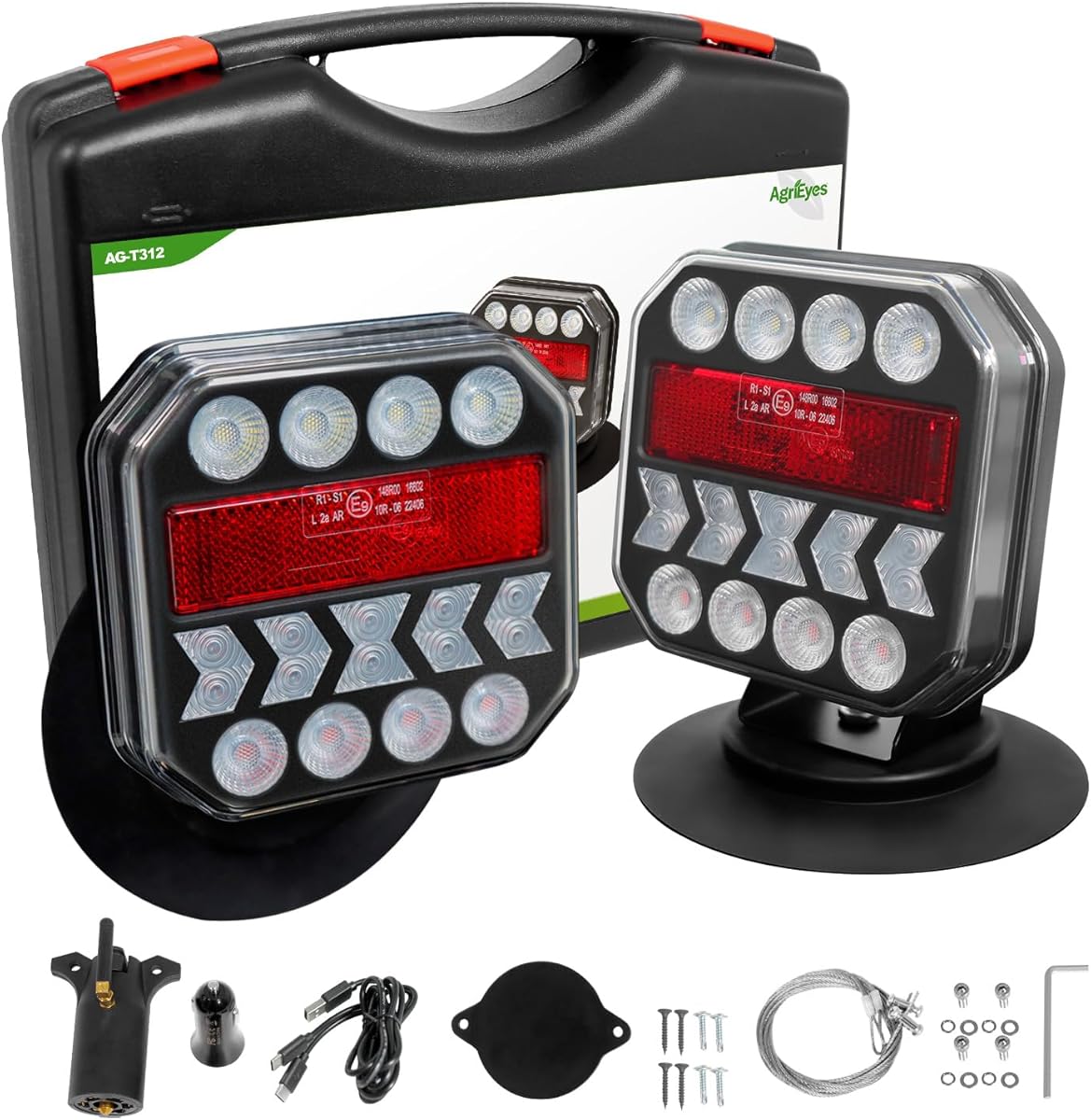
The Agrieyes T312 pairs wireless trailer lighting with fast USB-C charging, earning a 4.2 rating. Its 2.4GHz connection uses a built-in antenna and provides a stated range exceeding 100 feet, making it suitable for longer vehicles. Integrated reflectors and reverse-light functionality broaden its use beyond basic tail signaling.
We may earn a commission when you buy through this link, at no additional cost to you.
A full charge takes about 2.5 hours, while continuous use is stated at up to nine hours. The adjustable rubber-coated magnetic base is designed to protect the mounting surface and resist detachment at speeds up to 50 mph according to the manufacturer. Ceramic-based LED bulbs are also intended to improve brightness and heat dissipation.
The T312 carries an IP67 waterproof rating and an operating range of -23°C to 65°C, which makes it better suited to harsh outdoor conditions than a basic splash-resistant lamp. As with many wireless kits, circuit differences among vehicle brands can occasionally interfere with the transmitter, and the manufacturer asks owners to test the system upon receipt.
This kit is a strong fit for owners who frequently tow long trailers, RVs, or boats and value quick USB-C charging. The two-year warranty adds reassurance. Just ensure the lights are fully charged before departure and confirm that the tow vehicle supports the required trailer connector.
The universal charging port simplifies preparation compared with systems that require proprietary adapters. A stated 2.5-hour charge time makes it practical to replenish the lights overnight before another trip.
The IP67 rating and broad temperature specification support use through rain, snow, dust, and heat. The sealed construction is a meaningful advantage for marine and exposed trailer applications.
We may earn a commission when you buy through this link, at no additional cost to you.
This adjustable wireless kit earns a 4.2 rating and distinguishes itself with five lighting modes, including running lights, separate turn signals, brake lights, reverse lights, and warning lights. Its 2.4GHz connection has a stated range of more than 100 feet, while the included transmitter supports standard seven-pin and four-pin connectors.
We may earn a commission when you buy through this link, at no additional cost to you.
Mounting options include powerful magnets, a suction cup base, and an iron plate with screws for wood or aluminum surfaces. That range is useful for unusual trailers where a conventional metal attachment point is limited. The manufacturer reports magnetic stability up to 50 mph and uses a rubber-coated contact area to help protect the vehicle finish.
The kit is IP67 rated and states operation from -40°F to 149°F. Its ceramic-based LEDs are claimed to offer a 60,000-hour lifespan and visibility up to 1.5 miles, while USB-C charging provides up to nine hours of continuous use. Those claims make it well suited to RV, camper, utility trailer, boat trailer, and personal watercraft applications.
This system is a good all-around choice when reverse and warning functions are important. However, buyers should test it upon arrival because circuit variations may create a small percentage of compatibility issues. They should also avoid mounting on surfaces that are not sufficiently rigid, flat, and clean for the chosen attachment method.
The combination of running, turn, brake, reverse, and warning modes gives owners more signaling options. Reverse lighting is particularly useful when maneuvering a trailer with limited rear visibility.
Magnets and suction cups handle clean metal, while the supplied iron plate expands options for wood or aluminum. Owners can choose the attachment method that best fits the trailer rather than modifying the body unnecessarily.
We may earn a commission when you buy through this link, at no additional cost to you.
The NeaLia 110-degree kit receives a 4.2 rating and is built around adjustable positioning. Its metal brackets can rotate through 110 degrees, helping direct the signal toward the road when a trailer surface is angled or awkwardly shaped. Two spare iron plates are included for aluminum trailers and other situations where a magnetic surface is limited.
We may earn a commission when you buy through this link, at no additional cost to you.
The lights recharge through USB-C in a stated 2.5 hours and offer up to nine hours of battery life. Five modes cover running, brake, left turn, right turn, and reflector functions. A strong magnetic base allows temporary setup in about a minute, which is valuable for quick hitch-and-go use.
The construction combines PC, metal brackets, ABS material, and LED chips. The product is listed as DOT and FMVSS 108 certified and carries an IP67 waterproof rating for exposure to dust, dirt, rain, snow, and fog. Owners should still test the electrical connection because vehicle circuit differences may affect a small number of setups.
This NeaLia is a strong match for flatbed, horse, hay-bale, and enclosed trailers where the signal may need fine adjustment. The rotating brackets are especially useful when the rear structure does not present a flat mounting face. It is less suitable for buyers who require a stated long-range wireless signal for an exceptionally long combination.
The 110-degree bracket helps compensate for angled or irregular trailer surfaces. Owners can adjust each lamp's aim without relocating the entire unit or drilling multiple positions.
Two spare iron plates provide a magnetic contact surface where the trailer itself is aluminum. This makes the kit more adaptable than a system that relies entirely on direct magnetic attachment.
We may earn a commission when you buy through this link, at no additional cost to you.
The NeaLia CD28 is a compact wireless kit with a 4.2 rating and a practical mix of lighting and convenience features. It supports tail, brake, left turn, and right turn modes, while integrated reflectors and license plate lights help provide visibility from additional angles. A battery indicator helps owners monitor the remaining charge.
We may earn a commission when you buy through this link, at no additional cost to you.
Its magnetic base is designed for installation in about a minute without wiring or drilling, which makes repeated use across multiple vehicles more convenient. The 2.4GHz system transmits up to 100 feet and is advertised as resistant to interference. A full USB-C charge takes about 2.5 hours, followed by up to eight hours of stated battery life.
The kit is listed as DOT and FMVSS 108 certified and has an IP67 waterproof rating. Premium HD PC and ABS construction helps it withstand dust, dirt, rain, snow, and fog. Unlike several neighboring models, the product description does not identify a reverse-light function, so buyers needing reverse illumination should choose a more specialized option.
The CD28 works well for semi-trucks, boat trailers, box trucks, campers, caravans, fifth wheels, and RVs that fall within its stated signal capability. It is a balanced choice for owners who want more than basic turn signals but do not need warning mode, reverse lighting, or a rotatable bracket.
Built-in reflectors and license plate lights add passive visibility and functional rear illumination. These features make the kit more complete than a set consisting only of brake and turn lamps.
A 2.5-hour charge time and magnetic installation make the lights quick to prepare. The included battery indicator reduces uncertainty about whether the system is ready for another journey.
We may earn a commission when you buy through this link, at no additional cost to you.
The solar rechargeable wireless kit earns a 4.1 rating and offers a distinctive charging combination. A built-in solar panel supplements USB-C charging, while the magnetic lights can be positioned on the rear or roof of a metal vehicle. This makes the kit appealing to owners who split time between conventional travel and off-grid routes.
We may earn a commission when you buy through this link, at no additional cost to you.
The 2.4GHz system has a stated range of 100-plus feet and includes a built-in antenna for larger trucks, RVs, and boats. USB-C charging reportedly completes in 2.5 hours, while solar charging offers an additional way to replenish the batteries. The adjustable rubber-coated base is stated to remain secure at speeds up to 50 mph.
Ceramic-based bulbs are claimed to provide visibility up to one mile, with a 60,000-hour illumination lifespan. Retroreflectors and reverse lights broaden the safety functions. Its IPX6 rating offers protection from rain, dust, and weather across a stated temperature range of -23°C to 65°C, though it is not labeled IP67.
The main limitation is connector compatibility. It is designed for vehicles with a seven-pin trailer connector, and some vehicles may require a factory tow package, hitch, or activated outlet. Solar charging also depends on available sunlight, so USB-C remains the dependable primary method. The kit is well suited to long-distance and outdoor travel.
The side-mounted solar panel provides a supplemental charging path during outdoor stops. USB-C still offers the quickest and most predictable full-charge method, while solar adds flexibility for extended adventures.
The adjustable magnetic base allows the lights to move between the rear and roof of a metal vehicle. Position can be changed to improve visibility or avoid cargo, although owners should consider the effect of height and airflow.
We may earn a commission when you buy through this link, at no additional cost to you.
The ProlinePI 12V LED kit has a 4.4 rating and delivers a conventional wired approach with magnetic attachment. It is designed for trailers, RVs, dollies, cars, boats, and trucks up to 80 inches wide. The kit includes a 20-foot wire harness, standard four-flat connectors, and assembly and operating instructions.
We may earn a commission when you buy through this link, at no additional cost to you.
Its magnetic bases are intended to hold firmly to automotive metal surfaces while resisting scratches. The bright LEDs are listed as DOT compliant and have a stated lifespan of 100,000 hours. This straightforward configuration gives owners predictable control because the lights operate through the vehicle's standard wiring.
As a wired kit, it requires routing the harness and making the proper connection, so it is less convenient for temporary use than a rechargeable wireless product. The 20-foot cable length is intended to cover common towing setups, but very long trailers or complex routing may require additional planning. The system also has no radio signal that could fail or pair incorrectly.
The ProlinePI is a practical choice for owners who prefer a conventional trailer-light arrangement and want magnetic placement without a full bar. It offers strong stated LED longevity, straightforward installation guidance, and broad application support. Confirm connector type and available cable routing before installation.
A four-flat wired connection links the lights directly to the towing vehicle's system. This familiar arrangement removes the need to charge batteries or manage a wireless transmitter.
The stated 100,000-hour LED lifespan supports long-term use. Because the lights remain connected while towing, they are available without an additional battery-charging routine.
We may earn a commission when you buy through this link, at no additional cost to you.
The right magnetic tow light kit depends on your trailer's wiring, dimensions, operating environment, and whether you prioritize low-maintenance power, wireless flexibility, or maximum visibility.
A wired kit connects to the tow vehicle and draws power through a trailer harness. It is generally the simplest option for conventional trailers, requires no charging, and avoids wireless pairing or signal-range concerns. Wireless lights are more valuable for temporary installations, vehicles without dedicated trailer wiring, long trailers, and owners who frequently switch between tow vehicles. Their disadvantages include battery charging, radio synchronization, and the need to confirm signal range over the complete trailer.
Choose wired lights when a compatible connector and practical cable route are available. Choose wireless lights when installation flexibility matters more than simple power management.
Inspect the tow vehicle's rear outlet before selecting a kit. Common options in this guide include a four-flat connector, a seven-pin round connector, and an included seven-to-four-pin adapter. A physical connector is only part of the check: some vehicles require an activated trailer socket, factory tow package, or compatible trailer module. Circuit differences between manufacturers can also affect how signals are interpreted.
Match the plug type first, then confirm the vehicle is designed to activate trailer lamps. Test the complete system before relying on it for a trip.
The essential functions are tail or running lights, brake lights, and left and right turn signals. More complete kits may add reverse lights, warning modes, license plate illumination, and retroreflectors. Coverage also depends on whether the system uses four separate lamps, a compact pair of dual-sided lights, or a full-width bar. Four lamps offer flexible placement, while a bar creates a broad, centralized signal that is easy for following drivers to recognize.
List the functions your trailer actually needs, then compare lamp placement and total illuminated area. More features are useful only if they improve the signals required for your towing situation.
Magnetic lights require a clean, flat, rigid steel surface. Aluminum, wood, fiberglass, and painted or uneven panels may require a supplied iron plate, screws, suction cup, or another approach. Strong magnetic force is valuable at road speed, but finish protection is equally important. Rubber-coated bases and scratch-resistant surfaces can help prevent cosmetic damage. Adjustable brackets are useful for angled flatbeds, horse trailers, and enclosed trailers.
Clean the contact area before mounting and inspect the hold regularly. Never assume an adhesive or suction attachment will equal a properly positioned magnetic base.
An IPX4 rating indicates protection against splashing water, which may be enough for a covered utility trailer in mild conditions. IPX6 adds stronger protection against powerful water jets, while IP67 indicates dust-tight protection and temporary immersion resistance. None of these labels eliminates the need for sensible storage, especially because a light bar connector or charging port may remain exposed. Material quality, sealed construction, and operating-temperature specifications also matter in extreme conditions.
Match the weather rating to the environment, not just the product category. For marine, snowy, dusty, or high-heat use, stronger sealing and a wider temperature range deserve added attention.
Wired systems operate from the tow vehicle and avoid battery maintenance. Rechargeable systems are more portable, but their usable runtime depends on charge level, operating temperature, battery age, and signal load. USB-C offers a convenient charging standard, while solar input can provide a useful supplement for long outdoor trips. Compare stated full-charge time with expected travel duration and keep a charging plan for extended journeys.
Choose wired power for frequent towing without charging interruptions. For wireless use, select a runtime that comfortably exceeds a typical trip and recharge the lights before departure.
Wireless range should be judged against the complete length of the tow vehicle, trailer, and any portion extending behind the connection point. A stated 100-foot or 100-plus-foot range is suitable for many truck, RV, and boat trailer combinations, but extremely long trailers require more margin. A built-in antenna and 2.4GHz system are common among the listed products. Signal reliability also depends on correct pairing, antenna placement, obstructions, and electrical compatibility.
Do not rely on the headline range alone. Install the transmitter as directed and confirm that every signal is received before entering heavy traffic.
A warranty can be valuable when buying electrical equipment online, particularly for wireless kits whose fit may depend on vehicle circuitry. The products in this guide include warranty periods ranging from one to two years, and several manufacturers state that they will respond within 24 hours to reported issues. Warranty language does not replace responsible installation, so retain your proof of purchase and follow the testing and care instructions.
Consider warranty length alongside connector support and product documentation. A longer warranty is useful, but clear setup guidance and accessible support are equally important.
Begin by identifying the tow vehicle's connector, confirming that the trailer socket is active, and checking the complete width and rear profile of the trailer. Charge a wireless kit fully, pair its transmitter according to the manual, and place the receiver in the location where the lights will be mounted. Inspect the wires, plugs, housing, and mounting surfaces for damage before every trip.
Wired installations should use the complete harness, route it away from sharp edges and moving parts, and secure it with appropriate ties or clips. Magnetic lights should attach to clean, flat steel and remain secured throughout the journey. For adjustable units, aim the lamps where following drivers can see them, and use an iron plate when the trailer surface is aluminum or otherwise nonmagnetic.
After use, disconnect wired power before removing the lamps and clean the contact area to prevent dirt buildup. Store rechargeable lights dry and fully charged, and keep charging ports covered when they are not in use. Check the fasteners and bracket angle periodically, replace damaged wiring promptly, and test brake, turn, running, reverse, and warning functions before departure.
Requirements vary by jurisdiction, trailer type, width, and the signals a vehicle must display. A kit should provide functioning tail, brake, and turn lights, and some jurisdictions have additional rules for side markers, reflectors, or position lamps. Confirm local regulations and the requirements for your specific trailer before towing, particularly if the vehicle lacks a factory trailer wiring system.
Most strong magnets do not attach effectively to aluminum, so an auxiliary iron or steel plate is usually required. Some kits include spare iron plates, while others may require the owner to purchase and attach a suitable plate securely. The plate must be rigid, flat, well secured, and positioned so it does not weaken the trailer or expose a hazardous edge.
Runtime varies considerably by kit and usage. Products in this guide state continuous-use times ranging from about eight to nine hours, while charging times are generally around 2.5 hours through USB-C. LED brightness, signal activity, battery age, and temperature can affect performance. For long trips, recharge before leaving and carry a charging option rather than relying on the final minutes of stated runtime.
A quality magnetic base should hold securely on clean, flat steel, and several products in this guide specifically state that they were tested to remain attached at speeds up to 50 mph. Surface condition, bracket angle, vibration, and improper placement can still affect retention. Clean both surfaces, mount the lamps as instructed, check them after the first few miles, and never drive with an uncertain attachment.
Wireless lights are usually more convenient for temporary use, long trailers, and vehicles without suitable trailer sockets. They also remove the need to route a harness, although they require charging and must operate within their stated signal range. Wired systems remain attractive for conventional trailers because they draw power from the vehicle and avoid radio pairing, battery maintenance, and signal reliability concerns.
Common vehicle outlets include four-flat and seven-pin round configurations, but appearance alone is not enough to confirm compatibility. Some seven-pin sockets require a factory tow package, an activated socket, or an adapter. The product description should identify the included connector, and the vehicle's manual can confirm which trailer circuits are available. Testing every function before departure is essential.
Wireless kits rated IPX6 or IP67 are generally better suited to exposed marine environments than basic IPX4 wired lights. The MAXXHAUL 80778 specifically states that it is not intended for direct boat installation, so it should be used on an appropriate tow setup instead. Even with a strong water-resistance rating, lights should be protected during launch, recovery, and storage.
Connect or pair the system according to the instructions, then verify running, brake, left turn, right turn, reverse, and warning functions as applicable. Check that every lamp illuminates brightly and that the transmitter has no visible obstruction. Because circuit designs vary by vehicle brand, testing upon receipt is especially important. Repeat the check before each trip and address any inconsistent behavior before moving.
The MAXXHAUL 50871 is the most balanced overall recommendation for buyers who want a high-rated four-lamp system with straightforward magnetic placement. The Towmate TM22G stands out as the premium choice with a wide 22-inch wireless light bar, while the MAXXHAUL 80778 delivers a compact wired solution with dual-sided brake and amber flasher functions.
Prioritize connector compatibility, the light functions you actually need, mounting security, and the environment in which the lights will be used. Wireless systems add flexibility and convenience, while wired kits remain excellent for conventional trailers where simple power flow and no charging are priorities. Marine and severe-weather users should pay particular attention to IP ratings and temperature specifications.
Product specifications and prices can change, so verify the current listing before purchasing. Check the connector, included hardware, charging requirements, warranty, and stated towing width against your trailer. Testing the entire system before every trip remains essential, because even a well-designed magnetic tow light kit cannot compensate for incompatible wiring or insecure placement.