
Foval Automatic Trickle Battery Charger
4.6Editor score
Compact 1A charging design
Automatic four-step charging
Ring and alligator connectors
Multiple electrical protections
Our 12v DC Battery Charger guide compares ten chargers for lead-acid, LiFePO4, marine, RV, and maintenance use, with clear picks and key buying factors.
A dependable 12v DC battery charger helps preserve starting power, support auxiliary systems, and extend battery life during storage. The right unit depends on battery chemistry, capacity, installation method, and how quickly you need to recharge, so charger ratings alone do not tell the whole story.
We compared the ten products using their published charging output, supported battery types, safety features, repair modes, installation requirements, and customer ratings. The list covers compact maintainers, general garage chargers, high-output units, onboard models, and DC-to-DC chargers for RV and marine use.
Each review identifies the charger most likely to suit a particular setup, from a lightweight storage maintainer to a permanent-install power solution. Product features and availability can change, so readers should confirm current specifications and compatibility with their battery before purchasing.
4.6Editor score

4.4Editor score
4.0Editor score
The comparison below highlights charging capacity, battery compatibility, installation style, and notable functions across all ten chargers, helping readers match a unit to maintenance, recovery, vehicle, RV, or marine applications.



The NOCO GENIUS2D is a 2A onboard charger, maintainer, and trickle charger with a 4.6 rating. Its defining strength is the ability to remain permanently installed near a vehicle battery while adapting the charging process to temperature and battery condition.
We may earn a commission when you buy through this link, at no additional cost to you.
The direct-mount bracket, truss-head screws, and included eyelet terminals simplify a secure installation. A thermal sensor adjusts charging for hot or cold conditions, while pulse charging is designed to address sulfation and acid stratification. The charger can work with batteries down to 1V and offers Force Mode for batteries at zero volts.
The 2A output is intentionally modest, making the unit better suited to maintaining one vehicle battery than rapidly recharging a large battery bank. Its listed compatibility centers on 12-volt lead-acid types, including AGM, gel, SLA, VRLA, flooded, maintenance-free, deep-cycle, marine, and RV batteries.
This is a strong choice for someone who wants a discreet, permanently connected solution for seasonal vehicles, marine equipment, or an RV. Those needing fast recovery, lithium support, or substantial current should consider a higher-output or chemistry-specific model instead.
The mounting hardware allows the charger to remain close to the battery, reducing loose cable runs and making the installation suitable for long-term storage use. The included AC and DC cables provide the connections needed for setup.
Charging batteries from 1V and the optional Force Mode distinguish this model from ordinary trickle maintainers. These features are particularly relevant when a battery has sat unused long enough to lose much of its usable charge.
We may earn a commission when you buy through this link, at no additional cost to you.
The MOTOPOWER MP00205A combines an 800mA automatic charger, maintainer, trickle charger, and desulfator in a straightforward package. It carries a 4.5 rating and is built around 12-volt flooded, AGM, and gel-cell batteries.
We may earn a commission when you buy through this link, at no additional cost to you.
Its automatic pulse desulfation requires no manual intervention, while the programmed charge reaches 14.4V and transitions to a 13.6V maintenance level. Standby output drops to zero, helping avoid unnecessary drain, and spark-proof lead connections add another layer of safety.
A 24-hour timer terminates the active charging program once the battery exceeds 14V and moves the charger into maintenance mode. Reverse-polarity, overcharge, and short-circuit protection cover common installation mistakes, although the compact design offers less visibility than screen-equipped chargers.
The MOTOPOWER is well suited to routine maintenance of a small 12-volt battery in a car, motorcycle, or similar application. Buyers should choose a higher-output model when rapid recovery, lithium compatibility, or detailed operating data is the priority.
Automatic charging, timed completion, and low-output maintenance remove the need to monitor every stage. That simplicity makes the unit attractive for vehicles stored through long periods of inactivity.
Reverse-polarity and short-circuit protection help contain common connection errors, while zero-output standby reduces battery drain. Spark-proof connections are also useful when working in enclosed or poorly ventilated areas.
We may earn a commission when you buy through this link, at no additional cost to you.
The TowerTop Smart Charger is the most versatile general-purpose option in this roundup, combining 2A, 10A, 25A, and automatic current settings with a 4.4 rating. Its LCD, repair controls, winter mode, and engine-start function serve more than one garage task.
We may earn a commission when you buy through this link, at no additional cost to you.
The eight-stage program covers desulfurization, soft start, bulk charging, absorption, analysis, repair, float, and pulse maintenance. It supports common 12-volt sealed lead-acid varieties used in cars, boats, RVs, power sports vehicles, and deep-cycle applications.
Winter mode raises the original charging voltage by 0.2V for colder conditions, while the engine-start function can deliver 100A. These are specialized features, but they do not compensate for one important limitation: repair mode cannot revive a completely drained battery.
This charger suits a homeowner who wants one unit for routine maintenance, faster charging, diagnostics, and occasional recovery. Buyers focused only on compact battery storage can find simpler options, while those needing true DC-to-DC vehicle charging should look at dedicated alternator-aware models.
Four current settings let users match charging behavior to battery size and condition. The automatic mode also starts charging after detecting a connected battery, reducing the chance that a forgotten Start command delays recovery.
The LCD shows charging stages and parameters, while separate desulfurization and repair buttons give users direct control. Pulse maintenance follows a full charge, and stored settings can be restored after a power interruption.
We may earn a commission when you buy through this link, at no additional cost to you.
The Foval Automatic Trickle Charger is a compact 1A maintainer with a 4.6 rating. It is designed for 12-volt SLA, VRLA, gel-cell, AGM, and wet lead-acid batteries, covering the types commonly found in cars, motorcycles, boats, tractors, and recreational equipment.
We may earn a commission when you buy through this link, at no additional cost to you.
Its automatic program moves through initialization, bulk charge, absorption, and float mode before maintaining the battery at the appropriate storage voltage. The phone-sized enclosure weighs 10.5 ounces, while the 102-inch combined cable length offers flexibility around awkward battery locations.
Both ring and alligator connector styles are included, making it easier to choose an attachment method for different storage situations. Reverse-polarity, over-current, overload, and over-voltage protection improve safety, though the basic LEDs provide only a simple view of charging status.
This is a practical choice for owners who need inexpensive seasonal maintenance rather than rapid recovery. Its modest output and lack of lithium support make it less appropriate for large banks, demanding recovery work, or modern LiFePO4 systems.
The compact housing takes little room in a garage, trunk, or storage tote. Interchangeable lead options let users choose a permanent ring terminal or temporary alligator clips.
Four-stage charging and automatic float transition reduce the need for manual adjustments. Thermal safeguards are intended to avoid overcharging in hot climates and undercharging in cold weather.
We may earn a commission when you buy through this link, at no additional cost to you.
This 12V 20A Lithium Battery Charger is specifically designed for 12.8V LiFePO4 batteries rather than general lead-acid use. It holds a 4.7 rating and offers a three-stage profile consisting of pre-charge, constant current, and constant voltage.
We may earn a commission when you buy through this link, at no additional cost to you.
Its most notable feature is 0V activation, which is intended to wake deeply discharged or BMS-protected LiFePO4 packs so charging can begin. A 14.6V constant-voltage setting and 20A maximum current allow the charger to restore a 12V 100Ah battery to approximately half capacity in about 2.5 hours.
The included M8-terminal cable and quick connection simplify hookup, while a rugged aluminum alloy housing and cooling fan support stable output. Protection against over-voltage, over-current, short circuits, excessive temperature, and reverse polarity helps create a safer charging environment.
Choose this model when the battery is explicitly a 12.8V LiFePO4 pack and charging speed is important. It should not be substituted for a lead-acid charger, and buyers should verify that their connector, battery management system, and wiring arrangement are compatible.
The 20A output is much more capable than a typical trickle maintainer. Its constant-current and constant-voltage stages provide a practical route for restoring a compatible LiFePO4 battery after partial discharge.
The 0V activation function addresses a common obstacle with protected lithium packs. It is designed to initiate charging when a BMS has disconnected a deeply depleted cell group.
We may earn a commission when you buy through this link, at no additional cost to you.
The Schumacher SDC370 is a 25A DC-to-DC charger and maintainer designed to work with a vehicle's smart alternator. It has a 4.1 rating and is aimed at owners who need a permanently installed auxiliary-battery system.
We may earn a commission when you buy through this link, at no additional cost to you.
Rather than relying on household power, this unit is intended to draw charging support from the alternator while the vehicle operates. Its boost, absorption, and float stages provide a controlled charging cycle for an auxiliary battery in an RV, camper, or off-grid installation.
The weatherproof enclosure carries an IP66 rating, and the stated operating capability extends to very hot conditions. Compatibility includes standard, gel, AGM, calcium, and lithium batteries, giving owners flexibility when selecting an auxiliary pack.
This is most useful for a permanent vehicle installation, not a casual garage charger. Users must be comfortable wiring the unit securely and should follow the manual's guidance for placement, connection, and alternator compatibility.
DC-to-DC operation makes the SDC370 relevant for travelers who want auxiliary power replenished while driving. Pairing with a smart alternator supports a more controlled charging arrangement than an unregulated connection.
The IP-rated housing and stated high-temperature capability suit engine compartments and exterior installations. Permanent placement options include a chassis rail, engine compartment, or passenger cabin as permitted by the manual.
We may earn a commission when you buy through this link, at no additional cost to you.
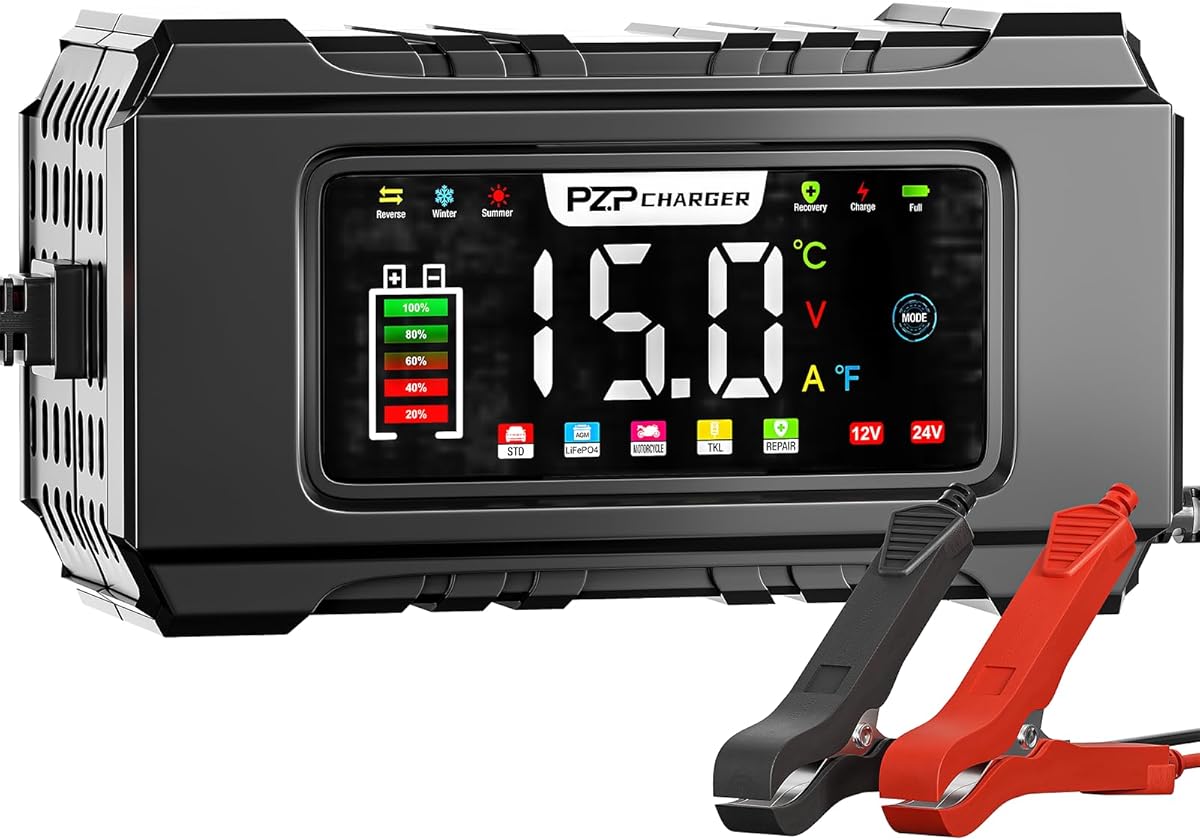
The PZ.P 15-Amp Charger combines 12V and 24V capability with support for LiFePO4 and several lead-acid chemistries. Its 4.5 rating and nine-stage process make it a flexible choice for mixed garages containing motorcycles, cars, trucks, lawn equipment, and marine batteries.
We may earn a commission when you buy through this link, at no additional cost to you.
At 12V, maximum charging current is 15A; at 24V, it is 8A. The display shows voltage, current, internal temperature, charge percentage, and summer or winter mode, while temperature compensation helps adapt the charging profile to ambient conditions.
Automatic pulse repair is intended to address sulfation and acid stratification, but the stated limitation is important: the charger cannot activate or charge a completely dead battery. Its operating range is also specified from 14°F to 82°F, so it is not intended for extreme cold conditions.
This model makes sense for users who want one charger to cover several battery systems and need readable diagnostics. Very low batteries, harsh subfreezing environments, and permanent onboard installations are better served by other products in the list.
Supporting both 12V and 24V batteries expands its usefulness for trucks, larger marine systems, and mixed equipment collections. Users must select the correct charging voltage for the connected battery.
The large color display reduces uncertainty by showing live charge information in direct sunlight. A long cable also improves access to batteries installed in tight or awkward spaces.
We may earn a commission when you buy through this link, at no additional cost to you.
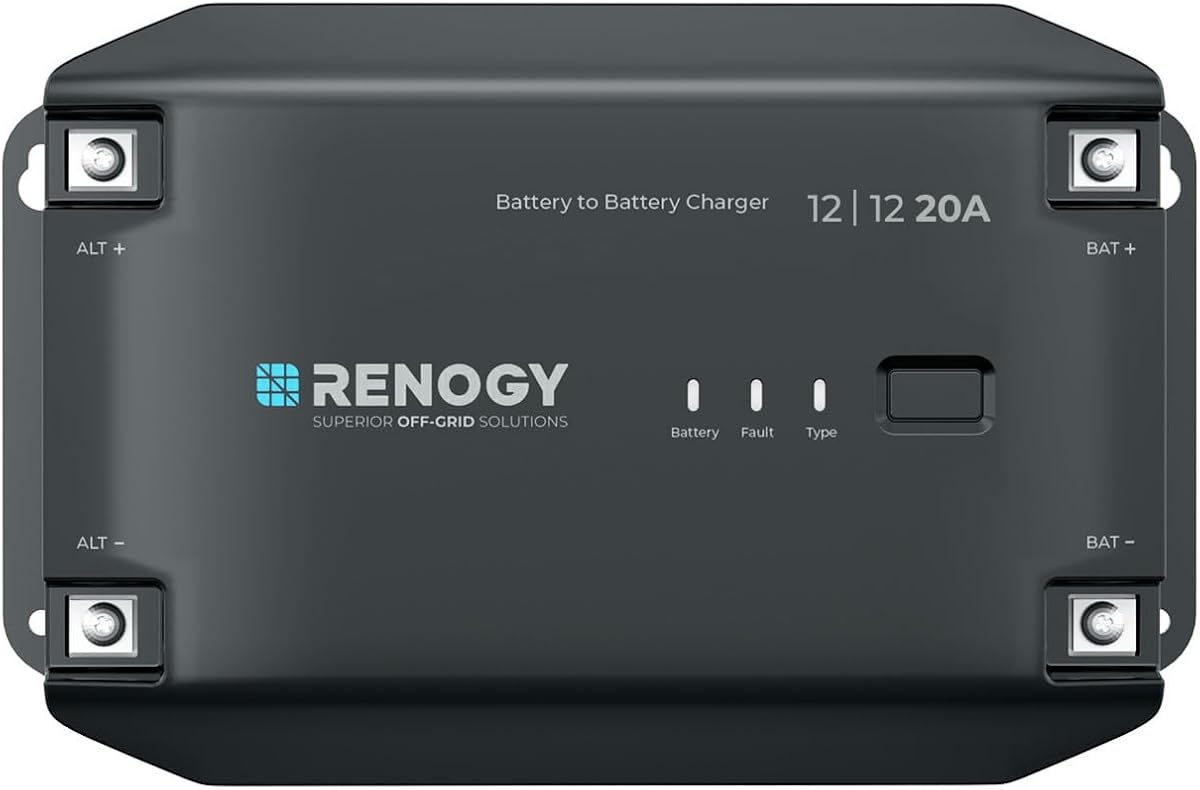
The Renogy 12V 20A DC-to-DC Charger is built around vehicle-alternator charging for RV, marine, and commercial applications. Its 4.0 rating reflects a capable specialist design, while built-in alternator detection helps ensure charging begins only when the engine is running.
We may earn a commission when you buy through this link, at no additional cost to you.
The 20A output supports flooded, gel, AGM, and lithium batteries. A one-touch control allows LiFePO4 activation to be enabled or disabled, and the internal terminal arrangement separates input and output connections to reduce short-circuit risk.
Its most distinctive premium feature is optional Bluetooth monitoring through the separately sold BT-2 module and the DC Home app or Renogy One Core. When configured, users can review up to 365 days of charging data and adjust settings remotely.
This is a strong premium pick for a fixed auxiliary-battery installation where monitoring and controlled alternator input matter. The requirement for permanent wiring and an optional monitoring module makes it less convenient than a plug-in maintainer for casual use.
The charger waits for the engine to run before charging, which helps protect the starting battery from unwanted discharge. Intelligent modes adjust to changing vehicle conditions, including startup.
The optional BT-2 module adds remote configuration and historical tracking through compatible Renogy platforms. This makes the charger especially relevant to RV, yacht, and commercial installations that benefit from ongoing oversight.
We may earn a commission when you buy through this link, at no additional cost to you.
The Battery Tender Plus is a 12V, 1.25A charger and maintainer with a 4.7 rating, the highest customer rating among the products listed. It is intended primarily for preserving vehicle, motorcycle, and lawn-mower batteries during storage.
We may earn a commission when you buy through this link, at no additional cost to you.
Its adaptive smart charging and four-step program are designed to provide a more complete charge than a simple trickle charger. The included fused ring terminal and alligator clip accessories offer flexible connection methods, while a quick-disconnect harness simplifies temporary maintenance.
A two-color LED indicates charge status and shows when the charger resumes full output if battery voltage falls too far under load. The manufacturer also backs the product with a ten-year warranty and lifetime customer support.
This is a compelling maintenance choice for owners who value established support and straightforward storage care. It is not a rapid-recovery charger, so buyers needing substantial current or lithium-specific charging should choose a different model.
Rather than applying a fixed trickle indefinitely, the four-step program adapts to the battery's condition. The float-stage behavior is designed to maintain a full battery without continuous heavy charging.
The quick-disconnect harness simplifies attaching and removing the maintainer during periodic checks. Fused leads and two connector styles provide flexibility for different battery locations.
We may earn a commission when you buy through this link, at no additional cost to you.
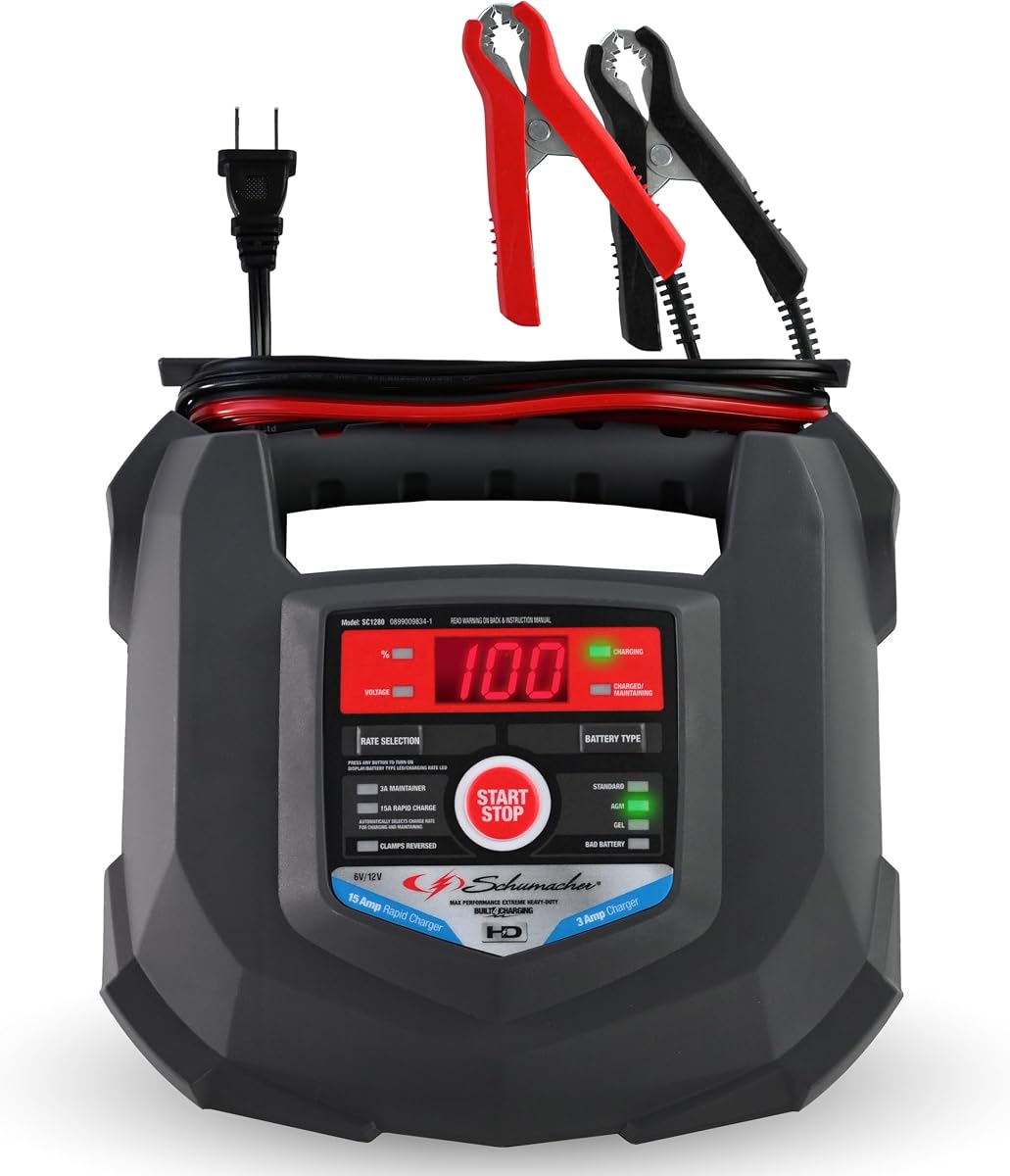
The Schumacher SC1280 combines charging, maintaining, testing, and restoration in one 15A unit. Its 4.6 rating and automatic 6V or 12V detection make it a practical garage charger for owners who may encounter more than one lead-acid battery type.
We may earn a commission when you buy through this link, at no additional cost to you.
Microprocessor control manages the multi-stage process, while an advanced desulfation mode is intended to improve performance in batteries affected by sulfation. The charger supports standard, AGM, gel, and deep-cycle batteries used in cars, motorcycles, ATVs, trucks, SUVs, and boats.
Automatic voltage detection reduces the need to choose a setting manually, and smart trickle charging handles longer-term maintenance. The included package contains the SC1280 charger and user manual, with no lithium battery profile listed among the supported types.
The SC1280 is a good general garage option for lead-acid batteries that need more recovery current than a trickle charger provides. It is less suitable for LiFePO4 systems or buyers who prioritize advanced app-based monitoring.
The 15A output provides meaningful recovery capability for compatible lead-acid batteries. It fills the gap between low-current storage units and heavier multi-amp garage chargers.
Automatic voltage detection and multi-stage algorithms streamline setup. Charging, maintaining, testing, and desulfation functions consolidate several separate tools into a single device.
We may earn a commission when you buy through this link, at no additional cost to you.
The best charger depends on battery chemistry, capacity, vehicle wiring, and the balance between fast recovery and long-term maintenance. Use the following factors to narrow the field before comparing models.
Match the charger to the label on the battery rather than assuming every 12V pack behaves identically.
Choose low output for maintenance and higher output when fast recovery is a priority.
Use AC charging for parked equipment and DC-to-DC charging for vehicle-supported auxiliary systems.
Choose permanent mounting for consistent long-term care and portable placement for shared equipment.
Check the minimum charging voltage and recovery limitations before relying on repair mode.
Prioritize temperature compensation in variable climates and detailed displays for diagnostic work.
Confirm protective functions and proper terminal selection before connecting any charger.
Treat connected features as useful additions, not substitutes for correct compatibility.
Before connecting the charger, identify the battery chemistry, confirm the system voltage, and inspect the terminals for dirt, corrosion, damage, or loose fittings. Disconnect the battery when the manufacturer's instructions call for it, particularly during installation or testing of a deeply discharged battery.
Connect the charger with the correct polarity, attach the AC lead to a suitable outlet for AC-powered models, and select any required voltage or battery-type setting. For DC-to-DC units, follow the vehicle wiring instructions, connect the input to the correct alternator-side circuit, and install the charger securely away from moving and hot components.
Monitor the first charging cycle, review the displayed or indicated status, and avoid interrupting a stage unless the manufacturer permits it. After charging, disconnect the charger in the recommended order, inspect the terminals, and reconnect the vehicle's electrical system if it was removed. Periodic maintenance and careful cable storage help extend service life.
Only if the charger explicitly supports LiFePO4 chemistry or offers a selectable lithium profile. Lead-acid and LiFePO4 batteries use different charging profiles, so an ordinary automotive charger may not be safe or appropriate. Confirm the battery label and the charger's compatibility list before connecting it.
A low-current charger around 1A is generally intended for maintenance rather than rapid recovery. A unit rated from 10A to 25A is more practical when a vehicle battery has lost substantial capacity and needs faster charging. Always use the current and voltage settings specified for the battery.
It depends on how the auxiliary battery is used. A DC-to-DC charger replenishes the battery from the vehicle alternator while driving, while an AC charger is useful when parked near a power source. Some RV owners use both because they support different operating situations.
Most cannot, and a charger may shut down when it detects unsafe voltage or condition. The NOCO supports charging from 1V and offers Force Mode for zero-volt batteries, while the dedicated lithium charger includes 0V activation for certain BMS-protected packs. Even with these features, battery condition and manufacturer guidance remain important.
Many smart maintainers are designed for long-term connection because they reduce output after charging and use float or pulse maintenance. Follow the product instructions, confirm the battery is compatible, and periodically verify that the charger remains in the expected status.
A charger intended for marine use should have suitable environmental protection and be installed according to its instructions. The Schumacher SDC370 has an IP66-rated enclosure, while other units may require careful placement in a protected enclosure or away from direct exposure.
No. Desulfation and pulse repair modes may improve charging performance in some batteries, but they cannot reverse all physical damage or restore capacity lost through age, corrosion, or deep discharge. If a battery remains weak, replacement may still be necessary.
No, not unless the charger explicitly supports 24V operation and the correct voltage is selected. The PZ.P charger supports both 12V and 24V configurations, but most products in this guide are intended for 12V systems. Verify voltage compatibility before connecting any unit.
The TowerTop Smart Charger is the strongest all-round choice because it combines several current settings, an eight-stage program, readable diagnostics, winter mode, and engine-start assistance. The Foval Automatic Trickle Charger is a practical budget option for compact maintenance, while the Renogy 20A DC-to-DC Charger is the premium pick for permanent vehicle systems that benefit from alternator-aware charging and optional connected monitoring.
Prioritize battery chemistry first, then match the charger's output and installation style to the task. A compact maintainer is enough for seasonal storage, a high-current charger is useful for recovery, and a DC-to-DC model is appropriate when an RV, boat, or commercial vehicle must charge an auxiliary battery on the move.
Before purchasing, verify the current specifications, connector requirements, warranty terms, and complete compatibility list. Product listings and promotions change over time, so checking the latest manufacturer guidance and retailer details helps prevent an incompatible purchase.