
8U Server Rack Rails Pair with Mounting Screws
4.3Editor score
Universal 19-inch rack compatibility
8U vertical rail capacity
Cold-rolled steel construction
Mounting hardware included
Server rack rails connect servers, network equipment, and other rack-mountable hardware to a compatible cabinet or frame. A well-matched kit should support the device securely, fit the available rack depth, and provide enough clearance for installation, removal, cables, and routine maintenance.
The products in this guide were compared using the information supplied for each kit, including rack type, supported equipment size, depth adjustment, material, included fasteners, and load rating. The list covers fixed rails for standard racks, vertical rails for DIY builds, and sliding rail sets for easier chassis access.
Each review explains the most useful fit, design, and installation details, along with the compromises that may affect a particular setup. Ratings reflect the supplied customer feedback and should be considered alongside rack dimensions and chassis requirements. Product prices and availability can change.
4.3Editor score

4.4Editor score
3.4Editor score
As an Amazon Associate we earn from qualifying purchases.
This side-by-side comparison highlights the major differences among fixed, sliding, 1U, and multi-U rack rail kits, including supported rack formats, depth range, construction, mounting hardware, and stated load capacity.


The Rosewill RSV-RL20HV2 is a three-section sliding rail kit for server and rack-mount chassis measuring between 2U and 5U in height. Its supplied rating is 3.5, placing it among the more specialized options in this guide. The main attraction is the combination of adjustable depth, a stated 100-pound load rating, and rails designed to let users remove the chassis without first dismantling the entire rack.
We may earn a commission when you buy through this link, at no additional cost to you.
The rail depth adjusts from 20 to 33.5 inches, giving it more flexibility than a fixed-depth rail set. That range is particularly useful when the distance between a chassis and the rear rack post is not known precisely or may need to change. The three-section format also separates the stationary rack attachment from the moving chassis support, which is the defining feature of a sliding installation. Rosewill states that the kit can be used with different server chassis, including all of its server cases except the RSV-AI01 and RSV-L460.
There are important qualifications. The listed load rating is a maximum rather than a guarantee that every chassis and rack combination will perform identically, so the actual equipment weight, mounting position, and rack construction still matter. The 3.5 rating is also the joint-lowest among the listed products. Buyers should not interpret broad chassis-height compatibility as proof that every 2U–5U device will have matching hole patterns, depth, or rear clearance.
This kit is best for a builder with a medium-depth 2U, 3U, 4U, or 5U server who values pull-out access over the lowest rating in the comparison. It is especially appropriate when equipment must be removed from the front of a crowded rack for inspection or component replacement. Confirm the chassis dimensions, mounting-hole layout, and excluded Rosewill case models before ordering, and verify that the fully extended rail will not interfere with doors, fans, or other installed equipment.
The product is a strong fit for the correct compatible server rather than a universal answer for every rack-mount device. Its range and sliding construction offer practical flexibility, while the exceptions and the moderate customer rating make careful compatibility checking essential. For a compatible chassis and a rack with suitable depth, it delivers a well-targeted installation solution.
The 20–33.5-inch adjustment range gives installers more tolerance when measuring a chassis against its rack posts. Measure both the chassis body and the space behind it, because the usable mounting depth can be narrower than the cabinet's advertised interior.
The three-section sliding design allows a compatible chassis to move forward for access, reducing the need to remove surrounding equipment. Leave adequate working clearance at the front and confirm that the sliding path does not conflict with doors, trays, or cable bundles.
We may earn a commission when you buy through this link, at no additional cost to you.
This 1U server rack rail set offers a practical balance of adjustability, compatibility, and customer feedback. It carries a 4.4 rating and supports most servers that fit the available 15–24-inch rail depth. Unlike chassis-specific sliding kits, it can be used with a 19-inch standard rack or cabinet, a 4-post rack, or a 2-post center-weighted rack, making it useful across several common configurations.
We may earn a commission when you buy through this link, at no additional cost to you.
Cold-rolled steel with a powder-coated finish provides a durable base, and the stated support capacity reaches 110 pounds when installed on a 4-post rack or cabinet at 15 inches deep. The included package contains one pair of 1U server shelf rails, eight sets of M6 screws, and cage nuts. That combination makes the installation package more complete than a bare pair of rails and reduces the chance of discovering that essential mounting hardware is missing.
Its limitations are structural rather than fundamental. The rails use a fixed-mount approach, so technicians cannot pull the device forward for service as they could with a sliding kit. The 1U profile is intended for servers and similarly shallow equipment; it should not be interpreted as a universal mounting platform for every rack device. The listed depth range also means the rack and chassis must be compatible with the rail's geometry.
This is a good choice for a home lab, small office, or conventional server room where a 1U server needs dependable support in a standard 19-inch rack. It works particularly well when front access is sufficient and rear connections can be made without repeatedly removing the equipment. Buyers should measure the available depth, compare the chassis hole pattern, and allow room for cables behind the installed server.
Among the fixed options, this kit stands out for combining a 4.4 rating, an adjustable 15–24-inch range, compatibility with both major rack styles, and included M6 screws and cage nuts. It is the most broadly useful pick in this guide for a standard 1U installation, provided that sliding access is not a requirement.
Support for 2-post center-weighted racks, 4-post racks, and 19-inch cabinets gives the kit broader usefulness than equipment-specific rails. The rack still needs compatible mounting points, and the selected server should remain within the supported size and load limits.
Eight sets of M6 screws and cage nuts support the stated installation process. Confirm whether your rack uses square or hex cage nuts and whether its existing hardware is sufficient before beginning the installation.
We may earn a commission when you buy through this link, at no additional cost to you.
The RackPath 16U kit is a pair of vertical rack rails intended for DIY rack builds. It has a 4.4 rating and spans 16 rack units, with dimensions listed as 28 inches high, 1.55 inches wide, and 0.62 inches deep. The substantial vertical format differentiates it from conventional horizontal server rails that attach directly to a server chassis.
We may earn a commission when you buy through this link, at no additional cost to you.
The rails are made from 2.5mm cold-rolled steel with a black electrostatic powder-coated finish. Silk-screened rack-unit measurements make it easier to align equipment, while pre-tapped 12-24 holes provide repeatable attachment locations. The package includes the two rails, 12 installation screws and washers for side rack mounting, and 64 12-24 screws for mounting rack-mountable equipment.
The principal trade-off is that this is not a drop-in server rail kit for an ordinary cabinet. Its usefulness depends on constructing or having a frame with compatible side mounting positions. The deep 0.62-inch rail profile also requires more consideration than a slim 1U shelf rail, particularly in a tightly packed homemade enclosure. The 4.4 rating suggests generally positive feedback, although the supplied information does not provide details about individual customer comments.
This kit is best suited to a maker, integrator, or small lab operator building a dedicated rack around network equipment or rack-mountable electronics. It is particularly useful when multiple device heights need to be organized in a DIY frame and pre-tapped holes are preferred over preparing separate mounting points for each device.
For a custom vertical build, the 16U RackPath set is a well-specified and generously equipped option. It does not offer the direct chassis support or pull-out convenience of a sliding server rail kit, so buyers should treat it as a DIY frame component rather than a general server replacement rail. It is a compelling choice when the rack structure and equipment are designed around its dimensions.
Silk-screened rack-unit measurements help builders position equipment consistently across the rail pair. Use the markings as a guide, then verify each device's physical alignment before tightening mounting screws.
The 12-24 threaded holes accept the included rack equipment screws without requiring the installer to create additional threaded positions. This is useful when the rail pair must support several types of 19-inch rack equipment.
We may earn a commission when you buy through this link, at no additional cost to you.
The Fengone 1U rail kit is designed for 19-inch 2-post center-weighted racks and 4-post racks or cabinets. Its 4.0 rating reflects generally positive supplied feedback, while its defining strengths are a compact 1U profile, adjustable depth, and compatibility with servers, network equipment, and UPS units. It is a more explicitly universal fixed-rail option than a chassis-specific sliding kit.
We may earn a commission when you buy through this link, at no additional cost to you.
Depth adjustment from 15 to 24 inches gives the installer some flexibility when fitting equipment between the front and rear rack posts. A server holding board measuring 1.97 inches wide by 16.5 inches deep supports the equipment, while the main rail profile is listed as 1.87 inches high and 2.02 inches wide. The stated load capacity is 110 pounds when mounted on a 4-post rack or cabinet at 15 inches deep.
The rails use cold-rolled steel with powder coating for corrosion resistance, and the package includes necessary mounting hardware. The fixed design is intended to keep the equipment stable while also making inspection, replacement, and cable management easier. It does not, however, provide the forward service movement associated with a sliding design, and the 4.0 rating is slightly below that of several alternatives.
This kit is appropriate for a compact rack where preserving vertical space matters and the mounted device can be serviced through the front. It may also suit a network switch, server, or compatible UPS installation, as long as the device's mounting pattern and dimensions correspond to the rail arrangement. Buyers should check the 16.5-inch holding board and chassis length before purchase.
The Fengone kit is a balanced choice for users who need broad 2-post and 4-post compatibility in a slim 1U format. Its main advantage over a 1U shelf-style kit is the stated rack and equipment versatility, while its main drawback is the absence of sliding access. For fixed installations with compatible geometry, it provides a compact and practical mounting solution.
The standard 1U height and compact width help preserve vertical room in densely populated racks. A slim rail does not eliminate the need to account for cable clearance, airflow, and the depth of the attached device.
The stated uses include network equipment, servers, and UPS units, making the rails relevant beyond conventional server cases. Verify the device's width, hole pattern, weight, and clearance around the holding board before installation.
We may earn a commission when you buy through this link, at no additional cost to you.
The RackPath 12U kit provides a more compact alternative to its 16U and 20U vertical rail sets. It has a 4.4 rating and measures 21 inches high, 1.55 inches wide, and 0.62 inches deep. Like the other RackPath vertical products, it is designed for DIY rack construction and uses 12-24 threaded mounting positions for compatible rack equipment.
We may earn a commission when you buy through this link, at no additional cost to you.
Its 2.5mm cold-rolled steel construction and black electrostatic powder coating provide a durable frame for a custom enclosure. Silk-screened rack-unit markings help users arrange equipment vertically, while the pre-tapped holes eliminate the need to prepare additional threaded inserts. The package includes two rails, eight side-mounting screws and washers, and 48 12-24 screws for equipment.
The main limitation is its narrow application compared with chassis-specific rails. It does not directly support a server chassis in the manner of conventional server rails and does not slide forward for maintenance. A builder must provide the surrounding frame and ensure that its side mounting locations align with the rail holes. The deep profile also requires more front-to-back and lateral planning than a slim 1U shelf.
This kit is a practical choice for a compact home studio, small office rack, or custom cabinet that needs 12U of vertical organization. It is especially relevant where a pre-tapped, clearly marked rail pair is more useful than a server-specific sliding mechanism. The included quantity of equipment screws provides flexibility for several pieces of 19-inch equipment.
For a well-planned DIY build, the 12U set offers a strong 4.4 rating, clear rack-unit positioning, and extensive mounting hardware in a manageable height. It should be chosen for a custom frame rather than treated as a universal replacement for a server rail kit. Those who need pull-out access or direct chassis support should look toward one of the fixed or sliding options designed specifically for servers.
At 21 inches tall, the 12U pair is shorter than the 16U and 20U alternatives. That can be advantageous in a compact cabinet, but the surrounding frame must still provide proper support and adequate space for the devices and their connections.
Forty-eight included 12-24 equipment screws allow the rail pair to accommodate several mounted items. Match screw type to the actual equipment and use the supplied side fasteners where appropriate.
We may earn a commission when you buy through this link, at no additional cost to you.
The RackPath 20U set is the largest vertical kit in this comparison, offering 20 rack units across rails that measure 35 inches high, 1.55 inches wide, and 0.62 inches deep. Its 4.4 rating places it alongside the strongest customer-feedback results in the guide. It is intended for builders creating a larger DIY rack rather than adding a single server to an existing standard cabinet.
We may earn a commission when you buy through this link, at no additional cost to you.
The pair is constructed from 2.5mm cold-rolled steel with a black electrostatic powder-coated finish. As with the smaller RackPath kits, silk-screened rack-unit measurements and pre-tapped 12-24 holes make repeated equipment positioning more straightforward. The package contains two rails, 16 rail installation screws and washers, and 80 equipment screws, providing ample mounting hardware for a densely populated build.
Capacity is the central benefit and the central constraint. A 20U system offers room for multiple devices, but its 35-inch height demands a correspondingly tall frame and enough working space to reach the upper mounting positions. This is not a compact option for a small cabinet. As a vertical DIY component, it also does not provide a sliding chassis path or the direct geometry of a purpose-built server rail pair.
The kit is suited to users assembling a dedicated equipment rack for networking, audio, servers, or other rack-mountable hardware. A studio or office installation with several devices and a plan for future expansion can benefit from the large number of threaded positions. The frame must be rigid and correctly aligned because the rails are only one part of the completed structure.
For a roomy custom build, the 20U RackPath kit provides a durable, clearly marked, and generously equipped vertical platform. Its 4.4 rating supports confidence in the overall product, while the need for a large custom frame narrows its audience. It is a strong choice when substantial organized capacity matters more than compact dimensions or pull-out service access.
Twenty rack units allow a custom frame to accommodate a broader collection of equipment than the 12U and 16U sets. Plan the layout before installation so heavy devices are not positioned at difficult-to-reach heights.
The large included screw count is useful for multiple 19-inch devices and repeated mounting positions. Use only the appropriate fasteners for each task and check the manufacturer's instructions for both the frame and mounted equipment.
We may earn a commission when you buy through this link, at no additional cost to you.
The 8U Server Rack Rails Pair is a versatile mounting option for DIY projects, wooden cabinets, custom frames, servers, network switches, and audio studio equipment. Its 4.3 rating is solid, and the focus on universal 19-inch equipment makes it more useful for mixed installations than a rail set designed around one specific server chassis.
We may earn a commission when you buy through this link, at no additional cost to you.
Constructed from thick cold-rolled steel with a black powder-coated finish, the pair is intended to provide stable vertical support. The package includes essential mounting screws and hardware, reducing the need for separate purchases during a custom build. The rails can be mounted vertically or horizontally according to the user's setup, and the 8U format offers more capacity than a single 1U shelf.
The supplied description does not state a specific depth adjustment range or load rating, so buyers should not assume it matches the 110-pound claims of the Fengone sets. It also depends on the strength and dimensions of the surrounding cabinet or frame. Its versatility is a benefit for mixed equipment, but the less detailed specifications require more verification before purchase, particularly for a heavy server or a mission-critical rack.
This product is a good option for a home studio, compact office cabinet, or maker enclosure that needs to hold several types of 19-inch equipment. It may suit a switch, lightweight server, or audio device better than a densely loaded frame with several heavy chassis. Confirm the available height, mounting positions, and the space needed behind the equipment.
The 8U pair stands out as a budget-conscious and adaptable vertical solution with a 4.3 rating and included installation hardware. It offers less documented precision than the 1U kits and lacks the sliding convenience of a premium rail set, but it can be a sensible choice for a varied home or studio build. Careful dimensional checks are the main requirement.
The 19-inch format supports servers, network switches, and audio studio equipment within the same custom organization. Confirm each product's mounting-hole pattern and ensure the frame can carry the combined weight.
The ability to mount the rails vertically or horizontally is useful when designing a cabinet around available space. Orientation should still preserve the equipment's supported orientation, airflow, service access, and safe cable routing.
We may earn a commission when you buy through this link, at no additional cost to you.
The Rosewill RSV-RL26HV2 is the longer-depth member of this guide's two Rosewill sliding kits. It supports server chassis between 2U and 5U in height, has a stated load rating of 100 pounds, and adjusts from 26 to 39.4 inches deep. Its 3.5 rating is tied for the lowest in the comparison, so compatibility and customer feedback deserve careful attention.
We may earn a commission when you buy through this link, at no additional cost to you.
Compared with the RSV-RL20HV2, this version is intended for deeper chassis and rack arrangements. The three-section sliding construction is designed to make chassis removal easier, which can be valuable for servers with densely populated rear connections. The hardware can be used with different server chassis, including all Rosewill server cases except the RSV-AI01 and RSV-L460.
Its longer minimum depth makes it less versatile for shallow installations. The rail must be able to extend far enough for the intended service position without colliding with the rack frame, door, wall, or neighboring equipment. The 3.5 rating does not identify the source of any complaints, so buyers should not assume a specific unresolved defect; instead, they should review current customer feedback for fit or installation details that matter to their setup.
The kit is most appropriate for a compatible 2U–5U server in a deep rack where technicians want slide-out access. It can reduce the effort involved in reaching rear ports and replacing components, particularly in a crowded installation with good front clearance. The excluded Rosewill chassis should be checked before purchase, as should the exact server hole pattern and weight.
As a deep sliding rail option, this product offers clear maintenance benefits and a 100-pound rating, but it is less accommodating than a fixed 1U kit. It works best when the chassis and rack dimensions align with its 26–39.4-inch range. Buyers prioritizing low cost or shallow-rack versatility will find other choices in the guide more suitable.
The 26–39.4-inch adjustment range provides useful reach for deeper server cases. Measure from the front mounting position to the rear post and account for the additional space required when the rails are extended.
Pulling a compatible chassis forward can make rear power, network, and storage connections easier to reach. Verify that surrounding equipment, cable bend radius, and rack doors leave a safe service path.
We may earn a commission when you buy through this link, at no additional cost to you.
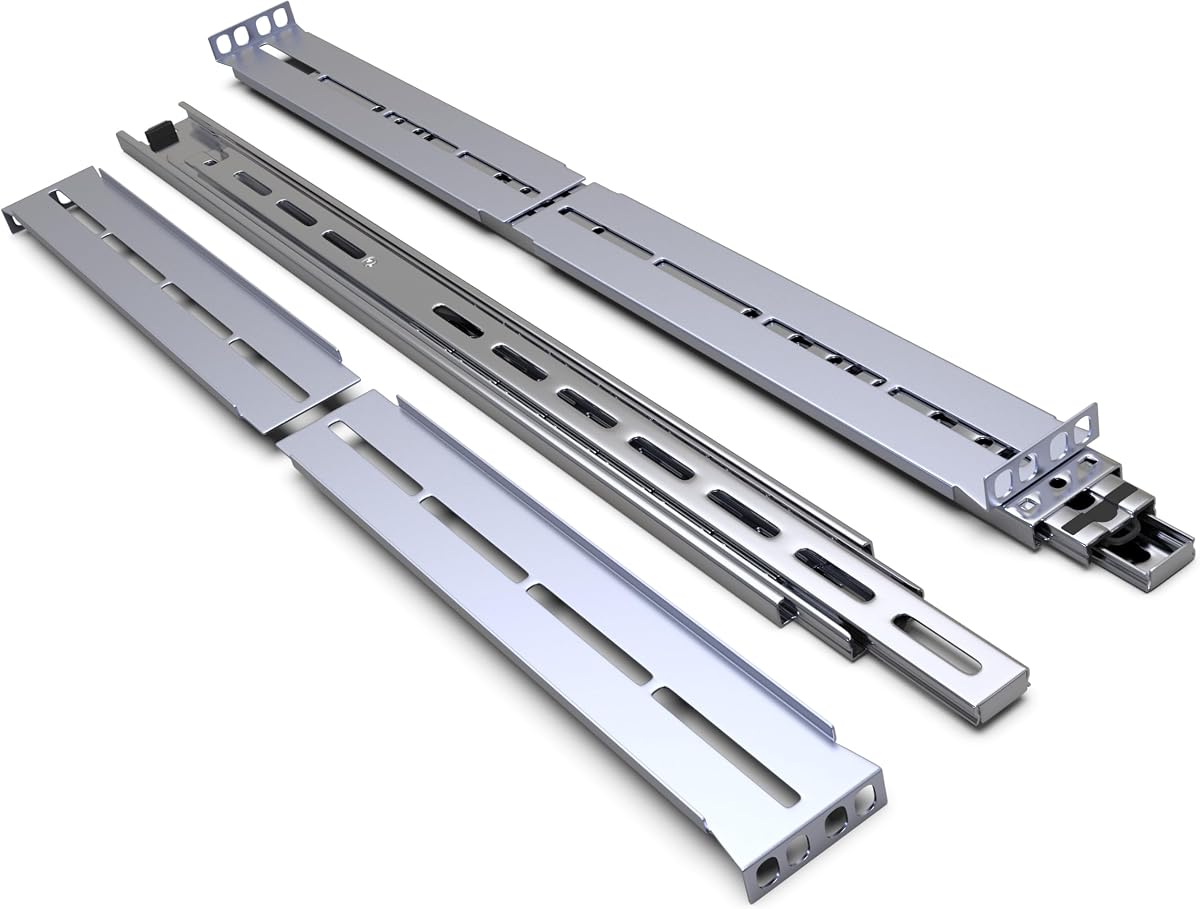
This rackmount sliding rail kit is the most feature-oriented product in the guide, supporting chassis from 2U to 8U with an adjustable mounting depth of 26 to 40 inches. It has a 3.4 rating, the lowest supplied rating in the comparison, but its specifications distinguish it through a 130-pound maximum load capacity, ball-bearing slides, temporary three-stage locking, and a toolless installation design.
We may earn a commission when you buy through this link, at no additional cost to you.
The sliding rails extend 26 inches and can provide an additional 26 inches when extended. A plastic handle allows quick detachment of a compatible mounted device, although the device must be at least 10 inches long. The kit is designed for universal assembly holes and 2U–8U equipment, giving it broader height compatibility than either Rosewill sliding option in the list.
The primary concern is the 3.4 rating, which is lower than every other supplied rating. Since the available information does not summarize individual reviews, buyers should examine current customer feedback for fit, wobble, hardware, or installation issues relevant to their chassis. The kit also needs at least 10 inches of chassis length, a minimum that rules out some unusually compact devices. A maximum load rating should never be treated as a blanket promise for every mounting position.
This kit is aimed at users with deeper 2U–8U equipment who prioritize serviceability and installation convenience. The three-stage locking can help stabilize a chassis while it is partially extended, and the toolless design may reduce assembly work. The supplied tip for flush installation inside the end of a U-post suggests that rack geometry can still require careful setup.
For the right chassis and rack, this is a premium sliding system with an impressive load specification and a wider size range than most alternatives. The lower rating and minimum-length requirement are meaningful trade-offs. It is best recommended after checking recent reviews and confirming the server's hole pattern, length, weight, and intended service clearance.
Ball-bearing construction is intended to support smooth movement as the chassis slides forward or back. Keep the rails free of debris and avoid forcing a slide that has reached the end of its travel.
Temporary locking at three stages helps hold a partially extended device in place during access. Use appropriate support and observe manufacturer guidance if the chassis is extended while powered or connected.
We may earn a commission when you buy through this link, at no additional cost to you.
This two-pack version of the Fengone 1U rail kit provides two sets of adjustable rack rails, each designed for 19-inch 2-post center-weighted racks and 4-post racks or cabinets. The 4.0 rating matches the single-pack Fengone product. It is particularly relevant to users who need to support more than one shallow device or who want a spare compatible rail set.
We may earn a commission when you buy through this link, at no additional cost to you.
Each set has a 15–24-inch adjustable depth and uses a 1.97-inch-wide by 16.5-inch-deep server holding board. The rails are made from cold-rolled steel with powder coating and are listed with a 110-pound load capacity when mounted on a 4-post rack or cabinet at 15 inches deep. The 1.87-inch-high, 2.02-inch-wide profile preserves rack space while keeping the mounted equipment stable.
The central trade-off is that some buyers may need only one pair, making the two-pack configuration more than necessary. It is still better than buying unrelated rail sets for multiple devices, because the units share the same adjustment and mounting design. As with other fixed rails, there is no sliding access. The product also requires compatible device geometry and hole patterns, and its load figure is tied to a specific installation configuration.
This kit is a good fit for a small rack containing two 1U servers, a server plus network device, or a primary installation with a backup set on hand. It suits a home lab or compact office where a slim fixed design is preferred and front access is sufficient. Installing two similar devices also simplifies matching their positions and cable-management habits.
The two-pack provides a straightforward way to support multiple shallow devices with the same 15–24-inch adjustable system. Its 4.0 rating, broad rack compatibility, and 110-pound stated capacity make it credible for ordinary fixed installations, although buyers should verify the actual device dimensions and avoid exceeding the specified limits. It is a practical choice when repetition and spare capacity matter.
Two matching rail sets make it easier to install paired servers or keep a compatible spare available. Confirm that the rack and each device have appropriate attachment points before ordering more equipment than needed.
The 1U profile is useful in cabinets where every rack unit matters. The fixed arrangement also requires less front operating space than a fully extended sliding system, although rear cables still need deliberate management.
We may earn a commission when you buy through this link, at no additional cost to you.
The right server rack rails kit depends on chassis size, rack geometry, mounting pattern, weight, and service needs. Measure before buying and distinguish fixed rails from sliding rails, because they solve different installation and maintenance problems.
Confirm whether the equipment will enter a 19-inch cabinet, a 4-post rack, or a 2-post center-weighted rack. The 1U kits in this guide explicitly support both 2-post and 4-post formats, while the RackPath products are vertical components intended for DIY frames and the Rosewill kits are designed for standard racks and compatible server cases. A rail that physically fits the post may still require the correct cage nuts, screws, side clearance, and mounting position.
Rack equipment is commonly organized by rack unit, and each rail set has a supported height. The Rosewill sliding rails and the 2U–8U sliding kit cover multi-height server chassis, the Fengone sets use a 1U profile, and the vertical RackPath and 8U kits support broader equipment arrangements. Chassis height is only one measurement; also check length, width, hole pattern, and whether a holding board or side support interferes with the case.
Depth determines whether a chassis can sit close to the front and rear posts without pushing against cables or the rear of the cabinet. The 1U kits adjust from 15 to 24 inches, the Rosewill 20-inch-depth set spans 20 to 33.5 inches, the longer Rosewill set spans 26 to 39.4 inches, and the premium sliding kit covers 26 to 40 inches. Measure usable depth in the actual rack rather than relying on its nominal size.
Fixed rails are generally simpler and maintain a compact installed position. Sliding rails let a compatible chassis move forward, making rear connectors and internal components easier to reach. The Rosewill kits use a three-section design, while the 2U–8U kit adds ball-bearing slides, three-stage temporary locking, and a quick-release handle. Sliding is valuable in a serviceable professional rack but requires additional space and careful cable planning.
The listed load figures range from 100 pounds for the Rosewill kits to 110 pounds for the 1U sets and 130 pounds for the 2U–8U sliding kit. These are maximum or configuration-specific statements, not permission to ignore chassis weight. Include the server, populated drives, expansion cards, and other installed hardware when estimating load, and avoid positioning a heavy device where it could create an unbalanced or unsafe installation.
Cold-rolled steel appears throughout the supplied specifications, offering a rigid base for mounted equipment. Several products use a powder-coated or black electrostatic finish intended to resist wear and corrosion. Rack environments are often exposed to changing airflow, dust, and handling, so a durable finish is helpful. Material alone does not determine compatibility, but it is a useful quality indicator when comparing otherwise similar rail sets.
Check the package contents before beginning. The 1U adjustable set includes M6 screws and cage nuts, while the vertical RackPath kits include side installation screws, washers, and sets of 12-24 equipment screws. The 8U pair includes mounting hardware, and the premium sliding kit is described as toolless with included hardware. Cage nut type, post dimensions, and included fastener suitability should all be verified against the rack.
A rail kit should support the device without obstructing airflow, service access, or cable bend radius. Sliding rails need room to extend safely, while fixed rails still need enough rear space for power and network cables. Consider neighboring equipment, rack doors, front bezels, and the direction in which a chassis must be withdrawn. A mount that works geometrically can still be difficult to use if the operating path is blocked.
Begin by identifying the rack type, measuring the distance between mounting areas, and comparing those dimensions with the rail's supported range. Confirm the chassis height, length, weight, and mounting-hole pattern, then inspect the rails and included hardware for damage before installation. A short written plan showing front and rear clearance can prevent conflicts with doors, cables, and neighboring devices.
Attach the rack-side components to the posts using the specified fasteners and appropriate cage nuts. Keep the rails parallel and the equipment support at a consistent height. After positioning the device, attach it to the moving or fixed rail sections according to the included instructions, then tighten fasteners evenly. For sliding rails, test the travel with the device disconnected if practical, and engage any temporary lock before working near an extended chassis.
Inspect the installation periodically, particularly after moving equipment or changing cabling. Look for looseness, unusual wear, cable strain, and signs of chassis movement. Keep the rails free of dust and debris, and never force a sliding mechanism. Before servicing, follow the equipment manufacturer's shutdown and safety procedures, support the chassis as directed, and avoid placing body weight or tools on an extended rail.
Fixed rails hold the equipment in one installed position and generally use less space at the front of a rack. Sliding rails allow a compatible chassis to move forward for access to rear ports or internal components. Sliding systems are more convenient for frequent maintenance, but they require adequate clearance and careful cable management during movement.
Many kits in this guide are designed for standard 19-inch equipment, but rack type still matters. Some support both 2-post center-weighted racks and 4-post cabinets, while the vertical RackPath products are intended for DIY frames. The Rosewill sliding kits are associated with compatible server cases and have stated exclusions, so check the complete fit requirements before ordering.
Measure the usable distance between the front and rear mounting positions while accounting for the rail structure and the equipment's own depth. Leave enough space behind the chassis for power and data cables without creating sharp bends or strain. Then compare that measurement with the kit's adjustment range rather than using the cabinet's full exterior depth.
It depends on the physical mounting pattern, dimensions, and weight of the equipment. The Fengone 1U kits specifically describe support for servers, network equipment, and UPS units, while the 8U vertical kit also lists switches and audio studio gear. Compatibility still requires matching the device's rack width, hole locations, and support requirements.
It means the kit is intended to support rack-mountable chassis whose heights fall between 2U and 8U. It does not mean that every device in that height range will fit without checking. Mounting-hole locations, case shape, minimum length, weight, and rack depth remain important compatibility factors.
The installed equipment should remain within the kit's stated load rating, with additional attention to the conditions under which that rating applies. The listed products range from 100 to 130 pounds. Consider populated drives and expansion cards, distribute weight appropriately, and follow the equipment and rack manufacturers' guidance.
Some kits include cage nuts and M6 screws, while others include 12-24 equipment screws, side fasteners, and washers. Included hardware does not guarantee a perfect match for every rack because post size and cage nut style can differ. Compare the supplied pieces with the rack and equipment before starting installation.
Keep the slide path clean and avoid forcing the chassis past its intended travel. Periodically check that mounting screws remain secure and that cables do not tug against the moving section. When extended for service, use the rail's locking feature and follow safe equipment-handling procedures before reaching into the chassis.
The best general-purpose option in this guide is the 1U adjustable rack rail set rated 4.4, because it combines a 15–24-inch adjustment range, support for common 2-post and 4-post racks, and included M6 hardware. The 8U pair earns the budget position for custom mixed-equipment builds, while the 2U–8U sliding kit offers premium service access, three-stage locking, and the broadest chassis-height range.
Prioritize compatibility before features. The correct rack type, chassis dimensions, mounting pattern, depth, and equipment weight determine whether a kit can be installed safely and function as intended. Sliding rails make sense for repeated maintenance, while fixed 1U rails are often simpler for compact installations and equipment that can be serviced from the front.
Before purchasing, review the current product listing, customer feedback, included hardware, and manufacturer instructions. Prices, availability, and product details can change, so confirm the final specifications and fit at the time of purchase. A careful measurement can prevent nearly every common rail installation problem.