
Sony STRDH590
4.3Editor score
Five-channel surround configuration
Four HDMI inputs
Virtual front surround processing
Compare 10 leading AV Receiver for 4 Ohm Speakers options, comparing power, channels, connectivity, surround formats, and setup features for home theaters.
An AV receiver for 4 Ohm speakers must do more than deliver enough power. It must combine stable amplification, compatible speaker outputs, useful surround processing, flexible source switching, and controls that make a home theater easier to operate. The right model depends on your room, speaker layout, display, gaming needs, and preferred source formats.
This guide compares ten receivers and amplifiers by examining channel configuration, stated power, supported impedance, connectivity, decoding features, radio and streaming functions, remote-control options, and practical appeal. The list includes dedicated surround receivers, two-channel stereo units, and multi-channel amplifiers designed for home audio, karaoke, and flexible speaker arrangements.
Each selection highlights a different way to approach 4 Ohm speaker use, from feature-rich home theater equipment to simpler music amplifiers. Ratings, specifications, and availability can change over time, and prices fluctuate, so shoppers should confirm the current listing, speaker requirements, and room setup before purchasing.
4.3Editor score

4.2Editor score

4.5Editor score
The comparison below highlights each receiver's channel count, amplification approach, speaker compatibility, and most useful entertainment features. It shows which models are built primarily for home theater, which favor music and flexible multi-speaker use, and which provide the connectivity required for modern displays and gaming systems.




The Denon AVR-S570BT is a 5.2-channel receiver with a 4.2 rating and a strong emphasis on modern displays, gaming, and accessible home theater setup. Its 70 watts per channel and five-channel architecture make it a practical centerpiece for living-room systems, especially for buyers who want current video standards without moving to a much larger nine-channel design.
We may earn a commission when you buy through this link, at no additional cost to you.
Four HDMI 2.1 inputs, one HDMI output, eARC support, and 8K capabilities form the model's most important strength. It supports HDR, HLG, Dolby Vision, HDR10+, Dynamic HDR, VRR, and QFT. Audio features include Dolby TrueHD, DTS HD Master, Dolby Atmos-related immersive support, and 5.1 surround, giving users a broad selection of native and processed formats.
The on-screen setup assistant, specific equalization options, and compatibility with Smart TV remotes simplify everyday operation. Bluetooth streaming supports services such as Spotify, TIDAL, and Pandora, while the Denon Remote App provides control from compatible iOS and Android devices. The limitation is its five main amplification channels, which can constrain large-room or height-speaker arrangements.
This receiver is best for a medium-size theater with a conventional front-left, front-right, center, and surround layout. Buyers using 4 Ohm speakers should verify their exact layout and the receiver's current manual guidance, then confirm every channel has appropriate speaker-wire and banana-plug connections. It is a strong all-around recommendation for modern movies, television, and gaming.
VRR, QFT, 8K passthrough, and four HDMI 2.1 inputs make the AVR-S570BT particularly appealing to gamers who want current consoles and high-resolution television to share a single receiver. Its eARC support also simplifies television-audio return over HDMI.
The on-screen HD setup assistant provides clear connection prompts, while dedicated equalization settings help users optimize surround playback. This focus on guidance makes the receiver approachable for first-time home theater owners.
We may earn a commission when you buy through this link, at no additional cost to you.
The Sony STRDH190 is a conventional two-channel stereo receiver rated 4.5, the highest customer rating among the products shown. It offers 100 watts per channel at 8 ohms and a stated 6–16 ohm speaker-impedance range, making it a relevant choice for two typical 4 Ohm bookshelf speakers or floorstanding speakers used in stereo.
We may earn a commission when you buy through this link, at no additional cost to you.
Its strongest features center on music playback and speaker flexibility. A phono input supports turntables, four stereo RCA inputs accommodate multiple analog sources, and a 3.5 mm input provides another convenient connection. A/B switching allows up to four speakers, either played together or divided into separate zones, while Bluetooth enables wireless streaming from phones, tablets, and computers.
The low-profile, 5.25-inch-tall housing is easier to place than a full-size home theater receiver. It also includes an FM radio with 30 presets, a full-size headphone output, high-resolution audio support, and a large-capacity power transformer. It does not provide the surround processing or HDMI switching expected from a dedicated theater model.
Choose the STRDH190 when your goal is reliable stereo amplification, multiple analog sources, or a receiver that can operate two speaker pairs. It is less appropriate for surround movies, gaming consoles requiring HDMI switching, or height-based audio. For 4 Ohm systems, its documented impedance range provides a clear advantage over models whose listing does not spell out speaker compatibility.
The combination of 100 watts per channel, phono connectivity, and multiple analog inputs is ideal for a traditional two-speaker music system. Buyers can connect a turntable, disc player, television, and other sources without relying entirely on network streaming.
A/B switching can play two sets of speakers together or use them independently. That flexibility is useful for comparing equipment, extending listening to another area, or controlling two zones from one receiver.
We may earn a commission when you buy through this link, at no additional cost to you.
The Sony STRDH590 combines a 5.2-channel configuration with a 4.3 rating, offering one of the more approachable dedicated home theater receivers in the roundup. Its stated 725-watt specification and 6 ohm, 1 kHz rating distinguish it from the smaller powered amplifiers, although a headline wattage figure should not be treated as a direct measure of output into every configuration.
We may earn a commission when you buy through this link, at no additional cost to you.
Four HDMI inputs and one HDMI output support 4K HDR passthrough with HDCP 2.2, while Audio Return Channel provides a convenient way to route television audio through the receiver. S Force PRO can create virtual front surround from only two speakers, useful for smaller rooms where a complete 5.1 speaker arrangement would be impractical.
Additional conveniences include Bluetooth streaming, Bluetooth Standby, an FM tuner, a headphone jack, four stereo RCA inputs, and both optical and coaxial digital outputs. The trade-offs are notable for modern enthusiasts: there is no stated 8K support, VRR support, or advanced gaming feature set, and the receiver has only one HDMI output.
The STRDH590 makes sense for buyers who want a traditional surround receiver, movie sound, and 4K television support without paying for the newest gaming specifications. Its 6 ohm reference should be checked carefully against the manual and the impedance of every connected 4 Ohm speaker. It remains a well-rounded pick for straightforward family home theaters.
S Force PRO gives a two-speaker setup a wider front-soundstage when a full surround layout is not possible. It should be treated as a convenience feature rather than a substitute for properly placed surround speakers in a larger room.
Optical and coaxial digital inputs, four analog RCA inputs, FM radio, and Bluetooth cover many common source types. This variety makes the receiver useful even when the primary television connection is not the only device involved.
We may earn a commission when you buy through this link, at no additional cost to you.
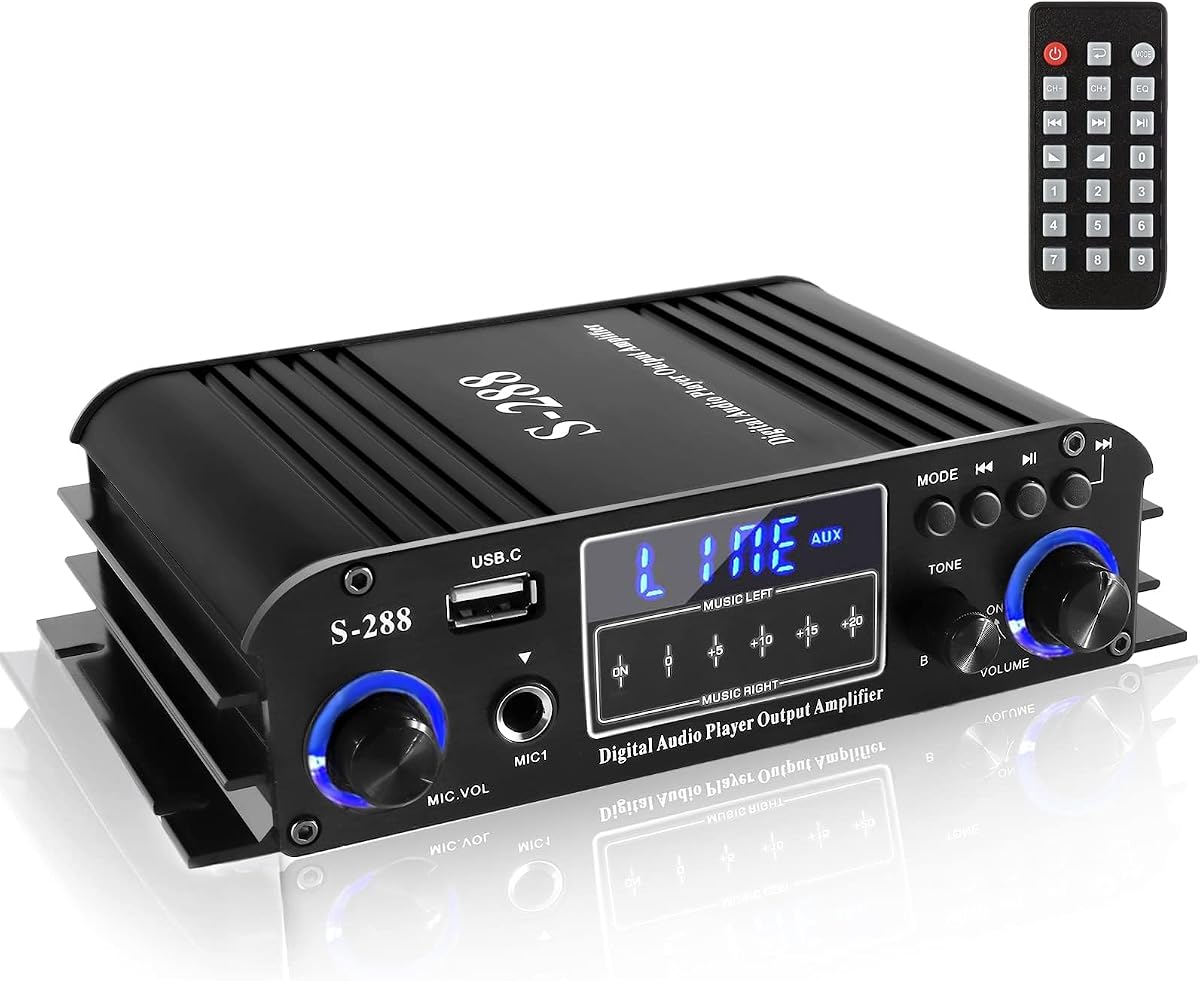
The Pyle PDA77BU is a four-channel amplifier with a 4.2 rating, designed for buyers who want to power several passive speakers without using a full surround receiver. Its headline 800-watt peak specification suggests substantial aggregate capacity, although the listing does not provide a detailed per-channel output or impedance rating.
We may earn a commission when you buy through this link, at no additional cost to you.
The amplifier supports Bluetooth 5.0 over a stated range of more than 30 feet, along with USB, SD-card playback, FM radio, AUX, RCA, and 3.5 mm inputs. Those connections make it suitable for a compact entertainment system, multi-room audio arrangement, party installation, or a home theater paired with powered subwoofers and separate amplified channels.
Two 1/4-inch microphone inputs are particularly useful for karaoke, with independent microphone volume, reverb, and delay controls. The front-panel control center and LED display provide direct access to source and level adjustments. Unlike a conventional AV receiver, however, it does not advertise HDMI switching, surround decoding, or surround-specific DSP modes.
The PDA77BU is most attractive to users who value flexible four-channel amplification and entertainment features over cinematic processing. Because its supplied information does not state a supported speaker-impedance range, anyone planning to use 4 Ohm speakers should consult the manual and confirm channel loading before connecting them. It is a flexible amplifier rather than a conventional cinema processor.
Independent microphone controls, echo, reverb, and delay make the unit especially practical for singing along. A karaoke system can use the same amplifier while keeping microphone adjustment separate from the main program level.
Bluetooth, USB, SD, FM, AUX, RCA, and 3.5 mm connections cover streaming, stored music, broadcast radio, and wired devices. That makes the amplifier useful across listening and entertainment priorities.
We may earn a commission when you buy through this link, at no additional cost to you.
The Romicta 50Wx4 is a compact four-channel Class D amplifier with a 4.2 rating. Unlike listings that emphasize a large peak-power headline, this model describes 4×50 watts RMS and 1,200 watts maximum output, giving shoppers more useful information when comparing multi-channel amplification with conventional 4 Ohm speakers.
We may earn a commission when you buy through this link, at no additional cost to you.
It can drive up to four passive speakers simultaneously for home audio, television, bookshelf-speaker, home theater, and karaoke applications. Its stated harmonic distortion of 0.04% targets clean reproduction, while a high-capacity transformer and aluminum casing support a compact installation. Bass and treble controls allow broad tonal adjustment, and the included remote handles level and settings.
Connectivity includes Bluetooth 5.0 with a stated operating range of 33 feet, 3.5 mm AUX, USB, microSD, FM, and microphone connections. MP3 playback and a bright LED status display add convenience. The unit does not provide Dolby or DTS decoding, video pass-through, surround-height processing, or the source switching expected from a cinema receiver.
This amplifier is a good match for a straightforward four-speaker system where each zone needs independent amplification. It also works well for car audio, small parties, restaurants, classrooms, and karaoke as described by the manufacturer. For 4 Ohm speakers, the lack of an explicit impedance rating means compatibility should be confirmed from the product documentation rather than assumed.
The 4×50 watts RMS description helps distinguish usable channel output from maximum headline power. Buyers should still consider each speaker's sensitivity, room size, and distance from the listening position.
Four passive outputs let the amplifier support separate stereo pairs, a multi-room arrangement, or a straightforward home theater. Independent channel use makes it adaptable beyond a single conventional surround layout.
We may earn a commission when you buy through this link, at no additional cost to you.
The Pyle PT796BT.5 is a 7.1-channel home theater amplifier with a 3.4 rating. Its defining benefit for this roundup is an explicit 4–16 ohm speaker-impedance range, which places nominal 4 Ohm speakers within the stated operating range and makes the product more straightforward to assess for compatibility.
We may earn a commission when you buy through this link, at no additional cost to you.
It advertises 2,000 watts of peak power and includes dedicated RCA subwoofer output, Bluetooth streaming, USB, RCA, HDMI, optical, and coaxial connections. Support for 4K Ultra HD, 3D, and Blu-ray video pass-through allows it to sit between compatible source components and a television, although it does not provide the same class of object-based audio processing found on more specialized cinema receivers.
Two quarter-inch microphone inputs, independent source selection, echo, bass, treble, microphone level, and master volume broaden its use for presentations and karaoke. A VFD display, AM/FM radio, remote, power cable, and protection against overcurrent, short circuits, and overvoltage are also included. Its 3.4 rating is the lowest shown, so prospective buyers should weigh user feedback carefully.
The PT796BT.5 suits a large collection of legacy and modern sources, especially where seven channels and explicit 4 Ohm compatibility are priorities. It is less attractive for buyers who want advanced Dolby Atmos or DTS:X decoding, a refined setup interface, or a more established measure of continuous per-channel output. Confirm all speaker assignments and amplifier limitations before finalizing the installation.
The published 4–16 ohm range directly addresses the roundup's central concern. It provides a clearer starting point than a receiver with no stated impedance information, although individual channel configuration still matters.
HDMI, optical, coaxial, RCA, USB, Bluetooth, and radio functions support a broad mix of equipment. This makes the amplifier useful for legacy components as well as newer streaming and television sources.
We may earn a commission when you buy through this link, at no additional cost to you.
The Pyle 500W 4-Channel amplifier has a 4.0 rating and an explicit 4–8 ohm range, making it a relevant multi-speaker option for conventional 4 Ohm systems. Its four-channel design supports multi-speaker entertainment, commercial audio, home theater, and karaoke, although it does not include the video switching and surround decoding of a dedicated AV receiver.
We may earn a commission when you buy through this link, at no additional cost to you.
The unit's 500-watt figure is described as peak power, and the listing says it can be used with multiple speakers. Buyers should avoid comparing that headline figure directly with continuous per-channel ratings. Its separate subwoofer output is valuable because a powered or passive subwoofer then does not have to share the main amplifier's output allocation.
Seven input paths include MP3 or iPod playback, USB, microSD, AUX, FM radio, audio input and recording, and RCA subwoofer output. Two quarter-inch microphone inputs, echo, talk-over, rotary equalization, and separate microphone and master volume controls make the unit particularly practical for announcements, paging, events, and karaoke.
This is a good choice for a system that needs reliable four-channel amplification, wired sources, radio, and microphone support rather than advanced cinema processing. Its 4–8 ohm compatibility gives 4 Ohm speakers a clear fit, but the number and power requirements of connected speakers still need to be considered. It is less relevant to a dedicated 8K television and console gaming setup.
Dedicated left and right subwoofer outputs provide more control over bass-channel allocation. They are especially useful when the main speakers are already handling a full four-channel speaker load.
The talk-over control temporarily lowers or halts music for microphone use. This makes the amplifier practical for hosted events, small venues, rehearsal rooms, and karaoke setups.
We may earn a commission when you buy through this link, at no additional cost to you.
The Denon AVR-X4800H is a 9.4-channel home theater receiver with a 4.5 rating, nine 125-watt amplification channels, and extensive support for current surround and video formats. It is the premium-oriented choice in this guide for listeners who want substantial channel expansion, multiple displays, and sophisticated audio processing rather than a simple stereo or basic surround system.
We may earn a commission when you buy through this link, at no additional cost to you.
Its 10 HDMI ports, divided into seven inputs and three outputs, support 8K and 4K at 120 Hz. HDR formats include HLG, Dolby Vision, HDR10+, and Dynamic HDR, with HDCP 2.3 and eARC support. Audio capabilities include Dolby Atmos, DTS:X Pro, IMAX Enhanced, Auro 3D, Dolby Surround upmixing, and DTS Neural:X.
The receiver can use Dolby Height Virtualization and DTS Virtual:X to create overhead effects in a 2.1, 5.1, or 7.1 arrangement. Four RCA/XLR subwoofer outputs, analog and digital inputs, a phono input, and HEOS Wi-Fi multi-room streaming provide extensive integration. Its greater complexity also means that the speaker layout must be carefully designed to benefit from the additional channels.
The AVR-X4800H is best suited to a serious home theater with multiple surround or height speakers, several source devices, and potentially more than one display. For 4 Ohm speakers, the abundant channel count is helpful, but buyers should still verify the manufacturer's supported impedance and power limits. It delivers the strongest combination of scale, features, and user rating among the picks.
Nine amplification channels provide the flexibility to build a larger surround configuration or add height and rear effects. Virtualization options can extend a smaller layout, although dedicated speakers generally offer more precise spatial cues.
Seven HDMI inputs and three outputs support several source components and displays. HDCP 2.3, eARC, 8K, and 4K at 120 Hz make the receiver suitable for a current-generation home theater ecosystem.
We may earn a commission when you buy through this link, at no additional cost to you.
The Pyle PT796BT is a 7.1-channel receiver-amplifier with a 3.6 rating and an explicit 4–16 ohm speaker range. Like the closely related PT796BT.5, it combines broad connection options with multi-channel amplification, making it relevant to buyers who want nominal 4 Ohm compatibility and a traditional surround layout.
We may earn a commission when you buy through this link, at no additional cost to you.
The listed 2,000-watt peak-power figure is intended for speakers and subwoofers, while a dedicated RCA subwoofer output handles bass separately. Bluetooth, USB, RCA, HDMI, optical, and coaxial inputs support modern streaming and a wide selection of legacy components. Video pass-through covers 4K Ultra HD, 3D, and video, although the supplied information does not mention advanced Dolby Atmos or DTS:X processing.
Two quarter-inch microphone inputs, independent source selection, echo, bass, treble, microphone level, and master volume make this a flexible karaoke and event amplifier. The VFD display, AM/FM radio, remote control, and overcurrent, short-circuit, and overvoltage protection add further utility. A stated HDCP caveat excludes Apple TV and Dish Network, which deserves attention for buyers with those services.
The PT796BT is most suitable for a straightforward seven-channel theater or flexible multi-speaker installation with many source types. Its rating trails the better-reviewed Denon and Sony options, and its peak-power presentation offers less insight into continuous output. If advanced cinema decoding is not essential, its connectivity and 4–16 ohm support remain compelling.
Optical and coaxial digital audio, multiple RCA connections, USB, Bluetooth, and HDMI allow a system to grow without discarding older equipment. This is helpful in homes with game consoles, disc players, set-top boxes, and streamers.
Protection against overcurrent, short circuits, and overvoltage adds useful safeguards for a multi-speaker installation. It does not replace correct impedance, ventilation, wiring, and speaker-load practices.
We may earn a commission when you buy through this link, at no additional cost to you.
The Pyle 5.2-Channel Receiver has a 4.0 rating and presents a straightforward home theater pathway with five speaker channels and subwoofer support. Its stated 1,000-watt maximum output and 4K Ultra HD passthrough make it visually appealing for a basic media system, but the absence of a per-channel continuous-power specification and published impedance range requires careful comparison.
We may earn a commission when you buy through this link, at no additional cost to you.
Bluetooth enables straightforward streaming from compatible devices, while a digital interface using a DAC can accept a computer's digital audio signal. The receiver is designed for home entertainment, with 5.2-channel amplification, immersive surround-style playback, and compatibility with a 4K display. It also supports MP3 and USB playback, broadening its role beyond television audio.
Overcurrent, short-circuit, and overvoltage protection are built in, helping protect the amplifier when components are connected correctly. The trade-offs are a more limited specification than the feature-rich Denon models, no stated HDMI input count, and no clear listing of surround decoding formats such as Dolby Atmos or DTS:X. It also does not state whether every channel supports the same output level.
This receiver is appropriate for a bedroom theater, apartment system, compact living room, or secondary media space where a 5.1-style layout and simple streaming are the priorities. For 4 Ohm speakers, buyers should obtain the manual, verify per-channel load limits, and avoid relying on the maximum-wattage headline. It is a practical entry point rather than a specification-heavy enthusiast model.
A 5.2-channel layout covers front-left, front-right, center, two surrounds, and a subwoofer output. It is a conventional configuration for smaller rooms and secondary theaters.
Bluetooth streaming and a digital DAC interface provide two ways to move computer or mobile audio into the main speaker system. USB and MP3 support add another convenient music option.
We may earn a commission when you buy through this link, at no additional cost to you.
Choosing an AV receiver for 4 Ohm speakers requires balancing electrical load, channel count, source connectivity, room size, and the audio features you actually use. The most important first step is to understand your speaker system and the type of entertainment the receiver must control.
Speaker arrangement also matters. A receiver with five channels may be rated for a specific speaker count, and connecting additional 4 Ohm speakers to one output can increase the load. Use the manufacturer's channel-assignment and impedance rules, and never combine speaker outputs unless the documentation explicitly permits it.
Prioritize clean, repeatable output rather than the largest headline number. The Romicta 50Wx4 offers a clear 4×50-watt RMS description, while several Pyle products emphasize maximum or peak power. A receiver can sound adequate without a dramatic specification, but buyers should avoid selecting solely on the biggest wattage claim.
Choose a layout based on furniture placement and room geometry. If a couch blocks rear speakers, a five-channel setup with good placement may be preferable to a larger configuration that cannot be positioned correctly.
For newer televisions and consoles, consider 4K and 8K passthrough, HDCP, eARC, VRR, and QFT. If your equipment does not support these features, paying attention to them offers little practical benefit.
Make a list of the formats you actually use. Supported features are valuable only when the source material, connected equipment, and speaker layout can reproduce them. Paying for advanced processing without matching height speakers or source content is less useful than ensuring stable core amplification and correct connections.
Look for a control scheme that matches your household. A simple receiver is often easier for occasional users, while enthusiasts may value source selection, detailed equalization, and multi-zone management.
Allow room for remote operation, front-panel access, and service clearance. Proper ventilation supports reliability and helps the amplifier manage heat during extended listening.
Rank your requirements before comparing models: speaker compatibility first, then channel count, power, connections, formats, controls, and secondary functions. This prevents a high wattage headline or extra connection from distracting from a more important requirement.
Begin by identifying every speaker and its impedance rating, then plan the channel layout on paper. Connect each speaker to the labeled output, keeping left, right, center, surround, and subwoofer connections in their intended positions. Use good-quality speaker wire, secure bare connections, and observe correct polarity. Do not add an extra pair of 4 Ohm speakers to a terminal unless the receiver documentation confirms that the combined load is supported.
Connect the television and source devices next, then enable the appropriate surround and room-correction modes before changing equalization settings. Start with moderate volume and allow the amplifier and speakers to warm up. If distortion, unusual heat, intermittent protection, or unstable output occurs, power down the system, check every connection, and confirm that speaker loading matches the manual.
Keep the receiver and its ventilation paths clear of dust and stored items. Use the included remote or supported app, update firmware when advised, and avoid placing drinks, cables, or decorative objects near the ventilation openings. Periodic dusting and careful cable management help preserve reliable operation and make troubleshooting easier when sources or speakers need to be changed.
Yes, provided the receiver's documentation permits 4 Ohm speakers and the complete connected load remains within its specifications. Check the published impedance range and the maximum number of speakers allowed on each channel. Never combine outputs unless the manufacturer explicitly allows parallel speaker connections, because doing so can create excessive electrical load.
The number describes nominal electrical impedance, which affects how much current the amplifier must provide. A 4 Ohm speaker presents a greater load than an 8 Ohm speaker. Many receivers support both, but their power output and thermal behavior can differ, so the receiver's manual and speaker specifications should always guide the connection.
A 5.2-channel receiver is a common and practical choice for medium or small rooms. It provides front-left, front-right, center, two surround speakers, and a subwoofer. It may not offer the same immersion as a 7.1 or 9.4-channel system, but correctly placed speakers and appropriate processing can produce excellent results.
There is no single wattage that suits every room and speaker. Speaker sensitivity, room size, listening distance, and the number of connected channels all matter. Compare continuous per-channel power rather than peak wattage, and avoid setting a receiver's limits beyond what its manual permits for the chosen speaker configuration.
A two-channel receiver can provide clear television audio and can be paired with a subwoofer through an appropriate output or an external system. However, a model without HDMI or surround decoding will not offer the same source switching, object-based audio, gaming features, or channel flexibility as a dedicated home theater receiver.
It can improve the experience by providing clean amplification, decoding, source management, and surround processing, but it cannot correct a poorly placed or unsuitable speaker system. Proper speaker selection, room acoustics, firmware settings, and correct calibration have a major effect on the final result.
Continuous or RMS power is generally more useful for comparing sustained output. Peak power describes a short-duration maximum and does not indicate how much clean power the amplifier can maintain across all connected channels. Speaker sensitivity and room conditions also influence how much power is needed in practice.
It depends on convenience and energy use. Leaving a receiver powered makes source changes convenient, but switching it off when it will not be used can reduce energy consumption. Allow adequate ventilation, use a surge protector appropriate for the setup, and follow the manufacturer's guidance for standby and power cycling.
The Denon AVR-S570BT is the strongest general-purpose home theater recommendation, balancing 5.2-channel amplification, modern HDMI features, gaming support, and an accessible setup process. The Sony STRDH590 offers a straightforward surround alternative with 4K HDR support, while the Denon AVR-X4800H represents the premium path for expansive channels, advanced decoding, multiple HDMI connections, and serious home theater integration.
For a simpler system, the Sony STRDH190 is an effective two-channel music receiver with documented 6–16 ohm support. Buyers seeking four or more amplified channels have additional choices in the Romicta 50Wx4, Pyle PDA77BU, and Pyle 500W model. The Pyle PT796BT variants stand out when explicit 4–16 ohm compatibility and broad connectivity are priorities.
Before buying, verify the receiver's current manual, supported speaker configurations, and exact impedance limits against your planned speakers. Also check current product availability, included accessories, and the latest price, since prices and listings change. The right choice is the model that safely supports your actual 4 Ohm speakers while meeting your room, source, and entertainment needs.