
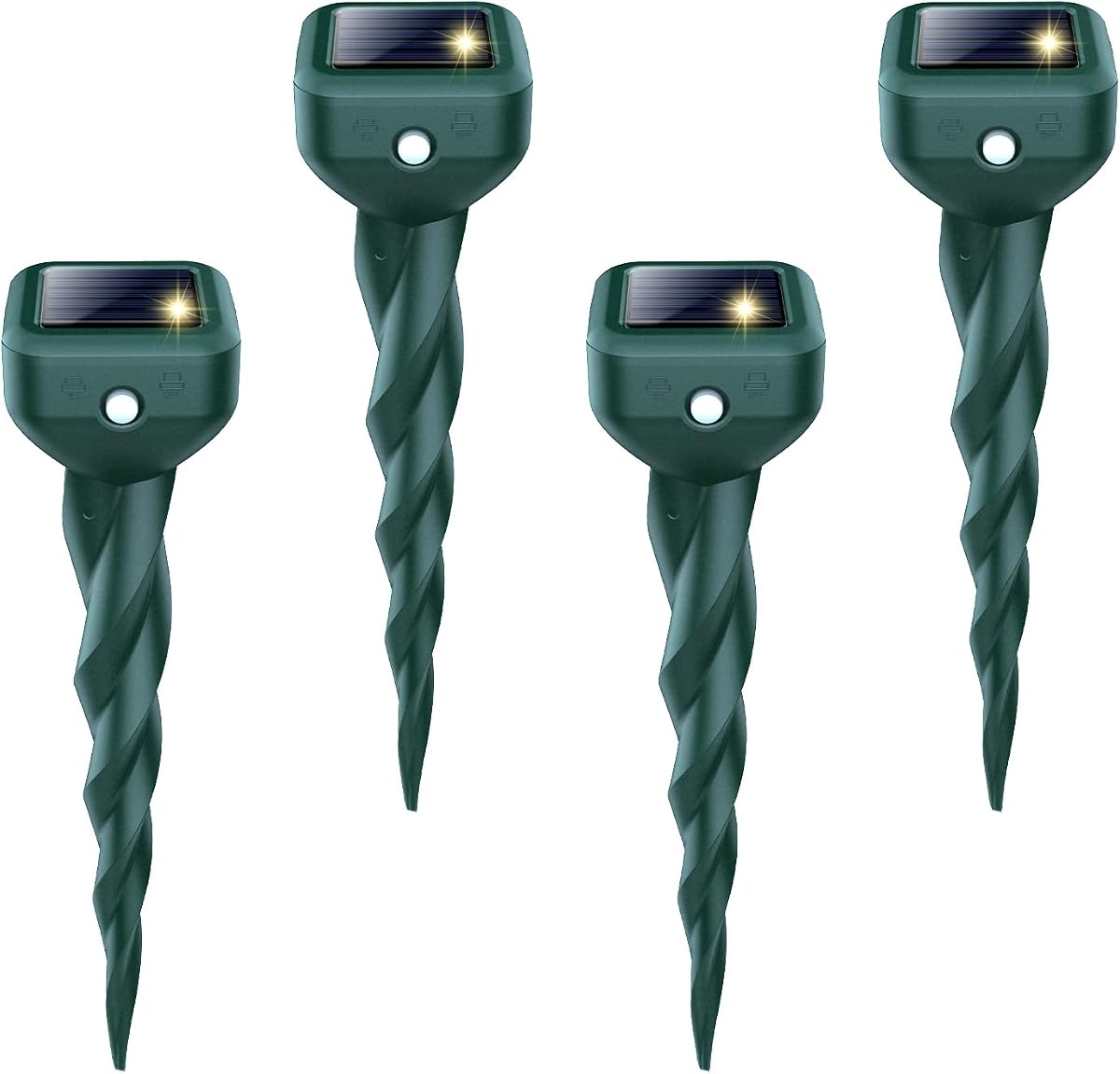
8 Pack Mole Repellent Ultrasonic Solar Powered Gopher Vole Repellent
5.0Editor score
Eight ground stakes included
Automatic solar charging
Periodic sound-wave output
Simple tool-free installation
Our Solar Powered Ultrasonic Yard Stake Repeller guide compares ten options for coverage, weather resistance, pest range, and ease of use.
Solar powered ultrasonic yard stake repellers offer a convenient way to discourage moles, gophers, voles, groundhogs, snakes, and other unwanted visitors without installing wiring or handling poison bait. The best units combine dependable solar charging, outdoor-rated construction, and periodic ultrasonic or vibration signals that can be distributed around vulnerable lawn and garden areas.
We compared all ten products by examining their stated pest coverage, pack quantity, power method, waterproofing, placement guidance, operating modes, and maintenance needs. The list includes stakes designed primarily for burrowing rodents as well as broader deterrents intended for snakes, skunks, rabbits, chipmunks, raccoons, and other common yard pests, giving readers a useful range of options.
Each review highlights the most important strengths, limitations, and ideal installation scenario without claiming that the products were personally tested. Every stake in the guide uses solar power, but their coverage figures, activation intervals, weather ratings, and installation advice differ. Prices and availability can change, so confirm current product details before making a purchase.
5.0Editor score

5.0Editor score

4.3Editor score
The table below compares the ten solar-powered stakes by their pack size, target pests, stated coverage, and outdoor construction, making it easier to identify the option that fits a particular lawn or garden.




This eight-pack combines solar charging, ultrasonic pulses, and vibrations to discourage a wide selection of burrowing and surface-dwelling animals. It carries a 4.6 rating and is listed for moles, snakes, skunks, rabbits, gophers, voles, chipmunks, deer, groundhogs, armadillos, and raccoons, making it one of the more versatile selections in the guide.
We may earn a commission when you buy through this link, at no additional cost to you.
Its strongest feature is the breadth of the deterrent package. The stakes are designed for lawns, gardens, farms, orchards, parks, campsites, chicken coops, and other outdoor spaces, while a stated 14,000-square-foot area per unit offers ample room to distribute them around active zones. The IP65 rating and solar design also reduce concerns about weather exposure and ongoing battery replacement.
The most important caveat is that the exceptionally large coverage figure is a manufacturer claim rather than an independently verified result. Actual performance depends on soil, animal habits, placement, sunlight, and the severity of the infestation. Buyers should still follow sensible spacing and monitor fresh tunnels rather than expecting a single stake to handle an entire property.
This is a strong choice for households confronting several kinds of unwanted visitors or for gardeners who want broad deterrence across multiple beds. For a focused mole problem, however, the more tightly specified alternatives may be easier to deploy. Overall, it is a flexible, generously packaged option with useful weather resistance and simple installation.
The unusually long target-pest list makes this pack useful where the problem is not limited to a single species. It can support a combined strategy around lawns, vegetable plots, orchards, and other areas where different animals may create damage.
Each stake uses a solar panel and includes no external wiring, allowing users to reposition units as animal activity changes. Keeping panels exposed to direct sunlight and clean is still essential for reliable charging.
We may earn a commission when you buy through this link, at no additional cost to you.
This ten-pack is designed primarily for moles, gophers, groundhogs, snakes, voles, and similar burrowing pests. Its 3.8 rating places it below several alternatives, but the generous quantity, solar operation, and straightforward ground installation make it relevant to buyers managing a broad lawn or garden.
We may earn a commission when you buy through this link, at no additional cost to you.
The product emits a short signal every 30 seconds and recommends placing stakes approximately every 96 feet. It uses a solar panel to charge before installation, while the ABS and PC body is described as able to withstand rain, snow, frost, and heat. A switch initiates automatic operation, and the listing says the gentle output is suitable around children and pets.
Its main drawback is the relatively modest rating, which may reflect concerns about durability, effectiveness, or overall satisfaction. The recommended spacing also means ten stakes may not be concentrated around a few small tunnels. A careful initial layout can compensate, but users should not treat a large pack as automatically equivalent to stronger performance.
This option suits larger properties or buyers who want enough units to create a broad perimeter. It may be less attractive for a compact yard with one clearly defined hotspot. Confirm the current rating and customer feedback before buying, and place the stakes where direct sunlight and active animal movement both support the intended use.
The high unit count gives buyers room to surround gardens, lawns, and known tunnel routes rather than clustering every stake in one location. Spacing according to the stated guidance can create a more consistent deterrent field.
The described ABS and PC construction and waterproof technology suit exposed installations. Periodic panel cleaning remains important because dust and debris can reduce the available sunlight used for charging.
We may earn a commission when you buy through this link, at no additional cost to you.
This eight-pack targets moles, gophers, voles, groundhogs, chipmunks, and snakes. Its 5.0 rating makes it one of the strongest customer-rated options in the list, and the product description emphasizes humane ultrasonic pulses, sturdy ABS construction, and operation without tools, wiring, or replaceable batteries.
We may earn a commission when you buy through this link, at no additional cost to you.
According to the supplied information, four hours of solar charging can support up to four days of protection, while ultrasonic pulses occur every 20 seconds. Each stake has a stated coverage area of up to 7,000 square feet, with spacing every 70 feet recommended across a lawn or garden. That arrangement is more suitable for broad property coverage than a single concentrated hotspot.
The performance and endurance figures are manufacturer statements and should be considered carefully, especially in cloudy, shaded, or heavily wooded locations. Keeping the panel clean is necessary to maintain charging efficiency. The absence of a formal IP waterproof rating also means buyers should avoid installation in areas that routinely collect water.
This is an appealing pick for a larger yard where moles and related rodents are active across several sections. It is straightforward to deploy and has a strong rating, but buyers should follow the 70-foot guidance and allow the device to remain continuously active. It is best suited to consistent sunlight and open, well-drained ground.
The 5.0 rating and clearly described twenty-second pulse cycle make this product appealing to buyers who prioritize simple operation. Its automatic behavior reduces the need for frequent switching or monitoring.
The recommended 70-foot placement distance means the eight stakes can be used to cover an expansive lawn systematically. Buyers with a smaller area may be able to concentrate them around tunnels and disturbed soil.
We may earn a commission when you buy through this link, at no additional cost to you.
This 5.0-rated eight-pack stands out for a smart-chip design that varies ultrasonic frequencies and adds low-frequency seismic pulses. The stated goal is to make the protected soil environment less comfortable for moles, voles, gophers, and snakes while reducing the chance that animals will adapt to one consistent sound.
We may earn a commission when you buy through this link, at no additional cost to you.
Its construction includes ABS plastic and an IP66 waterproof rating, one of the stronger weather-protection claims among the products reviewed. The stakes activate with a one-button control, and the product description recommends two days of initial charging. It also provides unusually specific installation guidance, including keeping the cap above soil level and using a pilot hole rather than direct hammering.
The main ambiguity is the recommendation to place one stake every 70 to 96 inches. That is much closer than the spacing commonly stated for competing products, and it could make a large lawn require many additional units. The listing also says meaningful improvement may take two to four weeks, so this is a consistency-based solution rather than an instant fix.
This is our Editor's Choice because it combines variable frequency, strong weather sealing, straightforward charging, and unusually thorough placement instructions. It is best for buyers prepared to deploy the stakes systematically near active soil disturbance and maintain them consistently for several weeks.
Changing ultrasonic frequencies and combining them with seismic pulses makes the deterrent less predictable than a fixed tone. This feature is particularly relevant to persistent burrowing animals that might otherwise adapt to a repetitive signal.
Clear instructions for height, charging, pilot holes, and sunlight help reduce installation errors. They also make it easier to reposition the stakes if fresh tunnels appear in a different part of the yard.
We may earn a commission when you buy through this link, at no additional cost to you.
This four-pack provides a more compact way to deploy solar ultrasonic and vibration deterrence around a lawn, garden, farm, orchard, park, campsite, or backyard. It has a 5.0 rating and shares a broad target list that includes moles, snakes, skunks, rabbits, gophers, voles, chipmunks, deer, groundhogs, armadillos, and raccoons.
We may earn a commission when you buy through this link, at no additional cost to you.
Each stake has a stated 7,000-square-foot coverage area and uses a waterproof ABS-style outdoor design with an IP65 rating. A simple ground insertion and switch activate automatic operation. The dual-action approach sends ultrasonic waves and vibrations through the soil every 20 seconds, providing a chemical-free and trap-free deterrent option.
Four units may be too few for a large property, particularly because the listing does not provide a specific spacing recommendation. The phrase that results can become obvious after a week should also not be treated as a guaranteed timeline. Animal behavior, weather, and the extent of the infestation can all affect results.
This product is a strong fit for targeted areas, such as a vegetable garden, flower bed, or section of lawn with recurring tunnels. It offers the same broad pest focus as larger packs in a more manageable quantity, making it easier to test a concentrated placement before expanding coverage.
A four-unit configuration is practical when the damaged area is compact. Buyers can position stakes near visible runways, raised soil, and garden borders where burrowing animals are most active.
Combining ultrasonic waves with physical vibration gives the stakes more than one deterrent mechanism. The signal is designed to travel through soil and make protected areas feel less inviting.
We may earn a commission when you buy through this link, at no additional cost to you.
This four-pack is a portable ultrasonic and vibration solution for moles, gophers, voles, groundhogs, and snakes. It carries a 5.0 rating and distinguishes itself with a practical relocation strategy: after allowing the stakes to work for three to four weeks, users can move them toward the edge of the target area.
We may earn a commission when you buy through this link, at no additional cost to you.
The stakes send vibrations through the ground across a stated 7,000 square feet per unit. Their built-in solar panels remove the need for wiring, while the waterproof construction is designed for yards, gardens, campgrounds, farms, and other exposed areas. The listing also describes the product as non-toxic and suitable for humans and pets.
The advertised strategy requires patience and active involvement. Moving a stake is not merely a maintenance task; it is part of the stated method for gradually pushing burrowing pests away from the desired area. A four-unit pack may also spread too thin if a buyer attempts to cover a large property immediately.
This pick appeals to gardeners who are willing to monitor animal movement and adjust placement over time. It is especially useful for smaller, well-defined areas where even a few repositionable stakes can remain close to active tunnels. Buyers should view the device as part of a multi-week strategy rather than a one-day solution.
The product's recommended method uses gradual movement to guide pests beyond the protected area. This makes the portable stake design more useful for active monitoring than a permanently fixed installation.
The IP65 construction and solar charging are appropriate for year-round outdoor placement. As with other stakes, direct sun and periodic panel cleaning remain necessary for dependable operation.
We may earn a commission when you buy through this link, at no additional cost to you.
This eight-pack is a direct, uncomplicated option for yards and gardens experiencing mole, gopher, or vole activity. It has a 5.0 rating and focuses on the core job of a solar sonic ground stake: periodically sending sound-wave output through the inserted structure into the surrounding soil.
We may earn a commission when you buy through this link, at no additional cost to you.
The built-in panel collects sunlight for automatic operation, removing the need for battery replacement or complicated wiring. Each stake can be inserted into the ground without special tools, and the broad quantity allows placement near tunnels, raised soil, garden borders, and other frequently disturbed sections rather than concentrating every unit in one location.
The product data does not provide a formal waterproof rating, a numerical coverage area, or a detailed signal interval. It also focuses more narrowly on moles, gophers, and voles than the broader multi-pest models. Buyers should therefore treat its main strengths as ease of use, flexibility, and the eight-unit layout rather than sophisticated coverage specifications.
This is our Best Budget pick for buyers who want a straightforward set of solar stakes without paying for an extensive range of documented features. It is well suited to lawns, flower beds, and vegetable gardens where users can monitor activity and move units as needed.
Eight units can be placed around separate tunnel systems or moved as the problem shifts. This practical approach is more valuable than clustering all stakes in one location when animal behavior changes.
Automatic solar charging keeps the maintenance burden low. Position each panel where it receives strong sunlight, and avoid extremely loose or waterlogged soil that could undermine the stake.
We may earn a commission when you buy through this link, at no additional cost to you.
This olive-finished eight-pack combines ultrasonic pulses and vibration to deter moles, voles, gophers, snakes, and other burrowing animals. Its 4.7 rating is among the stronger results in the guide, and the product offers a balanced mix of outdoor construction, automatic solar charging, and quick installation.
We may earn a commission when you buy through this link, at no additional cost to you.
Each stake has a stated 5,000-square-foot range, making the eight units suitable for distributing protection across a lawn, backyard, vegetable garden, orchard, or farm. The IP65 ABS shell is described as resistant to rain, snow, and strong sunlight, while a thicker wear-resistant structure is intended to resist rust and corrosion in ground environments.
The stated coverage is lower than that of several competing packs, so a large property may need more units or a closer layout. The recommended installation also calls for drilling a small pilot hole, which is a little more involved than simply pushing a stake into soft ground. Buyers should ensure the unit is firmly seated and the panel is not shaded.
This option is a good fit for buyers seeking a rugged, established-looking stake with a broad pest focus. It balances coverage, construction, and pack quantity better than options with only four units, although it is not the longest-reaching model available.
The thick ABS construction and corrosion resistance are useful for stakes exposed to moisture, soil contact, and changing weather. Firm placement in the soil helps the vibration and ultrasonic output interact with the surrounding ground.
A 5,000-square-foot area per unit and eight included stakes offer enough capacity for broad yards without requiring wiring. Buyers should map visible activity before deciding where each unit will provide the most benefit.
We may earn a commission when you buy through this link, at no additional cost to you.
This eight-pack uses low-frequency ultrasonic pulses lasting three to four seconds every 20 seconds to discourage moles, gophers, voles, groundhogs, snakes, chipmunks, and skunks. It has a 3.7 rating, the lowest in this comparison, but its stated coverage, activation instructions, and waterproof construction provide useful information for buyers.
We may earn a commission when you buy through this link, at no additional cost to you.
The stakes are rated at up to 7,000 square feet each, and the listing recommends spacing them roughly 70 feet apart. They should be placed in direct sunlight for at least two days before first use, inserted with the top approximately two inches above the surface, and activated using the on/off button. Once charged, they are described as operating for up to four days.
The low rating means durability or performance may not satisfy every buyer, and the four-day claim will naturally vary with sunlight and weather. Solar panels also require regular cleaning to maintain charging efficiency. The broad pest list is a strength, but the product should be judged primarily as a deterrent rather than a guaranteed removal solution.
This product is most appropriate for buyers who want a clearly documented setup routine and a large eight-pack for distributed coverage. It can be considered for gardens, orchards, yards, and farms, but reviewing recent customer feedback is wise before making it a first choice.
The two-day charging period, two-inch mounting height, and button operation give users a clear installation sequence. These details can help prevent units from being placed too low, shaded, or switched on before receiving a useful charge.
Coverage of rodents, snakes, chipmunks, and skunks makes this useful for mixed garden problems. The 70-foot spacing guidance is still important for turning the eight units into an organized layout rather than an arbitrary scatter.
We may earn a commission when you buy through this link, at no additional cost to you.
This ten-pack is the most feature-oriented premium selection, combining ultrasonic pulses, intermittent vibration, dynamic frequency, and IP65 weatherproofing. It targets more than 20 creatures, including snakes, moles, gophers, voles, rabbits, skunks, rodents, groundhogs, chipmunks, lizards, raccoons, squirrels, and deer.
We may earn a commission when you buy through this link, at no additional cost to you.
The product description states that the 2026 upgrade delivers effective coverage up to a 50-foot radius, compared with a 25-foot radius for a basic version, and that it can protect an area of up to one acre. It uses 400 to 1000 Hz pulses paired with vibrations every 20 seconds. Ten stakes provide a large quantity for distributing around lawns, gardens, and orchards.
Its 4.3 rating is lower than those of the Editor's Choice and Best Budget picks, so the expansive claims deserve realistic interpretation. A radius, area, and number of pests are not guarantees, and the different coverage language could cause confusion. Actual results will depend on placement, exposure, and pest persistence.
This is our Best Premium pick for buyers who want the broadest documented pest range, the largest pack, and a more advanced frequency system. It is well suited to expansive properties and mixed pest concerns, while buyers with one severe mole problem may find a focused model easier to deploy.
Dynamic frequency paired with physical vibration provides several ways to discourage unwanted animals. The variable output is intended to lower the risk of pests adapting to a fixed signal.
Ten units and a stated one-acre capacity suit larger lawns, farms, and orchards. A measured layout around active travel routes is more likely to be productive than relying on the maximum coverage figure alone.
We may earn a commission when you buy through this link, at no additional cost to you.
The right solar stake depends on the pests involved, the size and sunlight of the property, the amount of spacing available, and how much maintenance you want to perform. Review the stated specifications alongside the terrain and seasonal weather at the intended installation site.
Start by identifying whether the main problem is moles, gophers, voles, groundhogs, snakes, skunks, rabbits, chipmunks, or another animal. Some models focus on underground activity and combine ultrasonic waves with ground-transmitted vibration, while broader designs add surface pests such as raccoons, deer, squirrels, and skunks. A focused product may be easier to position around tunnels, whereas a multi-pest model is more useful where several species are active.
Choose a deterrent whose listed targets match the evidence around your property. Fresh raised tunnels suggest moles or voles, while broad lawn damage can point to gophers or groundhogs. Do not rely on a long target list as proof of effectiveness against every animal named.
Coverage claims range from 5,000 square feet per unit to 14,000 square feet, with the largest model using a radius-based claim. These figures are useful for estimating a possible layout, but they are not guaranteed protected zones and are not directly comparable without considering the property, soil, and placement.
Use the stated spacing advice as a starting point, then prioritize fresh tunnels, damaged plants, and animal paths. It is better to concentrate units in active areas than to spread them thinly across land that shows no signs of pests.
Solar charging works best where the panel receives strong, direct sunlight for several hours. Trees, buildings, dense shrubs, and deeply shaded fences can reduce available energy, particularly during cloudy seasons. Products with a stated two-day initial charging period should be placed in the sun before they are relied upon.
Choose a location that balances sun exposure with pest activity, but never sacrifice charging by placing a panel in permanent shade. Check the panel periodically, wipe away dust and leaves, and reposition the stake if seasonal shadows have developed.
Outdoor stakes must tolerate rain, soil contact, heat, and temperature changes. Several products specify IP65 or IP66 waterproof ratings, while others describe weather-resistant ABS construction without a formal rating. A stated rating provides a clearer standard, but proper positioning still matters, especially in areas that collect water.
Avoid extremely loose or waterlogged soil, and keep the top of the unit above the surrounding surface where the manufacturer recommends it. Installing a pilot hole can prevent damage to the stake and produce a more secure fit in hard ground.
Packs range from four to ten stakes. A four-pack is convenient for a vegetable bed, small lawn, or a few clearly defined tunnel areas, while eight or ten units provide better distribution across a larger yard. The number of visible problem areas matters more than raw pack size.
Map the lawn and garden before buying. If fresh damage repeatedly appears in several places, an eight- or ten-pack allows strategic placement. If activity is limited to one or two zones, a smaller set used more intensively may be the better choice.
Most stakes use intermittent ultrasonic pulses, sometimes paired with vibrations or low-frequency seismic signals. Variable frequencies are intended to discourage adaptation, while fixed cycles are simpler to specify. Some products describe their output as silent to humans, but buyers with sound-sensitive pets may wish to observe the product's behavior before placing it beside frequently used areas.
The signal is intended to make the protected soil less inviting, not physically remove animals. Allow consistent operation over the recommended period and judge results by reduced new tunnel activity rather than the disappearance of old tunnels.
Most units require only a switch press and insertion into soil, although hard ground may need a pilot hole. Some sellers recommend two days of precharging, and several models suggest relocating stakes every few days or after several weeks. That repositioning is part of the stated strategy for pushing pests away from a protected area.
Plan to inspect the yard at least weekly during the first month. Note new tunnels and soil displacement, then move units toward those areas. Continue using a consistent pattern and keep the solar panel clean.
Ratings range from 3.7 to 5.0 in this guide, providing a useful starting point for comparing customer experiences. Pay particular attention to recent comments about charging, weather resistance, and whether activity declined in the buyer's soil and climate. A high rating cannot guarantee identical results in every environment.
Check the latest customer feedback and product description together before purchasing. This is especially important for high-coverage or long-duration claims, because field performance can vary with shade, weather, installation, and the severity of the infestation.
Begin by mapping the affected lawn or garden and identifying fresh tunnels, raised soil, damaged roots, or entry points. Place stakes in direct sunlight near active signs of animal movement, while keeping the solar panel unobstructed. Where the manufacturer provides spacing instructions, follow them first; otherwise, distribute the units across the full affected area rather than clustering them in one location.
Install each stake firmly but gently. A pilot hole can help in firm soil, and the top should remain above the ground as directed to reduce the chance of water damage. Turn the unit on only after the recommended initial charging period, then leave it operating consistently. If the listing recommends a two-day charge, keep the new unit in full sun before relying on it around active tunnels.
Clean the solar panels periodically, especially after rain, leaves, dust, or bird droppings accumulate. Check the stakes for looseness, water pooling, and physical damage. Track new animal activity rather than judging success only by old tunnels, and reposition units toward fresh signs of movement. Allow the full time stated by the seller before deciding whether the layout needs adjustment.
They are designed to discourage moles by combining periodic ultrasonic or low-frequency signals with ground-transmitted vibration, making the protected area less attractive. Results vary with soil, animal habits, sunlight, placement, and infestation severity. Consistent use over several weeks is more meaningful than judging the device solely by whether an old tunnel disappears.
The required number depends on the size of the affected area and the product's stated spacing or coverage guidance. Four stakes may be enough for a compact garden, while eight or ten are more practical for a large lawn. Concentrating units around active tunnels and travel routes is usually better than placing every stake far apart.
The included product descriptions generally describe the stakes as non-toxic and suitable around children and pets because they use sound and vibration rather than poison or chemical bait. Nevertheless, responsible placement still matters. Keep units where they will not be knocked over, chewed, or tripped over, especially in busy play areas.
They are designed for outdoor use, and several models specify IP65 or IP66 weather resistance. However, reliable operation still depends on sufficient sunlight and a sound seal. Heavy shade, snow covering the panel, standing water, or a dirty surface can reduce charging and may require repositioning the unit.
Start near fresh tunnels, raised soil, damaged plants, and other signs of current activity, then distribute the remaining stakes according to the stated spacing guidance. Moles and related animals often travel along recurring routes, so a placement that covers both problem sites and likely travel lanes is more useful than an even but random scatter.
Allow at least the period recommended by the seller, and keep the units running consistently rather than switching them on only after new damage appears. Several products advise two to four weeks of continuous use, with some suggesting repositioning every few days. Old tunnels will not disappear, so evaluate success by whether fresh digging and new damage stop.
The included descriptions position these products as humane deterrents that cause discomfort or discourage entry without poison, injury, or trapping. Wildlife responses can vary, and no deterrent can guarantee that every animal leaves permanently. Professional wildlife advice may be appropriate where venomous snakes or persistent protected wildlife are involved.
Solar stakes depend on available sunlight to replenish their stored energy, so cloud cover, shade, and dirty panels can reduce performance. Clean the panel, move the stake into a brighter location, and allow the recommended initial charging period. If it performs poorly only in one location, check for shade and confirm that the stake is firmly seated in the soil.
The Mole Repellent Solar Powered 8 Pack Ultrasonic Gopher Repellent stands out as the Editor's Choice because of its variable frequencies, seismic pulses, IP66 construction, and detailed setup instructions. The 8 Pack Ultrasonic Gopher Vole Repellent is the Best Budget option for straightforward deployment, while the Snake Mole Skunk Repellent 10 Pack is the Best Premium choice for broad pest variety and a large-property layout.
Prioritize the pest category, sunlight, and placement before focusing on the largest coverage claim. A smaller number of correctly positioned stakes near active tunnels may outperform many units spread across unused ground. Allow enough time for consistent operation, keep the solar panels clean, and reposition units when new signs of activity appear.
Ratings, product availability, and prices can change, so check the current listing and recent customer feedback before buying. The supplied comparison covers ten solar-powered options, but your soil, climate, property size, and type of animal activity will ultimately determine which setup is most likely to meet your needs.