
0.32J Solar Electric Fence Charger with Panel for Livestock, 20-Mile Red
4.6Editor score
0.32J stored energy
Up to 20-mile coverage
Three-indicator status display
Our guide compares the best solar electric fence chargers by output, range, solar charging, portability, durability, and suitability for farms, gardens, and
Solar electric fence chargers provide dependable animal containment without requiring a nearby electrical outlet. A capable charger combines useful pulse energy, long fence coverage, dependable solar charging, sound grounding, and an enclosure designed for outdoor use. The right model depends on the animals, acreage, climate, and how often the fence will be moved.
This guide compares ten solar electric fence chargers using the specifications and product information supplied for each model. It considers stored-energy output, stated coverage, battery reserve, installation requirements, portability, monitoring features, environmental resistance, and included accessories. It also distinguishes basic fence energizers from complete bundles and higher-output units for larger operations.
Each review identifies the product's strongest application and any limitations suggested by its specifications. The top picks highlight a value-focused high-output charger, a feature-rich adjustable model, and a premium Gallagher unit. Listed prices and product configurations can change, so readers should confirm current details and compatibility before purchasing.
4.6Editor score

5.0Editor score

4.7Editor score
The comparison below highlights the major differences in output, stated coverage, power architecture, portability, and bundled equipment among these ten solar electric fence chargers.


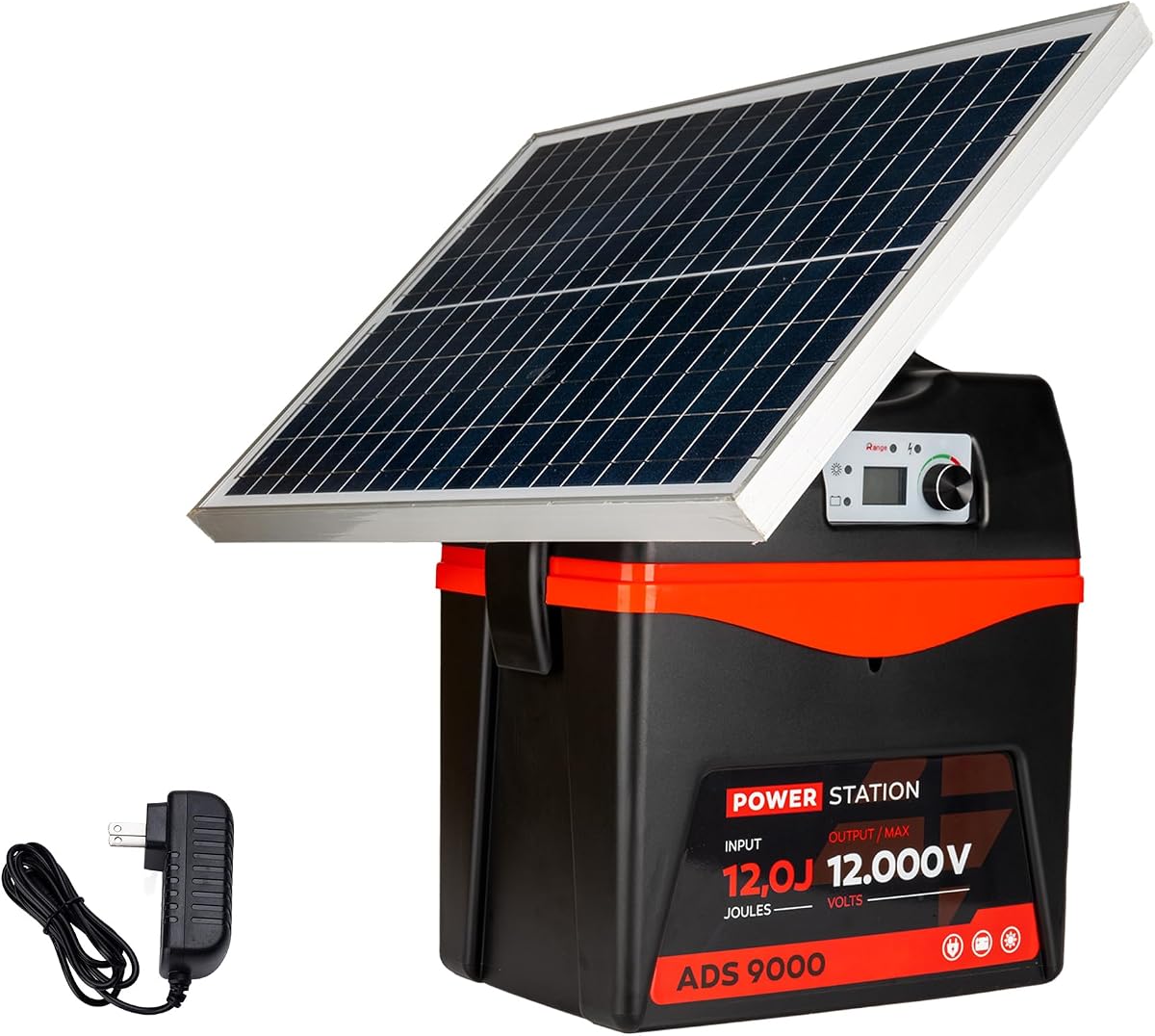


This 0.32J solar electric fence charger combines substantial stored-energy output with a stated range of up to 20 miles, making it an appealing all-around option for livestock properties. Its 4.6 rating reflects generally favorable user sentiment, while the three-indicator dashboard distinguishes it from simpler chargers. The status system covers battery level, faults, and solar charging conditions.
We may earn a commission when you buy through this link, at no additional cost to you.
The strongest feature is the combination of 0.32J output and a 14-day internal reserve. That reserve is particularly valuable in locations where extended overcast weather can interrupt solar collection. The independent power button also provides a safer way to stop output while moving equipment, repairing a wire, or changing the fencing arrangement. Its portable design suits rotational grazing and temporary paddocks.
Its large coverage claim should be read as a maximum under suitable conditions rather than a promise of identical performance on every fence. Dense vegetation, poor soil conductivity, long wire routes, and mixed fencing materials can reduce usable results. The product information also provides no clear manufacturer-warranty term, so buyers should consider after-sales support and installation documentation before making a final decision.
The charger is best for owners who want more output and diagnostics than a basic garden energizer without moving to a higher-capacity or premium system. It suits farms containing cattle, goats, sheep, horses, or similar animals and should appeal particularly to users who value a one-touch shutdown and a clear status dashboard. Overall, it offers the most balanced feature set in this roundup for the value-focused buyer.
The battery, fault, and sunlight indicators make routine inspection more informative than simply looking for a blinking light. The fault indicator can draw attention to shorts or grounding problems before animals discover that the fence is no longer working.
The stated 14-day reserve offers greater resilience than a charger designed only for overnight operation. It does not eliminate the need to clear vegetation and inspect grounding, but it adds useful protection during prolonged cloudy periods.
We may earn a commission when you buy through this link, at no additional cost to you.
This portable 0.18J solar fence charger is designed for users who need a compact energizer for dogs, goats, small pets, poultry netting, and temporary agricultural boundaries. Its stated 10-mile maximum makes it more versatile than a small garden-only unit, while its 4.1 rating suggests solid utility without matching the strongest overall scores in the group.
We may earn a commission when you buy through this link, at no additional cost to you.
The upgraded, thicker solar panel and integrated conversion battery reduce the need for external batteries or a grid connection. The battery is stated to maintain operation for up to 10 days without sunlight, a useful characteristic for temporary fencing in remote locations. Output is described as 5700 to 10200 volts, and the product information positions the charger as suitable for containing livestock and discouraging larger wildlife.
Compared with the 0.32J models, this charger offers less stored energy, so heavily vegetated or long fences may be less forgiving. Its 10-mile claim likewise depends on good grounding and attentive maintenance. The listing emphasizes portability, but buyers may still need a grounding rod, suitable wires, warning signs, and insulated posts because those items are not clearly included.
This is a good selection for small farms, homesteads, and owners who rotate fences frequently or need reliable operation away from mains power. It is less compelling for thick-coated livestock, severe weather exposure, or very large ranches where higher pulse energy offers a safer margin. For those portable, medium-scale needs, it balances capability and convenience well.
A lightweight all-in-one body can be relocated without dismantling a fixed electrical system. This makes the charger useful for seasonal paddocks, temporary poultry runs, and other boundaries that are not connected to a permanent farm circuit.
The 0.18J pulse is intended to provide meaningful deterrence without the higher power requirement of a large ranch energizer. It is most appropriate where fence lines remain clear and animal pressure is moderate.
We may earn a commission when you buy through this link, at no additional cost to you.
This solar fence charger is positioned for livestock containment and predator deterrence across small to medium grazing areas. Its title lists 0.32J output and a 20-mile maximum, while the descriptive copy also refers to 0.18J, creating an important specification inconsistency that buyers should resolve with the seller or current product documentation.
We may earn a commission when you buy through this link, at no additional cost to you.
Beyond that inconsistency, the core design is conventional and appealing: a portable all-in-one body, a built-in battery that charges in sunlight, and output stated at 5700 to 10200 volts. Solar operation removes the need for grid wiring and supports use in rotational grazing areas, gardens, temporary fencing, and remote fence lines. The 4.1 rating indicates a generally positive reception.
The absence of a clearly described battery, fault, or sunlight display makes this model less informative than chargers with explicit monitoring indicators. The maximum range also assumes properly maintained fencing, effective grounding, and vegetation control. Buyers should not treat 20 miles as a guaranteed operating distance under every environmental condition.
This charger makes sense for property owners who prioritize substantial output and portability but do not need a premium brand or a complete polywire bundle. Its specifications should be confirmed carefully before installation, particularly the energy rating. If the product is supplied with 0.32J output as the title indicates, it will be a strong general-purpose option for medium and large livestock fences.
The compact all-in-one construction simplifies relocation between grazing areas. Because the charger does not depend on a mains connection, it can support temporary fencing where bringing in electrical service would be inconvenient.
The product title and descriptive text disagree on stored energy. Confirming the specification with the manufacturer or seller before buying can prevent disappointment, particularly if the fence must contain cattle, horses, or other demanding livestock.
We may earn a commission when you buy through this link, at no additional cost to you.
The grey 0.32J Smart Display charger closely matches the feature set of the top-ranked value model, with a 4.6 rating and a stated 20-mile range. Its defining advantage is visibility: three indicators report battery level, fault conditions, and whether the solar panel is receiving suitable light.
We may earn a commission when you buy through this link, at no additional cost to you.
That dashboard is useful because fence problems often appear gradually. A low-battery warning, grounding alert, or fault notification can prompt a site visit before livestock discovers an interruption. The charger also combines 0.32J stored energy with a stated 14-day internal reserve and a one-touch power control. It is designed for farms, ranches, rotational pastures, and other off-grid installations.
The broad 20-mile figure is a maximum under conditions that include proper grounding and suitable fencing. Vegetation, damaged wires, poor connections, and insufficient sunlight can all affect performance. Like the related red model, the supplied information does not state a manufacturer warranty, so buyers should investigate support terms before installation.
This is a strong option for anyone who prioritizes monitoring and convenient shutdown as much as raw output. It may appeal to owners of permanent installations where a visible health display saves inspection time. For smaller gardens, its capability is more than necessary, but for medium and large livestock properties it offers a practical balance of power, diagnostics, and portability.
A mounted display gives owners an immediate indication of whether the unit has power, encounters a fault, or is receiving adequate sunlight. This is particularly helpful where frequent physical inspection is inconvenient.
The independent power button allows the output to be stopped without manually disconnecting wires. That makes routine adjustments safer and less awkward when working directly on the fence.
We may earn a commission when you buy through this link, at no additional cost to you.
The Gallagher S6 0.06J is a compact energizer designed for gardens, chicken coops, goat pens, and small pet enclosures rather than broad ranch coverage. Its 4.4 rating indicates a favorable reception, and the 0.74-mile range is a more realistic fit for the small-scale applications identified in the product information.
We may earn a commission when you buy through this link, at no additional cost to you.
Its built-in solar panel charges a lithium-iron-phosphate battery stated to run for up to three weeks without sunlight. Digital pulse control is designed to maintain steady voltage through light vegetation. The safe LiFePO4 battery chemistry is also highlighted for thermal stability, resistance to overheating, and maintenance-free operation over time.
Installation is more restrictive than with many competing units. The charger mounts directly to an unpainted grounding rod up to 0.5 inches in diameter, which is not included, and it cannot use another grounding method or mount to a T-post. The rod should be driven at least 18 inches into the soil, and deeper in dry or sandy ground, so the system is best for owners comfortable with proper grounding installation.
This Gallagher S6 is a good choice for a small homestead enclosure, poultry run, garden, or compact goat pen where a stronger ranch charger would be unnecessary. Its manufacturer warranty and U.S.-based support add confidence. The same qualities make it unsuitable for anyone seeking long-distance coverage without changing the grounding arrangement.
The compact 0.06J unit focuses on delivering a controlled pulse to short fences. It is better suited to chickens, small pets, garden protection, and contained goat areas than long perimeter systems supporting larger livestock.
The product has a specific rod-mounting requirement, making soil conditions and installation technique especially important. A deep, sound ground connection can be as important as charger output when maintaining a reliable pulse.
We may earn a commission when you buy through this link, at no additional cost to you.
This adjustable solar electric fence charger is the most feature-rich unit in the roundup, combining a 5.0 rating with output controls that let users select among multiple voltage and energy settings. The stated range extends from 6 to 12KV and 0.3 to 2J, allowing the same charger to suit several fence types and animal pressures.
We may earn a commission when you buy through this link, at no additional cost to you.
A 6W solar panel and built-in 18,000mAh battery form the primary supply, while the ability to switch to mains power when battery energy is low adds an important continuity option. The LED display and indicator lights present operating information for more convenient maintenance. Its 1.3-second discharge interval and 2.5W host consumption are designed for sustained operation.
The unit is rated for operation from approximately -20°C to 60°C and claims up to 20 miles of coverage under suitable conditions. Its package includes input and output cables, a power adapter, mounting screws, warning signs, and an instruction manual, reducing the chance that basic installation accessories are missing. The number of settings also adds complexity compared with simple fixed-output chargers.
This model is the strongest all-around recommendation for users who want flexibility. It suits large farms and ranches that need to tune output as livestock, vegetation, or fencing conditions change. It is also valuable where occasional access to mains power is possible but full dependence on a wired supply is not desired. The display, adjustable output, and dual-power architecture justify the feature focus.
Adjustable output can be valuable when one property includes small poultry, goats, cattle, and wildlife pressure. Matching energy to the application may also help a user avoid operating a high setting continuously when a lower one is sufficient.
The mains fallback gives owners an additional line of defense during long poor-weather periods. It does not make the unit a conventional plug-in charger, but it adds flexibility where an outlet can be reached during a backup period.
We may earn a commission when you buy through this link, at no additional cost to you.
This high-output solar energizer is aimed at extensive livestock properties, poultry systems, and users with unusually long fence networks. Its headline mentions 9 joules and 120 miles, while the detailed information describes 6 joules of effective output and a 100-mile effective length. Those differences make independent specification confirmation essential.
We may earn a commission when you buy through this link, at no additional cost to you.
The physical design is more substantial than that of the compact garden chargers. It includes a 25W adjustable solar panel, a 12V battery system, a one-button multifunction control, a 1-21 variable setting display, built-in lightning protection, and an enclosure described as sealed to IP65. The product can accept either a solar-panel connection or an AC adapter for charging.
The product information notes that a large-capacity battery is not included, which could materially affect out-of-box operation and low-sun runtime. A 3.0 rating is the lowest in this comparison and may reflect buyer satisfaction, configuration confusion, or other factors that the supplied data does not explain. The extensive range claims also depend on a properly engineered fence and suitable environmental conditions.
This charger may be worth investigating for a very large or specialized installation where high stored energy and a major solar panel are priorities. Buyers should verify the actual output, battery inclusion, accessories, and warranty before purchasing. Its raw capability is potentially impressive, but the lower rating and conflicting descriptions make it a more demanding purchase than the better-documented alternatives.
A 25W panel is a substantial charging component for a portable fence energizer. It may support demanding output and extended operation, provided the panel is positioned for strong, unobstructed sunlight.
The range, joule, and battery details conflict across the listing. Clarifying the exact configuration helps prevent a mismatch between the charger, required battery, and the size of the fence being powered.
We may earn a commission when you buy through this link, at no additional cost to you.
The Gallagher S60 0.6J combines a 4.7 rating with one of the stronger fixed-output specifications in the group: 0.6J of stored energy and up to six miles of fence under typical conditions. It is a premium choice for medium-sized operations that need dependable pulse energy without the extremely long range claimed by some high-output models.
We may earn a commission when you buy through this link, at no additional cost to you.
Its lithium-iron-phosphate battery is selected for long service life, thermal stability, and consistent outdoor performance. A tempered-glass solar panel and UV-stabilized, weather-resistant enclosure support durability, while the lightweight design mounts readily to posts or T-posts. Fence and ground leads are included, which simplifies the core setup.
The charger can power up to three full-length sections of electric poultry netting under typical conditions, expanding its usefulness beyond conventional wire fencing. It is also described as appropriate for rotational grazing, perimeter fencing, goats, chickens, pets, raccoons, deer, and coyotes. As with all electric fences, vegetation management and sound grounding remain essential to consistent results.
This S60 is an excellent option for owners who value a recognized brand, durable construction, and balanced performance. It is particularly suitable for small and mid-size livestock properties, mixed-use acreage, and portable poultry systems. Buyers with extensive fence networks may prefer a model with greater stated range, but for many applications, 0.6J and six miles form a more realistic and manageable combination.
The LiFePO4 battery and tempered-glass panel are designed for stable, long-term outdoor use. These component choices are valuable on fences that remain energized through changing seasons and repeated daily operation.
The stated ability to operate up to three full sections of electric poultry netting gives the S60 flexibility beyond ordinary perimeter wire. It can suit growers who rotate predator-control runs around a property.
We may earn a commission when you buy through this link, at no additional cost to you.
This bundle combines the Gallagher S6 0.06J charger with 1,312 feet of polywire, offering a convenient way to build a small temporary or portable electric fence. Its 4.2 rating reflects a practical package, and the included wire reduces the need to source one of the main fence components separately.
We may earn a commission when you buy through this link, at no additional cost to you.
The six-strand, 1/16-inch polywire is described as providing consistent conductivity while resisting UV damage and rust. The charger uses built-in solar panels and an internal rechargeable lithium battery, supporting off-grid operation. Together, these components create a useful package for a portable boundary, rotational pen, garden, or small animal enclosure.
Posts are not included, and the product listing suggests adding preferred insulated fence posts. The grounding rod also is not part of the bundle, which is important because the S6 uses a compatible rod as its mounting and grounding arrangement. Its 0.06J output remains modest, so this package is better suited to smaller fences than demanding cattle or wildlife boundaries.
The bundle is a strong fit for new users who want the charger and conductive wire together, especially for a compact chicken run, goat pen, pet area, or temporary paddock. Experienced fence builders can still purchase related components separately, but the coordinated package simplifies planning. For larger properties, a higher-output charger and more substantial grounding arrangement would be appropriate.
The 1,312 feet of conductive polywire gives a new user a clear foundation for constructing a portable electric boundary. It can also be divided among several short runs where the planned fence configuration permits.
The package does not include insulated posts or a grounding rod, so those remain part of the complete installation. Planning the fence layout and ground location first helps ensure the 0.74-mile maximum is approached under suitable conditions.
We may earn a commission when you buy through this link, at no additional cost to you.
The Gallagher S30 Polywire Bundle pairs a 0.3J solar fence charger with 1,640 feet of polywire, and its 5.0 rating is the highest in the comparison. This makes it a particularly attractive complete kit for buyers who want substantial fence material and a capable charger in one purchase.
We may earn a commission when you buy through this link, at no additional cost to you.
The wire can form approximately 820 feet of two-strand fencing, 547 feet of three-strand fencing, or 410 feet of four-strand fencing. Six stainless-steel strands support conductivity and rust resistance, while the UV-resistant poly construction is intended to remain flexible outdoors. The bundle also includes fence and ground leads, allowing the owner to proceed once posts, a grounding rod, and the site are prepared.
The S30 is described as suitable for cattle, horses, goats, sheep, gardens, and beehives, though actual performance depends on fence design, vegetation, and grounding. The total wire length can look larger than the usable fence distance because each strand travels along the fence route. Buyers should plan the enclosure and strand count before assuming the entire quantity can be installed on a single line.
This bundle is ideal for a new homestead, farm, or small ranch that needs a ready-made starting point rather than a charger alone. It combines a strong user rating with enough material to build several useful fence arrangements. Add suitable posts and a proper ground system, install the polywire carefully, and this can be a practical all-in-one solution.
The same 1,640-foot roll supports different fence lengths depending on strand count. Two or three strands may suit many modest enclosures, while four strands provide a taller barrier where additional control is important.
The 0.3J charger is substantial enough for varied small and medium livestock applications, while the generous wire allocation supports a broad perimeter. The result is a package that can simplify both purchasing and initial setup.
We may earn a commission when you buy through this link, at no additional cost to you.
Choosing a solar electric fence charger means balancing stored energy, fence length, battery reserve, portability, monitoring, and the conditions at the installation site. The most important starting point is the animal and fence rather than the largest headline number.
Stored energy, expressed in joules, indicates the amount of energy the charger can place into a fence line. It is a more useful starting comparison than voltage alone because a fence can show high voltage while still carrying an insufficient pulse through heavy vegetation or long distances. Larger or long-haired livestock often benefit from more energy, while small poultry and garden fences may need considerably less. Always match output to the most demanding animal likely to contact the fence.
Maximum coverage figures are useful for comparing designs, but they are rarely unconditional. A line burdened with weeds, containing multiple gate gaps, or using poorly connected wire will not perform like a clear, properly joined fence. Temporary subdivisions, corners, and long perimeter routes also create more load than a simple straight run. Measure the actual route, include the planned strand count, and avoid interpreting the highest published range as a guaranteed result.
The solar panel must collect enough daily energy to replace what the fence consumes, while the battery bridges nighttime hours and cloudy weather. A larger panel is helpful for demanding output, long fences, frequent cloudy conditions, and shaded installations. Stated sunlight-reserve duration offers another comparison point, but it normally assumes a charged battery and favorable operating conditions. Check whether the battery is integrated, replaceable, and included.
A charger cannot deliver a reliable pulse without a sound electrical ground. Some models require a specific unpainted grounding rod, while others accept more conventional grounding arrangements. Soil moisture, depth, corrosion, and connections all influence performance. Review the manual before selecting a location, especially when the charger must also mount to a fence post or rod. A proper installation also needs insulated leads, suitable wire connections, and secure strain relief.
Rotational grazing and temporary paddocks favor a lightweight, self-contained unit that can move between fence sections. Permanent installations may benefit from a larger panel, higher capacity, or a mains backup. Some models provide both solar and AC options, allowing continued operation if the battery falls low or weather limits collection. Consider how often the charger will move, how much space the panel needs, and whether backup power is realistically available.
A battery indicator, fault light, or solar-status display can make maintenance much more effective. Fault alerts may identify shorts or poor grounding before the problem becomes apparent through animal behavior. Real-time voltage or output information is also useful when diagnosing a difficult fence. These displays do not replace physical inspection, but they help prioritize where to look and reduce unnecessary troubleshooting time.
Fence chargers live outdoors and face rain, snow, heat, sunlight, dust, and impacts. Look for weather-resistant enclosures, sealed connections, stable solar panels, and battery chemistry suited to temperature variation. A stated operating-temperature range can help in extreme regions, but it is only one part of durability. Mounting the unit in a location where runoff and accumulated debris cannot reach it remains important regardless of the enclosure rating.
Some chargers are sold alone, while others include polywire, warning signs, cables, leads, or mounting hardware. A complete bundle can reduce purchasing and setup time, especially for a first-time buyer. However, ground rods, posts, and sometimes the battery remain excluded. Compare the actual contents with your planned fence rather than judging a bundle by the length of wire alone. Confirm strand count and usable coverage as well as the charger output.
Before installation, read the charger's instructions, identify the required ground system, and plan the fence route. Mount the solar panel where it receives unobstructed sunlight, and install the unit high enough to avoid livestock, machinery, and standing water. Connect the fence and ground leads with insulated hardware, then test the fence before releasing animals into the enclosure.
Keep the fence line clear of vegetation and inspect it regularly for broken strands, loose connections, animal damage, and accidental contact. Test the output as part of routine maintenance and use the charger's display, if present, to check battery, solar, and fault status. When working directly on an energized fence, switch the unit off using its power control or disconnect the appropriate lead according to the manual.
Clean the solar panel gently so dust, snow, manure, and debris do not reduce charging. Check the ground connection for corrosion and confirm that the rod remains securely installed. During extended cloudy periods, avoid unnecessary high-output settings, monitor the battery indicator, and use mains backup if the charger supports it and the installation is designed for that connection.
The usable distance depends on the charger's output, battery, solar exposure, fence conductivity, vegetation, and grounding. Published maximums assume suitable conditions, so a long fence with weeds or poor connections may need more than one energizer. Measure the actual route and allow for every planned strand.
They continue operating from stored battery energy, but solar collection may be reduced during cloudy weather. Models advertise different sunlight-reserve durations, ranging from several days to as much as two weeks in the supplied product information. Actual reserve depends on fence load, sunlight, battery condition, and the setting used.
Higher stored energy can improve performance on long fences, dense vegetation, and demanding livestock, but it is not automatically necessary for every setup. A small garden or chicken run may be served well by a compact unit. Match the charger to the animals and conditions rather than choosing only by the highest joule figure.
Properly connected conductive wire, polywire, and compatible electric netting can work well. Ensure that all sections are joined with suitable connectors and that the chosen material is rated for the expected animal pressure. Polywire bundles can be convenient, but strand count and usable fence length should be planned before installation.
The ground completes the electrical circuit and helps the fence deliver a consistent pulse. Poor grounding can cause weak output, inconsistent readings, and unreliable animal control. Follow the charger's required rod or ground method, install the rod deeply enough for local soil conditions, and check the connection for corrosion.
It may be possible if the combined wire length, strand load, and leakage remain within the charger's rated capability. Each section must also be connected correctly, and a single fault can affect the whole network. For extensive or heavily vegetated layouts, dividing the property among appropriately sized chargers often improves reliability.
Inspect the charger, fence connections, vegetation, and ground at least regularly, with more frequent checks during active livestock pressure or severe weather. Visual indicators can speed up routine checks but do not replace physical inspection. Clean the panel when dirt or snow reduces its exposure to sunlight.
The Gallagher S6 bundle includes the charger and 1,312 feet of polywire, while the S30 bundle includes the charger and 1,640 feet of polywire. Insulated posts and a compatible grounding rod are still needed. The usable length also changes with the number of fence strands.
The 0.32J red charger is the strongest value-oriented choice because it combines high stated output, a 20-mile maximum, a long battery reserve, and an informative three-indicator display. The adjustable 2J model is the most versatile overall, with selectable output, a solar-and-mains power architecture, and real-time status feedback. For premium construction and dependable medium-scale performance, the Gallagher S60 stands out with 0.6J output and a durable LiFePO4-based design.
Prioritize stored energy, the actual animal load, usable fence length, solar exposure, and correct grounding before comparing maximum ranges. Compact models can be ideal for gardens and poultry runs, while large livestock properties benefit from stronger output and careful vegetation control. Complete bundles save setup time, but verify that posts, grounding equipment, batteries, and other required accessories are not missing.
Product details, included components, ratings, and prices can change over time, so check the current listing before ordering. Also compare the actual fence specification with the charger's manual and confirm any inconsistent information directly with the seller. Those final checks can prevent an unsuitable purchase and help preserve reliable animal control after installation.