
Keurig K-Cafe SMART Single Serve Coffee Maker, Black
4.5Editor score
WiFi-enabled BrewID
Six brew sizes
Hot and cold frother
Smart WiFi Coffee Maker guide comparing connected brewing, pod and ground coffee options, app controls, carafes, customization, and convenience.
A smart WiFi coffee maker adds useful control to a familiar morning routine by allowing remote brewing, scheduling, and personalized drink settings through an app or compatible voice assistant. The best model also needs to deliver dependable extraction, convenient cleaning, and enough capacity for either one person or a full household.
This guide compares ten drip, pod, and versatile coffee makers using their listed connectivity, brewing controls, capacity, carafe design, and specialty-coffee credentials. It covers fully connected machines as well as programmable models that can be useful alternatives when app-based operation is not essential.
Each pick explains who it is best suited for, the features that distinguish it, and any practical compromises. Ratings reflect the supplied product information, while availability, package contents, app behavior, and pricing can change, so readers should verify current listings before purchasing.
4.5Editor score

4.8Editor score

3.0Editor score
The table below compares brewing format, connectivity, capacity, carafe style, and the most important practical features. It includes WiFi-enabled makers alongside programmable and non-connected alternatives that may appeal to buyers seeking a particular brewing style.



The Café Specialty Drip Coffee Maker 10-Cup Glass Carafe combines a strong 4.8 rating with a broad set of connected and brewing features. It supports one cup through a full ten-cup carafe, and built-in WiFi allows users to start, schedule, and personalize brews through the SmartHQ app. SCA certification adds a clear quality benchmark for temperature, brew time, and extraction.
We may earn a commission when you buy through this link, at no additional cost to you.
Its five modes—Gold, Light, Medium, Bold, and Ice—make it especially versatile. The Ice mode is designed to brew hot, concentrated coffee directly over ice, which can preserve more of the coffee's flavor and aroma than simply cooling a diluted brew. Precision temperature control operates within a stated 185–205°F range, helping the machine regulate the variables that influence extraction.
The glass carafe and warming plate are the main trade-offs. The plate maintains coffee above 178°F for up to two hours, but unlike a vacuum-insulated thermal carafe, it uses a warming plate rather than relying only on insulation. A visible glass carafe also has more weight than a thermal model and is easier to break if knocked, so it is best for a stationary kitchen counter rather than frequent table service.
This is the strongest general recommendation for households that want connected scheduling, precision drip brewing, and a dedicated iced-coffee mode in one machine. It is particularly suitable for buyers who value the visible coffee level and familiar glass-carafe design. For people who do not need WiFi or who prefer maximum portability, one of the programmable alternatives later in the guide may be more practical.
Built-in WiFi makes remote control, scheduling, and drink personalization possible through SmartHQ. That means a full pot can be ready according to a planned time rather than requiring someone to remain in the kitchen and press a button each morning.
The dedicated Ice mode and controlled temperature range support both standard hot coffee and more concentrated hot-over-ice preparation. This is a meaningful advantage for households that want multiple drink styles from the same drip machine.
We may earn a commission when you buy through this link, at no additional cost to you.
The GE Profile Smart Grind & Brew is the most technically elaborate machine in this group, with a 3.0 rating and a feature set aimed at buyers who want an integrated grinder, connected controls, and multiple brew formats. It can prepare fresh-ground coffee directly into a personal mug or brew a ten-cup thermal carafe, avoiding the pod-only approach of many connected brewers.
We may earn a commission when you buy through this link, at no additional cost to you.
Its adjustable burr grinder provides six grind settings, while brew controls include volume, temperature, bloom time, and strength from light to extra bold. MyBrew profiles, bloom time, and grind time can be customized from the SmartHQ app, and Amazon or Google voice control adds another way to start a brew. The removable 90-ounce reservoir is also a meaningful convenience for busy households.
The main concern is the 3.0 rating, which is notably lower than the ratings of the other WiFi models in the list. Buyers should interpret the strong specification set alongside that comparatively limited customer feedback. Its integrated grinder, stainless-steel construction, and multiple adjustable systems also make it larger and potentially more involved to clean than a straightforward drip or pod brewer.
Despite those caveats, this is the best premium option for a serious home coffee setup. It is ideal for someone who wants a single machine to grind beans, brew a single serving, and still produce a shareable carafe. Choose it when grind control and maximum format flexibility matter more than the highest available customer rating or a minimal footprint.
The integrated burr grinder has six adjustable settings and feeds the brewing system directly. This reduces the need to grind beans in advance and gives the user more control over how the coffee is prepared for a given brew.
MyBrew profiles can adjust grind time, bloom time, brew strength, temperature, and volume from the app. This makes the machine appealing to buyers who want repeatable personal presets rather than a single fixed brewing process.
We may earn a commission when you buy through this link, at no additional cost to you.
The Café Specialty Drip Coffee Maker with a 10-cup thermal carafe is a connected drip brewer that emphasizes familiar drink customization. Its 3.2 rating is lower than those of the newer Café models in the roundup, but the machine includes WiFi, voice control, SCA certification, and settings for both individual cups and a full carafe.
We may earn a commission when you buy through this link, at no additional cost to you.
The SmartHQ app works with Alexa and Google Home for voice-to-brew operation, while saved settings can cover cup count, temperature, and strength. Four modes—Gold, Light, Medium, and Bold—provide clear options for different coffee preferences. The thermal carafe also avoids relying on a continuously heated warming plate to keep the finished coffee warm.
Its 3.2 rating suggests that some users may have found aspects of the experience less compelling, and the product listing notes that replacement carbon filter cartridges are sold separately. Buyers should also remember that grind size, coffee quantity, and tamping can affect espresso-style pressure outcomes when experimenting with grind and recipe adjustments.
This model makes sense for someone who wants connected drip brewing but does not need a dedicated iced-coffee mode, integrated grinder, or milk system. It is a practical option for users who value voice control and saved profiles. If a broader range of brew strengths or a higher listed rating is a priority, the newer Café models may deserve closer attention.
SmartHQ, Alexa, and Google Home support provide several ways to start and manage coffee. Voice control is especially useful for people who want a hands-free start while preparing breakfast.
Saved settings for cup quantity, temperature, and brew strength reduce the need to adjust multiple controls each time. This is useful in a household where different people prefer noticeably different cups.
We may earn a commission when you buy through this link, at no additional cost to you.
The Keurig K-Cafe SMART pairs a 4.5 rating with WiFi, pod recognition, extensive customization, and one of the most useful milk systems in this guide. BrewID recognizes a specific K-Cup pod and recommends Signature Brew settings intended to optimize flavor for that pod.
We may earn a commission when you buy through this link, at no additional cost to you.
The Keurig app unlocks remote brewing, scheduling, saved favorites, and Café Creations, while Barista Mode provides step-by-step beverage directions. Five strength settings and six temperature settings give users considerable control, and six brew sizes range from two-ounce coffee shots through 12-ounce cups. Amazon Alexa and Google Home Voice Assist can also start a brew.
A hot and cold milk frother is the feature that most clearly separates this model from basic single-serve brewers. It offers three frothing speeds and a cold setting for milk or dairy alternatives, allowing the machine to serve coffee, lattes, and cappuccinos. The trade-off is dependence on compatible pods and a format limited to individual drinks rather than a household carafe.
This is a strong recommendation for a single person, couple, or compact kitchen that wants a connected drink station rather than a full pot brewer. It is particularly appealing to users who enjoy café-style milk drinks and want remote scheduling. If brewing several cups at once is essential, a drip model with a carafe will be the better fit.
BrewID recognizes the selected K-Cup and adjusts the recommended settings. For users who rotate among different coffee brands, this can simplify the process of finding a suitable strength and temperature combination.
The combination of remote scheduling, Barista Mode guidance, a hot and cold frother, and over-ice brewing turns a single-serve brewer into a more complete beverage system. It is well suited to personalized drinks rather than large-group service.
We may earn a commission when you buy through this link, at no additional cost to you.
The Keurig K-Supreme Plus SMART is a straightforward connected pod brewer with a 4.0 rating. It combines BrewID pod recognition, app-based remote operation, scheduling, saved settings, and voice-assistant support without adding the milk frother found in the K-Cafe SMART.
We may earn a commission when you buy through this link, at no additional cost to you.
Its five strength settings range from Balanced to Intense, while six temperature settings range from Warm to Max Hot. Multistream technology is designed to saturate grounds more evenly, and the over-ice function brews a stronger hot coffee to reduce dilution. The black stainless-steel finish gives it a more appliance-like appearance than many basic pod machines.
The important compatibility limitation is WiFi configuration. The brewer is optimized for home 2.4 GHz networks using WPA2-PSK security, but it is not compatible with 5 GHz networks, networks requiring an additional username or password, or sign-in pages that require a webpage click. It also lacks a dedicated frother, so latte and cappuccino drinks require separate preparation.
This model works well for buyers who want simple, app-enabled pod brewing without paying attention to a milk system. It is a particularly practical choice in a small kitchen or office where a one-cup format is enough. Before buying, confirm that the router supports the required 2.4 GHz WPA2-PSK setup.
The Keurig app can remotely start or schedule a brew, adjust settings, save favorites, and support voice-assistant operation. This keeps the connected features focused on the core task of preparing coffee.
A 2.4 GHz WPA2-PSK home network is required, while 5 GHz and browser-based sign-in networks are unsupported. Checking the router before purchase can prevent disappointment with the primary smart feature.
We may earn a commission when you buy through this link, at no additional cost to you.
The Café Specialty Drip Coffee Maker 10-Cup Thermal Carafe is a 4.4-rated connected drip model designed for households that want flexibility and a portable insulated carafe. It supports brews from one cup to ten cups, includes a dedicated Ice setting, and has built-in WiFi for remote starting, scheduling, and personalization.
We may earn a commission when you buy through this link, at no additional cost to you.
The vacuum-insulated thermal carafe keeps hot coffee above 178°F for up to two hours without a hot plate. Five modes cover Gold, Light, Medium, Bold, and Ice, while precision temperature control is specified within 185–205°F. These features make it a versatile option for regular hot coffee, concentrated coffee over ice, and larger morning gatherings.
This model is larger and more involved than a pod-only machine, and users will still need to replace the filter and descale as directed. The included coffee scoop, carbon filter, and descaling powder help with setup, although the compatible replacement filter and descaling powder are sold separately. A thermal carafe also does not show the exact remaining coffee level as clearly as a glass model.
It is best for buyers who want a full-featured connected drip machine but prefer an insulated carafe over a warming plate. It also suits households that need a range of serving sizes. People seeking a smaller footprint or a built-in milk frother should look to one of the Keurig single-serve options instead.
Vacuum insulation keeps the coffee hot for up to two hours while avoiding continuous warming-plate heat. The result is a more portable carafe and a design that may suit people who prefer not to keep coffee on active heat.
A coffee scoop, carbon filter, and descaling powder are included, helping new owners begin with the right basics. Routine filter replacement and descaling remain necessary to maintain extraction performance.
We may earn a commission when you buy through this link, at no additional cost to you.
This Café Specialty thermal model closely parallels another drip option in the roundup and carries the same 4.4 rating. It includes built-in WiFi, one-to-ten-cup flexibility, five strength modes, an Ice setting, and a vacuum-insulated thermal carafe for households that want connected control without a warming plate.
We may earn a commission when you buy through this link, at no additional cost to you.
SmartHQ connectivity supports remote starting, scheduling, and personalized brews. The dedicated Ice mode brews hot concentrated coffee directly over ice, while temperature control is specified within 185–205°F. Coffee can remain above 178°F for up to two hours, and delay brew adds another route to a prepared morning pot.
The practical distinction from the similar Café model is minimal, and buyers should compare the current listing, package contents, and available configuration carefully. Its thermal carafe is less transparent than a glass one, and it may be less attractive to buyers who want to check the remaining level at a glance. Regular filter replacement and descaling are also required for long-term performance.
This is a sound selection for anyone who prioritizes remote scheduling, insulated storage, and multiple serving sizes. It fits a household that wants a single connected machine for both quick cups and full pots. If visible coffee volume matters more than insulation, the glass-carafe Café model offers a more suitable design.
Delay brew and app-based scheduling make it possible to prepare a chosen volume in advance. The same flexibility ranges from a single serving to a ten-cup carafe, so one machine can serve different routines.
Gold, Light, Medium, Bold, and Ice modes offer a simple way to adjust the final drink. Precise temperature control and SCA certification provide a more structured foundation than an unconnected basic drip machine.
We may earn a commission when you buy through this link, at no additional cost to you.
The Keurig K-Duo Hot & Iced offers one of the broadest brewing formats in the guide, with a 4.1 rating. It can prepare coffee from K-Cup pods or ground coffee, serve individual cups, and brew a glass carafe, all while using a shared 72-ounce reservoir.
We may earn a commission when you buy through this link, at no additional cost to you.
Single-serve sizes include 6, 8, 10, and 12 ounces, while carafe settings span 6, 8, 10, and 12 cups. Multistream technology is intended to saturate grounds evenly in hot or cold preparations, and the over-ice function adjusts temperature to reduce melting. Programmable carafe auto brew can start a batch up to 24 hours in advance.
Although this is not a WiFi coffee maker, its scheduling feature still provides useful automation for people who do not need app-based remote control. The shared reservoir reduces the need to refill separate compartments, and Pause & Pour automatically pauses the carafe brew for 20 seconds. The main omissions are app connectivity and an integrated frother, so milk drinks need separate preparation.
This model is a strong alternative for buyers who value format versatility more than smart-home integration. It is especially useful for households that sometimes want one cup and sometimes want a full carafe, and for people who use both pods and ground coffee. Users committed to remote control should instead prioritize one of the Café, GE Profile, or Keurig SMART models.
Supporting both K-Cup pods and ground coffee gives users freedom to change formats without buying another brewer. It is an adaptable choice for households that occasionally want a stronger full-pot batch.
Programmable carafe brewing and Pause & Pour deliver useful automation even without WiFi. This makes the K-Duo a practical middle ground for buyers interested in scheduling but not voice assistants or remote profiles.
We may earn a commission when you buy through this link, at no additional cost to you.
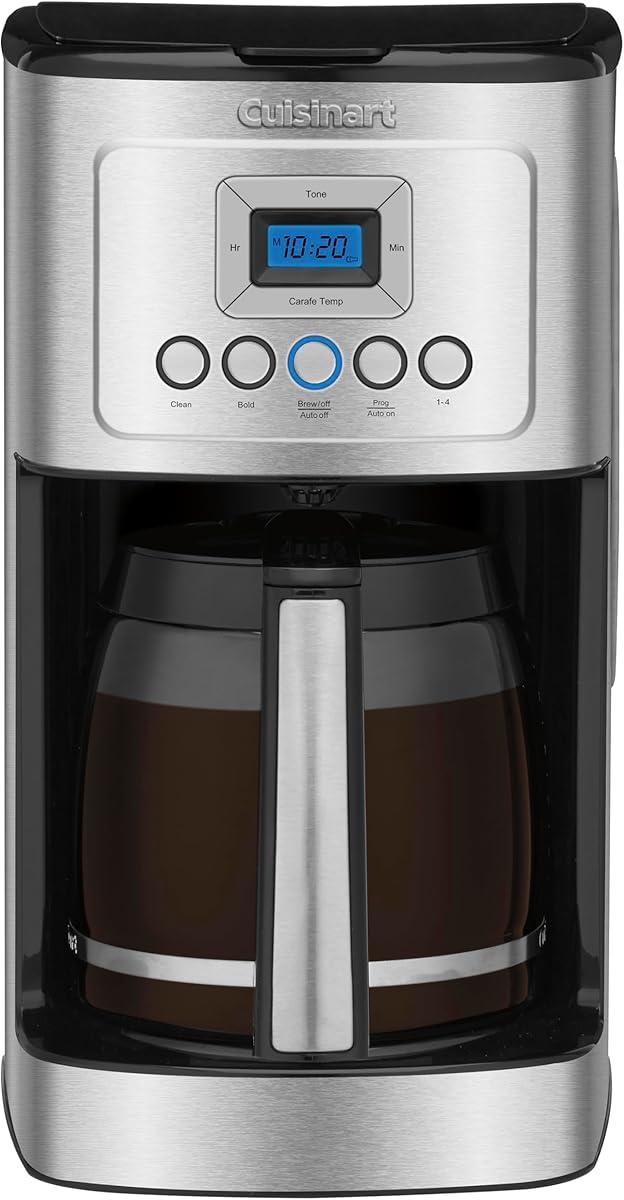
The Cuisinart DCC-3200 is a programmable traditional drip coffee maker with a 4.4 rating. It focuses on familiar full-pot operation, offering a 14-cup glass carafe, 24-hour programmability, adjustable brew strength, and three warming-plate temperature levels.
We may earn a commission when you buy through this link, at no additional cost to you.
Its controls support one-to-four-cup settings, an auto-off timer adjustable from zero to four hours, and an optional ready-alert tone. Brew Pause lets the user pour a cup before the cycle finishes, while the easy-to-view water window helps with more accurate filling. The visible glass carafe also makes it easy to judge how much coffee remains.
It does not provide the remote start, app control, voice assistance, pod recognition, or drink-profile features expected from a true WiFi brewer. Its warming plate also remains a contrasting design choice compared with a vacuum-insulated thermal carafe. However, the controls are direct and understandable, so the lack of smart features may not feel like a deficiency for users who only want a timer.
This is a sensible choice for a larger household that values capacity and straightforward scheduling more than connected features. It is also a useful lower-complexity option for anyone who does not want to manage an app or account. Buyers seeking remote access should treat the 24-hour timer as the machine's primary automation feature rather than a WiFi substitute.
The 14-cup glass carafe is useful for offices, gatherings, and households that brew for several people. Seeing the coffee level through the glass is also more convenient than checking a completely insulated carafe.
A 24-hour program, ready alert, adjustable auto-off, and one-to-four-cup settings cover the essentials. These physical controls make the machine approachable for users who prefer not to rely on a smartphone.
We may earn a commission when you buy through this link, at no additional cost to you.
The Ninja Hot & Iced XL CM371 earns a 4.6 rating and stands out for drink variety, particularly its rapid cold-brew function. It is not a connected appliance, but it offers four brew styles, eight size choices, and a 24-hour delay timer for buyers interested in iced and cold coffee more than remote app control.
We may earn a commission when you buy through this link, at no additional cost to you.
Classic, Rich, Over Ice, and Cold Brew modes cover several styles, and the cold-brew option can produce a smooth batch in as little as 10 minutes. Available sizes include small, regular, extra-large, travel, extra-large travel, quarter carafe, half carafe, and full carafe. The removable reservoir uses auto-metering to sense the water amount, reducing the need for manual measurement.
Compared with a WiFi machine, it lacks app profiles, remote start, and voice-assistant operation. The included 12-cup glass carafe, permanent filter, and Ninja Smart Scoop make it a complete ground-coffee setup, and even saturation and precise temperature control support its flavor-focused claims. Its strength lies in flexible cold preparations rather than connected routines.
This is an excellent choice for iced-coffee fans who value multiple brew styles and generous serving options. It is also well suited to buyers who want programmable delay brewing without creating a WiFi account. For remote start, scheduled app control, and personalized connected profiles, a SMART model is the more appropriate choice.
The rapid cold-brew mode can produce a smooth cold batch in as little as 10 minutes. For buyers who frequently drink cold coffee, this dedicated function is more compelling than a basic hot-only drip program.
Eight size choices span small drinks, travel mugs, and three carafe volumes. A removable auto-metering reservoir and 24-hour delay brew add convenience to a machine designed for both quick personal servings and larger batches.
We may earn a commission when you buy through this link, at no additional cost to you.
The most useful smart coffee maker is one whose connected controls, brewing method, capacity, and maintenance needs fit your household. Consider how you drink coffee, how many people you serve, and whether remote operation is valuable enough to justify a WiFi-dependent appliance.
A genuinely smart WiFi coffee maker should support remote starting, scheduling, and drink customization through a compatible app. Some models also work with Amazon Alexa or Google Home, while others limit voice control to basic start commands. Check whether the brewer needs a particular router band, security method, or account setup. The Keurig K-Supreme Plus SMART, for example, requires a home 2.4 GHz WPA2-PSK network and does not support 5 GHz or browser-based sign-in networks.
Keurig-based models deliver speed and convenience through compatible pods, while drip machines offer more control over coffee quantity, grind, and carafe volume. The GE Profile adds an integrated burr grinder and supports podless single-serve brewing as well as a full pot. Buyers who like experimenting with whole beans should favor a grinder-equipped model or a capable drip brewer, while pod users may prioritize BrewID recognition and a straightforward beverage menu.
Single-serve machines are efficient for one or two users but cannot produce a shared pot. Drip models commonly range from one cup to 10 cups, while the Cuisinart DCC-3200 offers a 14-cup glass carafe. Consider both the stated cup quantity and the real serving needs of your household. A smaller reservoir may be more convenient in a compact kitchen, whereas a 72- or 90-ounce tank reduces refills for busier homes and offices.
A thermal carafe uses vacuum insulation and can keep coffee above 178°F for up to two hours without a warming plate. It is also more portable because it does not need to remain plugged into a base. A glass carafe makes the remaining coffee level easy to see, and its warming plate can maintain coffee above 178°F for two hours on the listed models. Buyers sensitive to continuous warming may prefer thermal insulation, while those who value visibility may choose glass.
Useful customization includes brew strength, temperature, serving volume, and specialized hot-over-ice or cold-brew modes. The Café models provide several strength levels, and the GE Profile goes further with adjustable bloom time, grind time, temperature, and volume. BrewID can recommend settings for a recognized K-Cup pod. More controls can improve consistency, but the best system is the one the household will actually understand and use.
A dedicated Ice mode can brew hot concentrated coffee directly over ice, while a rapid cold-brew function uses a different preparation approach. These modes are more useful for preserving flavor than simply pouring regular coffee over ice, which can taste diluted. If iced coffee is a daily priority, compare dedicated modes carefully. Buyers interested mainly in hot coffee can place less emphasis on cold-specific features.
Smart features do not reduce the need for routine care. Water should be changed frequently, filters replaced on the manufacturer's schedule, and the brewer descaled when indicated. Some Café models include a carbon filter and descaling powder at the start, while replacement supplies may be sold separately. A frother or integrated grinder also introduces additional cleaning tasks, so buyers with limited maintenance time should favor the simplest system that meets their needs.
Remote brewing, saved profiles, notifications, and voice control can make connected machines considerably more useful. They also create a dependency on the app, network, and account continuing to work as intended. A programmable machine without WiFi may be more durable as a simple appliance because its timer and physical controls remain straightforward. Consider how important it is to start coffee while away from home before paying extra attention to connected features.
Begin by washing the removable reservoir and carafe, rinsing the permanent filter or installing the appropriate carbon filter, and filling the water tank with fresh water. Position the brewer on a level, stable counter with clearance around the carafe and controls. Connect the machine to its app, update the software if prompted, and confirm that the home network meets the manufacturer's WiFi requirements before attempting remote features.
Select the appropriate ground coffee and brew size, then choose a strength, temperature, or beverage setting. For best results, use coffee ground for the brewer's drip process rather than a setting intended for espresso. Remote or scheduled brewing should begin with a fresh reservoir and a clean carafe, and hot-over-ice settings should be used when stronger iced coffee is desired. Allow hot coffee to cool appropriately before adding milk or other dairy alternatives.
Empty used grounds and rinse the carafe after every brew, and clean the brew basket or pod chamber according to the manual. Replace the carbon filter on the recommended schedule, and descale when the machine prompts or when flow becomes noticeably slower. Users with frothers or integrated grinders should clean those areas frequently, dry removable parts thoroughly, and replace any compatible filters or descaling supplies specified by the manufacturer.
Most of the fully connected models in this guide can start or schedule brewing through their companion apps. The Café models use SmartHQ, the Keurig models use the Keurig app, and the GE Profile uses SmartHQ. App features can vary, so buyers should verify remote start, scheduling, and saved-profile support on the current product listing.
Basic physical brewing generally remains available, but remote starting, voice control, app profiles, and remote scheduling depend on network access. A stable home WiFi connection and a working app account are therefore important for getting full value from the connected features. The non-WiFi programmable alternatives keep working through their onboard timers.
A thermal carafe uses vacuum insulation and does not require a warming plate, making it easier to carry and potentially preferable for people who do not want continuous heat. A glass carafe makes the remaining coffee easier to see and is paired with a warming plate on the listed models. Both approaches can keep coffee hot for roughly two hours under their stated conditions.
Both formats can produce iced coffee, but their cold-brew methods differ. The Café Ice mode brews concentrated hot coffee directly over ice, the Ninja offers a dedicated rapid cold-brew mode, and the Keurig models include over-ice settings. A dedicated mode may deliver a more concentrated result than ordinary coffee cooled and poured over ice.
Most voice-control features require a compatible speaker or smart display, such as an Amazon Alexa or Google Home device, in addition to the coffee maker and its app. The machine must also be connected to a supported network. Buyers should check both the brewer and the voice platform's current compatibility before purchasing.
Remainder coffee and used grounds should be removed after each brew, while the carafe and brew chamber should be washed regularly. Follow the manual for filter replacement and descaling intervals, and descale when the machine's indicator requests it. Machines with milk frothers or grinders need additional cleaning because those components can retain moisture and coffee residue.
Yes, several models in this guide do. The GE Profile can brew podless single servings or a ten-cup carafe, while the Café models offer flexible brewing from one cup to ten cups. The Keurig K-Duo also supports individual cups and carafes, although it does not include WiFi connectivity.
The GE Profile Smart Grind & Brew stands out for its 90-ounce reservoir and ability to brew either a single serving or a ten-cup carafe. Among the Café options, the 90-ounce reservoir can support two full carafes before a refill. Households should also consider whether a glass or thermal carafe is easier for their serving routine.
The Café Specialty Drip Coffee Maker with the glass carafe is the strongest all-around recommendation, combining WiFi control, a dedicated Ice mode, flexible serving sizes, and the highest listed rating in the group. The Keurig K-Cafe SMART is ideal for people who prioritize fast pod brewing, BrewID recognition, and a built-in hot and cold frother, while the GE Profile Smart Grind & Brew takes the premium lead for its integrated grinder, detailed profiles, large reservoir, and podless single-serve capability.
The most important decision is to prioritize the features you will use every morning. Choose a drip brewer for carafe flexibility, a pod machine for quick individual drinks, and a grinder-equipped model for whole-bean control. App quality, voice support, router compatibility, thermal versus glass construction, and cleaning requirements can matter as much as headline connectivity, so buyers should evaluate the entire routine rather than focusing on WiFi alone.
Finally, check the current Amazon listing before ordering because package contents, app compatibility, availability, and pricing can change. The ratings and specifications summarized here are useful for narrowing the field, but current product details and household needs should determine the final choice.