
TP-Link AX1800 WiFi 6 Router (Archer AX21 V5)
4.4Editor score
Frontier-compatible Wi-Fi 6
AX1800 dual-band performance
Four high-gain antennas
OpenVPN and PPTP servers
Compare 10 Router for Frontier Internet, with key specifications, product ratings, pros and cons to help you choose.
Choosing a router for Frontier Internet requires balancing the speed of your fiber plan, the size of your home, and the number of connected devices. A capable router should distribute that connection consistently while offering modern Wi-Fi, useful Ethernet ports, reliable management features, and straightforward setup.
This guide compares ten routers using the supplied specifications, customer ratings, wireless standards, coverage claims, port configurations, security features, and provider compatibility. It covers standalone Wi-Fi 6, Wi-Fi 6E, and Wi-Fi 7 routers, plus a cable modem-router option that is not intended for Frontier fiber service.
Each review explains the product's strongest benefits, practical limitations, and ideal buyer. The top selections highlight the best balance of features and value, advanced wireless performance, and premium multi-gig connectivity. Product availability and prices can change, so confirm current specifications, Frontier compatibility, and firmware before purchasing.
4.4Editor score

4.5Editor score
4.2Editor score
The comparison below places each router's wireless generation, aggregate speed class, coverage target, and wired connectivity side by side. These distinctions help Frontier subscribers identify a model that matches their fiber plan, home layout, device count, and need for high-speed wired connections.
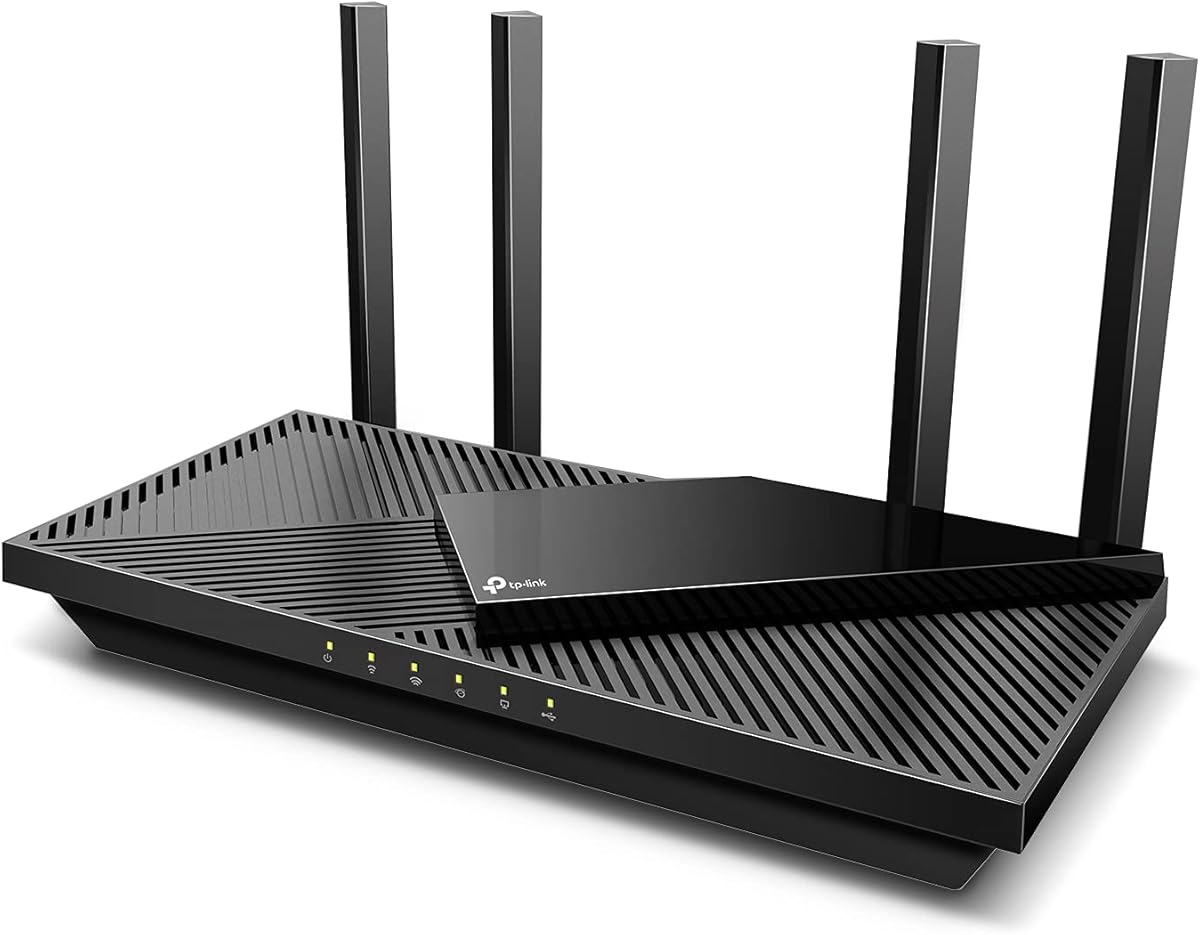


The TP-Link Archer AX21 V5 is a dual-band Wi-Fi 6 router that pairs an accessible feature set with explicit compatibility for Frontier and other major internet service providers. Its 4.4 customer rating reflects a favorable balance of performance, coverage, and value. It is designed for homes that want modern wireless performance without moving into the more complex category of premium tri-band systems.
We may earn a commission when you buy through this link, at no additional cost to you.
The router provides up to 1,200 Mbps on the 5 GHz band and up to 574 Mbps on the 2.4 GHz band, for an advertised total of 1.8 Gbps. OFDMA helps it communicate with multiple devices more efficiently, while Beamforming, four high-gain antennas, and a front-end module focus coverage toward connected clients. It also supports OpenVPN and PPTP server functions, adding useful options for accessing home-network resources remotely.
Its main limitation is that it remains a dual-band Wi-Fi 6 device and does not support the 6 GHz band. Actual wireless results will also vary with distance, walls, congestion, and the capabilities of the connected devices. Most Frontier installations still require the provider's modem or another compatible ONT and gateway arrangement, so buyers should confirm exactly what equipment is included in their service.
This is the most broadly sensible pick for a typical Frontier household. It is especially attractive for buyers who value straightforward provider compatibility, solid 2.4 and 5 GHz performance, and useful coverage features. Choose it when the goal is dependable everyday Wi-Fi rather than a dedicated 6 GHz or 10G upgrade.
Frontier is explicitly included in the list of supported internet service providers, which removes much of the uncertainty involved in pairing a third-party router with a fiber plan. A separate modem remains necessary for most providers, and Frontier customers should confirm the correct connection and addressing method before installation.
Four high-gain antennas, Beamforming, and OFDMA make the AX21 V5 well suited to homes filled with phones, televisions, computers, and connected appliances. The 2.4 GHz band remains useful for range, while the 5 GHz band handles faster local traffic.
We may earn a commission when you buy through this link, at no additional cost to you.
The TP-Link AX3000 is a dual-band Wi-Fi 6 router for homes that want more aggregate wireless capacity than an entry-level AX1800 model. It carries a 4.4 rating and advertises up to 2,402 Mbps on 5 GHz and 574 Mbps on 2.4 GHz. Frontier is among the providers listed as compatible, making it a relevant option for fiber subscribers replacing router-only equipment.
We may earn a commission when you buy through this link, at no additional cost to you.
OFDMA is central to its multi-device approach, allowing several clients to share a band more efficiently while reducing latency and jitter. Four high-gain external antennas and Beamforming help extend coverage, while Target Wake Time can improve device communication efficiency and battery life. The redesigned case and larger heat sink are intended to reduce heat-related throttling in demanding environments.
The router supports both VPN server and VPN client functionality, and its free HomeShield features include network security scanning, IoT device identification, basic parental controls, quality of service, and routine reports. Like the Archer AX21 V5, it lacks a 6 GHz band and requires a separate modem for most providers, limiting its appeal for buyers seeking the newest spectrum or integrated provider equipment.
This model is a good choice for Frontier subscribers who want a step up from AX1800 performance but do not need tri-band Wi-Fi 6E or Wi-Fi 7. It should suit busy homes using streaming, gaming, video calls, and work devices simultaneously, provided they install it in a central location and maintain current firmware.
The AX3000 class gives the 5 GHz band substantially more theoretical throughput than an AX1800 router. That extra headroom is useful when several nearby high-speed devices are active, although real results remain limited by the Frontier plan and client hardware.
The Tether ecosystem, HomeShield tools, improved cooling, and Target Wake Time make this more than a basic wireless box. These features support easier maintenance, network organization, and efficient communication with compatible battery-powered devices.
We may earn a commission when you buy through this link, at no additional cost to you.
The TP-Link Archer AXE75 is a tri-band Wi-Fi 6E router that adds a dedicated 6 GHz band to the 2.4 and 5 GHz bands. Its 4.3 rating and PCMag Editors' Choice designation make it an attractive all-around recommendation for Frontier subscribers who want more modern spectrum than a standard dual-band Wi-Fi 6 router. It can deliver up to 5,400 Mbps of combined wireless throughput.
We may earn a commission when you buy through this link, at no additional cost to you.
The 6 GHz band offers additional bandwidth and low latency for compatible devices, while OFDMA and true tri-band operation increase capacity when several clients are active. A 1.0 GHz dual-core processor, 512 MB of memory, and a housing designed for heat dissipation support sustained performance. The router can also join an EasyMesh system to extend coverage through compatible routers, extenders, or wireless powerline adapters.
Its main qualification is that the 6 GHz advantage requires compatible client devices. Older phones, laptops, televisions, and household electronics generally continue using 2.4 or 5 GHz. The AXE75 is also no longer the newest wireless generation in this guide, since several Wi-Fi 7 alternatives appear later, but it can remain a balanced choice for Frontier users who value 6 GHz without requiring Wi-Fi 7.
This router is best for a modern household with several Wi-Fi 6E-compatible devices and a need to reduce congestion on the traditional bands. It is also a sensible option for people who may later add EasyMesh equipment. Buyers with only older Wi-Fi 5 or Wi-Fi 6 clients will generally see less benefit from the 6 GHz radio.
The 6 GHz band provides additional channels that can reduce congestion and support responsive performance for compatible modern devices. Its practical value is greatest in homes where newer phones and computers make regular use of the band.
EasyMesh compatibility provides a path to reduce dead zones in larger homes. It allows the Archer AXE75 to work with compatible extension hardware rather than forcing the household into a single-brand mesh system.
We may earn a commission when you buy through this link, at no additional cost to you.
The NETGEAR Nighthawk CAX30 combines a DOCSIS 3.1 cable modem and AX2700 Wi-Fi 6 router in one enclosure. It is a strong all-in-one option for homes served by compatible cable internet. However, it is explicitly not compatible with Frontier, Verizon, AT&T, CenturyLink, DirecTV, DISH, or bundled voice plans, so it should not be considered for a Frontier fiber installation.
We may earn a commission when you buy through this link, at no additional cost to you.
For supported cable providers, the CAX30 can deliver Gigabit-plus download performance on eligible plans. Its dual-band Wi-Fi 6 system covers up to 2,000 square feet and is rated for more than 25 connected devices. Four Gigabit Ethernet ports give desktop computers, game consoles, and streaming devices stable wired connections, while the Nighthawk app supports guided setup, speed tests, device pausing, and guest networks.
The modem's provider restrictions are the decisive drawback for this guide's audience. It is also dependent on the serving cable network, which means its DOCSIS 3.1 potential has no direct bearing on a Frontier fiber plan. NETGEAR Armor is available as a 30-day trial, but continued use requires a separate subscription.
This model is worth considering only by Frontier-adjacent households that actually have compatible cable service. For readers using Frontier fiber, choose a standalone Wi-Fi router instead. Its strengths become relevant when someone wants to consolidate a compatible cable modem and router and can take advantage of DOCSIS 3.1 speeds.
The CAX30 is built around DOCSIS 3.1 cable standards rather than fiber Ethernet. Its compatibility list names major cable providers but expressly excludes Frontier, making the service type more important than its otherwise competitive specification sheet.
The free Nighthawk app helps with setup, wireless management, speed testing, pausing devices, and creating a guest network. These conveniences help simplify ongoing management, although the app requires an active internet connection for certain functions.
We may earn a commission when you buy through this link, at no additional cost to you.
The TP-Link Archer BE230 combines Wi-Fi 7 with a practical set of multi-gig wired connections. Its 4.2 rating reflects a modern platform that can deliver up to 2,882 Mbps on 5 GHz and 688 Mbps on 2.4 GHz. It is a compelling choice for Frontier subscribers who want faster wired connections without moving to a large tri-band premium router.
We may earn a commission when you buy through this link, at no additional cost to you.
Multi-Link Operation, Multi-RUs, and 4K-QAM are among the Wi-Fi 7 technologies highlighted for improving speed, reliability, and data capacity. The router includes one 2.5 Gbps WAN/LAN port, one 2.5 Gbps LAN port, and three 1 Gbps LAN ports. Beamforming and four internal antennas support a claimed coverage area of up to 2,000 square feet and as many as 60 devices at a time.
EasyMesh compatibility allows the Archer BE230 to become part of a broader mesh network, while Tether provides setup and firmware management. The lack of a 6 GHz band is the principal distinction from tri-band alternatives. Buyers should also recognize that real performance depends on distance, walls, network conditions, and whether clients support Wi-Fi 7 features.
This router fits well for a medium-size home with fast wired devices, a growing collection of modern electronics, and no need for a dedicated 6 GHz network. It is especially useful when one multi-gig port can connect to a Frontier gateway and another can serve a high-speed device directly.
The pair of 2.5 Gbps ports creates a practical path to exceed one-gigabit local and internet connections. One port can serve as the WAN connection while the other supports a compatible computer, NAS, or other demanding wired device.
Wi-Fi 7 features give newer devices access to improved efficiency and reliability, while four internal antennas keep the design visually restrained. The result is a modern option for households that value capability without a large tri-band enclosure.
We may earn a commission when you buy through this link, at no additional cost to you.
The NETGEAR Nighthawk RAX36 is a router-only Wi-Fi 6 model designed to work with an existing modem or gateway. It supports internet services up to 1 Gbps across cable, fiber, satellite, and DSL connections, making it broadly relevant to Frontier subscribers. Its 4.4 rating is among the strongest in the group.
We may earn a commission when you buy through this link, at no additional cost to you.
The RAX36 offers AX3000-class performance, with advertised speeds up to 3 Gbps, and is rated for coverage up to 2,000 square feet and 25 connected devices. Four one-gigabit Ethernet ports provide reliable connections for computers, game consoles, and streaming players. Built-in VPN, USB 3.0, and gaming-focused positioning broaden its appeal beyond basic wireless coverage.
The principal limitation is wired speed: all four LAN ports are one-gigabit rather than 2.5 or 10 Gbps. A separate cable modem is required for cable service, and Frontier fiber users will need the appropriate provider equipment or gateway. The stated one-gigabit service ceiling also makes it better suited to plans at or below that tier than to future multi-gig services.
Choose the RAX36 when a straightforward, provider-flexible router with no built-in modem is the priority. It is a good fit for homes that need strong Wi-Fi 6 performance, several wired endpoints, and a familiar gaming-oriented Nighthawk feature set without moving to higher-speed Ethernet.
Because it accepts an existing internet connection through its gateway port, the RAX36 is not limited to one delivery method. That makes it suitable for Frontier fiber, cable, DSL, or satellite arrangements when the upstream equipment supports the required connection.
Four one-gigabit LAN ports are sufficient for many conventional households, including computers, consoles, and televisions. Buyers planning multi-gig service, a fast NAS, or other high-bandwidth wired systems should favor a router with 2.5G or 10G ports.
We may earn a commission when you buy through this link, at no additional cost to you.
The GL.iNet GL-MT6000 Flint 2 is an eight-stream Wi-Fi 6 router built around speed, flexible connectivity, and hands-on network control. It has the highest customer rating in the group at 4.5. For a Frontier fiber subscriber, it is a distinctive alternative to the simpler TP-Link and NETGEAR models because it combines advanced wireless hardware with two 2.5 Gbps ports.
We may earn a commission when you buy through this link, at no additional cost to you.
The router advertises Wi-Fi 6 speeds up to 6 Gbps and is equipped with 1 GB of DDR4 memory and 8 GB of eMMC storage. Its OpenVPN and WireGuard rates are listed at up to 880 Mbps and 900 Mbps respectively, although actual VPN performance depends on the internet service, network environment, server location, and VPN provider. It also supports AdGuard Home for DNS-based ad and tracker filtering.
The DIY orientation introduces a modest learning curve. The manufacturer specifically instructs users to update the firmware during initial setup because that update improves performance and the overall experience. Setup can be completed by following the available tutorial or by connecting the MT6000 to a computer with Ethernet and accessing the web administration panel.
The Flint 2 is best for technically confident users who want high multi-gig wired speed, strong VPN support, and deeper control over local network services. It is a compelling choice for Frontier customers with a fast fiber plan who want more than a basic router and who are comfortable updating firmware and adjusting web-based settings.
Two 2.5 Gbps ports give the Flint 2 meaningful wired headroom, while the advertised VPN throughput makes it appealing for remote access and privacy-conscious users. Network conditions and remote server quality remain the practical limits.
AdGuard Home support, substantial memory, and eMMC storage make the router appealing to users who install additional features or manage many connected devices. These capabilities reward users who are comfortable with a more hands-on configuration process.
We may earn a commission when you buy through this link, at no additional cost to you.
The TP-Link Archer BE600 is a premium tri-band Wi-Fi 7 router built around very high wireless capacity and multi-gig wired connectivity. It has a 4.2 rating and offers a clear upgrade path for Frontier customers with fast fiber service, modern devices, and a home large enough to benefit from stronger coverage. Its combination of a 10 Gbps port and three 2.5 Gbps LAN ports is especially notable.
We may earn a commission when you buy through this link, at no additional cost to you.
The router can deliver up to 5,765 Mbps on 6 GHz, 2,882 Mbps on 5 GHz, and 1,032 Mbps on 2.4 GHz, producing 9,679 Mbps of aggregate advertised throughput. Seven streams, six positioned antennas, and Beamforming support coverage across as much as 2,600 square feet and up to 120 connected devices. Wi-Fi 7 features such as Multi-Link Operation, Multi-RUs, 4K-QAM, and support for channels up to 320 MHz improve the platform's potential for compatible clients.
The main drawback is the diminishing return for households with older devices. Legacy Wi-Fi 5 and Wi-Fi 6 equipment cannot use Wi-Fi 7 features and may perform much as it would on an earlier router. The larger feature set and advanced hardware also place it in a higher tier than most households need, while some users will need to confirm that Frontier's gateway or ONT supports the intended connection speed.
This is the premium recommendation for people who want a long-lived, high-capacity network, own several Wi-Fi 7 clients, or need multiple fast wired connections. It is also well suited to larger homes and can work with EasyMesh-compatible equipment for further expansion.
A 10 Gbps WAN/LAN port can connect to a compatible multi-gig modem or gateway, while the 2.5 Gbps ports support modern wired networks without forcing every device onto one-gigabit hardware. This arrangement suits advanced fiber and home-lab users.
The 6 GHz band and Wi-Fi 7 processing offer meaningful benefits for compatible phones, laptops, televisions, and game systems. Mesh support lets households extend a premium system into larger floor plans without relying on a single oversized router.
We may earn a commission when you buy through this link, at no additional cost to you.
The NETGEAR Nighthawk RS700S is a dedicated tri-band Wi-Fi 7 router designed for demanding homes and high-capacity fiber connections. Its 4.4 rating, 19 Gbps aggregate wireless class, 10 Gbps WAN port, and claimed coverage for up to 3,500 square feet place it among the most capable standalone options in this guide.
We may earn a commission when you buy through this link, at no additional cost to you.
A 12-stream design supports coverage for as many as 200 devices, using MU-MIMO and OFDMA to serve clients concurrently. The router pairs with an existing modem or gateway over Ethernet and works with most cable, fiber, DSL, and satellite providers. Some gateways or modem-router combinations require bridge mode, making it important to confirm the Frontier equipment and connection method before installation.
The Nighthawk app provides guided setup, remote network management, speed tests, device pausing, and guest-network controls. For wired equipment, the 10 Gbps WAN port can unlock premium fiber plans, while one 10 Gbps LAN port and four one-gigabit LAN ports serve workstations, NAS drives, and smart televisions. Walls, floors, interference, and building materials can reduce the stated coverage.
This router is best for a large, busy household with fast fiber service, many connected devices, and several high-bandwidth systems. It may also serve as a central component in a larger NETGEAR Orbi installation. For apartments or modest homes, the specification may be more than necessary.
The 10 Gbps WAN and LAN ports give the RS700S an unusually strong foundation for fiber service, local file transfers, and advanced home networks. Its high device target makes it a better match for busy homes than small apartments.
The stated 3,500-square-foot coverage is a maximum-style target rather than a guarantee because walls, floors, and interference matter. Very large or multi-story homes may still benefit from a dedicated mesh system such as NETGEAR Orbi.
We may earn a commission when you buy through this link, at no additional cost to you.
The ASUS RT-AX1800S is a dual-band Wi-Fi 6 router that combines a strong wired port count with subscription-free network security and AiMesh expansion. Its 4.3 rating makes it a solid alternative for Frontier subscribers who want ASUS-specific management features, parental controls, and a flexible path to whole-home coverage.
We may earn a commission when you buy through this link, at no additional cost to you.
The router supports 1024-QAM, MU-MIMO, and OFDMA to improve throughput and manage multiple devices efficiently. One Gigabit WAN port and four Gigabit LAN ports provide more usable wired connections than many competing AX1800 models. ASUS Instant Guard gives remote users a one-click secure VPN connection, while AiProtection Classic delivers network and IoT protections without requiring a subscription.
It remains a dual-band router without a 6 GHz band, and all wired ports are limited to one gigabit. Those constraints make it less attractive for buyers planning multi-gig service, a high-speed NAS, or a large collection of Wi-Fi 6E and Wi-Fi 7 devices. Actual throughput and range still depend on the client devices, network load, construction materials, and other environmental factors.
The RT-AX1800S is best for a household seeking dependable Wi-Fi 6, abundant one-gigabit LAN connections, and security features without another recurring fee. AiMesh support makes it particularly attractive for buyers who expect to expand coverage in the future or want to connect compatible ASUS mesh equipment.
AiProtection Classic and ASUS Instant Guard cover core network protection and secure remote access. This makes the router appealing to households that want useful built-in tools without adding a separate paid security service.
Four Gigabit LAN ports and one Gigabit WAN port provide generous connectivity for desktops, consoles, smart televisions, and other conventional wired devices. The lack of multi-gig Ethernet, however, limits future high-speed expansion.
We may earn a commission when you buy through this link, at no additional cost to you.
The best router for Frontier Internet depends on the speed tier, internet delivery method, home dimensions, connected devices, and preference for management software. Reviewing these factors before shopping prevents buyers from paying for unnecessary radio bands or running a router beyond its intended capacity.
Most Frontier fiber customers need a router that accepts an Ethernet connection from the provider's modem, ONT, or gateway. The TP-Link Archer AX21 V5, TP-Link AX3000, Archer AXE75, and several other standalone models are appropriate choices in that arrangement, although the correct Frontier equipment and addressing method should be confirmed before installation.
The NETGEAR CAX30 is the major exception in this list because it is a DOCSIS 3.1 cable modem-router combo. It expressly does not support Frontier, so it belongs only with compatible cable providers. Never assume that because a router supports fiber in general, it supports every provider's particular equipment.
Wireless standards matter only when the connected devices can use them. A Wi-Fi 7 router cannot upgrade an older Wi-Fi 5 laptop, while a Wi-Fi 6E router needs compatible clients to benefit from its 6 GHz band. For older devices, a well-placed dual-band Wi-Fi 6 router may provide the most practical experience.
Choose based on the number and capability of modern clients rather than the largest advertised aggregate speed. The Flint 2's eight-stream design, the AXE75's 6 GHz band, and the Archer BE600's Wi-Fi 7 features are meaningful for appropriate devices, but they do not accelerate unsupported hardware.
Router specifications often list maximum square-foot coverage, but walls, floors, wiring, furniture, and neighboring networks determine actual results. A centrally placed dual-band model may cover an average home effectively, while a large or multi-story property may need several mesh nodes or a more capable tri-band system.
The Nighthawk RS700S targets up to 3,500 square feet, while the Archer BE600 reaches a stated 2,600 square feet. Those are useful planning references, not guarantees. For a difficult layout, EasyMesh-compatible models such as the AXE75 and BE230, AiMesh support on the ASUS RT-AX1800S, or a larger multi-node system may be the more reliable answer.
Phones, televisions, speakers, cameras, consoles, laptops, and smart appliances all share limited radio time. OFDMA and MU-MIMO improve efficiency, while additional streams and bands can increase capacity. The BE600 is rated for up to 120 devices, the RS700S for 200, the BE230 for 60, and the RAX36 and CAX30 for more than 25.
The device count is only a guideline because traffic varies dramatically. A few active video calls and 4K streams create a different load than dozens of mostly idle sensors. Consider simultaneous usage, device capabilities, and wired placement rather than relying on a device rating alone.
A fast Frontier plan is only useful if the local network can move data beyond a basic one-gigabit connection. The Flint 2 has two 2.5 Gbps ports, the BE230 has one 2.5 Gbps WAN/LAN port and one 2.5 Gbps LAN port, and the BE600 offers a 10 Gbps port plus three 2.5 Gbps ports. These are better matches for multi-gig service and high-speed local storage.
The ASUS RT-AX1800S and NETGEAR RAX36 provide multiple one-gigabit LAN ports, which remain suitable for many conventional homes. If a NAS, workstation, or gaming system regularly transfers large files, verify that both the router port and the connected device support the intended speed.
Router software determines how easily users update settings, create guest networks, pause devices, apply parental controls, and monitor security. TP-Link models emphasize Tether and HomeShield, NETGEAR uses the Nighthawk app, ASUS provides AiProtection Classic and Instant Guard, and GL.iNet appeals to users who want deeper web-based control.
Look for accessible firmware updates, clear parental controls, and a manageable mobile interface. Advanced VPN, DNS-filtering, and customization options can be useful, but they also create a steeper learning curve. Select features that you will actually use rather than assuming more options always produce a better network.
A router may work well today but become constrained after a fiber upgrade, a move to a larger home, or the addition of high-speed wired equipment. EasyMesh support on the AXE75 and BE230, AiMesh support on the ASUS RT-AX1800S, and multi-gig ports on premium models create more opportunities to expand without replacing the entire network immediately.
Before buying, check which expansion standards and accessories are supported. Expansion products do not automatically create a seamless network unless they are designed for that purpose. Confirm compatibility, placement needs, and whether the existing router will serve as the primary mesh node.
Advertised router speeds are laboratory-style maximum classifications, not guaranteed household results. Frontier plan speed, modem or gateway capabilities, Wi-Fi client specifications, distance, interference, and building materials all influence the outcome. Wired connections often remain more predictable for large transfers and latency-sensitive applications.
Place the router centrally, keep firmware current, and avoid placing it inside enclosed cabinets. Connect high-demand devices by Ethernet when practical. If performance still disappoints, test with one device at a time, verify the correct network mode, and check whether the provider equipment is limiting the connection.
Begin by confirming how the Frontier service reaches the home. Connect the provider's approved modem, ONT, or gateway to the internet, then connect the new router to that equipment using the appropriate Ethernet port. Follow the manufacturer's setup process, create a strong administrative password, update the firmware, and change the default Wi-Fi names and passwords before moving all devices online.
Choose a central location with open space and keep the router elevated from the floor. Avoid enclosing it with books, placing it beside a microwave, or surrounding it with dense materials. If the home has multiple floors or difficult dead zones, add compatible mesh equipment and position each node where it can communicate strongly with neighboring nodes rather than merely near a weak area.
Review client and guest passwords, parental controls, firmware updates, and connected-device lists periodically. For a Frontier fiber installation, keep the provider gateway available if the service requires it or if a separate router is operating in bridge mode. Treat the router as a maintained network device: update its software, back up important settings before a major change, and replace it when its ports or wireless capabilities no longer match the home's service tier.
Most standalone Wi-Fi routers in this guide require an existing Frontier-compatible modem, ONT, or gateway to create the internet connection. Frontier can provide the necessary equipment or activation, depending on the service and customer arrangement. The main exception is the NETGEAR CAX30, but that device is a DOCSIS 3.1 cable modem-router and is expressly not compatible with Frontier fiber.
Not necessarily. A properly positioned Wi-Fi 6 or Wi-Fi 6E router can provide a strong experience on many Frontier plans, especially when clients and wired equipment do not support Wi-Fi 7. Wi-Fi 7 is most valuable for households with several compatible modern devices, very fast multi-gig service, or a need for newer high-speed wired ports.
The router must support the speed of the Frontier plan, but the fastest wireless standard cannot exceed the internet connection or the capabilities of connected devices. Placement, interference, construction materials, and Ethernet speed also matter. For large transfers, wired connections through suitable multi-gig ports can provide more predictable performance than wireless.
A mesh system may be a better choice when the home has multiple floors, thick walls, long hallways, or areas consistently outside the main router's reach. Several picks support expansion through EasyMesh or AiMesh. A single high-performance router is often sufficient for a smaller, open floor plan, but advertised coverage figures should not be treated as guarantees.
They are useful when the Frontier plan or local devices support speeds above one gigabit. A NAS, modern workstation, high-end gaming system, or frequent large file transfers can benefit from 2.5G or 10G connections. For typical browsing, streaming, and several standard one-gigabit devices, four one-gigabit LAN ports may be sufficient.
Many standalone routers accept a standard Ethernet connection and therefore work with Frontier equipment, but the provider's gateway may need to be placed in bridge mode or may continue handling routing. The setup process varies by gateway and service configuration. Confirm the required mode and obtain ISP activation or installation help where necessary.
Start by moving the router to a central, elevated, open location and comparing speed results near the router and in the weak area. Update the firmware, select a less congested channel where possible, and reduce physical obstructions. If dead zones persist, add a compatible mesh node or access point rather than expecting a single unit to pass through every wall effectively.
It depends on the equipment and activation method. Some installations use the gateway to convert the fiber signal or establish the WAN connection, in which case it remains necessary even if the third-party router handles Wi-Fi. Other arrangements allow bridge mode. Confirm the correct configuration with Frontier before disconnecting or changing the provider equipment.
The TP-Link Archer AX21 V5 stands out as the most balanced general recommendation because it explicitly supports Frontier, uses current-enough Wi-Fi 6 hardware, and includes coverage and VPN features without moving into a premium tier. The GL.iNet Flint 2 is the performance-oriented choice for users who want dual 2.5G ports and advanced VPN features, while the TP-Link Archer BE600 is the premium selection for tri-band Wi-Fi 7 and extensive multi-gig connectivity.
Prioritize the connection type, client devices, home layout, and Ethernet needs before choosing a radio standard. A simple dual-band Wi-Fi 6 router can be enough for many homes, while Wi-Fi 6E or Wi-Fi 7 becomes more useful as compatible devices and multi-gig service expand. Large or difficult homes may need mesh support regardless of the individual router's maximum coverage rating.
Finally, check current prices, availability, firmware, and Frontier connection requirements before purchasing. Router specifications and promotional pricing can change over time, so current manufacturer documentation and provider guidance should guide the final decision. The links in this guide point to the listed product pages for additional details.