
10 in 1 Water Quality Tester
3.8Editor score
Ten-in-one water testing
Resistivity up to 20 MΩ
Automatic temperature compensation
Backlit portable display
Resistivity meters for DI water vary widely; this expert guide compares accuracy, ranges, probes, data logging, and usability for home and professional testing.
Resistivity meters for DI water help users verify that deionized water remains free from dissolved ionic contaminants. A useful meter should provide a stable reading, appropriate conductivity range, reliable temperature compensation, and clear traceability. The right choice depends on whether you need occasional household checks or laboratory-grade monitoring.
We compared the listed meters by examining their supported measurements, resistivity capabilities, calibration features, probe bundles, data handling, portability, and intended applications. The list includes general-purpose water testers, professional multiparameter meters, conductivity-focused instruments, and two products whose core functions fall outside direct DI-water resistivity testing.
Each review explains what the product is best positioned to measure, highlights meaningful strengths and limitations, and identifies the type of user most likely to benefit. Product ratings and availability can change, and prices fluctuate, so readers should confirm current specifications and current offers before purchasing.
For buyers seeking dependable DI-water analysis, prioritize true resistivity measurement, a suitable conductivity range, automatic temperature compensation, and calibration support. A low-cost multiparameter can be convenient for home users, while laboratories, water-treatment professionals, and serious hobbyists may need traceable data, interchangeable electrodes, and greater measurement confidence.
3.8Editor score

4.6Editor score

4.9Editor score
The table below compares all ten listed products by their core function, supported water measurements, portability, and data-handling capabilities. It also distinguishes dedicated resistivity-capable instruments from water activity and flow meters that are not designed for direct DI-water purity analysis.

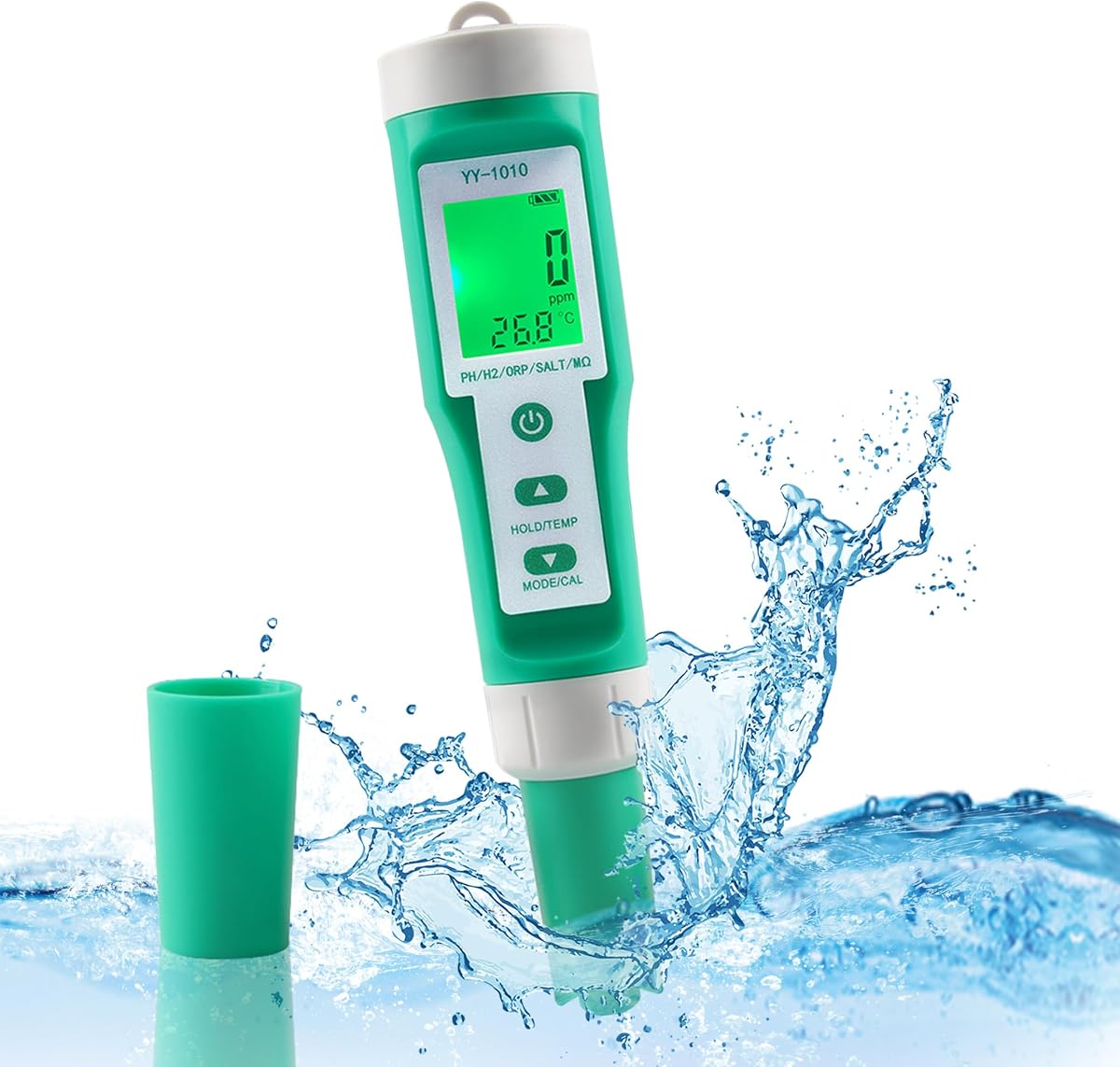


This 10 in 1 tester combines pH, TDS, EC, salinity, specific gravity, ORP, dissolved hydrogen, resistivity, fertility, and temperature in one compact instrument. Its 3.8 rating reflects a mixed user experience, but the feature set makes it a practical budget-oriented option for checking DI-water purity alongside several common water-quality parameters. The resistivity range extends from 5 Ω to 20 MΩ, which covers the high-resistance end commonly associated with very pure water.
We may earn a commission when you buy through this link, at no additional cost to you.
Automatic temperature compensation from 0 to 60°C is particularly useful because conductivity and calculated resistivity change with temperature. The green backlit display should remain readable in dim workspaces, and one-key mode switching helps limit menu navigation. A hold function lets users preserve a stable value, while the included calibration powder packs support routine maintenance. The device is only 1.65 by 1.65 by 7.44 inches and weighs 0.24 lb, making it easy to move between a bench, aquarium, hydroponic area, or treatment system.
The main trade-off is that a single inexpensive meter cannot provide the same confidence as a specialized laboratory instrument or a professional model with independently recognized probes and detailed data management. The 3.8 rating suggests some buyers may have encountered issues, although the supplied information does not identify specific defects. Batteries are also not included, and multiple functions increase the number of electrodes and modes that may require familiarization and occasional calibration. This is therefore a screening tool for ordinary users rather than a replacement for validated laboratory equipment.
This model makes the most sense for home users, hobbyists, and maintenance workers who want one compact device for frequent spot checks. It is particularly attractive when the goal is to confirm that a DI-water source, aquarium, pool, or hydroponic solution remains broadly acceptable. For regulated testing or critical contamination investigations, a professional meter with stronger data controls would be the better choice.
The 20 MΩ upper resistivity limit gives the meter useful reach for relatively pure water, while the other nine measurements expand its value across common household and maintenance tasks. This broad coverage makes it more versatile than a conductivity-only tester without requiring a separate device for every basic water check.
Automatic temperature compensation, a backlit screen, reading hold, auto sleep, and a compact body simplify repeated spot checks. The meter is best suited to users who can interpret readings in context and maintain the included electrode through regular cleaning and calibration.
We may earn a commission when you buy through this link, at no additional cost to you.
The Apera Instruments PCO60-Z is a smart multiparameter meter designed for pH, conductivity, TDS, salinity, resistivity, and ORP or redox measurements. Its 4.6 rating places it among the stronger products in this list, and its defining advantage is the combination of professional-style sensing with app-based control and cloud data logging. It can connect to a smartphone, tablet, or MacBook through Bluetooth within a stated 30-foot range.
We may earn a commission when you buy through this link, at no additional cost to you.
The kit uses a double-junction pH and conductivity combo sensor along with a separate ORP sensor. That sensor arrangement supports the broader water-quality workflow, while the ZenTest mobile app provides real-time control, calibration functions, and advanced data management. Cloud-based records can be stored, managed, and shared, making the meter more useful for repeated monitoring, trend analysis, and collaborative laboratory or field work than a display-only instrument.
Its hybrid design is important. The meter can operate as a conventional standalone tester when a phone, tablet, or computer is unavailable, so connectivity is an enhancement rather than a requirement. The trade-off is that software, wireless pairing, and cloud workflows introduce more setup than a simple handheld meter. A user who only needs an occasional reading may find the connected features unnecessary, and buyers should ensure their preferred devices and account setup are compatible before committing.
Choose the PCO60-Z when repeat measurements, remote operation, and organized records are important. It is a strong fit for water-treatment professionals, technical hobbyists, educators, and small laboratories that want more flexibility from a resistivity-capable meter. Those seeking the simplest possible reading experience should consider a non-connected model, while those needing the highest degree of professional ruggedness may prefer one of the premium portable systems in this guide.
Bluetooth control allows a user to view and manage live measurements away from the handheld display, which is useful when the probe is submerged in a vessel or connected to a fixed sampling point. This can improve convenience and reduce unnecessary handling around the sample.
Cloud-based logging and sharing turn isolated readings into a more useful monitoring history. Trending repeated DI-water checks can reveal gradual changes in ionic content that might be overlooked when each result is viewed only once.
We may earn a commission when you buy through this link, at no additional cost to you.
The Myron L Ultrameter II 6PIIFCE is a high-end handheld meter that combines pH, ORP, conductivity, TDS, resistivity, FCE, and temperature. Its 4.9 rating is the highest among the listed products, reflecting a favorable user reception for a model aimed at demanding water-treatment, industrial, laboratory, and field applications. It is the strongest premium recommendation in this guide for buyers who want broad capability in a single instrument.
We may earn a commission when you buy through this link, at no additional cost to you.
Advanced four-electrode conductivity technology is a key feature for users who depend on conductivity-derived measurements across changing ranges. Automatic temperature compensation, automatic range selection, and intuitive one-handed controls reduce setup and make repeated measurements efficient. User-adjustable temperature compensation and conductivity-to-TDS conversion settings offer additional control, which can be valuable when comparing samples under different conditions or using an application-specific conversion factor.
The device also protects practical uptime through auto shutoff, with the supplied information stating more than 100 hours or 5,000 tests. Nonvolatile memory retains calibration settings during battery replacement, avoiding the need to reconstruct the instrument's configuration. Its drawbacks are mainly financial and operational: this is a premium professional tool, and its extensive functions may take more time to learn than a simple four-function tester. The product information does not mention wireless connectivity or cloud storage, so users who require those features should consider the PCO60-Z instead.
The Ultrameter II is best suited to water-treatment professionals, serious aquarists, laboratory personnel, and users who regularly move between bench and field measurements. It is also a logical choice when conductivity range, retained calibration, and efficient one-handed operation matter more than mobile data transfer. For occasional home checking, a simpler meter may be more practical, but for comprehensive professional use, this is the leading choice in the roundup.
Four-electrode conductivity technology is a meaningful differentiator for a premium instrument. Combined with automatic range selection, it supports a broad range of water samples without requiring users to manually configure the meter for every measurement.
Nonvolatile memory preserves calibration settings during battery replacement. That convenience reduces downtime and helps maintain a consistent operating setup across field visits and maintenance days.
We may earn a commission when you buy through this link, at no additional cost to you.
The Myron L 6PIIFCE is a professional multiparameter meter dedicated to conductivity, resistivity, TDS, pH, ORP or free chlorine, and temperature. Its 4.4 rating indicates a favorable reception, and its feature set aligns closely with the needs of water-treatment professionals. For users whose main concern is resistivity alongside familiar treatment parameters, it is a direct and technically focused option.
We may earn a commission when you buy through this link, at no additional cost to you.
Automatic ranging reduces the need to select a measurement range manually, while adjustable temperature compensation and adjustable conductivity-to-TDS ratio support work with samples at different temperatures or application-specific conversion requirements. The built-in LSI and hardness calculator adds interpretation support beyond raw sensor output, which can help users assess scaling and hardness trends. A date and time stamp also makes this model more suitable for records that need to be associated with a specific sampling event.
Compared with the Ultrameter II listed earlier, this product's supplied information is less extensive. It does not mention four-electrode conductivity, one-handed operation, automatic shutoff duration, or nonvolatile memory in the provided data. Those omissions do not prove the meter lacks them, but they should not be assumed. The principal trade-off is therefore the need to compare closely related models and verify current specifications, rather than a clearly stated disadvantage in performance.
This meter is a good recommendation for water-treatment technicians, facility managers, and experienced users who value automatic ranging, hardness calculations, and timestamped results. It is less attractive for a first-time buyer who only needs to check DI water occasionally. Confirm the included probe configuration and required accessories before ordering, especially when the meter must cover a broad range of water-treatment duties.
The LSI and hardness calculator turns conductivity-related information into a more useful operational picture. It can support treatment decisions where hardness and scaling tendency matter, although operators should understand the assumptions behind such calculations.
Date and time stamping helps distinguish readings collected during scheduled checks, maintenance, or troubleshooting. This is particularly useful when comparing results over a longer water-treatment cycle.
We may earn a commission when you buy through this link, at no additional cost to you.
This 10 in 1 digital water tester measures pH, hydrogen, fertility, resistivity, ORP, TDS, EC, specific gravity, salinity, and temperature. Its 3.4 rating is the lowest among the listed products, so buyers should approach it as a feature-rich general-purpose option rather than a professional reference instrument. Its most distinctive pairing is dissolved hydrogen and resistivity, which makes it relevant to users evaluating hydrogen-rich water alongside broader purity indicators.
We may earn a commission when you buy through this link, at no additional cost to you.
The hydrogen range is stated as 0 to 2400 ppb or 0.001 to 2.400 ppm, and the meter can switch between the two units. Resistivity covers 50 Ω to 20 MΩ, giving it a useful high-purity range for DI-water spot checks. The product also offers data retention, a low-battery indicator, a green backlit screen, and a HOLD or TEMP control that locks a stable value for easier recording. A high-sensitivity probe and upgraded polymer-reference electrode are included in the feature description.
The main caution is the meter’s broad feature set combined with its relatively low rating. A single probe and software interface must support many measurement modes, and the supplied data does not discuss probe-specific calibration procedures, data export, or formal accuracy guarantees. The listing also makes broad health-oriented statements about hydrogen-rich water that should not be treated as medical evidence. The instrument can show a concentration, but it should not replace professional advice or independent verification.
This product is best for hydrogen-water enthusiasts, aquarium and hydroponic users, and home experimenters who want several basic parameters in one device. It may be especially useful for a quick comparison of hydrogen concentration and resistivity across stored water samples. For regulated testing, institutional water analysis, or records requiring export and traceability, choose a professional multiparameter meter instead.
Combining hydrogen concentration and resistivity lets users compare a feature of interest in hydrogen water with a broad indicator of dissolved ions. That combination is unusual in a compact general-purpose meter and supports more useful side-by-side spot checks.
The HOLD function preserves a settled value for note-taking, while the backlit display supports use in dim rooms. These are small features, but they make repeated home measurements less cumbersome.
We may earn a commission when you buy through this link, at no additional cost to you.
The Apera Instruments SX731 is a portable multiparameter kit positioned for lab-grade measurement in the field. Its 4.8 rating is among the strongest in the roundup, and its broad measurement coverage makes it a strong candidate for serious water-quality work. Depending on the connected probe, the meter supports pH, ORP, DO, conductivity, TDS, salinity, resistivity, and temperature.
We may earn a commission when you buy through this link, at no additional cost to you.
Three quality probes—pH, conductivity, and ORP—are included, reducing the need to purchase essential sensors separately. Automatic electrode recognition is a particularly useful feature: the meter recognizes the attached probe and switches to the appropriate parameter mode, reducing configuration errors. Automatic calibration, automatic temperature compensation, self-diagnosis, automatic power off, and data logging add further workflow support for technicians who move between samples and locations.
The meter stores 300 sets of data and allows them to be recalled, which is a meaningful advantage over basic display-only units. That does not necessarily mean the SX731 offers the same cloud and remote-control features as the PCO60-Z, but it does provide a local record for comparison and documentation. The trade-off is the greater responsibility associated with professional probes, calibration, and maintenance. Users should also note the inconsistency between the product description mentioning up to seven parameters while listing eight supported measurements including temperature.
Choose the SX731 for field technicians, laboratories, water-treatment professionals, and advanced hobbyists who need a portable kit with multiple quality probes. It is especially useful when pH and ORP must be measured alongside conductivity-derived resistivity. A simpler tester will be easier to maintain, but this kit offers greater flexibility and a stronger professional workflow.
Including pH, conductivity, and ORP probes gives users a more complete working set from the outset. It also allows the same meter to support broader water investigations than a conductivity-only instrument.
Electrode recognition and automatic mode switching help prevent mismatched parameter selections. For repeated field sampling, those safeguards can save time and make the instrument easier for multiple operators to use consistently.
We may earn a commission when you buy through this link, at no additional cost to you.
The Apera Instruments SX723 is a portable handheld meter kit designed around pH, millivolts, conductivity, TDS, salinity, resistivity, and temperature. No numeric user rating is supplied for this model, so its reception is less clear than that of the other Apera product in the roundup. Its feature set nevertheless makes it a streamlined professional option for users who need core water measurements without an ORP or dissolved-oxygen focus.
We may earn a commission when you buy through this link, at no additional cost to you.
The kit includes three lead-free automatic-temperature-compensated probes covering pH and conductivity, allowing users to address conductivity-derived resistivity and pH-based measurements. Automatic electrode recognition switches the instrument into the correct mode when a probe is connected, while automatic calibration, self-diagnosis, automatic power off, and automatic temperature compensation support dependable operation. The meter can store and recall 300 sets of data, providing a useful local record for repeat testing.
Its no-rating status is the biggest limitation for shoppers who depend heavily on customer feedback. In addition, the stated inclusion of three probes while the description refers to pH and conductivity may create uncertainty about the exact kit configuration, so the current package contents should be checked before purchase. Compared with the SX731, this model is more narrowly focused and may offer less flexibility when ORP or DO measurements are part of a standard protocol.
The SX723 makes sense for field technicians, water-treatment operators, and laboratories that primarily need pH, conductivity, TDS, salinity, and resistivity. It is a good fit for users who value automatic setup and local data storage but do not need the wider sensor suite of the SX731. Confirm the included probe quantities and current product documentation before buying.
Automatic temperature compensation is important when comparing readings taken at different sample temperatures. The included lead-free ATC probes support the goal of obtaining more stable, comparable results.
Storing 300 sets of measurements allows users to revisit results without immediately transferring them to another system. That is useful for spot checks and can support later comparison of DI-water purity over time.
We may earn a commission when you buy through this link, at no additional cost to you.
The Pinpoint Water Hardness Meter is a conductivity-based bench kit designed for home users, laboratories, and water professionals. Its 4.2 rating suggests a generally positive reception. Rather than combining a large collection of unrelated measurements, it focuses on water hardness and conductivity, making it potentially useful for users who want a straightforward bench instrument and can derive or interpret purity information from conductivity results.
We may earn a commission when you buy through this link, at no additional cost to you.
The package includes the meter, a permanent probe, and calibration fluid, so the core setup is covered. The large LCD is designed to be read easily from a distance, which is helpful in a workshop, treatment room, or laboratory bench. Portability makes it less restrictive than a permanently installed instrument, while the focused feature set can be easier to learn than a large multiparameter system.
The key limitation is that the supplied product data does not explicitly identify a dedicated resistivity mode. Conductivity and resistivity are inversely related, and professional meters can calculate resistivity, but a buyer should not assume this compact meter provides the same direct function and range as the Apera, Myron, or dedicated multiparameter products. It also lacks stated data logging, automatic temperature compensation, app connectivity, and extensive parameter switching. Those omissions make it less attractive when resistivity is the primary requirement.
Choose the Pinpoint kit for users who need an easy conductivity and hardness bench meter, especially in home or small professional settings. It can complement a broader water-testing setup, but it is not the strongest direct recommendation for someone whose chief goal is high-range DI-water resistivity monitoring. Confirm compatibility with your samples and required operating range before relying on it for purity decisions.
By concentrating on conductivity and hardness, the Pinpoint meter reduces the number of modes a user must navigate. That simplicity can be valuable for routine bench checks where a full multiparameter instrument would be unnecessary.
A probe and calibration fluid are included, giving users the principal components needed to begin. The permanent probe also avoids the recurring expense of replacing a consumable conductivity sensor, though routine care remains important.
We may earn a commission when you buy through this link, at no additional cost to you.
The GY1 is a smart water activity meter for food, agricultural, and research applications. Its 4.0 rating reflects a moderate user reception, but this instrument should not be confused with a resistivity meter. It measures water activity in a sample over a range of 0 to 1.0 aw with a stated accuracy of 0.02 aw, providing information about available moisture rather than the electrical conductivity of bulk liquid water.
We may earn a commission when you buy through this link, at no additional cost to you.
The GY1 uses a high-stability resistive sensor, and an intelligent equilibrium algorithm monitors stability in real time. Results typically require 15 to 30 minutes depending on the sample. Its backlit LCD shows water activity and sample temperature together, while USB and Bluetooth outputs support PC communication and data transfer. The portable, lightweight enclosure is convenient for agricultural, food, and research work that moves between locations.
Although the word resistive appears in the sensor description, it does not provide the direct conductivity or resistivity measurement required for assessing DI-water ionic purity. Its sample-based equilibrium process is also much longer than a liquid conductivity reading. Using this meter as evidence of DI-water purity would confuse water activity with electrical resistivity, two distinct properties. Its ±0.02 aw accuracy statement is also not comparable to a conductivity meter’s accuracy specification.
The GY1 is the right choice for food manufacturers, grain and produce handlers, moisture researchers, and others who need water activity data. It is included in this roundup to clarify its boundaries and prevent a category mismatch. Buyers seeking a resistivity meter for DI water should choose one of the multiparameter models that explicitly measures conductivity and resistivity.
Water activity describes the available moisture in a material, whereas resistivity describes how strongly a liquid conducts electrical current. The distinction is essential when choosing an instrument for a DI-water quality program.
USB and Bluetooth outputs make results easier to integrate into broader food, agricultural, or research workflows. The equilibrium display and sample-temperature readout also help users understand when a measurement has stabilized.
We may earn a commission when you buy through this link, at no additional cost to you.
The RESTMO meter is a water flow and consumption instrument for outdoor hoses and faucets. Its 4.5 rating is favorable, but it serves a completely different purpose from a resistivity meter. It tracks real-time flow, the previous session's consumption, daily averages, and cumulative usage rather than measuring dissolved ions or electrical resistance in DI water.
We may earn a commission when you buy through this link, at no additional cost to you.
A one-touch control changes the display among FLOW, CONSUMPTION, AVERAGE, and TOTAL modes. A long press in flow mode switches between gallons and liters, while a long press in the other modes resets the data. The LCD sleeps after one minute without operation or flow. Internally, a hall-type sensor and chipset support the measurements, with a stated tolerance of less than 5 percent.
The installation is designed for outdoor use. Pure brass inlet and outlet threads provide durable connections, while heavy-duty ABS housing, UV and weather resistance, and an IPX6 waterproof rating help the meter withstand outdoor conditions. Users must keep their hands dry when opening the battery tray, observe correct battery polarity, and lock the compartment after installation.
Choose the RESTMO meter for garden irrigation, hose-use monitoring, leak awareness, or water-consumption tracking. It may help identify whether a DI-water dispensing or rinsing setup is using more water than expected, but it cannot establish purity. Anyone comparing it with resistivity meters should select a dedicated electrical measurement instrument for DI-water quality and use this product only when volumetric consumption is the actual objective.
Real-time flow, last-use consumption, daily average, and total accumulation each answer a different operational question. That makes the meter useful for both immediate troubleshooting and longer-term usage awareness.
Brass threads, heavy-duty ABS, and an IPX6 rating support regular hose and faucet use outdoors. The stated measurement tolerance should still be considered when the meter is used for formal accounting rather than rough consumption awareness.
We may earn a commission when you buy through this link, at no additional cost to you.
Choosing a resistivity meter for DI water requires matching measurement capability, instrument quality, and recording features to the purity range and workflow. The most important distinction is whether the meter directly measures resistivity or merely provides a related parameter such as conductivity.
Summary: Look for an explicit resistivity mode and a documented high-resistance range, not merely the word conductivity on the box.
Summary: Choose a range that covers both incoming water and highly purified output, with automatic ranging preferred for field use.
Summary: Prefer automatic temperature compensation, and verify the reference range and compensation behavior before routine use.
Summary: Favor recognized probe systems, easy electrode identification, and a maintenance plan that matches the number of parameters you actually use.
Summary: Prioritize repeatable calibration over extra modes, especially if your results will influence treatment, production, or quality decisions.
Summary: Choose local storage for simple recordkeeping, or app and cloud connectivity when you need remote access, sharing, and trend analysis.
Summary: Ensure the instrument measures electrical behavior in liquid water, not moisture content, hardness alone, dissolved hydrogen, or flow.
Summary: Choose the form factor that matches the environment, favoring portability for field work and stable bench operation for fixed testing.
Begin by reading the meter's manual and identifying the conductivity or resistivity probe, calibration standard, and required preparation steps. Rinse the probe with an appropriate high-purity or deionized rinse solution before use, especially if it was previously immersed in a more concentrated sample. Avoid wiping the sensing surface with a cloth that can scratch or contaminate it, and fill the probe according to the manufacturer's instructions when a wet-cell or flow-cell design requires it.
Bring the meter, probe, and sample to a stable temperature. Confirm that automatic temperature compensation is enabled and set correctly, then check calibration status. For routine work, record the sample identifier, time, temperature, and instrument settings along with the result. Take measurements consistently from the same part of the DI-water system and use fresh, representative samples, since a line may contain water of differing purity depending on when and where it was drawn.
After testing, rinse the probe with deionized water, remove excess liquid without touching the sensing elements, and cap or store the probe as directed. Clean compatible probes with the recommended solution, avoid prolonged immersion in incompatible cleaners, and replace batteries according to the polarity and battery-compartment instructions. Recalibrate when readings drift, after probe replacement, or at the interval specified by the manufacturer, and keep a record of maintenance so future results can be compared reliably.
A resistivity meter measures how strongly the water conducts electricity, which is inversely related to the concentration of dissolved ions. Very pure DI water has low conductivity and therefore high resistivity. The result can help indicate contamination, but temperature compensation and calibration are essential for meaningful comparisons.
Higher resistivity generally indicates fewer dissolved ionic contaminants, so it is often a key purity indicator for DI water. The ideal value depends on the intended application and system specification. A very high reading should still be interpreted alongside pH, temperature, storage conditions, and possible carbon-dioxide absorption.
A conductivity meter can be useful for comparing samples, and some meters calculate resistivity from conductivity. However, buyers should verify the supported range, calculation method, temperature compensation, and calibration method. If direct resistivity display and professional records are important, a meter that explicitly supports resistivity is the more straightforward choice.
Electrical conductivity and resistivity both vary with temperature, and the direction and size of the change depend on the sample. Automatic temperature compensation adjusts the displayed result toward a reference condition. Users should let samples stabilize and verify the meter’s compensation range, especially when comparing measurements taken at different temperatures.
The correct interval depends on the meter, probe, sample quality, and how much confidence the result must support. At minimum, check calibration with each new probe and whenever readings become questionable. High-use professional instruments benefit from a written calibration schedule, while occasional home users can follow the manufacturer’s recommended procedure and recalibrate after contamination or drift.
Resistivity describes the electrical conduction behavior of liquid water, while water activity describes available moisture within a material such as food, grain, or dried produce. A water activity meter cannot verify DI-water ionic purity, even though it may use a resistive humidity sensor. For DI water, select an instrument with explicit conductivity and resistivity modes.
Data logging is not essential for an occasional spot check, but it becomes valuable when tracking purity over time or documenting maintenance. Onboard memory is enough for many users, while Bluetooth and cloud records are useful when results must be shared, trended, or reviewed remotely. Choose the level of connectivity that matches your actual workflow.
Repeat the measurement with a fresh sample and check the probe for bubbles, contamination, damage, or incomplete immersion. Confirm calibration, temperature compensation, and battery status, and compare readings taken at a known DI-water source. A persistent change may indicate contamination in the distribution system, a failing sensor, or an actual change in water quality.
The 10 in 1 Water Quality Tester is a budget-friendly choice for routine home and hobby checks, while the Apera PCO60-Z stands out for Bluetooth control and cloud-based records. The Myron L Ultrameter II 6PIIFCE is the premium recommendation for professionals who need a broad set of measurements, four-electrode conductivity, retained calibration settings, and efficient field operation.
The right meter should explicitly support resistivity, cover the high-resistance range expected of DI water, and provide temperature compensation and dependable calibration. More specialized needs favor the Apera SX731 or SX723 for portable multiparameter work, the Myron L 6PIIFCE for water-treatment analysis, and the PCO60-Z for connected monitoring. The Pinpoint, GY1, and RESTMO products serve useful but different jobs and should not be selected as substitutes for direct electrical purity measurement.
Before buying, verify the current package contents, probe configuration, measurement range, supported units, and data-export requirements. Prices, ratings, software compatibility, and product availability can change, so readers should check current listings and manufacturer documentation. The right instrument is ultimately the one that matches both the quality of your DI water and the documentation your workflow requires.