
TA002 Telephone Ringer Amplifier
4.3Editor score
Up to 110 dB ringer
Adjustable volume controls
White LED flash light
No battery or adaptor
Broad landline compatibility
Phone amplifiers for hard of hearing improve call alerts and speech clarity; this guide compares options across loudness, accessibility features, compatibility
Phone amplifiers for hard of hearing can make incoming calls easier to notice and conversations easier to understand, especially when a standard phone is not loud or clear enough. Effective options combine stronger ringtones, speech enhancement, visual alerts, and accessible controls rather than simply making every sound louder without control.
This guide compares ten products across several useful categories, including Bluetooth mobile phone ringers, telephone-line ring enhancers, amplified cordless phones, an amplified corded telephone, and a personal listening amplifier. The comparison considers alert volume, speech features, visual signaling, connectivity, power requirements, and ease of daily operation.
The picks show that the right solution depends on the phone system and the type of hearing difficulty being addressed. Some products focus on ringing, others improve call conversation audio, and a few combine both approaches. Product specifications and availability can change, so readers should confirm compatibility and current pricing before purchasing.
4.3Editor score

4.4Editor score

4.3Editor score
This side-by-side comparison highlights the alert methods, amplification levels, connectivity options, and accessibility features offered by each product, helping readers distinguish mobile Bluetooth ringers, landline enhancers, amplified phones, and personal listening devices.




The RENNY Loud Cell Phone Ringer Amplifier is a Bluetooth alert device for people who may not hear a standard phone ring. It receives calls through Bluetooth, offers a 117 dB ringer with five tone choices, and adds a bright white LED flash. Its 4.4 rating reflects a generally favorable reception, while the combination of sound and light makes the device more useful than a simple volume booster.
We may earn a commission when you buy through this link, at no additional cost to you.
Its strongest feature is the choice between RING mode and MUSIC mode. In RING mode, the ringer is loud and the other phone sounds remain on the handset, which can be the most useful setup for someone whose principal concern is missing calls. In MUSIC mode, calls, texts, music, and video audio can play through the unit. The automatic Bluetooth connection removes the need for an app or Wi-Fi service, and a stated range of up to 150 feet gives it room to cover a home.
There are a few limitations. The unit has no internal battery and must remain connected to a wall outlet, so a reachable outlet is important. It is not a speakerphone and has no built-in microphone, which protects call privacy but also means users answer on their phone rather than through RENNY. Music playback is a secondary function rather than a high-fidelity one, so listeners seeking better conversation audio should look to an amplified phone or personal sound amplifier instead.
RENNY is the strongest overall choice in this guide for someone who primarily uses a Bluetooth-enabled mobile phone and wants an unmistakable incoming-call alert. It is especially useful for a bedroom, kitchen, or other room where the phone is not always within easy reach. The bright LED provides a useful fallback at night, and the absence of recurring service fees keeps the setup straightforward.
The device combines a 117 dB ringer, five selectable ringtone styles, and a bright white LED flash. This dual-notification approach is helpful in noisy rooms, at night, or whenever a person may not immediately respond to sound alone.
After initial pairing, the unit automatically reconnects to one compatible phone with a stated range of up to 150 feet. Two RENNY units can serve the same phone, making it practical to extend alerts into multiple rooms without introducing an app or subscription.
We may earn a commission when you buy through this link, at no additional cost to you.
This Bluetooth ringer amplifier combines a 120 dB ringtone, four LEDs, a built-in speaker and microphone, and a large answer button. It is designed for compatible iPhone, Android, and iPad devices and offers a stated open-air range of up to 150 feet. Its 3.5 rating is lower than that of the leading options, so buyers should pay particular attention to current user feedback and compatibility.
We may earn a commission when you buy through this link, at no additional cost to you.
The product offers a more interactive design than many external ringers. Users can answer a call through the unit's speaker and microphone or answer on the connected phone, while the large button and adjustable volume make operation more accessible. Four LEDs illuminate for incoming calls, texts, and app notifications, and missed calls continue to flash silently. It also works as an alarm speaker for iPhone and iPad when a downloaded song is selected as the alarm sound.
Not every feature provides the same level of amplification. Call alerts use the built-in 120 dB ringtone, but text and app notifications rely on the connected phone's notification sound and four LEDs. The speaker is designed around voice clarity rather than high-fidelity music. It must also be plugged into an outlet, and its automatic reconnection does not remove the need to complete the initial pairing process.
This option makes sense for users who want more than a passive ringer and value the ability to answer from the external unit. It may be especially helpful in a home where the phone is regularly left in another room. Prospective buyers should confirm that their usual messaging apps and phone functions produce the expected alerts before relying on it as a sole solution.
A built-in speaker and microphone allow the user to answer through the external device instead of walking to the phone. The option to answer directly on the handset provides a useful fallback if hands-free conversation is not appropriate.
Four bright LEDs provide a clear visual cue for calls, texts, and app alerts. Unlike a sound-only ringer, the flashing pattern can persist after a missed call without repeatedly filling the room with noise.
We may earn a commission when you buy through this link, at no additional cost to you.
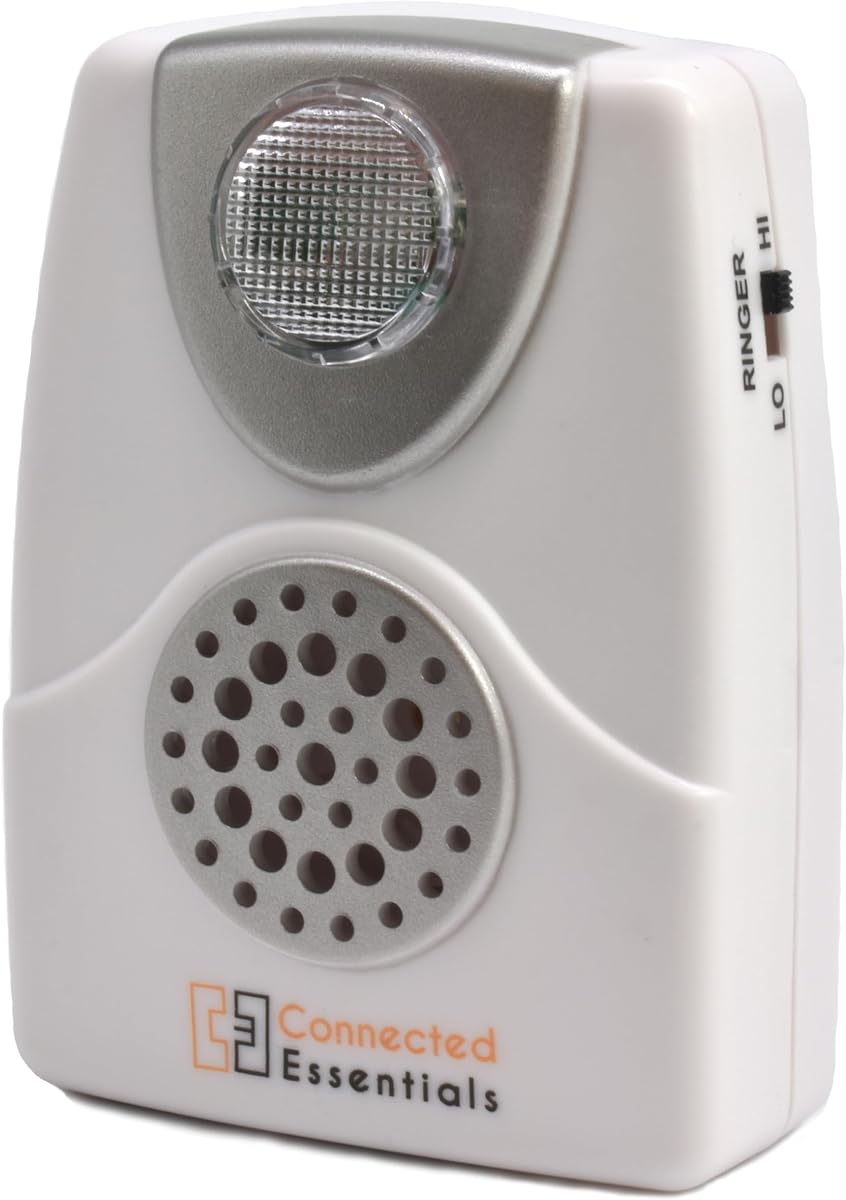
The TA002 is a telephone-line ringer amplifier for traditional landline systems, VoIP landlines that are not IP phones, analog extensions, and fixed wireless terminals. It can produce up to 110 dB at 25 centimeters and combines that output with a white LED flash. Its 4.3 rating and simple plug-in design make it a practical lower-cost choice for users whose main concern is hearing the ring.
We may earn a commission when you buy through this link, at no additional cost to you.
Installation is one of the product's clearest advantages. The unit is powered by the phone line, so it requires no separate power adaptor or rechargeable battery. Users can adjust the ringer volume and use the HI/LO switch to match different environments. The supplied wall mounting accessories also make it possible to position the alert where it can be seen and heard.
The TA002 does one main job: making the incoming-call signal more noticeable. It is not designed to amplify speech during a conversation, and its telephone-line design means it is unsuitable for someone whose primary communication is through a modern mobile phone. Compatibility with a VoIP service also depends on the type of line; IP phones are specifically excluded from the stated support.
This is the budget pick for a household with a compatible analog or supported landline. It suits users who can hear conversations but may miss a ring in another room, especially when visual alerts are useful at night. Anyone needing clearer incoming speech should instead consider an amplified corded or cordless telephone.
Because the amplifier draws power from the telephone line, there is no battery to charge and no extra adaptor to install. This reduces clutter and makes the device a straightforward addition to a compatible home phone system.
A high output ringer covers audible needs, while the white LED provides a visual alert for noisy rooms or nighttime use. Adjustable volume and the HI/LO control help prevent the output from being unnecessarily intense.
We may earn a commission when you buy through this link, at no additional cost to you.
The Panasonic KX-TGM420W is a one-handset amplified cordless phone designed to address both call volume and ringer visibility. It supports up to 40 dB of call amplification, has a base ringer rated at up to 100 dB, and includes six voice tone settings. Its 4.3 rating reflects a well-rounded feature set, and the combination of Slow Talk, noise reduction, and accessible display elements makes it the premium choice here.
We may earn a commission when you buy through this link, at no additional cost to you.
Slow Talk is the feature that distinguishes this model from a simple external ringer. It can slow the other speaker's real-time speech and recorded voice messages, giving the listener more time to process words. Noise reduction, speakerphone, Talking Caller ID, a talking keypad, and the phonebook add further support for users who benefit from spoken information. The bright 1.8-inch screen and backlit buttons improve visibility in low light.
As a complete cordless home phone, it requires a compatible base connection and is less useful for someone who wants to improve a mobile phone. The listed 100 dB figure refers to the base unit ringer, while the handset's role and placement can affect practical audibility. It includes call blocking, speed dials, power backup, and expansion to six handsets, which makes it more of a household telephone solution than a single-purpose accessory.
The KX-TGM420W is best for a household that wants a replacement landline phone with strong accessibility features rather than a separate Bluetooth ringer. It is a particularly compelling option for someone who understands calls but occasionally struggles with fast speech, since Slow Talk directly addresses that problem while the amplified ringer and visual cues help with incoming alerts.
The Slow Talk button reduces speech speed during live conversations and voice messages. This gives listeners more processing time without requiring a separate accessory or complicated setup.
The phone combines amplified caller audio, a very loud base ringer, six tone settings, noise reduction, and a large backlit display. These controls support different hearing needs rather than relying on volume alone.
We may earn a commission when you buy through this link, at no additional cost to you.
The Clarity P-300 is an amplified corded telephone for users who want a straightforward home phone with extra call volume and visual ringer support. It can amplify incoming sounds by up to 26 dB and includes an extra-loud ringer of more than 75 dB. Its 4.0 rating reflects a functional design centered on familiar phone controls and essential hearing assistance.
We may earn a commission when you buy through this link, at no additional cost to you.
The nine programmable photo memory buttons are particularly useful for people who may find standard numeric keypads difficult to navigate. The large photographs make frequently called contacts easier to identify and dial. Ring pitch and volume are adjustable, while the bright visual indicator supplies an additional way to notice an incoming call. These features make the P-300 approachable without requiring learning a complex menu.
The 26 dB amplification ceiling is lower than the capabilities of several amplified cordless phones in this list. Because it is corded, the handset remains tethered to the base, limiting movement around the home. It also does not offer the broader smart features, such as Slow Talk or Bluetooth connectivity, found in more specialized models.
The Clarity P-300 is a sensible choice for a person who stays near a fixed telephone location and values one-button dialing. It can help with both ordinary conversations and missed-call awareness, making it a practical option for a bedroom, kitchen, or home office. Buyers who need a more powerful boost or mobility between rooms should consider a cordless amplified model.
Nine programmable photo memory buttons make frequent contacts easy to identify at a glance. This is a practical accessibility feature for users who have difficulty remembering or reading conventional number sequences.
Users can vary the ring pitch and volume, and a bright visual indicator supplements the audible ringer. These options make the telephone more noticeable across different hearing profiles and room conditions.
We may earn a commission when you buy through this link, at no additional cost to you.
The Clarity XLC3.4+ is a DECT 6.0 cordless landline phone with up to 50 dB of extra-loud sound, a 95 dB ringer, and visual flashing on both the handset and base. Its 3.9 rating places it behind the stronger-rated products, but the combination of talking controls, large buttons, tone settings, and backup power makes it relevant for users who want accessible features throughout a home phone.
We may earn a commission when you buy through this link, at no additional cost to you.
A major advantage is the way information is presented. Talking Caller ID, a talking keypad, and a talking phonebook provide spoken information that can reduce the need to read small text. Four distinct tone settings allow users to identify a clearer sound profile, while the high-contrast display and large fonts improve visual access. The included belt clip supports hands-free movement around the home.
The cordless design is useful, but it is still tied to a landline base and is not a mobile phone amplifier. Users who rely exclusively on smartphones would need a Bluetooth device instead. The included backup batteries help maintain operation during a power interruption, though the product remains a full telephone system rather than a small add-on accessory.
The XLC3.4+ suits people who want both strong incoming audio and accessible phone controls in a cordless home system. It is especially useful for someone who can benefit from speech output as well as increased volume. Prospective buyers should check their existing telephone service and confirm that the included base meets their needs before replacing an established system.
Talking Caller ID, a talking keypad, and a spoken phonebook support users who find small text difficult to read. The phone combines this spoken feedback with four tone settings for a more personalized listening experience.
The handset can move around the home with the included belt clip, while backup batteries help preserve basic operation during an outage. Visual ringer indicators appear on both the handset and base for broader awareness.
We may earn a commission when you buy through this link, at no additional cost to you.
The Panasonic KX-TGM450S is an amplified cordless phone with up to 50 dB of caller-voice boost, six tone settings, Slow Talk, and a base ringer stated at up to 112 dB. Its 4.3 rating places it among the stronger options in the guide, and its broad accessibility toolkit makes it a compelling replacement phone for a home with challenging hearing or speech conditions.
We may earn a commission when you buy through this link, at no additional cost to you.
The most useful enhancements extend beyond volume. Slow Talk reduces the speed of live speech and recorded messages, while noise reduction suppresses background interference. The phone also provides speakerphone, Talking Caller ID, a talking keypad and phonebook, and a large 1.8-inch white backlit display. A bright red visual ringer appears on both the base and handset, helping users notice calls with or without sound.
Household management is another strength. Nine speed dials, a 250-number call block, an intercom, power backup, and expansion to six handsets make this a complete system. The scale of those features can feel unnecessary for someone who only needs a mobile ringer, and users must be comfortable with a landline-based setup. It also does not provide a portable Bluetooth connection to a smartphone.
The KX-TGM450S is a strong choice for a multi-room household that wants strong conversation volume, slow-speech support, and visual alerts from a new cordless system. It may be the better fit than the KX-TGM420W for someone who needs the higher stated voice boost and louder visual ringer. As with any full phone, checking service compatibility before replacing an existing base is essential.
Slow Talk makes fast speech easier to follow and also works with voice messages. Six tone settings and noise reduction give users additional ways to make conversation audio more comfortable.
Expansion to six handsets, intercom, speed dials, call blocking, and power backup create a complete home telephone system. The visual ringer on both base and handset improves awareness throughout the home.
We may earn a commission when you buy through this link, at no additional cost to you.
The Connected Essentials CEA-40 is a compact wall-mounted ringer enhancer for compatible BT telephone wall sockets. It provides ring amplification stated at up to 95 dB and a bright flashing light. Its 4.1 rating reflects a simple, focused product, and the direct wall-socket design makes it useful for anyone who needs a louder visual and audible alert without complex setup.
We may earn a commission when you buy through this link, at no additional cost to you.
The installation process is minimal. The unit plugs directly into a standard compatible BT telephone wall socket and requires neither mains power nor batteries. The supplied connection wires make the setup self-contained, while the compact 80 by 60 by 25 millimeter dimensions allow unobtrusive placement. A wall-mounted design also keeps the ringer at a consistent height and location.
The product's scope is narrow compared with amplified telephones. It is designed to improve the ring rather than amplify conversation audio, so a person who can hear speech but misses incoming calls may receive the greatest benefit. Compatibility is also important: users need an appropriate wall socket and connection arrangement, and the title's stated 105 dB figure differs from the 95 dB amplification figure in the product details, so buyers should confirm the relevant specification for their use.
The CEA-40 is best for a compatible landline installation where simplicity and visibility matter. It can be positioned near a bed, hallway, or frequently occupied room without requiring a separate power source. Users who want improved speech during calls should choose an amplified phone, while mobile-only users should consider a Bluetooth ringer.
The device needs neither batteries nor a separate mains adaptor because it uses the compatible telephone wall socket. This keeps installation clean and avoids routine charging or battery replacement.
Its small wall-mounted body can be positioned where the ringer is most useful without occupying a table or desk. The flashing light adds visibility alongside the amplified ring.
We may earn a commission when you buy through this link, at no additional cost to you.
PebblePulse is a Bluetooth cell phone ringer amplifier with a maximum output of 120 dB, flashing red and blue lights, and answer and hang-up controls. It is designed for indoor use with compatible Bluetooth smartphones and offers a stated coverage range of up to 200 feet. Its 3.7 rating is moderate, but the large controls, selectable modes, and long stated range serve users who want a noticeable external alert.
We may earn a commission when you buy through this link, at no additional cost to you.
The controls are one of its most distinguishing qualities. Large buttons with high-contrast printing are intended to be easier to operate for seniors and people with arthritis or Parkinson's disease. Users can answer or end a call without reaching the phone, while the three modes—RING ONLY, MESSAGE ONLY, and ALL—determine whether the unit alerts for calls, messages, or both. The flashing indicators provide a visual alternative to sound.
Bluetooth connectivity allows the device to reconnect automatically when the phone is within range, but it must remain indoors and plugged in for regular use. The stated 200-foot range is a maximum rather than a guarantee of performance through every wall or floor. The lower customer rating also makes it particularly important to check recent feedback, the fit of the phone's notification behavior, and room placement before making this the primary alerting system.
PebblePulse is a good candidate for a smartphone user who wants exceptionally loud alerts and very accessible physical controls. The remote answer and hang-up functions add convenience for someone who regularly leaves the phone out of reach. Users who place greater value on conversation audio should consider an amplified phone or personal listening amplifier rather than a ringer-focused accessory.
Large, high-contrast answer and hang-up buttons reduce the need for precise finger movements. The layout is intended to be accessible for seniors and people with conditions that affect dexterity.
RING ONLY, MESSAGE ONLY, and ALL modes let users decide which events should produce an external alert. Red and blue flashing lights and a stated range of up to 200 feet support use throughout a large home.
We may earn a commission when you buy through this link, at no additional cost to you.
The Williams Sound PockeTalker Ultra DUO is a personal sound amplifier rather than a dedicated telephone ringer. It includes a headset, a single earbud, a microphone, and a cord, while providing 20 to 40 dB of acoustic gain. Its 4.3 rating reflects a well-regarded product for users who struggle to hear a television, another room's conversation, or a nearby phone.
We may earn a commission when you buy through this link, at no additional cost to you.
The included accessories make it adaptable to different listening needs. A user can wear the headset for a more private listening experience or choose the single earbud to remain aware of surrounding sounds. External volume and tone controls permit adjustment without removing the device, and the removable microphone can be positioned near a television or telephone speaker. The integrated belt clip supports portable use.
This is not a Bluetooth phone ringer and cannot be assumed to connect directly to a modern smartphone. Its listed 12-foot and 2-foot cords and microphone-based design serve personal sound amplification rather than automatic call detection. The stated battery life of up to 100 hours depends on use, and the device still relies on two AAA batteries even though battery maintenance is infrequent.
The PockeTalker is the right pick when the central problem is hearing nearby audio rather than noticing a phone ring. It can help a person follow a television more comfortably or hear a room conversation without asking others to speak loudly. It should be viewed as a supplemental personal listening tool, not a replacement for an amplified phone or a dedicated visual and audible call alert.
The package includes both a headset and a single earbud, allowing the user to choose between more focused listening and awareness of the surrounding room. Both are designed for comfortable personal amplification.
External volume and tone controls make it easier to adapt the sound to a television, conversation, or telephone speaker. A removable microphone and extension cord allow the sound source to be positioned more effectively.
We may earn a commission when you buy through this link, at no additional cost to you.
The right phone amplifier depends on the type of phone used, the specific listening challenge, and the importance of visual alerts. The following factors help narrow the field before making a purchase.
External ringers are built primarily to make incoming calls noticeable. They may connect to a compatible mobile phone through Bluetooth or attach to a traditional telephone line. Amplified phones, by contrast, can increase the volume of the conversation itself, while a personal sound amplifier is designed to make nearby audio easier to hear. Choosing the wrong category can leave the most important problem unresolved.
Start with the device used for most calls. A Bluetooth ringer makes the most sense for a smartphone, a line-powered enhancer suits a compatible landline, and an amplified cordless or corded phone is appropriate when the user is willing to change the home telephone system.
A louder ringer does not necessarily make a caller's voice easier to understand. Some users need help noticing calls, while others can hear the ring but struggle with fast speech, background noise, low vocal volume, or specific frequencies. The strongest all-in-one phones in this guide combine a loud ringer with voice boost, tone settings, Slow Talk, or noise reduction.
If hearing incoming calls is the primary concern, prioritize a ringer's stated output, visual indicators, and room coverage. If conversation clarity is the main issue, prioritize amplification, tone controls, speech slowing, and noise reduction.
Bluetooth compatibility is more than a general promise that a phone will connect. The relevant phone must support the required Bluetooth calling profile, and some flip, landline, VoIP, and tablet devices may have limitations. Telephone-line enhancers similarly vary in their support for analog lines, analog extensions, fixed wireless terminals, and VoIP services. IP phones are specifically excluded from the TA002's listed compatibility.
Review the full specifications before buying and confirm that the existing phone, service, base, wall socket, and connector arrangement are supported. A product that offers ideal features will not help if it cannot connect to the user's system.
A bright LED can make an incoming call visible across a room and is particularly helpful at night, in a noisy environment, or when the user has reduced hearing. Some devices flash continuously, some have several indicators, and some continue flashing after a missed call. These differences can make an otherwise similar product much more practical for a specific home.
Consider both the brightness and placement of the light. A unit that is easy to see from the doorway or bedside is often more useful than one tucked behind furniture. A visual ringer should complement rather than replace a sound alert unless hearing the ring is no longer the primary concern.
A device with a high stated maximum volume may still be difficult to hear if it is too far away or behind several walls. Bluetooth products list ranges of up to 150 or 200 feet, although actual performance varies with the building and interference. Landline devices have a fixed relationship to the telephone socket, making placement especially important. Complete amplified phone systems can also solve coverage by adding handsets in multiple rooms.
For a mobile ringer, consider the likely distance from the phone and whether the product reconnects automatically. For a home phone, look at speakerphone capability, intercom, or expansion to additional handsets when mobility around the property matters.
Large buttons, high-contrast labels, backlit keys, spoken caller information, and simple physical controls can make a phone easier to operate. Features designed for low vision often help dexterity as well, while a talking keypad or phonebook can reduce the need to read a small display. The PebblePulse, Clarity P-300, and Panasonic models in this guide offer examples of these approaches.
Choose controls that match the user's actual dexterity and vision. A highly sophisticated interface is not helpful if it is difficult to operate, while a large external button can be valuable if the phone is regularly out of reach.
Some external devices are powered continuously from a wall outlet, some draw power from a telephone line, and the PockeTalker uses two AAA batteries. Continuous power is convenient because it removes charging from the routine, but it requires an accessible outlet and leaves the device unavailable during a local power interruption unless backup support is included. Line-powered ringers avoid separate adapters but depend on the phone service.
Battery backup matters most for a telephone used during emergencies. A complete cordless phone with backup power can provide continuity, while a mains-powered Bluetooth ringer may be less dependable during an outage. Consider the entire household communication plan rather than only normal daily use.
Maximum decibel figures describe peak output under specified conditions, not how loud every ring will sound in every room. Excessively loud alerts can be distressing or make it difficult to determine which sound is significant. Adjustable volume, selectable ringtone styles, tone settings, and silent visual modes give the user more control over daily comfort.
Set the device at a moderate level first, then increase it only as needed. Users with tinnitus, sound sensitivity, or different hearing levels in each ear may benefit from a product with separate tone and volume controls rather than a single maximum-output setting.
Begin by identifying which part of the phone experience needs support. For a Bluetooth ringer, place the unit in a central room, connect it to a wall outlet, and pair it with the phone after checking the device's compatibility list. For a line-powered enhancer, connect it to the supported telephone socket. For an amplified phone, install the base, charge the handset fully, and learn the volume, tone, Slow Talk, and visual-ringer controls before relying on it for important calls.
Test every relevant alert rather than assuming the setup is complete. Place a call from another phone and confirm that the ringer is audible in the intended room. Check the LED from a distance and at night, review whether texts or app alerts behave as expected, and test the conversation volume, speakerphone, talking caller information, and noise-reduction controls. Adjust the output to a comfortable level rather than immediately setting every control to maximum.
For ongoing care, keep Bluetooth devices connected to reliable power and their firmware or phone software current. Clean phone ringer surfaces with a dry or lightly damp cloth, and keep openings free from dust. Landline devices should be handled gently at the connectors, while amplified phones and the PockeTalker benefit from replacing batteries as needed and storing them in a dry place. If an alert becomes inconsistent, test the connection, pairing, telephone service, and notification settings before assuming the hardware has failed.
A phone ringer amplifier primarily makes incoming calls easier to notice through a louder ringtone, flashing light, or both. An amplified phone can also increase the volume of the call conversation and may include tone settings, Slow Talk, or noise reduction. The right choice depends on whether the main difficulty is missing calls or understanding the people speaking.
Bluetooth ringer amplifiers can connect to compatible smartphones to provide louder and visual call alerts, but they do not necessarily improve the live call audio heard through the phone. For stronger conversation audio, an amplified telephone or a personal listening amplifier may be more appropriate. Phone model and Bluetooth profile compatibility should always be confirmed before purchase.
No. Hearing loss is not identical for every person, and maximum output can be uncomfortable or unhelpful if speech frequencies are the real problem. Adjustable volume, multiple ringtones, tone controls, and a visual indicator provide a more balanced result. The best setting is the one that is noticeable in the intended room without causing distress.
Some amplified phones in this guide are explicitly described as hearing aid compatible, while other products provide visual and louder audible alerts without making that claim. A phone with adjustable tone settings may also produce clearer sound for a user with specific frequency loss. Users should consult their hearing-care professional and verify the product's compatibility information.
That depends on the product and setup. Mains-powered Bluetooth ringers generally need a working outlet, whereas the TA002 draws power from the compatible telephone line. An amplified cordless phone with backup batteries may continue to provide limited operation during an outage. A complete household communication plan can include a charged mobile phone as a backup.
The RENNY unit supports one phone at a time, although two separate RENNY units can connect to the same phone for coverage in multiple rooms. The 120dB Bluetooth Ringer and PebblePulse also describe one-to-one pairing in their supplied information. For a household with several phones, separate units or a multi-handset amplified system may be necessary.
It depends on the product and the type of VoIP connection. The TA002 supports VoIP landlines that are not IP phones, while the RENNY supports certain VoIP phones with Bluetooth headset capability. Other Bluetooth ringer models support mobile phones and tablets. Users should verify both the phone's Bluetooth support and the specific service connection before ordering.
Test the ringer in the room where the phone is normally left, then move the external unit to a more central or visible location. Confirm that notifications are enabled on the phone and that the device remains connected or paired. For landline models, check the telephone connection and supported socket. If the issue is understanding the caller rather than noticing the alert, consider a product with stronger voice amplification, tone controls, Slow Talk, or noise reduction.
The RENNY Bluetooth Ringer is the best overall option because it combines a 117 dB alert, bright LED, multiple ringtones, automatic Bluetooth reconnection, and generous stated room coverage. The TA002 stands out as the budget choice for compatible landlines, while the Panasonic KX-TGM420W offers the most complete premium approach with call amplification, a loud base ringer, Slow Talk, and accessible controls.
Prioritize the problem you actually need to solve. Choose a Bluetooth ringer for missed mobile calls, a line-powered enhancer for a compatible landline, an amplified phone for better conversation audio, and a personal amplifier for difficult nearby sound. Visual alerts, adjustable output, easy controls, and reliable power should be weighed alongside the maximum decibel figure.
Before ordering, verify the phone, service, base, connector, and Bluetooth compatibility, then test the setup from every room where calls need to be noticed. Product features, availability, and pricing can change, so checking the current listing and manufacturer information is an important final step.