
Yamaha MG10
4.6Editor score
Ten-input analog mixer
Discrete class-A preamps
Three-band channel EQ
One-knob channel compressors
Our Mixer for Live Performance guide compares 10 mixers on channel count, inputs, effects, recording, wireless features, portability, and control for performers
A mixer for live performance sits at the center of a stage signal chain, combining microphones, instruments, playback devices, monitoring, and effects into one controllable system. A useful model should offer clean preamps, intuitive controls, dependable connections, enough headroom, and features that simplify sound checks rather than adding complexity.
This guide compares ten options across channel count, input flexibility, equalization, effects, wireless playback, recording, portability, and stage monitoring. The list includes conventional analog mixers, digital consoles, a multitrack live recorder, a backing-track player, and a dedicated vocal processor, allowing performers to compare several approaches to live sound control.
Each review highlights the supplied specifications, practical strengths, and important limitations of its featured product. The top selections provide the clearest options for general live use, portable performance, and advanced show control. Product configurations and ratings can change, and current prices should always be checked before purchasing.
4.6Editor score

4.5Editor score
5.0Editor score
The comparison below organizes all ten products by their most important live-performance attributes, from channel capacity and connection types to recording, wireless playback, effects, and mobility. The options range from straightforward analog mixers to purpose-built live recorders and show-control systems.


The Yamaha MG10 is a straightforward 10-channel analog mixer built around live essentials rather than digital media features. It carries a 4.6 rating, and its strongest qualities are the class-A D-PRE preamps, three-band equalization, high-pass filters, and one-knob compressors. For a performer who wants reliable channel control without navigating a complex menu, that combination is refreshingly direct.
We may earn a commission when you buy through this link, at no additional cost to you.
Its discrete class-A D-PRE preamps use an inverted Darlington circuit, which the manufacturer describes as producing full, natural bass and smooth, soaring highs. The high-pass filters are especially useful for rejecting low-frequency rumble, while the three-band EQ gives each channel enough tonal adjustment for vocals, guitars, keyboards, and other stage sources. The one-knob compressors can make voices and instruments feel more controlled without requiring deep compressor knowledge.
The important limitation is that this is a standalone analog mixer with no USB interface or onboard effects. Performers cannot record directly to a computer from the mixer or select digital reverbs and delays from its control surface. It also offers fewer channels than several digital alternatives, so larger ensembles may need to prioritize inputs carefully.
Despite those constraints, the MG10 is an excellent general-purpose choice for rehearsals, small gigs, singer-songwriters, and musicians who value stable analog controls. It offers the essential balance of microphone connectivity, tone shaping, dynamics control, and robust construction without requiring screen-based operation. It is our best overall mixer for live performance because it delivers a particularly coherent set of basic tools for the money.
The fixed EQ, filter, gain, compressor, and fader controls make the MG10 approachable even when a sound check is brief. A performer can make a vocal sit more clearly, tame rumble, or add compression without navigating presets or opening a menu.
The impact-resistant, powder-coated metal chassis is suited to regular transport and setup. Phantom power supports condenser microphones, while the analog layout keeps live operation focused and predictable.
We may earn a commission when you buy through this link, at no additional cost to you.
The Depusheng DX8 is an eight-channel mixer designed for performers who want microphones, instruments, computers, phones, and stored music to share the same board. Its 4.2 rating reflects a feature-rich alternative to a basic analog console, with USB, flash-reader, MP3, and Bluetooth connectivity included.
We may earn a commission when you buy through this link, at no additional cost to you.
Its media controls are especially useful for singers, DJs, and performers who transition between live instruments and prerecorded material. Bluetooth allows cable-free streaming from a smartphone, including services such as Spotify or Pandora, while the USB and flash-reader options provide wired or removable-media playback. Built-in play, pause, skip, and mode controls reduce the need to operate a phone at the board.
The mixing section includes XLR and quarter-inch inputs, 48V phantom power, three-band EQ, LED peak indicators, and a ten-segment stereo output meter. The ultra-thin enclosure also makes the DX8 easier to transport than a large stage console, although eight channels may be restrictive for a full band with several microphones, instruments, and playback sources.
This is most appropriate for karaoke, rehearsals, compact shows, and performers who prioritize wireless media over a large channel count. The USB and Bluetooth functions add flexibility, but the product should not be treated as a substitute for verifying computer-driver compatibility or advanced multitrack routing. For a small live setup needing several playback methods, it remains a versatile choice.
USB, flash media, MP3 playback, and Bluetooth let performers move between live sources and stored music without repeatedly changing the signal path. Onboard transport controls are particularly helpful when the mixer serves as the central playback device.
Peak indicators and a ten-segment stereo meter provide useful visual references during setup and performance. Three-band EQ on every channel gives operators more tonal control than a simple two-band control surface.
We may earn a commission when you buy through this link, at no additional cost to you.
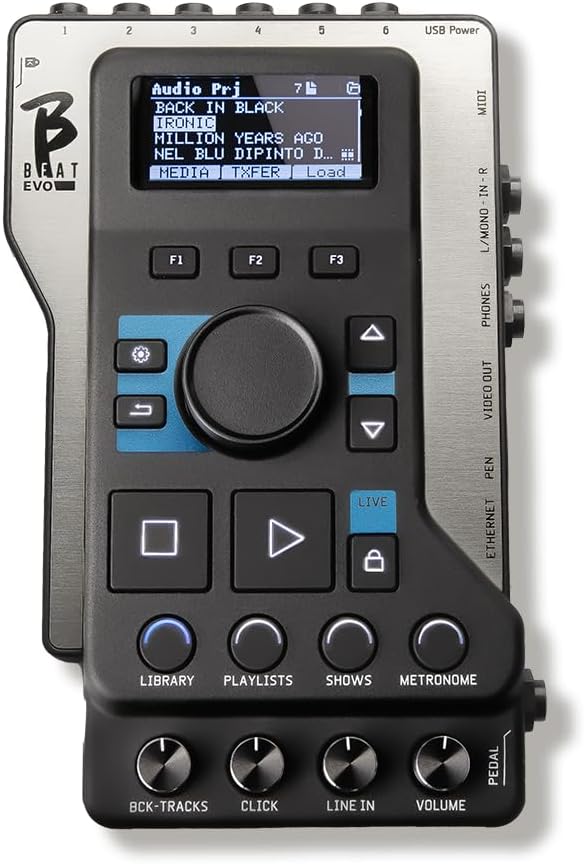
The M-Live B.Beat Evo is a purpose-built backing-track player for live musicians rather than a conventional channel-strip mixer. It has a 5.0 rating and consolidates track playback, video, click, mixing, lyrics, and show control into one compact stage device, reducing the need for a laptop, separate sound card, and conventional playback mixer.
We may earn a commission when you buy through this link, at no additional cost to you.
The device supports up to 16 mono or eight stereo tracks in WAV, MP3, OGG, AAC, and Stems formats. Processing is performed at 24-bit with a stated signal-to-noise ratio of 107 dB. Six balanced outputs, two line inputs, and independent headphone monitoring give performers multiple routing destinations and a separate cueing path, with dedicated click detection supporting rehearsal and performance timing.
Show management is another defining strength. The free PC and Mac app is used to build playlists and shows, while the Prompter App provides wireless control of lyrics and scores. A footswitch can start or stop playback hands-free. MP4, MOV, AVI, and image files can also be synchronized with music and sent to a video wall through HDMI at resolutions up to 1920×1080.
This is the premium selection for soloists, duos, worship teams, theater performers, and touring musicians who rely on elaborate backing tracks. It does not offer the same conventional microphone mixing workflow as the analog consoles in this guide, so it works best as part of a larger live production system. For musicians seeking a dedicated command center for tracks, click, media, and stage communication, it is exceptionally capable.
Centralizing playback and show functions in one unit reduces setup complexity for performers who previously depended on a computer, card, mixer, and separate prompting system. The wireless apps extend control beyond the device itself.
HDMI video output, synchronized image support, and high-resolution playback make the B.Beat Evo useful for shows that combine live musicians with projected media. The result is a more integrated performance workflow than ordinary media playback.
We may earn a commission when you buy through this link, at no additional cost to you.
The Zoom LiveTrak L6max combines live mixing with multitrack recording in a single unit, making it the most flexible choice for performers who want to capture a show while controlling the stage mix. Its 4.5 rating reflects a broad feature set across 12 channels, 14 simultaneous tracks, sound pads, noise reduction, and portable power options.
We may earn a commission when you buy through this link, at no additional cost to you.
The input configuration includes four combo inputs with Hi-Z support and eight line inputs across 12 channels. That makes it suitable for electric guitars, basses, microphones, and line-level sources without requiring every instrument to pass through a separate interface. Up to 14 tracks can be captured simultaneously to SD cards up to 2TB, giving performers a multitrack safety net even when a show is not planned as a recording session.
Dual AD converters on channels 1 through 4 are designed to capture clip-free audio across wide dynamic ranges. Real-time AI-based reduction is offered for hum, hiss, and background noise while preserving vocal and instrument detail. MIDI-clock-locked sound pads allow performers to trigger samples, jingles, and effects during electronic shows, adding a live-triggering capability that most conventional mixers do not provide.
Power can come from AA batteries, USB bus power, or a mobile battery pack, making the L6max suitable for outdoor and mobile performances. The trade-off is that digital operation introduces a more complex interface than a simple analog board, and 12 physical input channels may not cover every source in a large ensemble. Still, for musicians who want live mixing, isolated-track capture, samples, and portability in one device, it is the most complete all-in-one selection.
Recording up to 14 tracks simultaneously means each source can be captured independently rather than relying only on the stereo mix. Performers can balance the live sound while retaining options for a cleaner or more polished mix afterward.
AA batteries, USB bus power, and mobile battery-pack support remove the need for a nearby power outlet. This is valuable for street performances, outdoor events, and rehearsals in locations where mains power is inconvenient.
We may earn a commission when you buy through this link, at no additional cost to you.
The 16-Channel 99 DSP Mixer is a large-format digital console aimed at performers who need more inputs, onboard effects, and convenient media playback. With a 4.6 rating, it stands out for independent channel control, 99 DSP effects, a seven-band graphic EQ in the master section, and support for Bluetooth, USB storage, and a digital display player.
We may earn a commission when you buy through this link, at no additional cost to you.
Every input has its own gain, three-band EQ, fader, and mute button. Those dedicated controls are useful during live shows because a performer can silence a source immediately without hunting through a menu or disturbing neighboring channel settings. The 16-channel capacity also makes the board more adaptable to full bands, multi-microphone events, rehearsals, and situations requiring separate control of instruments and playback.
Its 99 built-in effects include reverb, delay, and ambience, providing more choices than a conventional analog board. The master section adds a seven-band graphic EQ, monitor control, and effect-level adjustment. A 48V phantom-power switch supports condenser microphones, while the hybrid input connections are described as accepting dynamic microphones, wireless systems, electric guitars, DI boxes, and other instruments.
The media system includes Bluetooth, USB playback, and a digital display player, with onboard controls for play, pause, skipping, and mode changes. This makes the mixer useful for DJ-style transitions, karaoke, rehearsals, and small live events. The broad digital feature set adds complexity and physical size compared with a simple analog board, but the channel count and effects make this a strong option for performers who want a versatile, all-in-one console.
Sixteen independently controlled channels provide room for a larger source count than most compact boards. Individual mute buttons make emergency changes fast and visually obvious during a performance.
The 99-effect library can add reverb, delay, and ambience directly to the performance signal chain. This reduces rack space and makes it easier to shape vocal and instrument spaces with the mixer itself.
We may earn a commission when you buy through this link, at no additional cost to you.
The AVE-100 is not a conventional live mixer; it is a dedicated processor for singers who want harmonies, pitch correction, reverb, delay, and feedback control in one unit. Its 4.2 rating makes it a specialized option for vocalists who need a repeatable way to enrich a live performance or create layered recordings.
We may earn a commission when you buy through this link, at no additional cost to you.
The standout feature is the harmony system. Unison, plus-third, and plus-sixth modes create additional vocal layers, while the KeyLearn function is designed to detect the key of a backing track automatically. That helps the processor support more musically appropriate pitch correction and harmony, particularly useful for solo performers who cannot manually control every pitch-based setting from the stage.
Effect pads provide direct access to common functions, and adjustable pitch correction lets the performer determine how much processing is applied. Reverb and delay add depth, while the built-in loop recorder allows multiple vocal passes to be layered. The intelligent anti-feedback function is intended to reduce unwanted feedback during live performances, karaoke, and stage use.
Connectivity includes an XLR microphone input with 48V phantom power, a 6.35 mm input for instruments and line-level sources, plus connections for headphones and speakers. This makes it easy to add vocal processing to an existing mixer, but it does not replace one. The right buyer is a singer who specifically needs harmonies, pitch treatment, and looping; a general live engineer seeking a multichannel board should look elsewhere.
The dedicated harmony modes allow a single singer to create additional vocal layers without requiring a second vocalist. Automatic key detection reduces the burden of matching harmony intervals to the accompaniment.
The loop recorder lets performers capture and layer multiple vocal parts during practice, streaming, or recording. It is particularly useful for rehearsing arrangements or creating live-style stacked vocals.
We may earn a commission when you buy through this link, at no additional cost to you.
The FULUODE CT-80S is a slim eight-channel mixer designed for karaoke, band rehearsals, small events, and mobile live use. It has a 4.4 rating and combines wired and wireless microphone options, 48V phantom power, Bluetooth and MP3/USB playback, reverb, and an LED display in a chassis described as only 1.57 inches thick.
We may earn a commission when you buy through this link, at no additional cost to you.
Each channel includes a three-band equalization section, giving performers control over high, mid, and low frequencies. The 48V phantom-power supply supports compatible condenser microphones, while the board's general-purpose input design allows it to handle microphones, wireless systems, and instruments. The large LED display presents song information and can also serve as a connection point for compatible digital effect peripherals.
Bluetooth 5.0 and MP3/USB input expand the board beyond live microphones and instruments. These playback functions are useful for karaoke, backing tracks, DJ-style transitions, and performances that move between live and recorded material. The slim enclosure is a major advantage for performers who carry their own equipment, since it occupies less space than a full console.
The product is specified for 110V operation with an American plug, and buyers should confirm that this matches their local power requirements. It is also noted that the display arrives with a protective film that can be removed. With only eight channels, it is best for compact ensembles, and its stage role is more versatile than a pure karaoke board. It suits performers who need portable channel control plus wireless media playback.
Bluetooth 5.0 makes it straightforward to add phone or smart-device audio to the performance. MP3 and USB playback offer alternatives when a wireless connection is not desired.
The thin chassis helps conserve space in a gig bag or compact stage setup. It also brings mixing, wireless playback, and LED song display functions into one portable unit.
We may earn a commission when you buy through this link, at no additional cost to you.
The Six-Channel Bluetooth Mixer is a compact analog console intended for karaoke, studio work, streaming, recording, and small live performances. Its 4.3 rating reflects a straightforward feature set centered on four XLR inputs, stereo quarter-inch connections, 3-band EQ, 16 DSP effects, Bluetooth, and USB media support.
We may earn a commission when you buy through this link, at no additional cost to you.
Channels one through four provide XLR connections, while the 6.35 mm jacks support unbalanced instruments and other line-level sources. The XLR channels accept condenser microphones when the 48V phantom-power button is engaged, as well as dynamic microphones, vocal sources, wireless microphones, electric guitars, and DI boxes. The remaining stereo input adds flexibility for paired sources or a stereo playback feed.
The USB interface can accept a flash drive for MP3 playback, and Bluetooth supports wireless streaming from a tablet or smartphone. Built-in menu controls manage play, pause, skipping, and mode changes. Per-channel gain, 3-band EQ, and faders provide basic tone and level control, while 16 DSP effects offer delay and reverb options without requiring an external processor.
As a traditional analog product, it does not automatically guarantee smooth operation for every modern device or software environment, and the supplied information specifically notes that incorrect operation can result in no sound. The six-channel capacity is also the smallest in this comparison, making it better for a singer, duo, or compact rehearsal than a full ensemble. It remains attractive for performers who want essential mixing and media functions in a compact board.
Four XLR inputs and stereo quarter-inch connections cover common live sources without the footprint of a larger console. This makes the mixer convenient for mobile karaoke and rehearsal setups.
Bluetooth and USB media playback let a performer bring songs, backing tracks, or streamed content into the mix. The console is also described as supporting mixing and recording through its USB interface.
We may earn a commission when you buy through this link, at no additional cost to you.
The MD-10 is a 10-channel digital stage mixer with a 5.0 rating, 99 DSP effects, independent channel equalization, wireless playback, and a large LED display. It is positioned for stage performances, studios, churches, clubs, conferences, and other environments where a performer wants more control than a basic analog console.
We may earn a commission when you buy through this link, at no additional cost to you.
All 10 inputs have independent gain and three-band tone controls for high, mid, and low frequencies. The large display presents effect parameters, making it easier to select and adjust sounds such as hall, plate, room, delay, chorus, pitch shifting, and distortion. A nine-band equalizer with real-time monitoring adds another layer of control for the overall output.
Bluetooth and USB playback provide flexible ways to bring music into the mix. The USB port is described as accepting lossless audio from a drive, while wireless playback reduces cable clutter. Intelligent noise-reduction technology is intended to reduce floor noise and hum, and 48V phantom power expands compatibility with condenser microphones.
The digital interface is the primary trade-off. A large display and extensive feature set require more setup knowledge than a simple analog mixer, and a five-star rating may reflect a smaller or newer history of user feedback than the established products in the list. Even so, the MD-10 offers a compelling combination of channel control, sound shaping, effects, playback, and monitoring for a performer who wants substantial onboard processing.
The large LED screen displays effect parameters, giving the operator immediate visual feedback. That visibility is valuable when choosing reverb, delay, pitch effects, or other processing during a sound check.
Ninety-nine effects, a nine-band equalizer, intelligent noise reduction, and 48V power create a broad processing toolkit. Bluetooth and USB playback extend the mixer beyond conventional microphone and instrument mixing.
We may earn a commission when you buy through this link, at no additional cost to you.
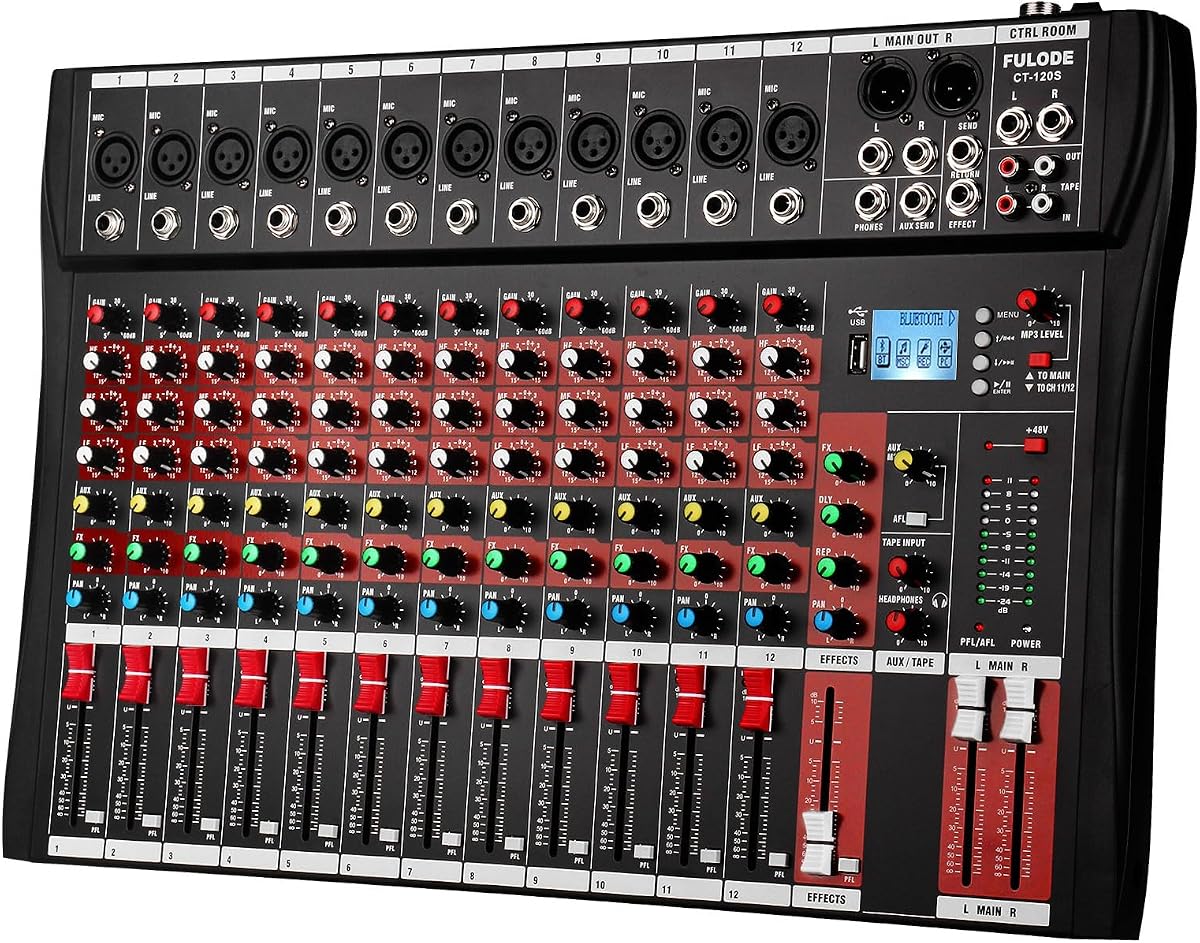
The FULUODE CT-120S offers a balanced middle ground between compact eight-channel designs and larger digital consoles. It is a 12-channel mixer with a 4.4 rating, three-band EQ, 48V phantom power, reverb, MP3 and USB playback, Bluetooth 5.0, and an LED display, making it relevant to band rehearsals, small events, karaoke, and live performance.
We may earn a commission when you buy through this link, at no additional cost to you.
Each of the 12 input channels has its own three-section tone control, allowing performers to balance vocals, guitars, basses, and other sources independently. The console supports wired microphones, wireless microphones, and instruments, while the phantom-power supply accommodates compatible condenser microphones. This makes the mixer adaptable to a mixed performance rig rather than limiting it to one source type.
MP3 and USB input provide direct playback from removable storage, and Bluetooth 5.0 permits cable-free streaming from a phone or smart device. A large LED display shows song information and can connect to compatible digital effect peripherals. The thin 1.57-inch enclosure is convenient for transport, while USB recording expands the board's usefulness beyond live amplification.
Compared with the CT-80S, this model offers four additional channels, making it better suited to a fuller band. Its trade-offs are less advanced processing than the MD-10 and less effect variety than the 16-channel digital console. It is specified for 110V with an American plug, and the display has a removable protective film. Overall, it is a capable option for performers who need more channel capacity than an eight-channel board but prefer a straightforward, portable console.
Twelve channels offer additional room for microphones, instruments, and playback compared with compact six- and eight-channel models. Per-channel EQ gives every source a dedicated tone-control section.
Bluetooth, MP3, and USB playback support several backup and transition methods. The slim enclosure makes the CT-120S easier to move between rehearsal spaces, rehearsal rooms, and small venues.
We may earn a commission when you buy through this link, at no additional cost to you.
The right mixer depends on the size and type of show, the number and type of sources, required outputs, and how much setup time is available. Matching those needs to the control surface, processing, and connectivity is more important than choosing on channel count alone.
Begin by listing every source that must be mixed at once, including lead vocals, backing vocals, drums, guitars, bass, keyboards, DI feeds, playback devices, click tracks, and monitoring returns. Count each physical source as one channel unless the mixer explicitly supports stereo faders or linked controls. Performers should also account for spare channels because troubleshooting, guest microphones, and future additions are common needs.
XLR connections are the standard for microphones and many balanced instrument feeds, while quarter-inch inputs support instruments, DI boxes, and line-level sources. Combo sockets can improve versatility when they accept both microphone and instrument connections. Performers using condenser microphones should also confirm that the mixer supplies switchable 48V phantom power, and users of electric guitars or basses should look for Hi-Z or instrument-specific inputs.
Outputs determine how the mixed signal reaches the rest of the show. A basic stereo main output may be enough for a small rehearsal, while a stage mixer may need multiple balanced outputs for a front-of-house mix, monitor mix, external effects, and recording. Balanced outputs are generally preferable for longer cable runs and reducing interference. Performers should verify whether they need independent headphone monitoring, a separate click feed, or auxiliary sends.
Analog mixers provide direct, tactile control and are often attractive for simple live rigs because their operation is immediately visible. Digital mixers can add effects, recall, wireless media, flexible displays, and advanced routing, but they may require more setup and menu navigation. A performer who prioritizes quick decisions and uncomplicated rehearsal may prefer analog, while a fixed production setup may benefit from programmable and visible digital control.
A mixer with a USB interface is not automatically a multitrack recorder. Some products record only a stereo mix, while others capture individual channels and playback files. Performers who want isolated tracks should look specifically for simultaneous multitrack recording, suitable storage support, and separate monitoring. Dedicated live recorders may also provide background recording even when the stage mix is handled by another console.
Equalization helps each source occupy its proper place in the mix, while compression can make vocals and instruments more consistent. Digital effects add reverb, delay, chorus, and other treatments without separate rack equipment. Performers should look for per-channel EQ, useful filtering, channel dynamics control, and an effect-return path that does not take away too many input channels. Specialized vocal processors can be valuable when harmony or pitch correction is central to the performance.
A mixer that is excellent in a rehearsal room may be awkward to carry, connect, and power on a small stage. Consider chassis depth, weight, back-panel spacing, and available stage area. Battery or USB-bus power can be valuable for mobile shows, while thin housings make transport easier. Cable management is also important: crowded outputs, fragile controls, or a display positioned poorly can make an otherwise capable mixer frustrating to operate.
Bluetooth, USB storage, MP3 playback, and computer connectivity can simplify rehearsals, karaoke, DJ-style sets, and shows that alternate between live and recorded material. Multitrack backing-track systems go further by handling stems, click tracks, video, lyrics, and synchronized playback. The right approach depends on whether the performer merely needs background tracks or requires a complete, repeatable show sequence with hands-free operation.
Begin with a quiet power-up, inspect cables, and confirm that every gain control is at an appropriate starting level. Connect sources one at a time, set input gain conservatively, and listen before adding EQ or effects. Identify the main output and monitoring path, place the mixer where its controls remain visible, and keep a simple signal map showing which microphone or instrument belongs to each channel.
During sound check, speak or play at expected performance volume and watch output meters rather than relying only on the sound heard in the room. Set adequate headroom, bring levels to a usable range, and address feedback by reducing gain, changing microphone position, or applying high-pass filtering where appropriate. Make only one major adjustment at a time so the cause and result of each change remain clear.
After the show, mute outputs before disconnecting sources, power down the mixer according to its manual, and remove media or devices only after shutdown. Keep the console dry and dust-free, coil cables without sharp bends, and periodically inspect connectors for dirt or corrosion. Save any digital presets, show files, or recordings in more than one location, and update software or firmware only when the performer has the time to verify the changes before an important event.
A small live band should start by counting every simultaneous source, including microphones, instruments, playback, and click. Ten to twelve channels generally provides useful flexibility, while six- or eight-channel models are better for soloists, duos, and rehearsals. Input compatibility, monitor routing, and output count matter as much as the headline channel number.
Not if the only goal is controlling a live mix. USB is useful for recording, computer playback, software integration, or multitrack capture. Verify whether the USB connection handles audio playback, recording, or both, and check the required computer or mobile operating environment before purchasing.
An audio mixer combines live microphones and instruments into controllable outputs. A backing-track player focuses on synchronized tracks, stems, click, video, lyrics, and show playback. A backing-track player can sit inside a larger sound system, but it does not necessarily replace the channel mixer used to balance the band.
No. Phantom power should only be enabled for microphones that are designed for it, which is most common among condenser microphones. Connecting or activating the wrong power configuration can damage some equipment, so check microphone documentation and the mixer's channel labeling before engaging it.
Choose at least a few spare inputs beyond your current show. Spare channels support guest microphones, added instruments, click tracks, external effects, and troubleshooting without constantly rearranging the console. The best capacity is the smallest number that comfortably handles today and provides realistic room to grow.
Bluetooth can be convenient for rehearsals, karaoke, and backup media, but it may be less predictable than a wired connection in a crowded radio environment. For critical performance playback, test the device thoroughly, keep a wired alternative available, and download required media in advance.
Built-in effects reduce equipment and make basic reverbs or delays readily available. An external processor offers more dedicated routing and may be preferable for complex rigs. For most small live shows, onboard effects are sufficient if the mixer offers clear control and enough input channels.
Verify every cable, input assignment, gain setting, phantom-power state, output route, and monitor feed. Test the full show at realistic volume, save essential presets or show files, and keep a backup of critical tracks and cables. A final power-down and power-up rehearsal can reveal setup mistakes before an audience is present.
The Yamaha MG10 is the most straightforward general-purpose selection, offering ten inputs, useful channel processing, and rugged analog construction. The Zoom LiveTrak L6max stands out when isolated recording, Hi-Z instrument support, sound pads, and portable power are important. The M-Live B.Beat Evo is the premium choice for musicians who need sophisticated backing-track, click, video, lyric, and show control rather than a conventional mixer workflow.
The right priority depends on the performance environment. A small acoustic act may place channel simplicity first, a band should prioritize input count and output routing, and a digital touring act may require multitrack recording, media synchronization, or recallable scene control. Always compare connectors, phantom power, Hi-Z inputs, monitoring, and recording behavior rather than choosing only by effect count.
Ratings, configurations, and prices can change, so confirm the current product details before buying. Review the intended power supply carefully, test the mixer with the actual instruments and microphones, and allow enough setup time for a complete sound check. A mixer is most valuable when it supports the show reliably and remains easy to operate under performance conditions.