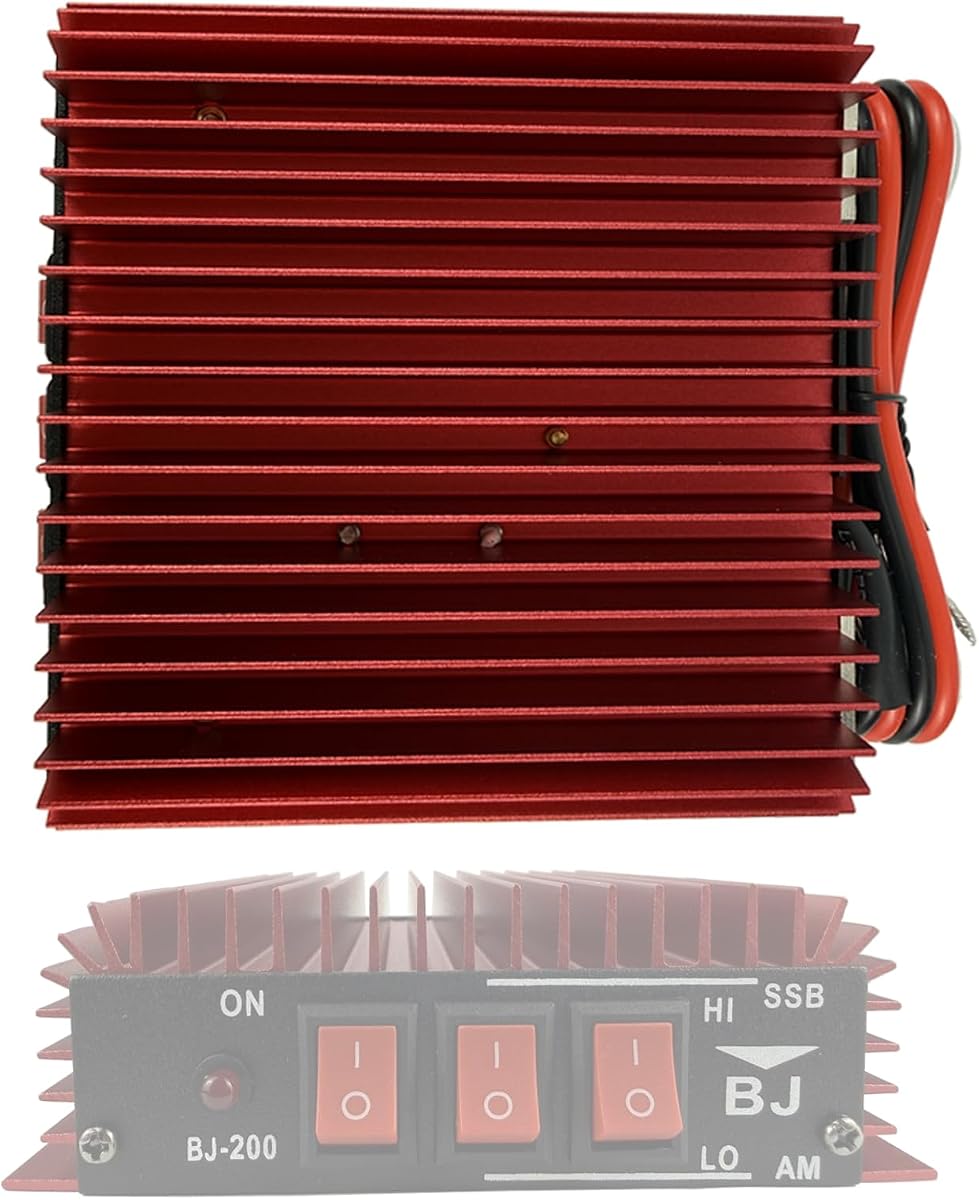
BJ-200
5.0Editor score
3–30MHz broadband coverage
Up to 150W SSB output
AM, FM, and SSB support
Polarity reversal protection
This guide compares the 10 best linear amplifiers for ham radio, covering power output, modes, protection, cooling, compatibility, setup needs and value.
Linear amplifiers for ham radio can turn a modest QRP transceiver into a more capable station, but the best model depends on your radios, operating modes, antenna system, and available space. A useful amplifier should increase usable power while preserving signal quality, controlling heat, and protecting both the amplifier and transceiver.
This guide compares ten amplifiers and a related RF amplifier module using the information supplied for each product. We examine stated output power, supported modes, frequency coverage, drive requirements, protection circuitry, cooling, display features, radio compatibility, installation considerations, and available customer ratings.
The selections range from compact broadband units and an exposed amplifier board to feature-rich Xiegu systems with automatic antenna tuners. Three standouts are highlighted at the top, while every product receives a detailed review that identifies its strongest benefits, practical limitations, and best-fit operators. Availability and pricing can change.
5.0Editor score

4.2Editor score

3.9Editor score
The table below compares every listed device by its stated output, operating scope, user controls, and system integration. Note that one entry is a receive-focused low-noise RF amplifier rather than a conventional transmit power amplifier, so it serves a different purpose within the broader radio setup.


The Xiegu GPA100 is a solid-state linear power amplifier intended to upgrade low-power HF transceivers into higher-powered stations. Its stated capability of up to 100 watts on HF and 80 watts on 6 meters makes it substantially more versatile than a simple single-purpose RF booster. It carries a 4.2 rating, and its most compelling feature is not raw output alone but the way it coordinates band selection, cooling, protection, and compatible radios.
We may earn a commission when you buy through this link, at no additional cost to you.
Seven bands can be selected manually using illuminated buttons or handled automatically when the amplifier is placed in auto mode. The built-in Bluetooth connection adds another layer of convenience for an IC-705 because band changes can be synchronized without an additional cable. Compatibility is also listed for the Xiegu G90, G1m, G106, X108G, X5105, X6100, and X6200, along with other suitable QRP transceivers. Where supported by the radio, ALC can also assist with efficient, safe amplification.
The intelligent protection system is another meaningful strength. It monitors for high SWR, overcurrent, overheating, low efficiency, and excessive drive, helping prevent a mismatch or operating mistake from becoming a larger problem. That matters for an amplifier whose job is to add substantial output to a working radio. The compromise is that it does not include an automatic antenna tuner, so a separate tuner and a suitable antenna system remain important parts of the installation.
This is the most complete choice for operators who want a dedicated HF station amplifier with thoughtful radio integration. It suits owners of the listed Xiegu transceivers, especially IC-705 users who can exploit wireless band control. Buyers using another radio should confirm drive levels, control compatibility, and whether ALC or automatic band tracking is available. For those needs, the GPA100 delivers the strongest overall balance of output, protection, and connected features in this list.
Manual band buttons, automatic tracking, and Bluetooth control make the GPA100 convenient for changing operating conditions. Compatible radios can reduce repeated front-panel adjustments, although operators should still verify every band change before transmitting.
Monitoring for SWR, current, temperature, efficiency, and excessive drive helps protect the amplifier and connected transceiver. These safeguards are especially valuable when moving quickly among antennas, bands, and operating modes.
We may earn a commission when you buy through this link, at no additional cost to you.
The BJ-300 Plus is a broadband linear radio amplifier offering a stated maximum output of 150 watts in SSB, 120 watts in AM, and 100 watts in FM. It also supports CW, making it a potentially useful platform for operators moving among voice, Morse, and FM applications. The product has a 3.1 rating, so its headline specifications should be weighed against the limited customer feedback represented by that score.
We may earn a commission when you buy through this link, at no additional cost to you.
Its input flexibility is designed around transceivers producing approximately 3–5 watts for AM or FM and 2–10 watts for SSB. The description also refers to compatibility with many CB radios and walkie-talkies operating in the HF range. That flexibility is useful for experimentation, but the broad wording makes it especially important to verify the exact impedance, drive requirements, and operating mode of your own equipment before making a connection.
Thermal management and electrical protection are the most persuasive hardware details. A cooling fan and large red aluminum heat sink are intended to support extended operation, while electronic reverse-polarity protection and dual 15-amp fuses help guard against incorrect power connections and electrical surges. The operator-facing design is comparatively simple, with a power switch, mode selector, and high or low adjustment. Standard PL-259 connectors labeled for the transceiver and antenna reduce installation complexity.
The BJ-300 Plus is best considered by operators who want substantial mode-dependent output and appreciate a simple, fan-cooled design. It may be particularly attractive for a shared CB and ham radio installation, although ham-radio-specific filtering, isolation, and compliance questions deserve careful review. The modest rating and vague compatibility language make this less of a confident all-purpose recommendation than the GPA100, but the stated output, protection, and straightforward controls still make it worth investigating for suitable stations.
Rather than treating every operating mode identically, the amplifier lists separate FM, AM, and SSB power levels. This makes it easier to compare the stated output with the mode and drive conditions used by your particular radio.
The combination of a radiator fan and aluminum heat sink addresses a central challenge in high-power amplification. It also makes airflow around the unit an installation consideration that should not be overlooked.
We may earn a commission when you buy through this link, at no additional cost to you.
This BJ-300 Plus listing shares the same broad 13.8-volt, four-mode architecture as the other Plus model, including support for AM, FM, SSB, and CW. Its stated maximum outputs are 100 watts FM, 120 watts AM, and 150 watts SSB. With a 3.1 rating, it offers substantial advertised capability, but prospective buyers should distinguish the headline output figures from the strength of the available customer feedback.
We may earn a commission when you buy through this link, at no additional cost to you.
The amplifier is designed to accept 3–5 watts of drive for AM and FM and 2–10 watts for SSB. A high or low output control lets operators adapt the unit to different conditions, and the mode selector makes the basic operating choice visible on the front panel. The supplied information also states compatibility with many CB radios and walkie-talkies in the HF range, though buyers should check exact model requirements and whether their intended equipment needs an interface they do not have.
Protection and thermal design form the core of the unit's practical appeal. Electronic polarity reversal protection helps prevent damage from an incorrectly connected power source, while two 15-amp fuses provide an additional layer against surges. A large red aluminum heat sink and a dedicated cooling fan are included to help dissipate heat during extended transmissions. Standard PL-259 transceiver and antenna ports support a relatively familiar installation process.
This listing makes the most sense for an operator seeking a simple, high-output amplifier with selectable operating modes and conventional connectors. It is less obviously suited to a modern, tightly integrated station because the product description does not mention digital control, automatic band tracking, or a tuner. Verify drive power, RF impedance, mode behavior, and local operating requirements first. If those factors align, the advertised output and robust physical protections could make it a practical base-station addition.
Dedicated mode selection and high-low controls provide a direct operating experience without a complicated menu. This simplicity can be useful for rapid setup or for operators who prefer physical switches.
Polarity protection and dual fuses address common installation mistakes before they become serious faults. Correct grounding and a stable 13.8-volt supply remain the operator's responsibility.
We may earn a commission when you buy through this link, at no additional cost to you.
The BJ-300 is a compact 13.8-volt broadband amplifier designed for HF transceivers and ham-radio operation. It lists support for AM, FM, SSB, and CW, with maximum output of 150 watts in SSB, 120 watts in AM, and 100 watts in FM. No customer rating is supplied, so the product's stated capabilities and design details provide the basis for evaluation rather than the track record reflected in the rating field.
We may earn a commission when you buy through this link, at no additional cost to you.
The listed drive range of 3–5 watts gives operators a clearer starting point than models that use more general language. A high-low power switch, separate on/off control, and LED indicator make day-to-day operation accessible. The amplifier also has an electronic switch, polarity inversion protection, and overvoltage protection, giving it several safeguards against common power-supply errors. Standard ANT and RTX ports support straightforward hookup with the radio and antenna system.
Durability is addressed through an aluminum alloy heat sink intended to dissipate heat efficiently. The compact construction is useful for a base station, but the exact dimensions and weight are not provided in the source information, so prospective buyers may still need to allow room around the unit for ventilation. The listed four-mode support and mode-dependent power figures are useful for comparing it with more specialized alternatives.
The BJ-300 is a sensible target for someone who wants a straightforward amplifier with a high maximum output and basic protections. It is particularly relevant when your radio produces roughly 3–5 watts and you use multiple modes. The absence of a customer rating, automatic tuner, advanced display, or explicit radio-control integration means it should be judged primarily on compatibility and simplicity. Confirm the required input range, connector type, and antenna impedance before purchasing.
Physical power controls and a visible LED reduce setup time and make the amplifier's state easy to identify. There is no complex configuration layer between the operator and the main power function.
Overvoltage and polarity protection are valuable because much of the amplifier's reliability depends on receiving the correct DC supply. A properly rated fuse and secure power installation should accompany those built-in safeguards.
We may earn a commission when you buy through this link, at no additional cost to you.
The BJ-200 is a broadband linear amplifier covering 3–30MHz and offering stated output levels of 50 watts FM, 100 watts AM, and 150 watts SSB from a 3–5 watt input. It holds a 5.0 customer rating, the highest numerical rating among the listed products. As a budget-oriented option, it focuses on straightforward amplification rather than an integrated tuner, large monitoring display, or wireless radio control.
We may earn a commission when you buy through this link, at no additional cost to you.
AM, FM, and SSB are explicitly supported, while the source information does not list CW as a supported mode. That distinction matters because a product intended for serious HF work is often expected to handle Morse as well as voice. Operators who regularly transmit CW should not assume compatibility merely because the amplifier covers the relevant frequency range. Instead, they should seek documentation from the manufacturer or seller before committing.
The amplifier operates from 13.8 volts DC with an 8–11-amp current draw, which demands a stable and correctly rated supply. Built-in polarity reversal protection reduces the risk of damage from a reversed power connection. A red aluminum alloy heat sink is included for thermal management, while an on/off switch, high-low adjustment, AM/SSB selector, and LED indicator keep the controls understandable. Its compact form is suited to either a base station or a vehicle installation where space is limited.
The BJ-200 is a strong pick for an operator who wants meaningful amplification across a wide HF span without paying for a more complex integrated system. It is especially relevant for AM, FM, or SSB users with a low-power radio. Its limitations are the absence of stated CW support and the need to verify exact connector, impedance, and drive compatibility. With those checks completed, the 5.0 rating and broad feature set make it an attractive value-oriented choice.
The broad 3–30MHz specification allows one unit to serve many HF and shortwave frequencies. Actual operation still depends on the amplifier, radio, filter arrangement, and antenna system working together correctly.
A rugged, compact housing and simple switches suit fixed or vehicle-based stations. The sizeable current draw makes power-supply capacity and wiring security especially important in an automotive environment.
We may earn a commission when you buy through this link, at no additional cost to you.
The Xiegu XPA125B combines a 100-watt-class HF power amplifier with an integrated automatic antenna tuner. The supplied description notes a maximum amplifier output of 125 watts, making it appropriate for moving a low-power QRP radio or SDR transceiver to substantially higher output. Its 3.9 rating reflects a useful mix of capability, although the more advanced feature set also creates a larger learning curve than a basic broadband amplifier.
We may earn a commission when you buy through this link, at no additional cost to you.
The built-in tuner is the defining feature. It handles stated loads from 14 to 500 ohms across HF and the 6-meter band, and the tuner and power-amplifier functions can be used independently. This flexibility allows the operator to use automatic tuning with the integrated amplifier or deploy the tuner as a separate matching device. That versatility is especially valuable when operating portable, compact, or otherwise less forgiving antennas.
A 2.7-inch backlit LCD provides unusually clear station feedback, showing input and output power, SWR, voltage, current, temperature, amplifier status, and warnings. Intelligent protection monitors excessive SWR, excessive drive, and high temperature, moving the amplifier into bypass and displaying an alarm when abnormalities arise. The enhanced XPA125B is also described as smaller than the earlier XPA125, making it more practical for a crowded operating position.
This is the premium pick for operators who value integrated tuning, detailed telemetry, and a single-device approach to a higher-powered station. It is particularly compelling for portable QRP work, SDR users, and operators with antennas that change often. Confirm that your radio's drive level, operating modes, and control expectations are compatible, and allow appropriate ventilation. For those who value the tuner and monitoring display, it offers a more complete station package than a basic amplifier.
The integrated tuner can accommodate a wide stated impedance range and serve as an independent matching unit. This makes the system useful where antenna conditions vary or a compact antenna is part of the operating plan.
The backlit display consolidates power, SWR, voltage, current, temperature, and alarm information. Clear feedback helps an operator recognize changing conditions before continuing to transmit.
We may earn a commission when you buy through this link, at no additional cost to you.
The LICAEVEY 30W is a finished shortwave power amplifier board rather than a complete console-style amplifier. It is designed to add up to 30 watts across the 3–30MHz spectrum, with the supplied information specifically identifying CW and SSB operation. No customer rating is available, making the technical description the primary basis for evaluating this more specialized component.
We may earn a commission when you buy through this link, at no additional cost to you.
The board uses broadband circuitry intended to provide consistent gain without manual retuning across major amateur bands. It includes clearly marked RF input, RF output, and power connections, which can simplify integration into a home-built station. An integrated heat sink and low-loss PCB material are intended to handle extended transmit cycles, while the described transistor design and stable circuitry target dependable operation.
Its main appeal is modularity. Operators comfortable with RF assembly can incorporate a 30-watt stage into a compact or custom station without buying a large dedicated enclosure. The trade-off is that the product does not present the same finished, protected, display-equipped experience as the Xiegu units or larger BJ-series amplifiers. RF layout, grounding, shielding, filtering, enclosure design, and power-supply integration all become important parts of the project.
This board is best for a technically confident builder seeking a compact CW or SSB amplifier module for a home station, Field Day setup, or portable project. It is less appropriate for a first-time amplifier buyer who wants a ready-to-connect system with comprehensive monitoring. Before installation, verify drive requirements, impedance, bias or operating parameters, and the intended cooling arrangement. For the right builder, the board offers a more flexible path to a personalized HF station.
The product data emphasizes linear operation for CW and SSB across the shortwave spectrum. This focus makes it more relevant to a dedicated home-built HF station than to a broad multi-mode radio accessory.
Marked connections simplify the broad layout, but a usable station still requires enclosure, supply, cooling, grounding, and appropriate RF connections. Builders should treat the board as a component within a complete design.
We may earn a commission when you buy through this link, at no additional cost to you.
The BJ-200 CB Radio Power Amplifier is a compact unit centered on uncomplicated installation. It accepts 12–14 volts DC and can use either an appropriate automotive supply or a stationary CB power source. The broad voltage range is useful because many mobile installations experience voltage changes during engine starts, although the amplifier and its wiring still need to be securely installed.
We may earn a commission when you buy through this link, at no additional cost to you.
Connection is described through a three-wire arrangement covering RF input, RF output, and DC power. The RF interface uses an SO-239 connector, a common choice in CB installations. This straightforward architecture reduces the number of configuration decisions, making the amplifier relevant to CB operators who want more output without a complex station-control system.
The source information is limited compared with the other entries. It does not provide a detailed output-power figure, operating-mode list, frequency range, protection circuitry, cooling arrangement, or numerical customer rating. Those omissions make it difficult to compare this listing confidently with a fully specified HF linear amplifier. Ham-radio buyers should obtain a complete specification and confirm regulatory, filtering, and operating-mode requirements before considering it for an amateur station.
This amplifier is best matched to a straightforward CB installation where a simple 12–14-volt supply and SO-239 connections are the deciding factors. It may be useful for a vehicle setup or a basic fixed station, but the limited information argues against choosing it solely on the BJ-200 name. Confirm the actual power rating, drive level, frequency coverage, thermal requirements, and whether it meets local amateur-radio operating rules.
Using an SO-239 interface and separating RF from DC makes the connection concept familiar to CB operators. Cable quality, grounding, and impedance continuity remain essential to good results.
The stated input range fits common automotive and stationary power environments. Secure wiring and a supply capable of supporting the amplifier's actual current draw remain essential.
We may earn a commission when you buy through this link, at no additional cost to you.
The Low Noise RF Amplifier is included for comparison because it is frequently marketed to ham-radio users, but it serves the receiving side of the station rather than boosting transmitted power. It covers an unusually broad 0.1–2000MHz range with a typical gain of 32dB. Its 4.2 rating makes it one of the better-rated products in the list, though its purpose should not be confused with a linear transmit amplifier.
We may earn a commission when you buy through this link, at no additional cost to you.
The device is designed to improve weak-signal reception and can serve as a front-end amplifier for ham radio, SDR, CB, shortwave, and other RF reception systems. It operates from 9 to 12 volts and draws only 27 milliamps, making it practical for portable or battery-powered arrangements. Maximum output is specified as 13dBm, or 20mW, at a 50-ohm system impedance, which illustrates that it is not intended to deliver substantial transmit power.
Its broad frequency coverage, consistent 50-ohm impedance, and low-noise design can be helpful where a station struggles with weak signals. The same characteristics require care, however, because a wideband amplifier may also increase noise or interference outside the desired band. A properly selected receive filter, isolation from transmitter leakage, and careful antenna placement are more important than headline gain alone.
This product is an excellent companion for a receive-focused station, particularly for shortwave listeners, SDR users, or operators with weak local signals. It is not a substitute for a 100-watt-class linear amplifier and should not be connected in the transmit path. The low current draw, wide coverage, and 4.2 rating make it a useful accessory, while the 13dBm output ceiling makes its role clear.
The stated 32dB gain can make quiet shortwave or SDR signals easier to work. In practice, filters and antenna improvements often determine whether a receive preamplifier helps the overall station.
A 9–12-volt supply and 27mA current draw support field and battery operation. Keeping the device close to the antenna can also help reduce unwanted signal loss before amplification.
We may earn a commission when you buy through this link, at no additional cost to you.
This Xiegu XPA125B listing presents the XPA125B as a combined 100-watt PA and automatic antenna tuner designed for Xiegu host radios. It carries a 4.1 rating, making it one of the stronger customer-rated products in the guide. Its key attraction is the combination of higher output, automatic tuning, and compatibility with several established Xiegu transceiver models.
We may earn a commission when you buy through this link, at no additional cost to you.
Automatic tuning is intended to reduce the need for manual adjustment, while the system is described as maintaining maximum output. The stated compatibility list includes the Xiegu G90, G106, X5105, X6100, and X6200, along with future Xiegu models. That makes the unit most compelling to an operator whose primary radio already belongs to the Xiegu ecosystem and whose antenna system benefits from automatic matching.
The description also emphasizes the use of quality materials for durability and long-term reliability, along with technical support offered through the seller. The source information does not reproduce the more extensive display, protection, and tuner details associated with the other XPA125B listing in this roundup. Buyers should therefore review the complete manual and compare the exact package contents, especially if considering both versions, because their supplied descriptions emphasize different aspects of the same model family.
This amplifier is best for Xiegu owners who want an integrated, higher-powered station with automatic tuning and coordinated radio compatibility. It is less attractive if your transceiver comes from another brand or you require a fully open, documented control interface. Verify the radio-control connection, output behavior, antenna impedance range, and included accessories before ordering. For the stated ecosystem, it offers a convenient route to a polished integrated station.
Compatibility with several popular Xiegu transceivers reduces guesswork for operators building around that product line. Future-model support may also make the amplifier useful across a longer ownership period.
The amplifier is designed to tune automatically and maintain its stated output, reducing repeated manual adjustments. Operators should still monitor SWR and ensure their antenna and feed line are suitable.
We may earn a commission when you buy through this link, at no additional cost to you.
A ham-radio linear amplifier is only as useful as its match to the radio, antenna, operating modes, and installation environment. Before comparing maximum output figures, consider drive requirements, signal integrity, thermal needs, protection, and how much control you want the amplifier to provide.
The first step is to identify the radio's exact model, output power, impedance, and supported operating modes. A good linear amplifier should accept the radio's normal drive level without being underdriven or forced beyond its safe input range. The listed BJ-300 models accept approximately 2–10 watts for SSB and 3–5 watts for AM or FM, while the BJ-200 uses a 3–5-watt input. The GPA100 and XPA125B are explicitly presented as suitable for low-power Xiegu and QRP radios.
Maximum output is rarely a single universal number. The BJ-series products list separate SSB, AM, and FM levels, reaching as high as 150 watts in SSB in the supplied data. The GPA100 lists up to 100 watts on HF and 80 watts on 6 meters, while the XPA125B listings describe a 100-watt operating class with a 125-watt maximum in one listing. Compare output using the same mode and measurement conditions, and consider whether your antenna and feed line can safely handle the resulting power.
Coverage should include the amateur bands and frequencies you actually plan to use. The BJ-200 is specified for 3–30MHz, the LICAEVEY board covers 3–30MHz with CW and SSB emphasized, and the XPA125B tuner covers HF and 6 meters. Mode support also varies: several BJ models include AM, FM, SSB, and CW, while the BJ-200 listing specifically names AM, FM, and SSB. Confirm that the selected device supports every mode in your operating plan.
A linear amplifier should preserve the shape of the transmitted signal across its operating bandwidth. Stable broadband operation and low distortion are especially important for SSB and digital modes. Because harmonic and spurious emissions must also be controlled, an amplifier should be used with appropriate station filtering and a sound antenna system. The included specifications for these products emphasize linear output and mode compatibility, but they do not provide detailed spectral-purity measurements for every model.
Protection should cover the failure conditions most likely to damage an amplifier or its connected radio. The GPA100 monitors high SWR, overcurrent, overheating, low efficiency, and overpower, while the XPA125B can bypass on excessive SWR, excessive drive, or high temperature. The BJ units emphasize polarity protection, fuses, and in some cases overvoltage protection. None of those features replaces correct installation, but they provide valuable layers of defense after a mistake or changing operating condition.
High-power solid-state amplifiers generate significant heat that must be removed consistently. The BJ-300 Plus uses a cooling fan and large heat sink, the BJ-200 and BJ-300 rely on aluminum heat-sink construction, and the LICAEVEY board incorporates a heat sink. In every case, leave the recommended clearance around the unit and use a power supply that can maintain its required current without becoming the weak point in the installation.
An integrated automatic tuner can simplify operation, especially with portable antennas or changing feed-point impedances. The XPA125B provides the strongest tuner-focused option in this group and can operate its tuner and amplifier independently. The GPA100 instead emphasizes band control and wireless synchronization with compatible radios, while the basic BJ models focus on manual mode and power settings. Choose based on whether automatic matching, radio integration, or simple physical controls matter most.
A display can make a high-power station safer by showing SWR, power, voltage, current, temperature, and warnings. The 2.7-inch XPA125B screen provides the most detailed stated monitoring, while the GPA100 uses indicator lights and intelligent protection. The BJ products rely on physical switches, which can be quicker to understand. In every case, confirm connector type, physical size, required grounding, available space, and whether your antenna system includes a separate tuner.
Begin with the manufacturer's instructions, the radio manual, and the amplifier's stated drive requirements. Confirm the RF impedance, connector type, operating mode, DC supply voltage, and current capacity before connecting anything. Install the amplifier in a stable, ventilated position with unobstructed airflow around its heat sink, and use a properly rated fuse close to the DC source.
For a basic amplifier, connect the transceiver to the drive input and the antenna system to the output, then begin with the amplifier off and the radio's output at its lowest setting. Increase drive gradually while watching indicated power, SWR, current, and temperature. If using an integrated tuner, follow its automatic-tuning procedure and allow it to complete before sustaining a transmission. Never operate the amplifier into a known mismatch or continue transmitting after a protection alarm.
Care for the unit by allowing the heat sink and fan to cool after transmissions, keeping dust away from vents and connectors, and checking wiring and connectors periodically. Watch for unexpected changes in output, SWR, or operating temperature, as these can indicate a failing cable, antenna issue, power-supply problem, or amplifier fault. Follow local amateur-radio rules, use any required station filtering, and never transmit unless the complete system is operating correctly.
A linear amplifier is optional, but it can help when a QRP or low-power radio cannot reach the level needed for a particular band, path, or operating style. It is most useful when the antenna system can support the added power and the operator has a reliable cooling and grounding arrangement. For many local contacts or portable setups, a good antenna and radio may provide more value than additional amplifier power.
The correct drive depends on the specific amplifier and mode. The products here list requirements such as 3–5 watts for the BJ-200 and approximately 2–10 watts for SSB on the BJ-300 models. Drive must also stay below the amplifier's safe input limit, and the radio's ALC or carrier-control behavior should be understood before connecting it.
A linear power amplifier boosts the signal being transmitted from a radio, generally from a few watts to a much higher output level. A low-noise RF amplifier boosts received signals at the front end, helping weak signals become more readable. The low-noise module in this guide improves reception but cannot replace a transmit amplifier and has a maximum output far below the high-power units.
It depends on the antenna system. A well-matched resonant antenna can work well with many amplifiers, while portable, indoor, or multiband antennas often benefit from automatic tuning. The XPA125B includes an integrated tuner, whereas the GPA100 and BJ models do not, so operators should plan an external tuner where the antenna feed point requires one.
The amplifier should have unobstructed airflow around the heat sink, and any built-in fan should be able to draw clean air. Exact clearance depends on the manual, but tightly enclosing a high-output unit can raise internal temperatures and shorten component life. Monitor temperature during long transmissions and never block the intended cooling path.
Only if the device's frequency range, modes, filtering, and technical characteristics are appropriate and lawful for the intended amateur operation. The sparse BJ-200 CB listing does not provide enough detailed output or filtering information to confirm suitability. Operators should request complete specifications and verify applicable local regulations before using it on amateur bands.
A protective trip usually indicates excessive SWR, overdrive, high temperature, an electrical fault, or another condition outside the safe operating envelope. The GPA100 and XPA125B specifically monitor several of these parameters. After a protection event, stop transmitting and check the antenna, feed line, drive level, ventilation, power supply, and connectors before retrying.
It can be a good match when the SDR produces a suitable low drive level and the operator needs more output than the radio provides. The XPA125B is explicitly described as suitable for low-power SDR transceivers. Confirm output impedance, drive control, filtering, and antenna compatibility, and begin with conservative power to avoid damaging either device.
The Xiegu GPA100 is the strongest all-around recommendation in this guide because it combines useful HF output, seven-band selection, intelligent protection, cooling, and wireless integration with compatible radios, particularly the IC-705. The BJ-200 stands out as the best budget-oriented pick, offering a 5.0 rating, broad 3–30MHz coverage, and substantial stated mode-specific output. For operators seeking the most complete premium station, the XPA125B adds an integrated automatic antenna tuner and detailed status monitoring.
Before choosing, prioritize compatibility with your exact transceiver, the modes and frequencies you use, and the power your antenna system can safely support. Protection, thermal management, and truthful control information matter more than the largest output number. Low-drive radios generally benefit most from a well-matched amplifier, while demanding or portable stations may place greater value on automatic tuning and detailed operating feedback.
Finally, check current pricing, availability, seller information, warranty terms, and the latest product documentation before ordering. Technical specifications and market conditions can change, and two listings may present the same model with different amounts of detail. Comparing the live listing against your radio, antenna, power supply, and operating plan is the safest way to select an amplifier that will be useful rather than merely powerful.