
WG-026 10-Piece Test Lead Set
4.7Editor score
Ten color-coded test leads
Twenty-inch nickel-plated clips
Flexible 22 AWG copper wire
Discover the best electrical alligator clips with wires by comparing lengths, gauges, ratings, clip sizes, colors, insulation, and testing uses.
Electrical alligator clips with wires connect a test instrument to terminals, components, batteries, and circuit-board points where a conventional probe is difficult to position. A useful set should combine secure jaw tension, sound electrical contact, flexible insulated leads, accurate length, and a construction suited to the voltages and currents involved in your work.
This guide compares ten dual-ended alligator-clip test-lead sets using the specifications and customer ratings supplied for each product. The comparison covers wire gauge, cable length, clip dimensions, color coding, insulation type, stated voltage and current limits, lead quantity, and practical applications such as laboratory diagnostics, prototyping, automotive inspection, and temporary circuit connections.
Each review identifies the strongest reason to consider a particular set while noting any important limitations. The selections include budget options for electronics experimentation, longer leads for automotive work, high-gauge cables for heavier current, and color-coded kits for organized benches. Product availability and pricing can change, so confirm current listings and specifications before purchasing.
4.7Editor score
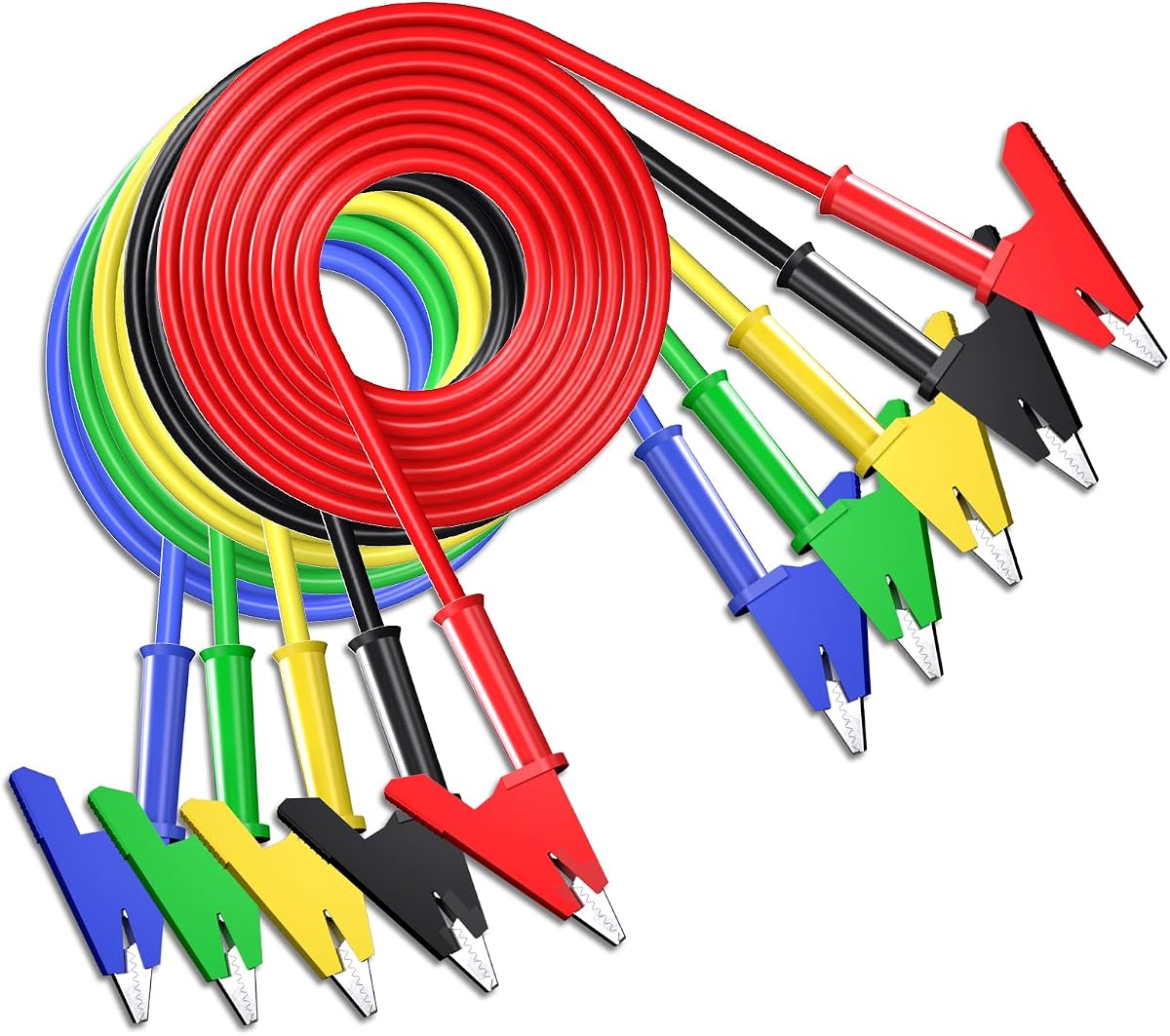
4.8Editor score

4.6Editor score
The comparison below places all ten sets side by side, highlighting practical differences in lead count, cable construction, reach, color organization, and stated electrical limits that can influence which option fits a particular test bench or diagnostic workflow.


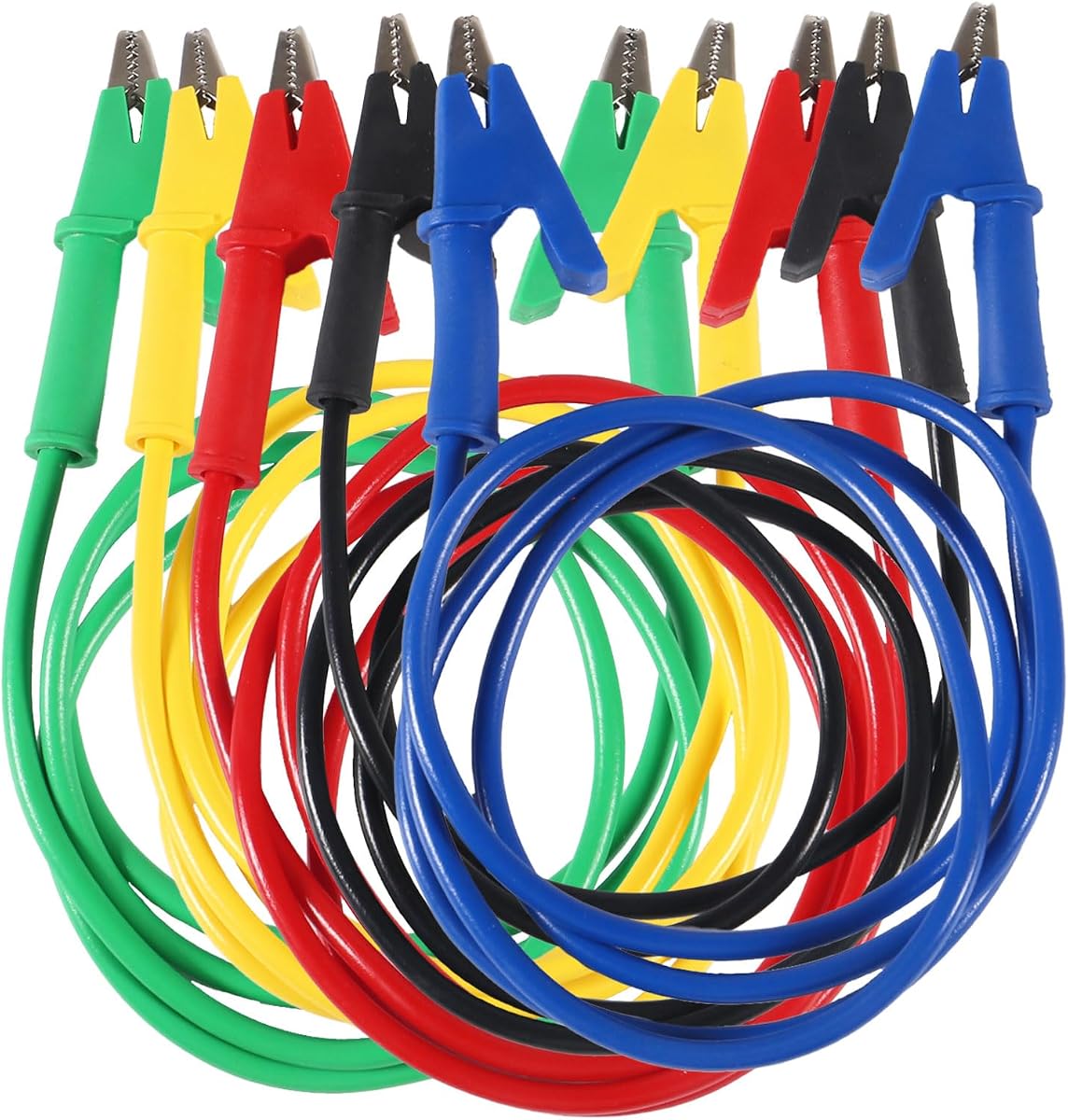
The WG-026 is a 10-piece dual-ended test-lead set that combines five colors, flexible 22 AWG copper wire, and nickel-plated steel alligator clips. Its 4.7 rating reflects a broadly favorable customer response, and its most immediately useful quality is organization: two leads each in red, black, yellow, green, and white make it easier to separate circuits or identify paired connections on a crowded work surface.
We may earn a commission when you buy through this link, at no additional cost to you.
The clips are specified at 1.6 inches long and feature strong springs for a secure grip. Their nickel-plated steel construction and corrosion resistance make them suitable for repeated electronics testing, while PVC insulation on the wire provides the basic electrical separation needed for typical bench work. The clips are soldered and stamped to the conductors, a construction intended to support dependable conductivity and long-term use.
The principal limitation is wire capacity. A 22 AWG lead is thinner than the 14 and 18 AWG alternatives in this guide, making the WG-026 better aligned with light electronic testing, breadboards, prototyping, and diagnostics than with demanding high-current work. The supplied information also does not list an overall voltage or current rating, so users should evaluate the complete setup against their own equipment rather than infer a rating from the materials alone.
This set is an attractive choice for students, hobbyists, technicians, and educators who want multiple color-coded leads without carrying a large assortment of specialized cables. The 20.5-inch length is useful for reaching nearby test points while remaining compact enough for storage. It is a particularly well-rounded starter set for users who value clear organization and dependable clip contact more than heavy-current capability.
Two leads in each of five colors make it simpler to maintain a visual map between positive, negative, signal, and auxiliary connections. This is especially helpful in electronics experiments, classroom demonstrations, and troubleshooting sessions where crossing or reversing leads can create confusion.
At 20.5 inches overall, the leads offer enough separation for many bench-level measurements without creating excess cable clutter. The compact format also makes them easier to coil, store, and carry between a toolbox and a workbench.
We may earn a commission when you buy through this link, at no additional cost to you.
The SWANLAKE set consists of two dual-ended alligator-clip leads designed for electrical testing with multimeters, probes, and banana-terminal equipment. Its 4.7 customer rating and clearly stated 1000V, 15A limits make it easy to distinguish from lighter general-purpose jumper sets. The 3.5-foot, or approximately one-meter, length is the defining convenience for reaching recessed terminals or keeping a meter away from the connection under inspection.
We may earn a commission when you buy through this link, at no additional cost to you.
The leads use copper alligator clips and thick insulated cables. Their rubber insulation covers are intended to protect the cable from damage and reduce the likelihood of accidental contact between conductors. The clips are designed to grasp test points firmly, allowing a user to leave them attached while reading a meter, probing another node, or moving to the next stage of a diagnostic process.
Because only two leads are supplied, this package is less convenient when several simultaneous connections or numerous color-coded circuits are required. There is also no multi-color assortment to help separate channels. Its advantages are therefore most apparent for technicians who need one or two dependable reach extensions rather than a comprehensive collection of short bench leads.
Choose the SWANLAKE set when distance, explicit rating information, and hands-free contact are the leading priorities. It suits multimeter measurements, battery checks, circuit-board testing, and other jobs where the clip must remain attached to a small terminal while the instrument is positioned elsewhere.
The approximately one-meter cable gives the operator room to work around panels, housings, and crowded assemblies. It can also reduce the need to hold a probe manually while both hands remain focused on reading and adjusting the test instrument.
Published limits of 1000V and 15A make it easier to match the leads to the test equipment and circuit under examination. Users should still apply appropriate electrical safety practices and confirm that every connected component is suitable for the intended test.
We may earn a commission when you buy through this link, at no additional cost to you.
The EDGELEC 12-piece set offers a broad assortment of color-coded leads, with 12 total pieces distributed across six colors. Its 4.5 rating indicates generally positive feedback, while the use of UL1015, 18 AWG tinned copper wire distinguishes it from the thinner 22 AWG option near the top of the list. These leads are positioned for experiments, breadboards, prototyping, troubleshooting, and temporary circuit connections.
We may earn a commission when you buy through this link, at no additional cost to you.
Each 1.77-inch alligator clip is made from nickel-plated steel and covered by a non-slip rubber sleeve. The maximum opening is stated at 0.67 inches, giving it a useful range for gripping small component leads, hookup wire, and test terminals. The total lead length is 23.5 inches, and the clips are soldered and stamped to the wire to support a robust mechanical and electrical connection.
The six-color palette is the set's most noticeable organizational feature. It allows more separation between test categories than a typical red-and-black set, while the 18 AWG conductor provides a more substantial feel and lower resistance potential than lighter wire. However, the supplied details do not include a maximum voltage or current rating, so the listing should not be treated as a complete safety specification for every working environment.
This EDGELEC assortment is well suited to electronics learners, prototyping enthusiasts, and bench technicians who frequently move among several circuits. It is especially helpful when identifying individual connections matters, and the relatively long 23.5-inch lead reaches from a board to a meter or nearby fixture without requiring extension cables.
The 18 AWG tinned copper construction sits between lightweight bench leads and heavy-gauge diagnostic cables. It is a sensible middle ground for low- and moderate-current experiments where conductor durability and secure attachment matter.
Having more colors available helps users maintain consistent paths across multiple experiments. The visual separation is particularly valuable when several nodes must remain connected while troubleshooting or documenting a circuit.
We may earn a commission when you buy through this link, at no additional cost to you.
The 20-piece crocodile test-lead kit is the largest assortment in this comparison, providing dual-ended leads in five colors. Its 4.3 rating is the lowest of the ten, but the sheer number of leads gives it substantial value for users who want options on hand. Each lead measures about 21.7 inches overall, and the clip terminal is approximately 1.38 inches long.
We may earn a commission when you buy through this link, at no additional cost to you.
PVC-covered cable provides the primary insulation, while the metal clip terminals are explicitly noted as uncovered. The listing warns against use above the rated voltage, although no overall voltage or current figure is supplied in the product information. This makes the set more appropriate for general low-level testing and prototyping than for assuming a maximum operating envelope.
Its detachable design is practical for quick connection changes. The 1.38-inch jaws are described as firm enough to resist slipping, which is useful when a lead must remain connected to a battery, appliance terminal, motor connection, or digital product during a power test. The high count also makes it easier to assign separate leads to different circuits and retain them as a ready-made testing group.
This is the strongest budget choice for users who need many leads more than they need high-current or explicitly rated performance. Electronics students, hobbyists, and repair technicians can use the assortment for temporary connections, power tests, motor checks, and circuit experiments. The main reason to hesitate is the absence of a stated overall rating, so it should be reserved for applications where the circuit and the user's safety practices are appropriate.
A large inventory reduces the need to improvise temporary jumpers from spare wire. Users can keep dedicated leads for separate circuits, voltage ranges, or bench areas and reduce the chance of confusing their roles.
The detachable clip arrangement allows leads to be connected or repositioned quickly during repeated diagnostic checks. That convenience is useful when testing several appliance, motor, or digital-product connections in succession.
We may earn a commission when you buy through this link, at no additional cost to you.
The EDGELEC heavy-duty set is built around 14 AWG, UL3135 tinned copper wire with silicone insulation. Its 4.6 rating reflects a solid customer response, while the conductor gauge and 1500V, 15A stated limits position it as a more heavy-duty option than most of the lighter test-lead sets in this guide. The package includes one red and one black lead.
We may earn a commission when you buy through this link, at no additional cost to you.
The two clips are specified at 2.2 inches long and use nickel-plated copper with non-slip rubber sleeves. Their maximum opening is 10 millimeters, allowing them to attach to relatively small test points while maintaining a secure jaw. The overall length is listed as 3.86 feet, or 1.18 meters, and the clips are soldered and stamped to the wire for a robust connection.
Silicone insulation adds flexibility and remains workable across changing temperatures, which is valuable in automotive and motorcycle maintenance environments. The longer cable and larger clip body make this set easier to work with outside a stationary electronics bench. However, the two-lead format is minimal for users who need many simultaneous or color-separated connections.
This is the premium choice in the group for automotive, motorcycle, and higher-current inspection work where wire robustness matters. It is also suitable for laboratory experiments and troubleshooting involving larger conductors. Choose it over a smaller-gauge kit when mechanical durability, reach, and stated electrical capacity outweigh the benefit of having many color-coded leads.
Fourteen AWG wire is noticeably more substantial than the 18 and 22 AWG options in the guide. Its lower conductor cross-section can better accommodate higher-current test demands and is less prone to feeling undersized during automotive-style diagnostics.
The silicone jacket supports easy routing around engine bays, battery terminals, and other confined spaces. Its flexibility also makes the leads simpler to coil for storage between jobs.
We may earn a commission when you buy through this link, at no additional cost to you.
This four-group set offers eight clip ends arranged into red and black groups for temporary electrical testing and circuit connections. Its 4.4 rating indicates generally favorable feedback, and the one-meter lead length provides useful reach between a test instrument and a component. Each end is an alligator clip, allowing hands-free connection to terminals and exposed test points.
We may earn a commission when you buy through this link, at no additional cost to you.
The cable uses PVC insulation, while the clips use nickel-plated steel with strong springs. The listing notes that the insulated clip sleeves can slide to adjust the exposed metal area, which gives users a degree of control over contact and coverage. It also describes the surface plating as glossy and states that the construction helps prevent wire crossing and short circuits during organized bench work.
A four-group format is more versatile than a basic two-lead set but less varied than the 12- or 20-piece assortments. The red-and-black scheme is straightforward for polarity-aware measurements, although it offers less channel separation for complex setups. No overall voltage or current rating is included in the supplied specifications, so the set is best treated as a general test-lead option rather than a fully specified high-energy product.
This set works well for laboratories, workshops, schools, homes, circuit-board prototyping, and troubleshooting. It is a good middle ground for users who want several leads and approximately one meter of reach without a very large assortment. Its grouped red-and-black organization is particularly convenient when the same pair of meter leads is repeatedly moved among different test points.
Keeping red and black leads in distinct groups reduces the chance of reversing a connection during repetitive checks. This is helpful for beginners and for workflows involving several separate circuit-board tests.
Sliding insulated sleeves allow the amount of exposed clip metal to be adjusted. That feature can help balance contact area with protection during low-voltage bench tasks.
We may earn a commission when you buy through this link, at no additional cost to you.
The Goupchn five-piece set combines dual-ended copper clips, five distinct colors, and a 3.3-foot lead length. It carries a 4.8 rating, the highest in this comparison, and its stated 1000V and 15A limits make it one of the most clearly specified options. The package is designed for general electrical testing and automotive accessories, including circuits protected by 15A-or-smaller fuses.
We may earn a commission when you buy through this link, at no additional cost to you.
The clips have a maximum opening of 10 millimeters and are firmly fixed to the wires. Rubber insulation layers are intended to keep the clips from slipping, while the springs are described as strong enough to resist deformation during repeated use. These characteristics support stable hands-free contact, which is valuable when testing vintage cars, trucks, motorcycles, or ordinary circuit boards.
The five colors make it easy to distinguish separate test paths without carrying a much larger assortment. The 3.3-foot length offers a balance between reach and manageable cable bulk. One practical boundary is the stated 15A ceiling and the guidance that the tested circuit use a fuse of 15A or less; the leads should not be treated as suitable for circuits beyond those conditions.
This is the most balanced overall recommendation for users who want color coding, explicit ratings, secure clips, and automotive-capable reach in a compact five-lead package. It works particularly well for general electrical testing, vehicle accessory checks, and circuit troubleshooting. Choose it when a five-color set offers enough flexibility without carrying 12 or 20 individual leads.
Five leads provide enough distinction for several channels while remaining easy to store and transport. The color scheme is particularly valuable when moving between a vehicle, an appliance, and a circuit board without rebuilding the entire test arrangement.
Firmly attached clips and robust springs help the leads remain attached to a terminal during measurement. This stability reduces the need to hold a connection while operating a meter or inspecting another part of the circuit.
We may earn a commission when you buy through this link, at no additional cost to you.
The EBOOT four-piece set includes double-ended alligator-clip leads arranged in two color groups. Its 4.4 rating reflects a favorable reception for a straightforward test-lead package. Each lead is one meter, or 3.28 feet, long, providing useful separation between a meter and the component being checked without the bulk of longer automotive cables.
We may earn a commission when you buy through this link, at no additional cost to you.
The construction combines copper wire, a PVC-insulated sleeve, and vinyl-covered alligator clips with strong springs. The clips attach securely to support good conduction, while red and black color coding helps prevent crossed wires and shorts during circuit tests. The four-lead quantity gives users enough options for a pair of connections without creating the storage burden of a much larger kit.
This set is positioned primarily for low-voltage electrical and laboratory testing, circuit connection, experimentation, and temporary jumper work. No maximum voltage or current rating appears in the supplied product information. Accordingly, users should apply it only in compatible circuits and should not infer a high-energy rating from the copper wire or clip construction.
The EBOOT set is a practical choice for schools, home workshops, electronics benches, and basic troubleshooting kits. It is best for users who prioritize familiar red-and-black polarity coding and dependable clip attachment over advanced specifications or a large color range.
Red and black leads make polarity immediately recognizable during routine measurements. That familiar convention helps users keep signal and return paths consistent across different circuits.
The spring-loaded vinyl-covered clips are suitable for making temporary links between components and wires. Their secure attachment is useful during experiments where the connection must remain stable while other adjustments are made.
We may earn a commission when you buy through this link, at no additional cost to you.
The DROK pair uses heavy 14 AWG copper wire in a compact 50-centimeter format. Its 4.6 rating places it among the stronger customer-rated options, while the stated maximum current of 19A makes it a credible choice for diagnostics that require more conductor capacity than the lighter sets in this guide. The package includes two jumper wires with alligator clips.
We may earn a commission when you buy through this link, at no additional cost to you.
The clips use copper with nickel plating for corrosion resistance, and the wire has durable PVC insulation. Reinforced construction is intended to withstand frequent use in electrical testing, automotive diagnostics, and DIY projects. The lead length keeps the set easy to control while still providing enough reach for compact components, batteries, and terminals.
The absence of a stated voltage rating means the current figure should not be treated as permission for unrestricted testing. The compact length and two-lead count also make this more of a purpose-built heavy-gauge pair than a comprehensive collection. It is most attractive when conductor thickness and current handling matter more than lead count or color variety.
The DROK set suits automotive circuit diagnostics, laboratory experiments, and DIY electronics requiring a compact 14 AWG lead. It is also useful for users who often replace lighter jumpers and want a sturdier pair without carrying long cables. For broad bench organization, however, a multi-color set would be the better companion.
Fifty centimeters is long enough to span nearby test points but short enough to prevent excessive cable from becoming tangled. The format is particularly useful on a crowded bench or inside a compact vehicle diagnostic setup.
Nickel-plated copper clip contacts are designed to resist corrosion during repeated use. This supports consistent contact in automotive and workshop environments where exposure and handling are frequent.
We may earn a commission when you buy through this link, at no additional cost to you.
This five-piece dual-ended set combines 3.3-foot flexible copper jumper wires with alligator clips and a stated 1000V, 15A rating. Its 4.7 customer rating places it near the top of the guide, and its five-lead format offers a practical middle ground between a basic pair and a large assortment.
We may earn a commission when you buy through this link, at no additional cost to you.
The silicone-covered cables are described as smooth, kink-free, easy to coil, and flexible in cold weather. That construction is especially useful for users who route leads around panels or store them in a toolbox between tasks. Each clip has a maximum opening of 10 millimeters, uses pure copper contacts, and is firmly secured to the wire. Rubber insulation and a robust spring help maintain a firm grip and resist deformation from regular wear.
The product is intended for electrical testing, experimentation, breadboarding, prototyping, troubleshooting, and temporary circuit connection. It lacks a clearly stated conductor gauge in the supplied details, so a buyer seeking a specific heavy-gauge or fine-wire construction should not assume one. Likewise, the stated rating must be observed along with appropriate limits on the rest of the test setup.
This set is a versatile general-purpose option for laboratories, workshops, schools, homes, and industrial work. It is especially appealing to users who value flexible silicone leads, several colors, and explicit voltage and current information without needing a very large assortment.
Smooth, flexible jackets resist kinking and remain manageable during routing and storage. These qualities are valuable when a lead must bend repeatedly around a component or pass through a narrow access opening.
The assortment provides enough physical separation for several test paths while remaining compact. Distinct colors make it easier to keep track of connections during breadboarding, prototyping, and troubleshooting.
We may earn a commission when you buy through this link, at no additional cost to you.
The right alligator-clip lead depends on the circuit, the equipment being tested, and the working environment. Wire gauge, lead length, insulation, clip dimensions, color organization, and stated electrical limits should be considered together rather than judged from a single specification.
Wire gauge indicates conductor cross-section and strongly influences current handling, flexibility, and physical durability. The guide includes 14 AWG options for heavier diagnostic work, 18 AWG for a balance of substance and flexibility, and 22 AWG for lighter electronics testing. Select the gauge according to the expected current and the demands of the circuit, not merely the clip size, because a strong jaw cannot compensate for an undersized conductor.
Choose heavier wire for higher-current or demanding automotive work, and lighter wire when low-current experimentation, compact storage, and easy handling are the priorities.
Lead length determines how far a meter or circuit can be separated from the point under test. Options range from compact 50-centimeter leads to approximately one-meter and 3.5-foot cables, with the WG-026 at 20.5 inches and the EDGELEC assortment at 23.5 inches. Longer leads provide reach around panels and crowded assemblies, while shorter leads are easier to control and store but may not bridge a large work area.
Match cable length to the distance between connection points and consider how the leads will be coiled, routed, and stored when the test is complete.
A stated voltage or current limit provides a concrete reference for safe selection. Several products in this guide specify 1000V and 15A, while the EDGELEC heavy-duty pair states 1500V and 15A and the DROK pair states a 19A maximum. The absence of a rating does not automatically make a lead unusable, but it means the user must evaluate it more cautiously against the test equipment and circuit. A lead's rating is only one part of a safe measurement system.
Verify the published limit before use and never assume that a clip or wire rating permits testing beyond the capabilities of the meter, circuit, insulation, and attached equipment.
The insulation protects both the conductor and the person using the test setup. PVC provides a common, flexible jacket for electronics and general laboratory work, while silicone is highlighted in heavy-duty and general-purpose sets for its flexibility, kink resistance, and continued usability in cold conditions. The insulation type is especially relevant in vehicle maintenance, where leads may route through hot, cramped, or variable-temperature spaces.
Choose PVC for routine bench work and silicone when flexibility, temperature resilience, or heavy-duty routing is more important to the task.
Alligator clips must fit the terminals being contacted without slipping. Clip lengths in this guide range from 1.38 inches to 2.2 inches, and stated maximum openings include 0.67 inches for the EDGELEC 12-piece set and 10 millimeters for several one-meter and three-foot sets. Jaw force is equally important because a clip that fails to maintain contact can interrupt a measurement or create an unreliable temporary connection.
Compare both jaw opening and clip length with the smallest and largest intended test points, and favor clips with strong springs, plated contacts, and protective sleeves where appropriate.
Lead count and color organization affect how efficiently a set can manage several connections. The 20-piece kit offers the largest inventory, while the 12-piece set provides six colors and the WG-026 includes ten leads in five colors. The Goupchn and five-piece dual-ended sets use five colors, whereas several other options rely on conventional red-and-black coding. More colors help distinguish signal, return, and separate circuits, while fewer leads are easier to carry and manage.
Choose a broad, multicolored set for busy benches and complex experiments; choose a small set when you only need a dependable pair or pair of pairs and value compact storage.
The point where a clip meets its wire is a frequent source of failure. Several products specify soldered and stamped attachment, while others emphasize a detachable design or firmly fixed clips. Soldered joints can create a permanent, compact transition, and detachable leads can be convenient for quick changes. Strong springs, non-slip sleeves, nickel plating, and corrosion-resistant finishes all contribute to longer service under repeated handling.
Inspect the clip-to-wire transition for strain relief and secure attachment, especially when leads will be pulled, repositioned, or used in a mobile workshop.
The products differ as much in intended workflow as in specifications. Five- or ten-lead sets suit recurring electronics testing, four grouped leads support organized meter hookups, and two heavy-gauge pairs focus on durability and current capacity. Larger assortments offer more ready-made connections, while small packages pair naturally with an existing bench. Automotive and motorcycle inspection, breadboarding, prototyping, laboratory experiments, and home repair each place different demands on the set.
List the connections you expect to make before choosing a quantity, then select the construction, length, and organization that match the most common task.
Before testing, inspect the cable jacket, clip jaws, springs, and wire-to-clip transition. Confirm that the leads' stated voltage, current, and wire specifications suit the circuit and meter. Connect the clips with the circuit de-energized whenever possible, position them on the intended terminals, and avoid placing metal clip surfaces across unintended conductive points.
Attach the leads to the test instrument and circuit using the procedure appropriate for the meter and measurement. Turn the circuit on only after checking the connections, observe the displayed reading, and avoid exceeding the rating of the leads or any other component in the setup. For repeated measurements, label each lead by function and disconnect it promptly when it is no longer needed.
After use, disconnect power and remove clips without tugging on the cable. Coil the leads loosely rather than making sharp bends, keep connectors away from moisture and extreme heat, and store them where the insulated portions are not crushed. Periodically check for nicked insulation, loose clips, discoloration, corrosion, or stiff sections of wire, and replace damaged leads before placing them back into service.
These leads are used to create temporary electrical connections between a multimeter, test instrument, battery, circuit board, vehicle terminal, or other test point. Their spring-loaded jaws remain attached without requiring a hand to hold the probe in place. They are particularly useful in electronics experiments, prototyping, troubleshooting, automotive inspection, and laboratory work.
Alligator clips can improve control and reduce the chance of accidentally moving a probe, but they are not inherently safe at every voltage or current. Their suitability depends on the insulation, wire gauge, construction, and published ratings. The clips, meter, circuit, and attached equipment must all be appropriate for the test being performed.
Choose 14 AWG when you need a heavier conductor for higher-current work, automotive diagnostics, or frequent handling. Choose 18 AWG for a balance of current capacity, flexibility, and manageable cable size. The choice should reflect the expected load and the lead's stated rating rather than the size of the test point alone.
Short leads around 20 to 23 inches are convenient for breadboards, compact enclosures, and nearby component connections. Leads near one meter offer more room around panels and crowded assemblies while remaining manageable. Compact 50-centimeter pairs work well for focused automotive or bench measurements where excess cable would be inconvenient.
Color coding makes circuits easier to identify, especially when several nodes are connected at once. Red and black are familiar for polarity, while larger multicolored sets can distinguish separate channels or test paths. Color does not determine electrical capacity, so users should still check wire gauge, insulation, and ratings.
Suitable automotive-rated or appropriately specified leads can be used for battery, accessory, and circuit diagnostics when the circuit and test equipment are appropriate. Heavy-gauge silicone-insulated sets are especially attractive for this purpose because of their conductor size and flexibility. Avoid exceeding the lead's stated limits, and remove the leads before servicing energized vehicle systems.
Store the leads loosely coiled and keep them dry, clean, and away from sharp edges or excessive heat. Do not pull components by the wire, and inspect the insulation and clip jaws periodically for cracking, corrosion, or looseness. A damaged lead should be replaced rather than used with compromised insulation or an unstable connection.
They are primarily designed for temporary test connections, and prolonged clamping can stress the clip, wire transition, or terminal. For a permanent connection, use an appropriately rated connector or a proper terminal arrangement. Alligator clips remain useful for prototyping and experiments where a secure but removable connection is desired.
The WG-026 leads are the strongest all-around starter choice for users who value ten color-coded leads, compact construction, and organized bench work. The Goupchn set earns the Editor's Choice designation through its five-color assortment, clear 1000V and 15A limits, secure copper clips, and strong 4.8 customer rating. For heavier-duty diagnostics, the EDGELEC 14-gauge silicone-insulated pair provides the most robust premium construction in the group.
Prioritize wire gauge and stated ratings for demanding work, lead length for access to recessed points, and color coding for complex benches. Smaller users may prefer the DROK pair for its short, heavy-gauge design, while larger assortments such as the 12- and 20-piece sets provide more ready-made connections. Match the selected leads to the exact test environment rather than treating clip size as a substitute for electrical capacity.
Ratings, availability, product details, and pricing can change over time, so review the current listing before buying. Confirm the wire specification, insulation type, overall length, clip opening, and published electrical limits, and choose the set that best fits the circuits, instruments, and working conditions you expect to encounter.