
Eyoyo TVI/CVI/AHD to HDMI Converter Adapter
4.4Editor score
Supports TVI CVI AHD CVBS
Eight-megapixel camera input
HDMI and BNC loop output
Continuous surveillance operation
Our Coax to HDMI Converter guide compares 10 options for legacy video, RF, and CCTV signals, highlighting compatibility, signal direction, and setup needs.
A coax to HDMI converter is most useful when an older source device sends analog video through a coaxial connector while a newer television, monitor, or projector accepts HDMI. The right model must match the source signal format, connector type, television standard, and intended resolution. A converter that looks similar physically can still fail because “coax” describes several incompatible technologies.
The products in this guide were compared by checking their stated signal direction, supported input formats, output resolution, channel support, accessories, and device compatibility. The list includes true coax-to-HDMI models, BNC security-camera converters, and several HDMI-to-RF modulators included to clarify the opposite direction. Those distinctions are essential before buying anything for a legacy console, VCR, DVR, or camera system.
Each review identifies the product's best use and important limitations rather than treating every coax connector as interchangeable. The top choices cover direct legacy-video conversion, security-camera support, and broader compatibility features, while the remaining entries explain where an HDMI-to-RF adapter may be useful. Product availability, ratings, features, and prices can change, so confirm current listings before purchasing.
4.4Editor score

5.0Editor score

5.0Editor score
This side-by-side comparison highlights the critical differences in signal direction, connector type, supported standards, and practical use. Only converters that accept a coax-based source and provide an HDMI output are direct matches for the requested category; the HDMI-to-RF modulators serve the opposite direction.


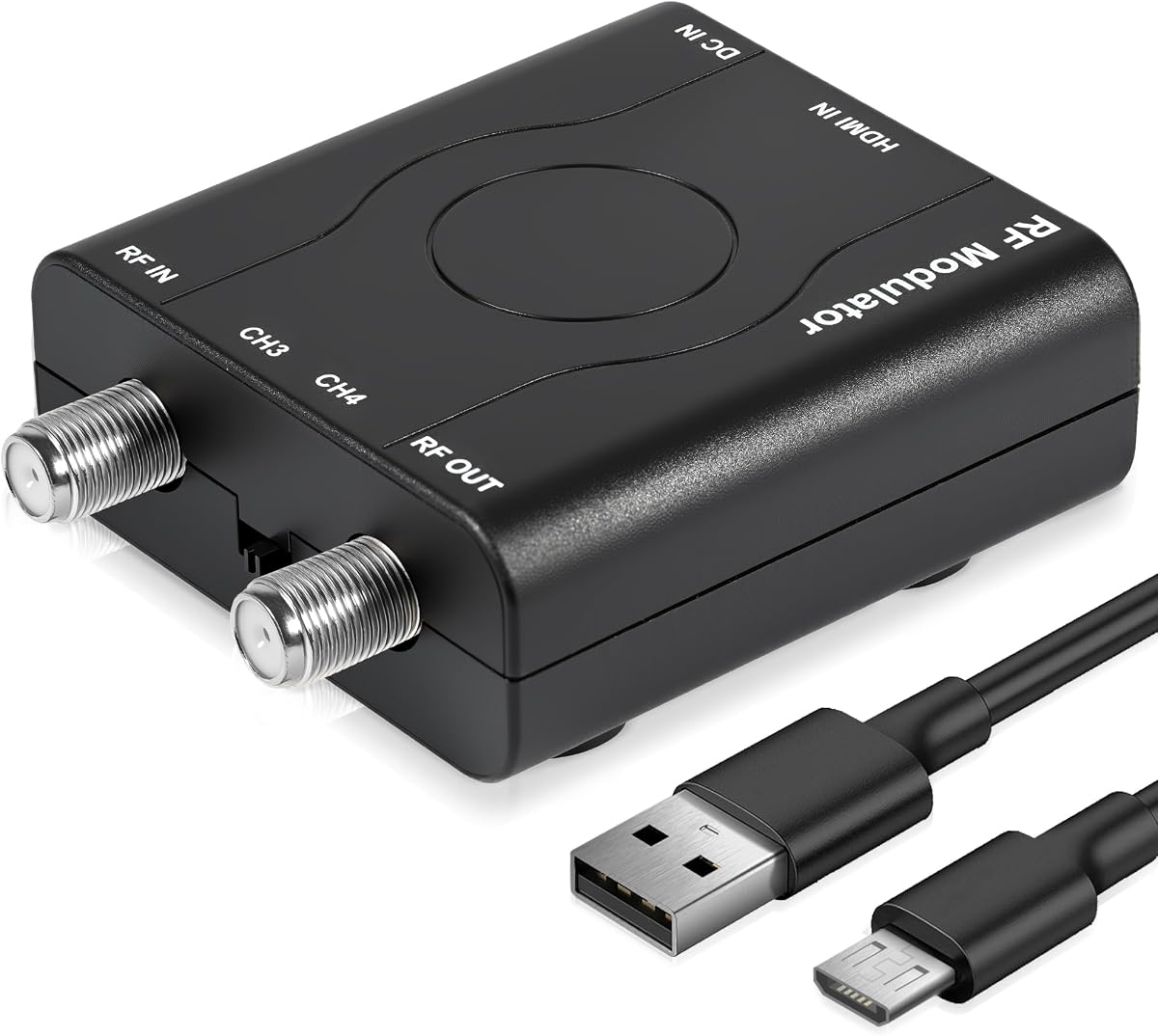


This HDMI to RF modulator has a 4.3 rating and is built for people who want to connect a modern HDMI source to an older television or RF-input display. It accepts HDMI, converts the digital audio and video signal to NTSC analog RF, and makes that signal available on channel 3 or channel 4. Despite its placement in a coax-to-HDMI roundup, its direction is the reverse of what most readers in that category need.
We may earn a commission when you buy through this link, at no additional cost to you.
The package is thoughtfully assembled: it includes the modulator, a 1.2-meter HDMI cable, a power adapter, a power cable, and a user manual. Its listed compatibility includes Fire TV Stick, Roku, current and previous game consoles, Apple TV, and Blu-ray or DVD players. PLL control is intended to stabilize the VHF output, while the stated RF level of 80 ± 5 dBµV provides a clear technical target for the analog broadcast.
The main limitation is fundamental rather than a minor omission. It cannot accept a coax source and produce HDMI, so it will not help someone connect an Atari 2600, VCR, analog camera, or other legacy RF-output device to a modern television. It also supports only NTSC, and the listed 1080P capability refers to accepted HDMI input rather than the quality of the analog RF output. Those distinctions should guide the purchase decision.
Choose this product if the problem is bringing a streaming stick, game console, or disc player into an RF television. For a collector trying to modernize an old console, look instead for a true RF demodulator or coax-to-HDMI converter. Within the HDMI-to-RF category, this is a well-equipped and broadly compatible option with a helpful included cable.
The modulator provides a practical bridge when the display has an antenna-style coax input but no usable HDMI port. Its fixed channel output and included cabling reduce the number of separate accessories required for a straightforward installation.
Streaming platforms, game systems, disc players, and television boxes are explicitly represented in the compatibility list, making the unit more relevant for contemporary entertainment than for recovering an old RF recording.
We may earn a commission when you buy through this link, at no additional cost to you.
This RF demodulator has a 3.4 rating but addresses the central need behind a coax-to-HDMI purchase more directly than most entries in the list. It accepts an analog VHF or UHF television signal through a female F-type connector and outputs HDMI, allowing legacy consoles, VCRs, videodisc players, and camcorders to be viewed on a modern television, monitor, or projector.
We may earn a commission when you buy through this link, at no additional cost to you.
The supported-source list is unusually broad. It names Atari 2600 and 5200 systems, Magnavox Odyssey, Intellivision, ColecoVision, Nintendo Entertainment System, Sega Master System, Fairchild Channel F, Vectrex, Commodore 64, RCA SelectaVision, JVC CED, Betamax, U-Matic, VHS, VCRs, Video8, 8mm, and VHS-C. Internally, the unit is described as a full-standard channel selector supporting NTSC and PAL, VHF and UHF operation, and as many as 251 channels.
Its 3.4 rating is the most important caution. The ambitious device list and extensive tuner functions suggest a complex product, and no single specification can guarantee compatibility with every vintage model. In particular, this is an RF television demodulator, not a converter for the composite BNC output found on many security cameras. The distinction between an antenna-style coax signal and a coax connector carrying baseband analog video is fundamental.
This is the most relevant option for someone reviving an old Atari, VCR, or camcorder with an RF output. Buy it after confirming that the original equipment really uses a modulated RF coax signal rather than composite video. It is also worth checking the original device's output standard and consulting its documentation before purchasing, because connection compatibility matters more than the length of the seller's supported-device list.
The tuner is designed for classic consoles and tape formats that commonly used modulated RF output. It gives collectors a path to modern displays without replacing the original hardware.
The included remote supports functions such as channel selection, shutdown, timer functions, reminders, reservations, a calendar, and a child lock. These extras are particularly useful when operating a legacy source from across a room.
We may earn a commission when you buy through this link, at no additional cost to you.
This BNC-to-HDMI converter earns a 4.7 rating, the highest among the products presented, and is a strong fit for older analog security cameras feeding a modern television or monitor. It accepts analog baseband video through a BNC connector, automatically detects PAL or NTSC, and provides HDMI output at 720P or 1080P with 50Hz or 60Hz timing. The output aspect ratio can also be switched between 4:3 and 16:9.
We may earn a commission when you buy through this link, at no additional cost to you.
Its key benefit is specificity. Unlike an RF demodulator, this unit is designed for a BNC connector carrying a coax-routed analog video signal. It includes a separate audio input, which is valuable when the camera or nearby equipment provides sound through RCA-style connectors. The listed package contains the converter and a 27.5-inch cable, but the product data explicitly notes that an adapter cable is not included, so users should verify which BNC lead and audio lead they already own.
Compatibility is limited to genuinely analog cameras. The description excludes digital, AHD, TVI, and CVI sources, which prevents a common purchasing error. Although the word “coax” appears throughout the product category, the cable and signal carried over it matter. A standard BNC video cable is not interchangeable with the F-type coax wiring used for an RF television channel, and neither is interchangeable with an HD-SDI or other digital camera connection.
This is a compelling choice for a small analog CCTV installation that needs to remain while the display is upgraded. Its 4.7 rating, automatic standard detection, and flexible HDMI output make it a focused converter rather than a general-purpose RF tuner. Confirm that the camera emits standard analog composite video and that its audio is available before buying; if the camera is AHD, TVI, CVI, or digital, use a converter explicitly designed for that format.
Offering both 720P and 1080P output gives the converter flexibility across television sizes and refresh-rate preferences. Automatic PAL or NTSC detection reduces setup guesswork when moving between older camera systems.
The explicit exclusion of AHD, TVI, CVI, and digital cameras is a strength because it makes the intended signal path clear. Users can avoid buying a baseband converter for a camera system that requires format decoding.
We may earn a commission when you buy through this link, at no additional cost to you.
This HDM61 converter has a 4.3 rating and is designed to send HDMI sources to an older television through VHF RF output. It supports channel 3 at 61.25MHz and channel 4 at 67.25MHz in NTSC format. Listed input resolutions include 1080P, 1080i, 720P, 576P, 576i, and 480p, allowing a range of modern sources to feed a legacy RF display.
We may earn a commission when you buy through this link, at no additional cost to you.
Compatibility extends beyond entertainment. The stated device list includes PCs, laptops, game consoles, game switches, cameras, television boxes, DVD players, CCTV equipment, and DVRs. HDMI 1.4 and HDCP 1.4 support are also stated, while the ABS housing is intended to make the adapter portable and suitable for regular use. The product requires no driver installation, simplifying setup in a home, classroom, or installation environment.
The central trade-off is that this is not a coax-to-HDMI device. It accepts HDMI and produces analog RF, so it cannot modernize a VCR or retro console that already has only an RF output. Nor does it improve the original source: once HDMI is converted into an NTSC broadcast signal, the displayed image is constrained by analog television capabilities. The listed 1080P support refers to the input side, not a native 1080P RF broadcast.
This model is worth considering for game consoles and computers that need access to an NTSC RF television or for a temporary installation that must travel between locations. It is less suitable for PAL-only systems because the output is explicitly NTSC. Buyers seeking to connect old coax sources to a new HDMI television should choose the RF demodulator or a BNC camera converter instead.
The broad device list makes the adapter practical for mixed entertainment and monitoring environments. Its driver-free design also means setup does not depend on operating-system drivers or network access.
PLL control is used to maintain the selected VHF channel. The two fixed channel options align with common NTSC-TV input arrangements and help simplify antenna-style installation.
We may earn a commission when you buy through this link, at no additional cost to you.
This HDMI-to-RF modulator carries a 5.0 rating and stands out for its complete, approachable kit. It converts HDMI digital video and audio into analog RF suitable for older televisions and displays with antenna or coaxial inputs. Its primary use is distributing a modern source over existing coax wiring, making it useful in homes, classrooms, hotels, and business environments where replacing display connections would be inconvenient.
We may earn a commission when you buy through this link, at no additional cost to you.
The included package contains the modulator, a four-foot HDMI cable, a power cable, a power adapter, and an instruction guide. That level of bundling is a meaningful convenience because many small converters leave the buyer to source a compatible HDMI lead and suitable power supply separately. The listed source compatibility is broad, covering streaming players, game consoles, disc players, cable and satellite boxes, computers, laptops, and cameras.
This product does not perform a true coax-to-HDMI conversion, so it should not be purchased for an old console or VCR that needs to send an RF signal to a modern television. The product information also does not state a precise television standard or channel frequency in the same way as several competing modulators. Buyers operating a PAL region or needing exact channel specifications should confirm those details with the seller before ordering.
As an HDMI-to-RF solution, however, it is a strong all-in-one choice. The 5.0 rating, included installation kit, broad source list, and explicit distribution use case make it especially useful for connecting newer media devices to coax-based display infrastructure. It earns the Editor's Choice badge as the most complete general-purpose modulator in this group, not as a substitute for a genuine legacy RF demodulator.
Both the source cable and power components are included, reducing setup friction. The step-by-step guide also provides a clear starting point for users who have not configured RF distribution equipment before.
The unit is explicitly positioned for sending one HDMI source through a coax system to more than one television. That makes it relevant to buildings where displays are already wired and rearranging those connections would be costly.
We may earn a commission when you buy through this link, at no additional cost to you.
This compact HDM61 adapter has a 5.0 rating and is a straightforward HDMI-to-RF solution. It accepts HDMI audio and video from a modern source and outputs an analog NTSC-M coax signal on channel 3 at 61.25MHz or channel 4 at 67.25MHz. The fixed-channel arrangement and compact housing make it practical for a small installation involving an older television.
We may earn a commission when you buy through this link, at no additional cost to you.
Its signal processing uses 1080P PLL frequency control, with HDMI 1.4 and HDCP 1.4 support. The actual RF output is stated as 480P, which is a more realistic description of the downstream analog signal than presenting the input capability as the final displayed resolution. The product also needs no extra driver software, so it can be deployed without operating-system configuration.
Its limitations are easy to identify. This one-way device cannot convert RF back to HDMI or AV, and it is not the correct product for connecting a VCR, Betamax player, Atari, or other old RF-output console to a modern television. It also operates in NTSC-M rather than PAL. The molded ABS shell is described as supporting steady transmission during daily use, although no ingress rating or extensive environmental certification is stated.
This is the best budget choice within the HDMI-to-RF subgroup because it has a 5.0 rating, a clear and compact design, and straightforward fixed-channel operation. Its value is strongest for users who already know their display accepts NTSC-M on channel 3 or 4. For a true legacy-source-to-HDMI installation, choose a directionally correct RF demodulator or BNC video converter instead.
Two familiar NTSC channel positions make configuration straightforward. Users do not need to navigate a complicated tuner merely to find an initial operating channel.
The explicit one-way design prevents confusion about signal flow. It is built for sending HDMI toward a coax-equipped television, not for importing a legacy coax broadcast into a new display.
We may earn a commission when you buy through this link, at no additional cost to you.
This HDMI-to-RF modulator has a 4.5 rating, placing it among the stronger-rated models in the guide. It accepts HDMI input and provides NTSC analog RF output on channel 3 or channel 4. The listed input formats include 1080P, 1080i, 720P, 576P, 576i, and 480p, making it a useful bridge from several modern source devices to an RF television.
We may earn a commission when you buy through this link, at no additional cost to you.
The product information emphasizes broad compatibility with computers, laptops, game consoles, switches, cameras, television boxes, DVD players, CCTV systems, and DVRs. It includes a USB power cable and user manual, while PLL control is used to maintain the VHF operating frequency. HDMI 1.4 and HDCP 1.4 support add useful context for matching the converter to compatible sources.
Although the seller's title includes “Coax to HDMI Adapter,” the detailed description repeatedly clarifies that the actual conversion is HDMI to RF and that RF-to-HDMI is not supported. That inconsistency is worth noticing. Product titles often compress related search terms, so the bullet specifications should determine suitability. This unit cannot accept a coax television signal and output HDMI for a modern display.
This model makes sense for a user with multiple possible HDMI sources and an NTSC RF television, especially if a USB power connection is preferred over a separate power brick. It is not a solution for preserving an old VCR or game console that only offers modulated RF output. For that task, the dedicated RF demodulator in this roundup is the relevant choice.
The included USB power cable can simplify placement near a television or powered accessory. A compact modulator is particularly useful where shelf space is limited.
Support for progressive, interlaced, high-definition, and standard-definition HDMI inputs means the converter can accept output from many source types without requiring users to search for a narrowly limited device.
We may earn a commission when you buy through this link, at no additional cost to you.
This HDMI-to-coax and RCA converter has a 4.2 rating and distinguishes itself through dual analog outputs. It converts an HDMI source into both RCA composite video and VHF RF, allowing a television with a coax input and a capture device with an RCA input to be used together. That makes it more versatile than a modulator that offers only one legacy output path.
We may earn a commission when you buy through this link, at no additional cost to you.
Its stated HDMI compatibility includes Apple TV, Amazon Fire Stick, Fire TV, Roku, HD TV tuners, Android TV boxes, satellite and cable receivers, several PlayStation and Xbox systems, Nintendo Switch, DVD and Blu-ray players, and VCRs. The coax output can feed a television or RF splitter, while the RCA output can be directed to a capture card for recording. A channel switch is included and is designed not to interfere with existing players such as VCRs.
The product's direction remains HDMI to legacy analog signals, not coax to HDMI. It also introduces a potential misunderstanding around the F-type female antenna input: that connector is described as accepting an antenna, tuner, satellite receiver, or cable box before the device provides separate RF and RCA outputs. This is a modulator and converter, not a demodulator for importing an analog RF channel into HDMI.
This is a good choice for a user who needs to watch and record the same modern HDMI source, or who wants both coax and composite connections. The 4.2 rating is respectable but lower than the leading products, and the multi-port setup takes more care than a simple modulator. Buyers should map each cable and verify that their television, capture card, and source device use the expected connectors.
The simultaneous RF and RCA outputs are valuable in a recording setup. One display can receive the coax signal while a capture card receives composite video from the same source.
RF is well suited to carrying a television signal over longer cable runs and through splitters. The result can be useful in rooms where placing a new HDMI cable would be difficult.
We may earn a commission when you buy through this link, at no additional cost to you.
This Eyoyo converter has a 4.4 rating and is built specifically for security-camera systems. It supports TVI, CVI, AHD, and CVBS signals, automatically detects the video format, and accepts camera resolutions from 720P through 8MP. It outputs 1080P at 60FPS over HDMI, making it a strong choice for keeping an existing camera installation while moving monitoring to a modern display.
We may earn a commission when you buy through this link, at no additional cost to you.
A particularly useful feature is HDMI and BNC loop output. The camera feed can appear on a television, monitor, or projector while the BNC signal continues to a connected DVR. This allows an installer to test a camera feed directly on a modern display during setup or maintenance without rebuilding the surveillance wiring. The unit also recognizes PAL and NTSC, improving its usefulness across mixed legacy systems.
The metal housing is designed to dissipate heat and support stable round-the-clock operation, a more substantial construction choice than a basic plastic converter. The stated coax coverage of 500–700 meters is valuable for warehouses, farms, parking areas, and properties with cameras far from the monitor room. Actual results depend on the camera, cable quality, installation, and signal characteristics, so the figure should be treated as a stated capability rather than a guarantee.
This converter is ideal for installers, homeowners, and small businesses maintaining older analog surveillance equipment. It is not a general RF-to-HDMI converter for an Atari console or VCR, and its value is greatest when the source is a BNC camera supporting one of the listed formats. For mixed camera installations, the automatic detection and loop output justify choosing it over a basic analog-only converter.
Supporting TVI, CVI, AHD, and CVBS in one unit reduces the need to replace cameras when different parts of an existing system use different formats. Automatic detection further reduces manual configuration.
The metal enclosure and heat dissipation are particularly appropriate for surveillance environments where the converter may remain powered around the clock. The loop output also supports troubleshooting without taking the DVR path offline.
We may earn a commission when you buy through this link, at no additional cost to you.
This HDMI61 coax adapter has a 5.0 rating and is among the most technically clearly described HDMI-to-RF modulators in the guide. It outputs NTSC RF on channel 3 at 61.25MHz or channel 4 at 67.25MHz, while accepting HDMI input in 1080P, 1080i, 720P, 576P, 576i, and 480p formats. PLL control manages the VHF working frequency.
We may earn a commission when you buy through this link, at no additional cost to you.
The compatibility list is extensive, covering PCs, laptops, game consoles, game switches, cameras, television boxes, DVD players, CCTV equipment, and DVRs. HDMI 1.4 and HDCP 1.4 support are stated, and the unit is described as compatible with local CATV systems. Its driver-free, portable design also makes it convenient for temporary events, classroom demonstrations, or installations where equipment must move between locations.
It is important not to let the 1080P language obscure the direction and final signal type. The converter accepts high-definition HDMI input but sends an analog NTSC RF signal to the television. It cannot turn a legacy RF source into HDMI, and it cannot preserve native high-definition detail through the analog broadcast stage. The ABS housing and manufacturing claims support regular use, but the unit is primarily an installation accessory rather than a general-purpose media hub.
This product earns the Best Premium badge because it combines a 5.0 rating, a detailed specification profile, broad source compatibility, and strong channel-frequency information in a portable design. It is a good option for someone who needs to feed an NTSC RF television from a modern HDMI source. For a VCR, Betamax deck, or retro console, select the dedicated RF demodulator instead.
The range of accepted input resolutions and stated HDMI standards makes it easier to connect different source devices. It can serve as a common bridge in mixed home or small commercial installations.
The absence of required drivers and the compact ABS construction support temporary or mobile use. The product can be moved between compatible displays without a complex software setup process.
We may earn a commission when you buy through this link, at no additional cost to you.
The correct converter depends first on the signal your source actually outputs, followed by the connector, television standard, resolution, and installation environment. Checking those details prevents the most common and costly mistake: buying a device that converts in the wrong direction or for the wrong coax-based signal.
A true coax-to-HDMI converter accepts a coax-connected legacy video source and produces HDMI for a modern display. An HDMI-to-RF modulator does the opposite: it accepts a modern source and sends an antenna-style signal to an older television. The product listings in this roundup include both types because their connector shapes and broad uses can look similar. Before buying, write down the input available on the source and the input required by the display. If the source says HDMI and the display says RF or antenna, you need a modulator. If the source says RF, antenna, BNC, or coax and the display says HDMI, you need a demodulator or video converter.
Coax can carry modulated RF television channels, analog baseband video, digital camera data, or even network traffic. The RF demodulator reviewed here is intended for VHF or UHF television signals, such as those produced by many old game consoles and VCRs. The two BNC-focused converters handle baseband security-camera video, but their supported camera formats differ. One covers standard analog PAL and NTSC, while the Eyoyo unit supports TVI, CVI, AHD, and CVBS. These systems are not interchangeable, and a physically identical BNC plug does not guarantee that the signal can be decoded.
Legacy analog video depends on the broadcast standard used in the source region. A converter that outputs only NTSC may not display properly on a PAL television, while a PAL-only converter may be unsuitable for NTSC equipment. The RF demodulator supports both standards, and the Eyoyo converter recognizes PAL and NTSC camera signals. Most HDMI-to-RF modulators in this list are explicitly NTSC and fixed to channel 3 or channel 4. For a one-way modulator, the television's tuner must also support the generated channel and standard. Checking both ends prevents a situation in which the cables fit but the picture does not appear.
An HDMI output is not automatically full high definition. The RF demodulator's detailed listing does not promise a specific maximum HDMI output resolution, so buyers should verify that with the seller if display sharpness is critical. The BNC analog converter offers 720P and 1080P output at 50Hz or 60Hz, while the Eyoyo converter accepts camera resolutions through 8MP and outputs 1080P at 60FPS. For HDMI-to-RF modulators, high-resolution input does not mean high-resolution RF output because the final signal is analog NTSC. Distinguish input capability from output quality whenever assessing specifications.
A video picture may appear while sound remains missing when a converter does not receive or pass the correct audio signal. The BNC analog converter has a separate audio input, which is useful when the source provides audio through another connector. Other one-way RF modulators are described as accepting HDMI audio and video and transmitting a combined RF signal. Before buying, identify how the source outputs sound and whether the television or amplifier expects it through HDMI, RCA, RF, or another route. A coax-to-HDMI adapter for an old console may also require the appropriate original audio lead.
The distance between source, converter, and display can influence the installation more than the converter itself. RF and coax-based video can be useful over longer runs, and the dual-output product can feed an RF splitter. The Eyoyo converter states that coax transmission can reach 500–700 meters without quality loss, though cable quality, camera output, splitters, and environmental conditions affect actual performance. For HDMI cable runs beyond common consumer limits, an active or distribution solution may be required. Plan the route, identify whether splitters or couplers are necessary, and avoid assuming that every passive adapter preserves signal strength.
A complete kit can make setup faster and more predictable. The HDMI-to-RF modulator at rank 5 includes an HDMI cable, power adapter, power cable, and guide, while the rank 1 model includes a 1.2-meter HDMI cable and its power components. The Eyoyo converter includes a 27.5-inch cable, while the BNC analog converter's listing clarifies that an adapter cable is not included. Accessories vary considerably, so check whether the required coax, BNC, HDMI, RCA, and power cables are present before assembling a complete shopping list.
Most of the compact modulators use molded ABS housings suited to portable, home, classroom, or occasional commercial use. The Eyoyo converter uses a metal housing designed for better heat dissipation and continuous surveillance operation. Continuous operation, high humidity, temperature extremes, exposed locations, or dusty industrial settings may justify a more rugged solution, but no product in this roundup should be assumed weatherproof. Confirm the enclosure's intended environment, provide ventilation, and avoid placing power adapters in unsafe locations. Construction choices can improve longevity, but correct signal compatibility remains the first priority.
Begin by identifying every connector in the intended signal path. Disconnect the television and source from power, then connect the converter to the appropriate legacy input. For a true coax-to-HDMI setup, run the coax or BNC lead from the source to the converter, connect the converter's power supply, and then connect its HDMI output to the television or monitor. For an HDMI-to-RF modulator, reverse the logic: connect the modern source to HDMI, run the RF coax output to the television, and select the matching channel 3 or 4 setting.
Power the television and source before checking the picture. For NTSC RF modulators, tune the television to the selected channel and make sure it supports the expected standard. For a BNC camera converter, allow it to detect PAL or NTSC automatically, then choose the appropriate HDMI resolution and aspect ratio. If the display remains blank, verify that the source is producing the exact format the converter supports; a plug-in connection alone does not prove signal compatibility.
For regular use, keep the converter and power connections dry, ventilated, and free from heavy mechanical stress. Coax and BNC fittings should be tightened by hand without damaging the connector, while HDMI cables should have enough slack to prevent strain at the plug. Periodic testing is especially important in surveillance systems: check the HDMI monitor path and the looped DVR connection, and investigate image noise, rolling, or intermittent loss rather than assuming the camera is at fault.
A coax-to-HDMI converter takes a legacy coax-based video signal and creates an HDMI output for a modern television or monitor. An HDMI-to-RF modulator accepts HDMI from a modern source and converts it into an analog antenna-style signal for an older television. The names can be confusing because both products may include a coaxial connector, so the direction of conversion is the decisive factor.
No. A BNC coax connector may carry standard analog video, TVI, CVI, AHD, or a digital signal, and each category requires different handling. The BNC analog converter reviewed here supports standard analog PAL and NTSC but excludes AHD, TVI, and CVI, while the Eyoyo model supports those formats along with CVBS. Check the source's output format and the converter's supported list before connecting equipment.
Usually not. The converter changes the connection format so that a modern display can accept the signal, but it cannot restore detail that was never present in an analog recording or broadcast. The BNC models can upscale the analog image to 720P or 1080P, but the underlying source detail remains limited.
Only if the console's output is a modulated RF television signal. Older systems such as the Atari 2600 commonly used RF output and need a demodulator that accepts that signal and provides HDMI. If the console instead has composite RCA video, a simpler RCA-to-HDMI converter is usually the more appropriate solution.
First confirm that the modulator outputs the same television standard as the television supports; several listed modulators are NTSC-only. Next, select the exact channel used by the device, usually channel 3 or 4, and verify that the coax connection reaches the antenna input. Also check that the source is sending a valid HDMI signal and that the television is not expecting a different channel mode.
An HDMI-to-RF modulator can distribute its RF output through compatible coax splitters, which is one of the stated uses for the rank 5 model. A basic coax-to-HDMI converter normally provides one HDMI output, so additional splitters or distribution equipment would be required for multiple displays. The splitter must support the intended signal and avoid introducing unacceptable degradation.
Most of the modulators listed here explicitly support NTSC only, including the fixed channel 3 and channel 4 designs. They may not work correctly on a PAL-only display. The RF demodulator at rank 2 is the clearer choice for mixed or PAL compatibility because its product information specifically lists NTSC and PAL support.
The required cables depend on the converter and source. A direct coax-to-HDMI system may need an F-type or BNC lead, an HDMI cable, and a power cable, while an RF modulator may need an HDMI lead and a coax lead to the television. Some products include these accessories and others do not, so verify the package contents before ordering.
The strongest direct match for legacy game consoles and VCRs is the RF Demodulator Coax to HDMI because it accepts modulated television signals and outputs HDMI. The Eyoyo TVI/CVI/AHD to HDMI converter is the standout choice for compatible security cameras, while the BNC to HDMI Converter offers a focused solution for standard analog cameras. The top HDMI-to-RF modulators serve the opposite direction but remain useful for bringing modern media devices into older televisions or coax distribution systems.
Prioritize signal direction first, then identify whether the source carries RF television, analog baseband video, or a particular camera standard. Match NTSC or PAL, confirm the connector type, check the final output resolution, and make sure the required cables and power accessories are available. A more expensive or highly rated converter cannot compensate for receiving a signal format it does not support.
Ratings, product specifications, availability, and prices can change, so review the current listing before purchasing. For the true coax-to-HDMI category, carefully compare the original source output with the television input. For a modern source feeding an RF television, choose a modulator whose NTSC or PAL output and channel range match the display.