
GE Digital 2-Way Coaxial Cable Splitter
4.6Editor score
Simple two-output distribution
Gold-plated RG6 connectors
Broad device compatibility
Explore the best cable TV splitters for 2, 3, 4, 6, and 8 outputs, comparing bandwidth, connectors, power pass, signal handling, and home compatibility.
A cable TV splitter lets one coaxial feed serve multiple televisions, set-top boxes, antennas, modems, or other coaxial devices. The right model depends on output count, supported frequency range, connector construction, power-pass capability, and the signal characteristics of your home installation.
We compared all ten featured splitters across those practical considerations, paying particular attention to two-way versus larger distribution systems. The list includes conventional metal-bodied models, short jumper-style splitters, a two-pack, and options supporting MoCA configurations for compatible home networks.
Each review explains the product's strongest traits, likely compromises, and best-fit installation. Rankings reflect the supplied specifications and customer ratings, while product availability and prices can change, so readers should confirm current listing details before making a final purchase.
4.6Editor score

4.6Editor score

4.6Editor score
This side-by-side comparison shows each splitter's output count, frequency coverage, connector configuration, and principal use case, making it easier to identify the model that matches your coaxial network.




This 2-way coaxial splitter earns the top position because it combines a practical output count with broad compatibility and a customer rating of 4.6. It divides one incoming coaxial line into two balanced outputs while supporting a 10 MHz to 2.6 GHz frequency range. That makes it a strong general-purpose choice for television, antenna, satellite, and internet connections.
We may earn a commission when you buy through this link, at no additional cost to you.
Its internal printed circuit board, nickel-plated zinc die-cast housing, and sealed body are designed to support return loss, insertion loss, port isolation, and resistance to outside interference. Every port has power-pass capability, allowing power from a satellite set-top box to reach a dish or multiswitch. It also works with RG6 and RG59 cables and is listed for MoCA 2.5 and MoCA 3.0 configurations.
The tradeoff is that this is a two-output splitter, not a multi-output distribution hub. A new television or coaxial device will require another splitter, and adding outputs can further divide the available signal. The product also does not amplify the feed, so it cannot compensate for weak source signal or poor cable runs. Those limitations are normal for a compact two-way distribution device.
It is best for homeowners splitting one good cable, antenna, or satellite feed between two locations while retaining broad device compatibility. Choose it when power pass-through, MoCA readiness, and a 2.6 GHz operating range matter. For users needing more than two destinations, the three-, four-, six-, or eight-way options in this guide provide a more direct solution.
The splitter takes one source and provides two balanced outputs for separate televisions, set-top boxes, antennas, or internet equipment. Its 10–2602 MHz coverage makes it a versatile option across common coaxial services.
Power-pass enabled ports support satellite installations that need to carry power back toward the dish or multiswitch. MoCA 2.5 and 3.0 compatibility also makes this a sensible option for compatible whole-home networking setups.
We may earn a commission when you buy through this link, at no additional cost to you.
The GE Digital 2-Way Coaxial Cable Splitter is a compact and uncomplicated way to send one digital coaxial signal to two devices. Its 4.6 rating reflects solid customer reception, and the stated 5–2500 MHz range covers many common cable, antenna, television, and internet applications without adding unnecessary complexity.
We may earn a commission when you buy through this link, at no additional cost to you.
Gold-plated RG6 connectors support reliable connectivity and corrosion resistance, while the splitter is described as compatible with all brands. Its listed uses include amplifiers, amplified antennas, HDTVs, cable boxes, and related coaxial equipment. This makes it especially approachable for consumers who want a familiar screw-on F-connector arrangement and a simple way to add a second television.
The primary limitation is its narrow role as a two-way device. It offers no stated MoCA compatibility, unlike several newer models, and it does not include an amplifier. If the incoming feed is weak, splitting it can make channel stability harder to achieve. The model also provides only one input and two outputs, so it cannot serve a large group of rooms without a more extensive distribution arrangement.
This splitter is a good budget pick for a straightforward two-TV installation or for adding a second coaxial device to an amplified antenna system. Choose it when simplicity, gold-plated connectors, and broad basic device compatibility are the priorities. For a dedicated MoCA network or a higher-frequency range, the first-ranked splitter offers more flexibility.
Gold-plated RG6 connectors are designed to maintain good connectivity while resisting corrosion. That makes the splitter suitable for a permanent installation behind a television, entertainment center, or antenna cabinet.
One input and two outputs are enough for a television and a second coaxial endpoint. It can also be used with compatible amplifiers and amplified antennas where a basic distribution point is required.
We may earn a commission when you buy through this link, at no additional cost to you.
This 3-way coaxial splitter provides a practical middle ground between a two-output unit and a larger distribution hub. It has a 4.6 customer rating and splits one input into three balanced output signals. The 10 MHz to 2.6 GHz range supports HDTV, cable television, satellite, antenna, high-speed internet, and compatible MoCA configurations.
We may earn a commission when you buy through this link, at no additional cost to you.
Construction details include an internal printed circuit board, nickel-plated zinc die-cast housing, sealed body, and machine-formed F-port threads. The product is compatible with RG6 and RG59 cables, and every port is described as power-pass enabled. A grounding screw port and two accessible mounting holes make it easier to secure in a practical installation.
Its main limitation is the unavoidable signal division involved in sending one source to three endpoints. If the feed reaching the splitter is already weak, three outputs may produce marginal reception at one or more devices. The splitter also does not include amplification, so it should not be treated as a remedy for an inadequate antenna, damaged cable, or poor provider signal.
This model fits households that need exactly three coaxial destinations and value broad frequency coverage, power pass, and MoCA capability. It is a sensible choice for three televisions, a television plus modem and set-top box, or a compatible home-network distribution point. Avoid adding unnecessary outputs when a two-way unit would be sufficient.
Three balanced outputs cover common arrangements that need more capacity than a two-way splitter but not the larger port count of a four-, six-, or eight-way unit. It keeps the layout comparatively simple.
MoCA support, a 2.6 GHz range, and power pass on all ports allow the splitter to participate in compatible television and networking arrangements rather than serving only a basic antenna connection.
We may earn a commission when you buy through this link, at no additional cost to you.
The 6 Way Coaxial Cable Splitter is intended for larger homes or installations that need to distribute a single coaxial source to six devices. It carries a 4.6 rating and supports 10–2602 MHz frequencies, giving it broad coverage for CATV, satellite, antenna, HDTV, internet, and MoCA-based systems.
We may earn a commission when you buy through this link, at no additional cost to you.
Every output is balanced, and all ports support power pass. The internal circuit board and nickel-plated zinc die-cast shell are designed to improve return loss, insertion loss, and isolation while shielding against outside interference. Its compatibility with both RG6 and RG59 cables expands installation flexibility, while grounding and mounting provisions support a tidy permanent setup.
The central trade-off is signal headroom. A six-way split places greater demands on the source than a two- or three-way split. Even with careful shielding and isolation, attenuation from the internal network and connected cables can affect the weakest endpoints. This model contains no amplifier, so a strong, healthy source signal is important. It is not a substitute for an amplifier in a long or poorly terminated run.
It is a good candidate for six planned television or coaxial endpoints, especially where MoCA 2.5 or 3.0 equipment is present. Confirm that the provider or antenna signal remains strong enough at the splitter before buying. If only four endpoints are needed, the four-way option offers a more restrained split and may preserve more usable signal.
Six outputs suit homes distributing service to several rooms, televisions, set-top boxes, and compatible network devices. One central splitter can simplify the physical layout compared with chaining multiple smaller units.
Support for MoCA 2.5 and MoCA 3.0, 2.6 GHz bandwidth, and power pass across all ports makes the unit suitable for contemporary compatible coaxial and home-network configurations.
We may earn a commission when you buy through this link, at no additional cost to you.
This package includes two compact coaxial splitters, each using an F-type RG6 male input and dual F-type female outputs. Its 4.2 rating is the second-lowest among the featured products, but the included pair and straightforward construction make it appealing for users who want two distribution points or a spare on hand.
We may earn a commission when you buy through this link, at no additional cost to you.
Both adapters use nickel-plated metal construction intended to provide durability, reusability, conductivity, and low signal loss. Installation uses familiar screw-on F connectors without specialized tools. Listed applications include cable TV, MATV, CCTV, satellite systems, over-the-air antennas, broadcast receivers, streaming devices, and home theater equipment.
The main uncertainty is that the supplied specifications do not state a frequency range, port isolation, or power-pass capability. Because those factors can influence compatibility with a particular provider, television, satellite arrangement, or MoCA network, buyers should verify the current listing and their installation requirements. It also offers no amplifier, so the source must already be adequate.
This two-pack works best for straightforward television, antenna, satellite tuner, or similar coaxial distribution where the required compatibility is confirmed. It is also helpful for separate rooms because each installer can mount one unit where needed. For a high-frequency or MoCA-specific installation, a model with clearly published bandwidth and power-pass details may be easier to justify.
The package gives you two identical splitters, allowing distribution in separate areas without buying another individual adapter. A spare can also support future rearrangements or troubleshooting.
An RG6 male input and dual female outputs make the units familiar to work with and easy to integrate with common coaxial wiring. No specialized connector or installation tool is required.
We may earn a commission when you buy through this link, at no additional cost to you.
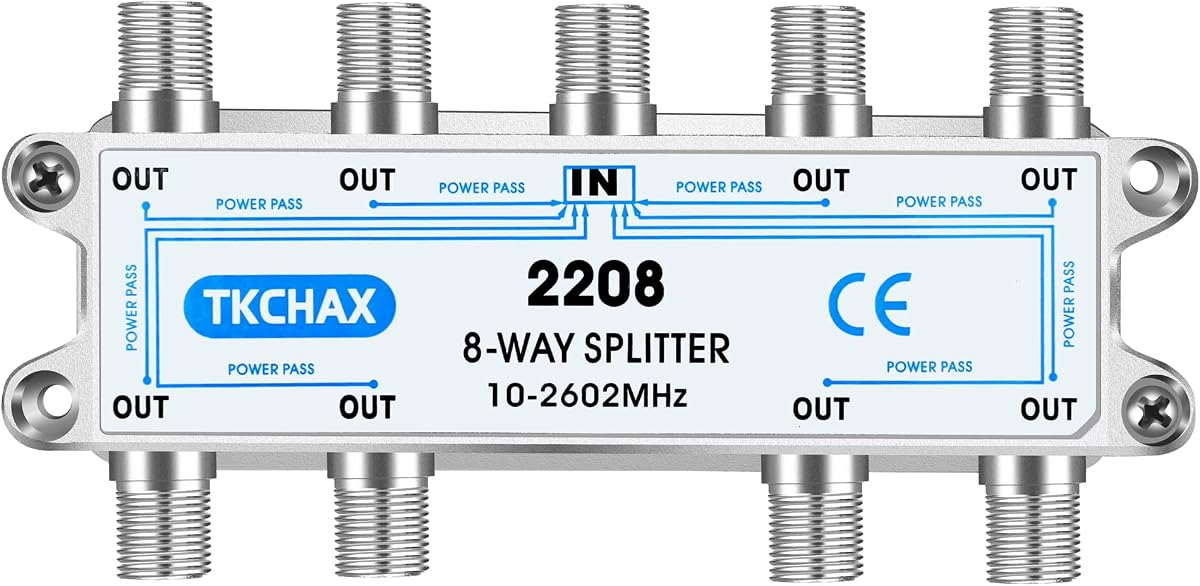
The 8 Way Coaxial Cable Splitter is the largest distribution model in this guide, providing one input and eight balanced outputs. It carries a 4.6 rating and supports a 10 MHz to 2.6 GHz range, making it suitable for homes with numerous coaxial endpoints or a planned expansion requiring a central distribution point.
We may earn a commission when you buy through this link, at no additional cost to you.
The splitter is compatible with CATV, satellite television, antennas, HDTV, high-speed internet, and MoCA configurations. Its internal printed circuit board and nickel-plated zinc die-cast housing are designed to support strong isolation and reduced interference. All ports have power pass, and the sealed body, grounding screw, and mounting holes help support a permanent, organized installation.
Eight outputs create the largest signal demand in this list. Unless the incoming source is strong and well distributed, some endpoints may experience weaker reception than they would through a smaller splitter. The unit does not include amplification, and installing it does not eliminate losses associated with long cables, poor fittings, splitters, or other distribution devices. Using only the outputs actually needed is advisable.
This is most appropriate for a large installation with many televisions or compatible network endpoints. It can also serve as a central hub when future rooms are already planned. For the same household with only a few endpoints, a two-, three-, four-, or six-way model will generally preserve more signal and make the layout less demanding.
Eight outputs let one incoming service feed multiple rooms or endpoints through a single physical distribution point. That can simplify cable routing in a large or pre-wired home.
The 2.6 GHz bandwidth and power-pass-enabled ports are useful for modern coaxial networks, including compatible MoCA configurations and satellite arrangements that require power to continue toward the dish.
We may earn a commission when you buy through this link, at no additional cost to you.
The GE Digital 4-Way Coaxial Cable Splitter offers a useful balance between output capacity and manageability. It has a 4.6 customer rating, distributes one digital signal to four balanced outputs, and operates across 5–2500 MHz. Its support for HDTV, satellite, internet modems, cable television, amplified antennas, and amplifiers makes it broadly useful.
We may earn a commission when you buy through this link, at no additional cost to you.
Power passes through all four ports, while gold-plated connectors are designed to provide good connectivity and corrosion resistance. The splitter works with both RG59 and RG6 cable. Its strongest distinguishing feature is the included limited-lifetime replacement pledge and free U.S.-based technical support available Monday through Friday, 7 a.m. to 8 p.m. Central Time.
The trade-off is that no MoCA compatibility is stated, so buyers with a specific whole-home networking standard should confirm compatibility before purchase. As with any passive four-way splitter, the signal is divided among four paths, and this unit does not add amplification. A marginal source can therefore become weaker at the farthest endpoint. Cable quality and connector workmanship remain important.
This is a strong choice for a four-TV or four-device installation that values established support, connector reliability, and straightforward compatibility. It is also a sensible middle option between a compact two-way splitter and a much larger distribution hub. Choose it when four outputs are needed and service quality at the source is already strong.
Four balanced outputs can serve several televisions or a mixture of television, modem, set-top box, and antenna-related equipment. It covers common household layouts without moving to a six- or eight-port unit.
The limited-lifetime replacement pledge and U.S.-based technical support can be valuable when a new installation involves unfamiliar coaxial equipment. Scheduled weekday support provides a clear contact point for setup questions.
We may earn a commission when you buy through this link, at no additional cost to you.
This Digital 8-Way Coaxial Cable Splitter offers eight outputs in a housing described as small and light, weighing 86 grams. It has a 4.6 rating and targets television, satellite, wireless internet access, cable television, amplified antennas, amplifiers, and other coaxial equipment. MoCA support makes it particularly relevant to compatible home-network users.
We may earn a commission when you buy through this link, at no additional cost to you.
Its 5–2400 MHz range covers many common uses, and the product states that signal loss between 1750 and 2400 MHz is only 4.5 dB on each output. A die-cast zinc alloy shell with a nickel-plated surface is designed to provide isolation, rust resistance, and corrosion resistance. All ports support power passing, simplifying balanced satellite connections.
Compared with the 2.6 GHz models, its upper frequency limit is lower, which may matter for advanced equipment. The instructions also specify that only one highest voltage may pass at a time, an important caution when planning powered coaxial arrangements. An eight-way split also creates substantial signal demand, and the splitter does not amplify the feed.
It fits large homes already wired for many coaxial endpoints or users building a MoCA-capable television network. The included one-year warranty and stated technical support offer added reassurance. Those wanting the highest published bandwidth, six fewer outputs, or power pass across a larger range should compare the first-ranked, fourth-ranked, and sixth-ranked alternatives.
The splitter is explicitly designed with MoCA in mind and can distribute a digital source to eight devices. It suits compatible installations that prioritize network functionality and compactness.
All ports can pass power for compatible satellite setups, but the instructions allow only one highest voltage to pass at a time. Installers should follow that restriction carefully when combining powered equipment.
We may earn a commission when you buy through this link, at no additional cost to you.
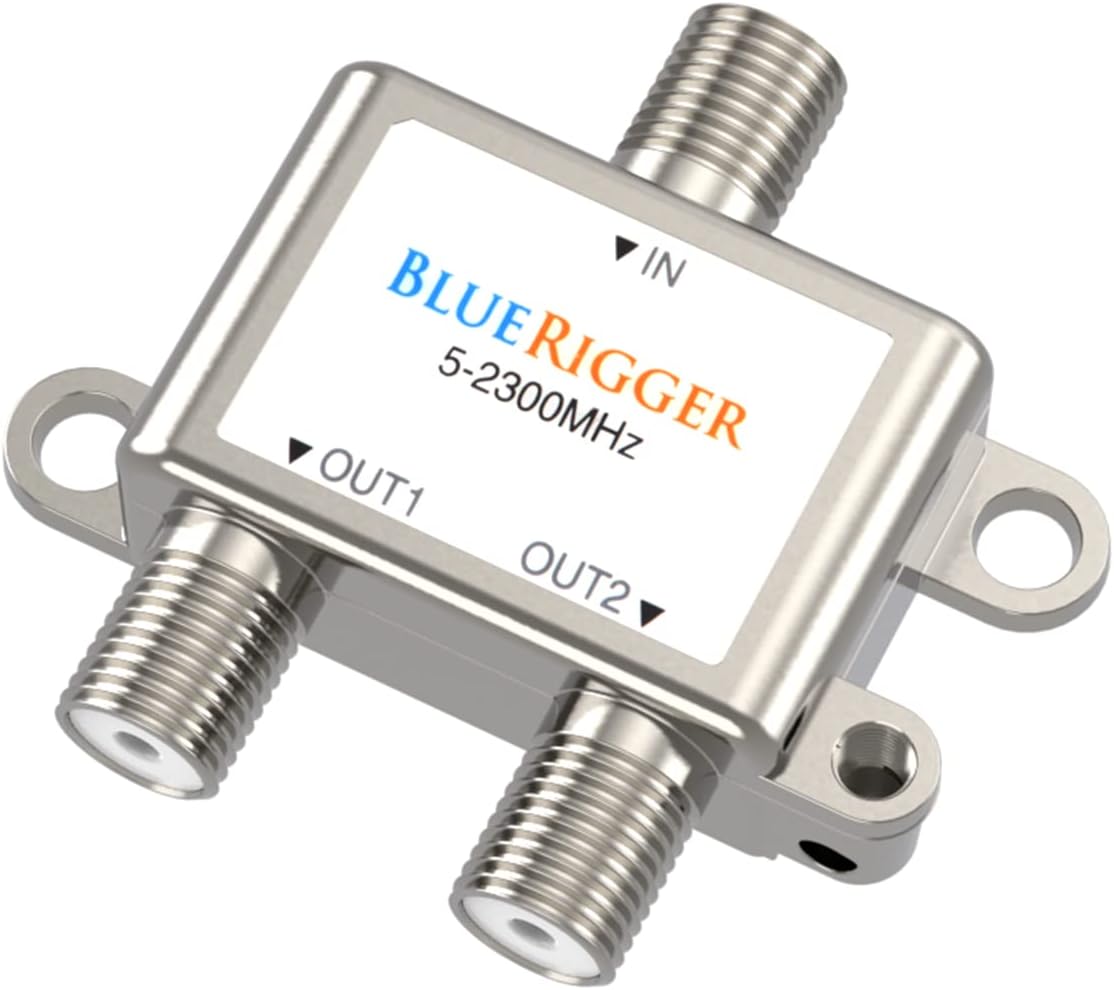
The BlueRigger 2-Way Coaxial Cable Splitter converts one digital signal into two and supports 5–2300 MHz frequencies. Its 4.3 rating is modest compared with most products in the guide, but the compact mini-diplexer design, broad equipment compatibility, and lifetime warranty give it a distinct set of strengths.
We may earn a commission when you buy through this link, at no additional cost to you.
A nickel-plated zinc alloy die-cast housing is designed to provide durability and reduce digital noise, while screw-on F-type connectors make installation and removal straightforward. The splitter is listed for HDTV, antennas, CATV, cable modems, coaxial couplers, cable set-top boxes, satellite systems, amplifiers, dishes, and standard RG59 or RG6 cables.
Its upper frequency limit of 2300 MHz is lower than that of the 2.5- and 2.6-GHz alternatives. While this covers many common television applications, buyers with advanced equipment or specific high-frequency requirements should verify compatibility. The two-way output count is also intentionally limited, and there is no stated MoCA support or integrated amplification. Signal quality therefore depends on the original feed and cable installation.
This splitter is best for a compact two-TV arrangement, a dish or antenna setup, or another common coaxial connection where a small durable body is useful. It is particularly attractive to buyers who value the stated lifetime warranty and U.S.-based customer support. For more outputs or a higher frequency ceiling, one of the 2.6 GHz models is a better fit.
The small die-cast zinc alloy housing is intended to resist corrosion and limit digital noise. It is well suited to installations where a full-size multi-port splitter would be unnecessary.
A two-output configuration, familiar F connectors, and a lifetime warranty make this an uncomplicated option for adding one destination to an existing coaxial feed.
We may earn a commission when you buy through this link, at no additional cost to you.
The Superbat F-Type Splitter Cable differs from conventional box-shaped splitters by incorporating a short, flexible 15-centimeter, or six-inch, coaxial section. It has an F male connector at one end and a dual F female connector at the other, allowing one source to feed two devices. Its 4.5 rating reflects generally positive customer feedback.
We may earn a commission when you buy through this link, at no additional cost to you.
The flexible jumper can be positioned to fit around a television cabinet, antenna, or set-top box where a rigid splitter body is inconvenient. Applications listed include cable television, CATV, VCR, DVD, HD-TV, DTV, satellite receivers, cable boxes, RG6 cable, LTE filters, television antennas, and digital HD television reception.
The six-inch length is both its main convenience and its chief restriction. It cannot bridge a meaningful distance between outlets, so a separate RG6 cable is still required for longer runs. The supplied specifications do not state frequency range, port isolation, or power-pass behavior. As a result, buyers with advanced MoCA or powered satellite requirements should confirm compatibility before installation.
This jumper-style splitter is best for a nearby two-device arrangement, temporary setup, or tight cabinet installation where a conventional splitter will not fit neatly. It also works for common over-the-air antenna and television connections. For a permanent multi-room distribution point, a full-size splitter with published bandwidth and power-pass specifications will generally be more informative.
The slim six-inch cable can bend and rotate to reach nearby connectors more easily than a rigid metal splitter body. That makes it convenient behind entertainment centers and around compact antenna equipment.
The F-male input and dual F-female output provide a simple one-to-two connection using standard coaxial fittings. It is best suited to short, local installations rather than long cable runs.
We may earn a commission when you buy through this link, at no additional cost to you.
Choosing a cable TV splitter involves balancing the number of required endpoints against signal strength, bandwidth, power handling, connector quality, and the type of service entering your home.
Start by counting the devices that genuinely need the coaxial feed, including televisions, set-top boxes, cable modems, and compatible network hardware. This guide includes two-, three-, four-, six-, and eight-output models, as well as a two-pack of compact two-way units. An output count close to the actual requirement is generally preferable because every additional branch divides the available signal. Matching the ports to the planned layout also prevents unused cables and unnecessary installation complexity.
The published frequency range indicates the frequencies the splitter is designed to carry. Featured models range from 5–2300 MHz to 10–2602 MHz, while the short Superbat cable and compact two-pack do not provide a stated range. Cable, satellite, antenna, and internet systems may use different portions of the coax spectrum, so compatibility with the source and all connected equipment matters. A wider range can provide more flexibility, but it should be considered alongside connector construction and isolation rather than treated as the only measure of quality.
Most home coaxial installations use RG6, especially for broadband, high-definition television, and longer indoor runs. RG59 remains common in some older, shorter, or less demanding installations. Nine featured products explicitly mention RG6 or RG59 compatibility, while the Superbat product is identified as a 75-ohm RG6-style splitter cable. Using cable and connectors appropriate to the run helps preserve signal quality and makes connection more predictable. Confirm the physical connector type as well, because F-type fittings are used throughout this category but are not interchangeable with every coax connector.
Some satellite systems require power to travel from a set-top box back toward the dish or multiswitch. A power-pass splitter allows that path to continue; a non-power-pass model may block it. The first four products in the ranking and both eight-way models state that all ports are power-pass enabled, while the 2.6 GHz products list maximum pass currents. The Digital 8-Way model also notes that only one highest voltage may pass at a time. If your installation uses powered satellite equipment, this feature is essential rather than optional.
MoCA, or Multimedia over Coax Alliance, uses the existing coax wiring to carry network traffic in compatible home environments. Several products here explicitly support MoCA configurations, including models specified for MoCA 2.5 and MoCA 3.0. However, MoCA performance depends on the complete network, including the adapter, modem, cables, and installation. A splitter advertised for MoCA should be treated as one component of a designed system. If whole-home coax networking is the primary goal, review the product's exact MoCA statement and consult the equipment provider's requirements.
Connector plating, housing material, shielding, and internal design can affect long-term reliability. Gold-plated connectors appear on the GE two-way and four-way splitters, while many other featured products use nickel-plated fittings. A printed circuit board, die-cast zinc housing, sealed body, and isolation-oriented construction are highlighted in the 2.6 GHz models. The short Superbat product instead prioritizes a flexible cable. Choose construction that suits the location: a shielded box may be preferable in an equipment cabinet, while a compact jumper can solve a tight physical arrangement.
A splitter divides a signal; it does not strengthen it. As the number of outputs increases, the signal available to each endpoint generally decreases, particularly when long cables and additional distribution points are present. If reception is already marginal, start by checking the source, connections, and cable condition. An amplifier may be appropriate in some weak-signal systems, but it is not automatically needed for a healthy feed and can create its own complications. A passive splitter is usually the cleaner choice when the input signal is strong and the output count is modest.
Simple F-type screw-on connectors make most of these products straightforward to install, but support can still be useful when diagnosing a larger network. The GE four-way model stands out for its limited-lifetime replacement pledge, scheduled U.S.-based technical support, and stated compatibility with a wide range of coax equipment. The Digital 8-Way splitter includes a one-year warranty, while the BlueRigger model advertises a lifetime warranty and U.S.-based customer support. Warranty terms should complement, not replace, checking the stated electrical and device compatibility.
Plan the cable route before attaching the splitter. Identify the source feed, place the splitter where the required output cables can reach without sharp bends or strain, and confirm that the incoming signal is healthy. If the system uses powered satellite equipment, verify power-pass requirements and the permitted power configuration before connecting anything.
Connect the source cable to the splitter's input, then attach each output to the appropriate television, set-top box, modem, antenna, or network device. Tighten F connectors by hand in a consistent manner, avoiding overtightening that could damage the fitting. Do not leave unused branches connected unnecessarily, and avoid joining signal sources unless the product and installation specifically support that arrangement.
Power the system gradually and test each output. Channels should initialize, video should appear without obvious interference, and network devices should complete their normal connection process. If a device fails, check the relevant cable and connector first, then compare it with another output. Keep the splitter dry, protected from crushing impacts, and mounted so its connectors and grounding features remain accessible.
No. A cable TV splitter divides one incoming signal among its outputs, so the signal available to each device is generally lower than the original feed. If reception is weak, check the source, cable condition, and connections first. An amplifier may be appropriate in some installations, but it should be selected for the signal and system rather than used to compensate for an oversized split.
A two-way splitter has one input and two outputs, while an eight-way splitter has one input and eight outputs. The eight-way version serves more devices but creates a greater signal division and requires more planned cable routing. Choose the smaller model whenever it can provide all required endpoints, because fewer branches generally preserve more usable signal.
It can, provided the splitter's frequency range and connector configuration support the antenna system and receiving equipment. Products in this guide list antenna compatibility and commonly support RG6 and RG59 coax. Check the antenna's supported frequencies and the splitter's published range, especially if the installation includes cellular or other filtering requirements.
You need power pass if a satellite set-top box must send power back through the coax line to a dish, multiswitch, or similar device. A standard splitter without that capability may block the required power. For installations that do not use powered satellite equipment, power pass is generally unnecessary, though models offering it remain usable.
RG6 is generally preferred for modern home coaxial networks because it suits broadband and high-definition television connections, especially over longer runs. RG59 can work for shorter or less demanding installations. The important point is to use a splitter and cable system compatible with each other, with secure F-type connectors and properly seated fittings.
Many coaxial splitters can carry both services because cable television and broadband signals occupy different frequency ranges, provided the devices and splitter support the signals involved. A compatible cable modem can share the coax network with televisions. Check provider requirements, frequency range, and any power or filtering needs before making the final connection.
MoCA compatibility means the splitter is intended to carry compatible multimedia-over-coax network traffic along with the relevant television or broadband signals. The splitter still needs to work with compatible adapters, a suitable modem or network connection, and properly installed coax. MoCA performance depends on the whole network rather than the splitter alone.
Compare each output with a known-good direct connection, checking the source feed, cables, and connectors first. A splitter-related problem often appears on every connected output or after adding a specific branch. Unused outputs should be disconnected, and powered setups should be checked against the manufacturer's power-pass instructions. If the issue remains, test the source independently.
The 2 Way Coaxial Cable Splitter stands out as the most complete general-purpose option because it combines a 10–2602 MHz range, power pass on every port, MoCA 2.5 and 3.0 support, and a 4.6 rating. The GE two-way model is a simpler budget-oriented choice, while the GE four-way splitter is well suited to four-device layouts and offers notable support and replacement terms.
Prioritize the number of outputs, source signal quality, frequency coverage, and power requirements in that order. Larger eight-way models can centralize a major installation, but they create the greatest signal demand. A smaller splitter is preferable when it can support the required devices, and a powered satellite setup should never rely on a model without the necessary power-pass capability.
Before ordering, confirm the product's full specifications, connector type, supported services, and current listing details. Prices, ratings, and availability can change, so the final decision should reflect both today's listing and the physical needs of your coaxial installation.