
BEAMNOVA Upgraded Pink Ribbon Cutter Machine
4.8Editor score
Retained length presets
Material-specific cutting modes
Two-million-cut blade box
An automatic tape dispenser and cutter can simplify packaging, gift wrapping, crafts, and repetitive shipping work by dispensing material and creating consistent lengths with less manual effort. A worthwhile model should combine accurate cuts, useful controls, dependable safety features, and compatibility with the tape types you actually use.
This guide compares ten electric and handheld automatic dispensers across cut length, tape width, preset memory, operating modes, continuous-cutting capability, portability, and jam protection. The list includes compact electric machines, a battery-free dispenser gun, and a rotary model for shorter pieces, so each format is considered according to its intended use.
Each numbered review explains the machine's strongest capabilities, practical limitations, and most suitable workflow. Our top selections emphasize versatility, dependable controls, and useful material handling, while prices and availability can change, so readers should confirm current details before purchasing.
4.8Editor score

4.6Editor score

4.4Editor score
As an Amazon Associate we earn from qualifying purchases.
The comparison below highlights the major differences among electric desktop dispensers, a rotary cutter, and a handheld tape gun, including supported dimensions, controls, continuous cutting, and safety features.


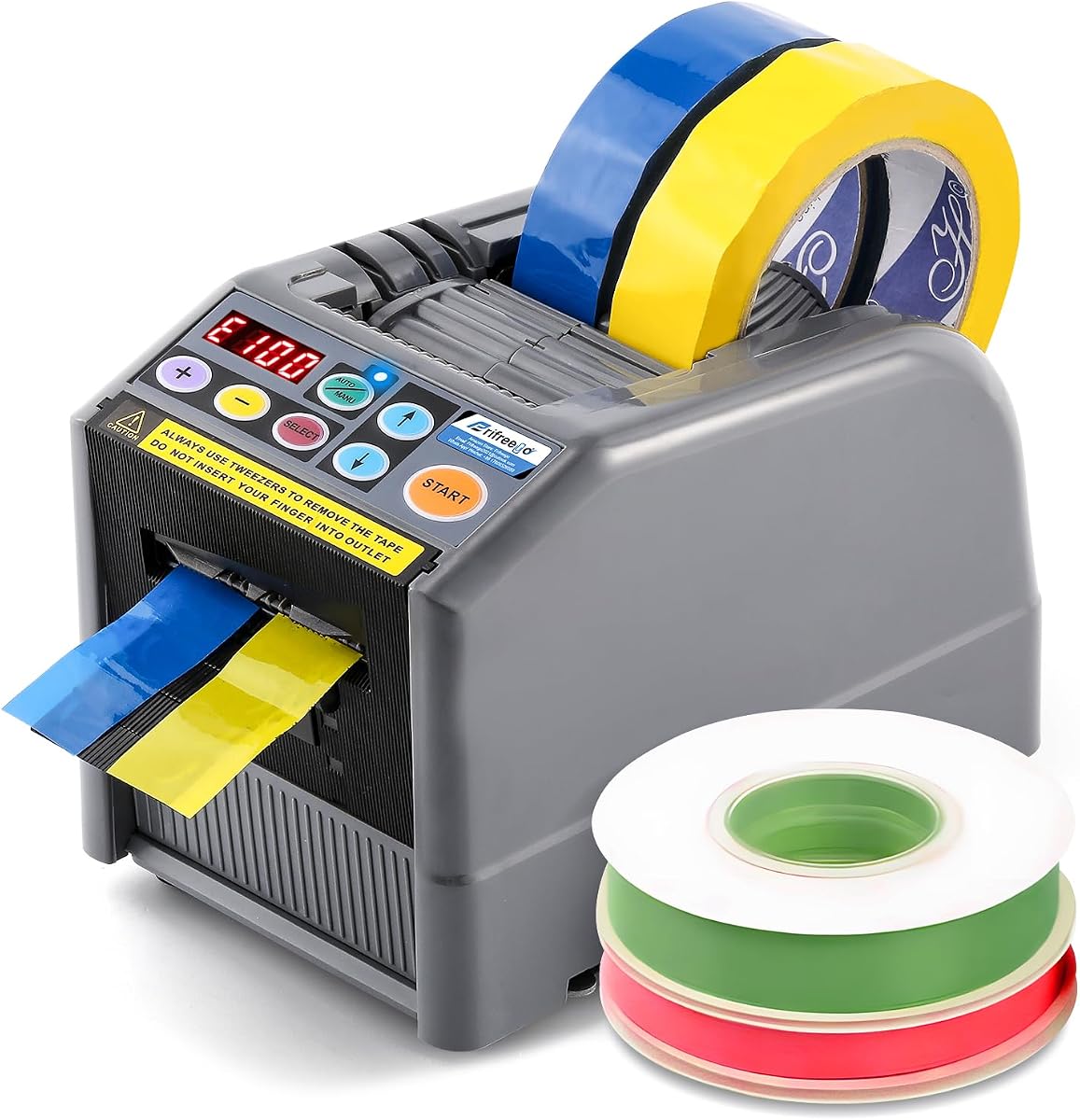


This advanced automatic dispenser combines a broad cutting range with one of the clearest specifications in the category. Its stated accuracy is within 0.04 inches, while the supported material range extends from approximately 0.24 to 2.36 inches wide and from 0.2 to 39.9 inches long. That makes it a strong candidate for packaging counters, gift-wrapping stations, schools, restaurants, and small businesses.
We may earn a commission when you buy through this link, at no additional cost to you.
The defining advantage is flexible operation. Users can select preset lengths, repetitive cycle cuts, and automatic cutting, while holding the SELECT button activates LCON continuous mode for uninterrupted ribbon work. The machine can accommodate two tape types at the same time, reducing duplication when a workflow uses different finishes or widths. Smart storage and memory functions allow repeated lengths to be reproduced consistently.
There are practical trade-offs. This is a powered desktop-style unit rather than a portable tape gun, so it requires a stable work surface and access to power. Continuous cutting should be used with appropriate attention to the moving blade area, and the reported accuracy ultimately depends on correct loading, material selection, and maintenance. Despite those considerations, the feature set is unusually balanced for mixed-use workspaces.
Our overall recommendation goes to this model because it offers the strongest combination of range, repeatability, and operating flexibility. Choose it when consistent preset lengths, long cuts, two-material handling, and hands-free continuous cutting matter more than compact size.
Preset and cycle functions make repetitive work more consistent by removing much of the judgment involved in judging tape length. The stated 0.04-inch accuracy also supports packaging and presentation tasks where visibly uneven ends would be inconvenient.
Holding two tape types at once is particularly useful when packaging teams alternate between transparent, decorative, or double-sided materials. The wide supported range gives buyers more freedom than a dispenser limited to one narrow tape width.
We may earn a commission when you buy through this link, at no additional cost to you.
This model targets users who need repeatable cuts without a large stationary machine. It supports tape from 6 to 60 millimeters wide and cut lengths from 5 to 999 millimeters, providing enough range for shipping seals, craft strips, and decorative ribbons. Its under-4.85-pound weight also makes it easier to move between packing areas.
We may earn a commission when you buy through this link, at no additional cost to you.
Operation can be automatic or manual, which is useful when a workflow alternates between batch cutting and carefully placed individual pieces. Long-pressing SELECT starts LCON continuous mode, allowing the operator to attend to other tasks while ribbons are processed. The memory system stores six length settings, which is a practical number for recurring packaging dimensions.
The most important limitation is material behavior. Strongly adhesive or unusual ribbons may cause feeding difficulties, and non-adhesive ribbon is better handled in LCON mode. Users must also allow for the sensor's jam response: the machine stops to prevent damage, after which the obstruction must be cleared and operation restarted.
This is a compelling recommendation for small businesses, schools, restaurants, and mobile packing teams that need a full-featured electric dispenser without moving up to a larger machine. It may be less attractive for buyers wanting a completely cordless or handheld unit.
The lightweight chassis makes the dispenser practical for businesses that move between packing, crafting, or service areas. Portability does not remove the need for a suitable power source, but it simplifies repositioning the machine when tasks change.
LCON mode addresses the tendency of non-sticky ribbon to behave differently under automatic sensing. It is particularly valuable for decorators and gift-wrapping operations that need many similarly sized pieces.
We may earn a commission when you buy through this link, at no additional cost to you.
This automatic electric dispenser is built around a choice between automatic and manual operation. That flexibility is useful for mixed workloads: automatic mode can support repetitive jobs, while manual mode gives the operator more direct control over individual cuts. Its maximum cut length is 999 millimeters and its width capacity extends to 2.36 inches.
We may earn a commission when you buy through this link, at no additional cost to you.
The machine includes intelligent memory for as many as six lengths and a sensor intended to support accurate, clean cutting. LCON mode provides an uninterrupted workflow for ribbon, while the portable body helps warehouse, restaurant, school, factory, and home users place it where work is occurring. It is therefore more of a flexible production tool than a narrowly specialized dispenser.
Users should account for setup and power requirements. Setting up multiple presets takes time before the efficiency benefit becomes apparent, and the corded format is less convenient than a battery-free handheld model. The sensor also stops operation during a jam, making correct clearing and restart procedures important for consistent throughput.
We recommend this model for buyers who want meaningful control over each cycle without giving up batch automation. It suits users who alternate between high-volume repetitive cuts and occasional precision work rather than relying on a single operating style.
Automatic mode is the logical choice for repeated, standardized lengths. Manual mode is better when material placement, visual alignment, or an individual cut calls for a more deliberate response from the operator.
Six stored lengths accommodate several common packaging or craft sizes. This reduces repeated manual entry and helps different users reproduce work more consistently across a busy shift.
We may earn a commission when you buy through this link, at no additional cost to you.
This semi-automatic cutter differentiates itself through two-roll operation, allowing multiple users to work at the same time. It accepts transparent or double-sided adhesive ribbon and supports widths from 0.23 to 2.36 inches and lengths up to 999 millimeters. That makes it relevant to packaging counters, gift shops, factories, and shared craft rooms.
We may earn a commission when you buy through this link, at no additional cost to you.
Its controls include manual and automatic modes, six saved length settings, cycle presets, and LCON continuous cutting. These features cover both measured batch work and continuous ribbon processing. A safety barrier and photoelectric sensor create layers of protection, while a manual restart requirement after an obstruction prevents the machine from resuming unexpectedly.
The central constraint is the combined width of the two rolls, which must not exceed 60 millimeters. This means the machine cannot simply accept any pair of full-width rolls; users need to select compatible materials. The manual restart after an obstruction can also interrupt work, although it is a sensible safety measure.
This cutter is a good choice for shared environments where two operators need tape available concurrently and material dimensions are known in advance. It is less suitable for users who want to load any two maximum-width rolls together.
Holding two rolls at once can reduce interruptions in busy workspaces. Different operators can use separate materials, or one workflow can alternate quickly between transparent and double-sided tape.
The safety barrier and photoelectric sensor work together to interrupt cutting when the operating area is obstructed. Requiring a deliberate restart adds another layer of control before the blade resumes.
We may earn a commission when you buy through this link, at no additional cost to you.
This electric dispenser places unusual emphasis on consumables and user guidance. It supports tape or ribbon up to 60 millimeters wide and 0.5 millimeters thick, with a maximum preset length of 999 millimeters. The package includes an additional set of specified consumables, an instruction manual, and access to an uploaded knife-box replacement demonstration.
We may earn a commission when you buy through this link, at no additional cost to you.
The silicone wheel is intended to minimize adhesive residue, while the machine can hold two rolls for synchronized cutting. Two automatic tape-output modes accommodate different output needs. These details make the product appealing for operators who value straightforward maintenance and clearer troubleshooting support.
Material compatibility is the decisive constraint. Highly adhesive materials can leave residue and cause jams, while materials thicker than 0.5 millimeters may overheat the motor. Non-sticky ribbon may not trigger automatic sensing reliably, so LCON mode is recommended. Elastic ribbon such as organza should not be used because it can jam the gears.
We recommend this model for users working with conventional tape and non-elastic decorative ribbon who will follow the stated material limits. It is less suitable for specialized industrial adhesives, very thick stock, or elastic decorative ribbon.
The included replacement set and available knife-box guidance reduce uncertainty around routine service. A weakened wheel or consumable can affect feeding, making periodic inspection worthwhile in high-volume workflows.
The stated thickness and adhesive limitations are central to safe operation. Checking the intended tape before ordering avoids the residue, jamming, and motor problems associated with unsupported materials.
We may earn a commission when you buy through this link, at no additional cost to you.
The BEAMNOVA stands apart with the highest customer rating in this comparison and an unusually complete feature set. It handles 6- to 60-millimeter tape and 5- to 999-millimeter lengths, supports two rolls, and can store six preset lengths that remain in memory after a power outage. Preserved settings are especially useful in shared businesses where different users return to the same machine.
We may earn a commission when you buy through this link, at no additional cost to you.
Its L and P modes address different material behaviors. L mode supports continuous cutting of non-adhesive material, while P mode uses automatic sensing for adhesive tape. Automatic and manual cutting controls add another layer of flexibility. The stated material range includes transparent tape, ribbon, craft paper, double-sided tape, fiberglass, aluminum foil, and masking tape.
The anti-static ABS construction, dual sensors, built-in fuse, and blade box stated to have been tested for two million cuts add to the premium positioning. The dual sensors also help prevent unintended continuous cutting. Users must still load materials correctly and select the appropriate mode, because a broad compatibility list does not remove every handling requirement.
This is our premium recommendation for buyers who want polished storage, adaptable modes, and broad material support. It is a strong choice for craft rooms, gift shops, packaging stations, and creative businesses handling several tape types rather than only one standard sealing tape.
Retaining six programmed lengths means operators do not need to rebuild the machine's core settings after an interruption. This is valuable in shared workspaces, production areas, and any workflow with several recurring sizes.
Separating continuous handling for non-adhesive ribbon from sensing-based adhesive cutting makes the machine more adaptable. The appropriate mode reduces feeding uncertainty when materials have different surface properties.
We may earn a commission when you buy through this link, at no additional cost to you.
This compact dual-tape dispenser delivers the core capabilities found in more elaborate machines: a 999-millimeter maximum cut length, two-material capacity, six stored presets, continuous cutting, and sensor-based jam protection. Its 4.8-pound weight and automatic or manual operation make it practical for offices, craft areas, decorators, florists, and shipping stations.
We may earn a commission when you buy through this link, at no additional cost to you.
Dual-tape support allows two ribbons or tapes to be cut at once, which is valuable when one task needs coordinated decorative elements or a packing station uses more than one material. The memory settings remain stored after power-off, supporting consistent repetitive output and reducing setup time across shifts.
Its simpler interface may not offer the same material-specific sophistication as the BEAMNOVA, and the machine still needs a power connection. Users should also expect to clear jams and press START before operation resumes. These are modest limitations given the breadth of its core functions.
Our budget recommendation goes to this model because it covers the most important electric-dispenser features without adding many secondary considerations. It is best for buyers who want dual-tape output, useful presets, and portability in a straightforward package.
The dual-roll layout supports coordinated production without requiring two separate machines. Its modest dimensions and 4.8-pound weight also make it easier to integrate into smaller work areas.
Six retained presets help users reproduce recurring dimensions quickly. The memory function is especially helpful when several people share the machine and need the same standard lengths.
We may earn a commission when you buy through this link, at no additional cost to you.
This automatic tape cutter combines a portable body with broad 6- to 60-millimeter width and 5- to 999-millimeter length support. It can handle two tape types simultaneously, making it useful for packaging areas that alternate between standard sealing tape and another adhesive or decorative material.
We may earn a commission when you buy through this link, at no additional cost to you.
Automatic sensing and manual control offer a choice between efficient feeding and operator-led cutting. LCON mode supports continuous ribbon work, while six programmable length settings improve consistency in repetitive jobs. Jam detection halts the machine when material becomes trapped, helping protect the blade and tape from further damage.
Compared with some premium competitors, the description does not explicitly state that presets remain after a power outage. This distinction matters when several recurring lengths must be restored for each new session. The machine also remains dependent on electrical power despite its light weight.
This is a suitable choice for businesses and homes that prioritize easy relocation, two-tape flexibility, and dependable operating modes. It is especially useful for packing benches where cords can remain connected but the machine itself may need to move between stations.
At under 4.85 pounds, the dispenser can be moved between packing, crafting, and presentation areas with relatively little effort. A stable surface and nearby power outlet are still necessary for dependable cutting.
Six saved length settings reduce the chance that pieces will vary substantially during a busy job. Automatic jam stopping further improves consistency by preventing a blocked cut from becoming a larger equipment problem.
We may earn a commission when you buy through this link, at no additional cost to you.
The one-handed tape dispenser gun offers a radically different approach from the electric desktop machines. It requires no batteries or cord and uses a concealed internal blade to dispense and cut tape. Pressing and releasing produces a short strip, while holding the lever allows a custom length to be pulled, making it useful for envelopes, light packaging, crafts, and gift wrapping.
We may earn a commission when you buy through this link, at no additional cost to you.
Its compatibility with half-inch to three-quarter-inch tape on standard one-inch-core rolls covers common everyday materials. A roll is included, so the kit can be used without an immediate additional purchase. The handheld form keeps the blade away from the user's fingers and allows the other hand to hold wrapping paper, a box, or a gift.
Its limitations are substantial compared with programmable electric dispensers. There are no saved length presets, continuous production mode, or support for broad ribbon widths. The standard cut is one inch, and custom lengths depend on the user's hold time rather than a precise digital setting.
We recommend this gun for gift wrapping, office sealing, and lightweight crafting where portability and one-handed operation matter more than batch precision. It is not the right choice for a warehouse needing hundreds of identical preset pieces.
The battery-free mechanism makes the dispenser convenient for wrapping away from a desk or working in locations without an outlet. It can also be moved easily between family members sharing a gift-wrapping session.
The hidden blade improves handling because the user does not need to manipulate a separate knife or pair of scissors. The lever controls dispensing and cutting while the other hand remains free to stabilize the material.
We may earn a commission when you buy through this link, at no additional cost to you.
This rotary dispenser is optimized for short pieces rather than long packaging or decorative strips. It supports tape widths from 3 to 25 millimeters and cut lengths from 13 to 60 millimeters. The large cutting disc can be used by multiple people, making the format interesting for craft rooms, shared counters, and small production spaces.
We may earn a commission when you buy through this link, at no additional cost to you.
Its large-disc design gathers cut tape around the wheel, while adjustable cutting length and distance allow the operator to match specific short requirements. The tungsten steel blade is described as solid and capable of producing neat edges. An English manual is included, and operation follows a straightforward plug-in, switch-on, and button-press sequence.
The transparent safety cover must remain closed for the machine to operate. This safety interlock is sensible but worth understanding before use. The narrow dimensions also mean it cannot replace a long-cut dispenser for ribbons, oversized tape, or packaging strips.
Although the product description notes that the simple process can be easy for younger children, it explicitly advises against unsupervised use. We recommend it for supervised craft applications and shared short-strip tasks, with clear blade awareness and stable placement.
The large disc design allows several people to access finished pieces around a shared station. That arrangement can be useful in busy craft environments where short lengths are needed more often than long ribbons.
The machine will not turn on unless its transparent cover is closed. This keeps the cutting area enclosed during operation, but users should still supervise the device and keep hands away from the blade.
We may earn a commission when you buy through this link, at no additional cost to you.
The right dispenser depends less on the broadest specification sheet than on the materials, cut lengths, workload, and working environment involved in your daily tasks. Compare these factors before choosing a model.
Start by measuring the actual material you intend to cut. Most electric models in this guide accept tape from 6 to 60 millimeters wide, or approximately 0.23 to 2.36 inches, but the handheld gun is much narrower and the rotary model tops out at 25 millimeters. Thickness is especially important for electric models: the Electric Ribbon Cutting Machine limits supported material to 0.5 millimeters and warns that thicker tape can damage the motor.
Match the machine to the narrowest and thickest materials in your workflow, not merely the most common tape. Strong adhesives, elastic ribbon, fiberglass, foil, and craft paper can behave differently, so compatibility should be confirmed for every unusual material.
Long-cut dispensers support packaging seals, decorative ribbons, and gifts, while short-cut tools are better for craft labels, small strips, and compact packaging. Models with a 999-millimeter maximum length cover a broad range, whereas the rotary dispenser cuts only 13 to 60 millimeters and the advanced 39.9-inch model extends considerably further for very long materials.
Choose a maximum length comfortably above your longest common requirement. A slightly higher limit adds flexibility without making the machine harder to operate, while an undersized model may force you to join or reposition material unnecessarily.
Preset functions save time when several lengths recur throughout the day. Six programmable settings appear across several electric models, while the BEAMNOVA and some competing machines also specify that those settings remain after power loss. Cycle settings are particularly useful when a job requires repeated batches at the same length.
For occasional sealing, a handheld dispenser may be sufficient. For warehouses, gift shops, and packaging counters, saved settings reduce operator effort and make output more consistent across shifts.
Automatic sensing feeds and cuts tape with minimal intervention, making it efficient for routine sealing. Manual control is helpful when the operator needs to position material more deliberately or supervise each piece. LCON or continuous mode is especially important for non-adhesive ribbon, which may not trigger ordinary automatic sensing reliably.
A machine that offers all three approaches is more adaptable. Material-specific modes, such as the BEAMNOVA's L and P settings, can further simplify selection when different tape types are used throughout the week.
Sensor-based stopping is important because a jam can damage the blade, strain the motor, or waste material. Most electric models stop when a tape jam is detected and require the obstruction to be cleared before restarting. The semi-automatic dual-roll cutter adds a physical safety barrier and photoelectric sensor, while the BEAMNOVA uses dual sensors and a built-in fuse.
Pay attention to restart procedures and keep hands clear of the cutting path. A safety feature reduces risk but does not make unattended operation appropriate, particularly around children or in fast-moving work areas.
Consider where the machine will live and whether it must move between locations. Electric models weigh under 4.85 pounds or approximately that amount, making them reasonably portable, but they still require a power source. The one-handed dispenser gun is battery-free and cordless, while the rotary unit uses a plug-in design and needs its transparent cover closed.
Choose a cordless handheld tool for mobile, occasional tasks. Choose an electric desktop model when repeated cuts, preset accuracy, and material capacity justify a dedicated power connection.
Two-roll machines can hold different tape types simultaneously, support multiple users, or produce coordinated pieces from matching materials. They are particularly helpful in shared packaging areas and businesses that alternate between transparent sealing tape and decorative or double-sided ribbon.
Check the combined width limit. On the semi-automatic dual-roll model, the two rolls together must not exceed 60 millimeters, so two individually compatible rolls may still not be usable together.
Automatic cutting creates wear on the blade, wheel, and other consumable parts. A machine with replacement parts in the package, clear maintenance guidance, and accessible support is more attractive for frequent users. Residue-prone tapes may require closer wheel and blade inspection than clean, low-adhesive materials.
Review the manual and replacement instructions before operating a new machine. Keep spare consumables available if the workload is high, and never use unsupported thicknesses or adhesive levels simply to avoid sourcing a different material.
Before operating an electric model, place it on a stable surface, connect the power supply, and confirm that the cutting area is clear. Load the tape in the specified direction, usually with adhesive facing downward as indicated by the manufacturer, and check that the roll sits correctly in its holder. Enter the desired length before selecting automatic, manual, or continuous mode.
Run a short test piece before processing a batch. Confirm that the tape feeds freely, the selected length appears correct, and the cut edge meets your needs. For continuous ribbon work, use LCON or the manufacturer's equivalent mode rather than automatic sensing, especially when the ribbon has no adhesive.
When a jam or obstruction is detected, stop the cycle and disconnect power if the manual advises doing so. Clear the material carefully, inspect the wheel and blade path, and restart only after the obstruction is removed. Keep the blade area away from fingers and clothing, and arrange for supervision around children.
Automatic mode feeds and cuts tape after a start command and is efficient for repeated standard lengths. Manual mode gives the operator more direct control over each cut. Continuous mode keeps processing material for sustained ribbon work and is often better for non-adhesive materials that may not trigger automatic sensing.
It depends on the ribbon and the machine's sensing system. Models with LCON or continuous mode are specifically designed to handle non-adhesive ribbon more reliably. Elastic ribbons such as organza can jam gears and should not be used with the models that identify them as incompatible.
Most of the electric models accept approximately 6 to 60 millimeters, or 0.23 to 2.36 inches. The handheld gun supports only half-inch to three-quarter-inch tape, while the rotary dispenser handles 3 to 25 millimeters. Measure your rolls and check thickness as well as width before buying.
That depends on the model. The BEAMNOVA explicitly retains up to six settings after a power outage, and the Dual-Tape Smart Dispenser also describes stored settings that survive power-off. For other models, check the manual or manufacturer listing for confirmation before relying on that feature.
Stop the machine and follow its jam-clearing instructions before restarting. Confirm that the tape is loaded in the correct direction, that its thickness and adhesive level are supported, and that the cutting path is free. Strong adhesive or unusually thick material may require a different machine.
It can be useful when staff alternate between two materials or need to prepare different tape types concurrently. It reduces reload time and can support simultaneous work. Check the combined roll-width restriction, because two rolls that fit individually may not fit together within the machine's stated limit.
Children should use powered cutters only with adult supervision and clear instructions. The rotary model's description notes that the process is simple, but it explicitly warns against unsupervised use. Keep the cutting area clear, use any required cover or barrier, and keep hands away from the blade.
A one-handed tape gun is often sufficient for occasional wrapping because it is cordless, battery-free, and easy to carry. An electric model becomes more valuable when you repeatedly need exact preset lengths, long ribbon cuts, continuous production, or automatic dispensing.
Our top three recommendations serve different priorities. The 39.9-Inch Advanced Dispenser is the most balanced overall option because of its broad length range, stated accuracy, presets, dual-tape capability, and continuous mode. The BEAMNOVA is the premium choice for retained settings, material-specific controls, broad tape compatibility, and refined safety features.
The Dual-Tape Smart Dispenser is the value-oriented recommendation for buyers who want two-roll capacity, six presets, portable construction, and jam protection without an expansive premium feature set. If your work involves only occasional wrapping and short standard strips, the handheld tape gun offers a simpler and cordless alternative.
Before buying, verify the exact tape dimensions, required cut length, operating mode, and safety procedure against your intended materials. Current prices, promotions, and availability can change, so check the latest listing information before making a final purchasing decision.