
GIANDEL 4000W Pure Sine Wave Power Inverter
4.4Editor score
Pure sine wave with low distortion
8000W peak surge capacity
UL 458 safety compliance
Hardwired heavy-load terminal
Aluminum alloy cooling housing
Our 4000 Watt Power Inverter guide compares ten 12V-to-120V models for output quality, connectivity, safety, remote monitoring, and use at home or away.
A 4000 watt power inverter can transform a 12V DC battery into household-style 110V or 120V AC power, making it useful for RVs, trucks, boats, off-grid cabins, job sites, and emergency backup. A worthwhile model should deliver stable continuous output, handle appropriate startup surges, protect the battery, and provide clear operating information.
We compared ten 4000 watt power inverters using the specifications supplied for each model. The evaluation covers waveform type, continuous and peak output, AC outlets, USB and Type-C charging, remote controls, displays, battery compatibility, cooling, and protective functions. The list includes pure sine wave and modified sine wave models rather than treating them as interchangeable.
Each review identifies the configuration that makes that inverter most suitable, from compact mobile installations to high-output systems with wired controls and hardwired connections. Continuous power should not be confused with surge capacity, so we call out both where the available information permits. Product listings and prices can change, making it wise to verify current specifications and terms before buying.
4.4Editor score

4.4Editor score

5.0Editor score
The comparison below places the ten inverters side by side, emphasizing practical differences in waveform, output, controls, charging ports, and installation options. These specifications describe the supplied product information and should be checked against current listing details before installation.




This 4000W Pure Sine Wave Inverter combines a 4000W continuous rating with an 8000W peak surge capacity, making it a broad-purpose option for mobile and stationary battery systems. Its pure sine wave output is the central feature, offering a smoother alternative to modified sine wave power for sensitive electronics and motor-driven appliances. The supplied rating is 4.4, with the product earning recognition for its extensive monitoring and connection options.
We may earn a commission when you buy through this link, at no additional cost to you.
The most notable strength is the 15-foot wired LCD remote. It displays battery voltage, AC output voltage, load wattage, frequency, and warning indicators, allowing an operator to check the system without reaching into a cabinet, vehicle, or crowded equipment area. Four AC outlets, a USB port, and a Type-C port add useful flexibility. Adjustable low-voltage shutdown from 9.5V to 11V is especially useful for owners using LiFePO4, AGM, gel, SLA, or deep-cycle batteries, subject to correct battery-specific settings.
A full complement of protections covers overload, short circuit, overheating, high or low voltage, and spark-free operation, while intelligent cooling fans help control heat. The trade-offs are that the listing does not mention a hardwired AC output, and this is a battery inverter rather than a grid-tied solar inverter. Those limitations are reasonable for a model intended for backup, RV, mobile, and off-grid use, but they should be understood before purchase.
This is the strongest all-around recommendation for buyers who want clean output, practical remote monitoring, multiple outlets, and flexible battery cutoff settings in one package. It suits RV owners, mobile installers, emergency-preparation buyers, and off-grid users who can power a substantial mixed load. Check the appliance startup requirements and battery capacity before installation, then confirm the current package contents and warranty information with the seller.
The remote places key operating data at the user's fingertips, including voltage, wattage, frequency, and fault warnings. That visibility makes it easier to identify a depleted battery, overloaded circuit, or unsuitable load before the situation becomes a shutdown.
The adjustable 9.5V-to-11V shutdown range allows the inverter to work with several lead-acid and lithium battery types. Correctly matching the cutoff to the battery chemistry helps reduce excessive discharge and protects battery health.
We may earn a commission when you buy through this link, at no additional cost to you.
The LANDERPOW 4000 Watt Inverter Pure Sine Wave 12V DC to 110/120V AC for Home combines 4000W continuous output with 8000W surge capability and a stated efficiency above 91%. That makes it a compelling option for mixed loads such as refrigerators, coffee machines, laptops, CPAP devices, microwaves, and selected power tools. Its 4.4 rating reflects a well-rounded feature set rather than a minimalist design.
We may earn a commission when you buy through this link, at no additional cost to you.
Its strongest configuration detail is the combination of four AC outlets and a hardwired terminal. The hardwired connection gives an installer another route for a high-current appliance or tool, while the outlets support several ordinary consumer devices. A 5V/3.1A USB connection and 30W PD Type-C port support convenient charging without occupying every AC socket. The 15-foot LED remote also provides real-time battery, output, and error information.
The supplied data lists undervoltage, overvoltage, overload, overheating, short-circuit, and reverse-connection protection. A full metal shell and heat-dissipation design are intended to withstand mobile use, while the included 1AWG, two-foot copper battery cables are specified to limit resistive heating. Even so, continuous 4000W output requires a battery bank and cable system capable of supporting that load, and the 8000W surge figure should be treated as short-duration headroom.
This model is best for a homeowner, RV user, or tradesperson who wants both normal outlets and a hardwired connection in a portable inverter. Pure sine wave output makes it more versatile than a basic modified sine wave design, while the included remote improves control in awkward installations. It is a strong alternative to the first-ranked model for buyers who prioritize efficiency, the hardwired terminal, and its stated three-year coverage package.
Four AC outlets handle everyday loads, while the hardwired terminal provides a more permanent route for equipment that benefits from a dedicated connection. USB and Type-C ports add a convenient way to charge compatible devices.
The pure sine wave format is suited to electronics, compressors, and inductive loads that may behave poorly with a modified waveform. This does not mean every appliance is compatible, so startup demand still needs to be evaluated.
We may earn a commission when you buy through this link, at no additional cost to you.
The Yinleader 4000 Watt Power Inverter combines 4000W continuous output, 8000W peak power, and conversion efficiency above 90% in a package aimed at RV, camping, off-grid solar, and emergency use. It has a 5.0 rating, the highest listed rating in this group, though ratings alone do not replace checking load compatibility. Its standout feature is the two-screen monitoring system.
We may earn a commission when you buy through this link, at no additional cost to you.
Both the main inverter and its 16.5-foot wired remote have LCD displays. The remote shows input voltage, output voltage, operating frequency, and system status, allowing operation from outside a vehicle, storage compartment, or equipment cabinet. Three AC outlets and one USB port provide the basic connection mix, while the cooling fan is controlled by temperature and load. The stated activation point above 45°C or during high-power operation is intended to balance heat management with quieter running.
Protection includes overvoltage, undervoltage, overload, short circuit, overcurrent, overheating, and reverse polarity. The high-strength casing is designed for impact resistance and heat dissipation, and the unit supports lead-acid, gel, and lithium 12V battery systems. The main limitation is that the supplied information does not identify the waveform. Buyers who need assurance of a pure sine wave should not assume that capability from the high continuous wattage alone.
This inverter is a sensible choice for users who want a 5.0-rated model with an unusually accessible dual-display arrangement without paying for a hardwired terminal or a large collection of charging ports. It works well for a balanced mix of household devices and tools where individual loads remain under the inverter's ratings. Confirm the waveform, connector layout, and installation requirements before finalizing the purchase.
Having an LCD on the inverter and a second display on the wired remote offers useful redundancy. Users can confirm voltage, frequency, and status from a more convenient position, particularly in RV cabinets or mobile installations.
The fan responds to temperature and load rather than running continuously. This design can reduce unnecessary noise during lighter use while still directing heat away from the electronics during demanding operation.
We may earn a commission when you buy through this link, at no additional cost to you.
The Energizer 4000 Watts Power Inverter is a modified sine wave model with 4000W continuous and 8000W peak output. It is positioned for vehicle and camping use, where two AC outlets, two 2.4A USB ports, a hardwire kit, and battery cables create a straightforward utility package. The 4.4 rating is backed by an important distinction: the supplied information states that the product is ETL approved under UL 458.
We may earn a commission when you buy through this link, at no additional cost to you.
Safety documentation and visible status information are the primary benefits. The LCD presents input voltage, output wattage, battery level, and fault conditions, while protection covers overload, overvoltage, undervoltage, high temperature, and short circuit. A hardwire kit broadens installation options beyond direct battery-cable use, and the included three-foot 0AWG cables support a high-current connection.
The central compromise is the modified sine wave. It is less suitable for sensitive electronics and some motor-driven loads than a pure sine wave unit, even though it can run many common camping devices, phones, laptops, televisions, lights, and similar equipment. It also offers two AC outlets rather than the three or four found on most competitors in the list. Appliance manuals and device manufacturers should be checked for waveform requirements.
This Energizer model is most appropriate for a mobile user who prioritizes a documented safety listing, straightforward monitoring, and established brand support. It is less compelling for a home medical device, sensitive audio system, or installation requiring the cleanest available waveform. It is still a relevant 4000W option for conventional RV and vehicle backup use, especially when recognized testing is a deciding factor.
The stated ETL approval under UL 458 gives buyers a specific certification reference to verify. That can be more useful than vague durability language when safety documentation is an important purchasing criterion.
The LCD reports input voltage, output wattage, battery level, and protection status. These readings help users balance loads and diagnose issues without relying only on audible symptoms or indicator lights.
We may earn a commission when you buy through this link, at no additional cost to you.
The Sunivora 4000W Power Inverter offers 4000W of continuous modified sine wave power, an 8000W surge rating, and conversion efficiency above 90%. It is designed for camping, mobile work, emergency use, and conventional household tools. Its 4.3 rating is supported by a broad feature set, but the remote range of 165 feet is the specification most likely to distinguish it from wired-control competitors.
We may earn a commission when you buy through this link, at no additional cost to you.
The wireless remote and LCD provide input and output voltage, battery capacity, load capacity, output frequency, radiator status, converter temperature, and the reason protection activated. That level of diagnostic detail can help owners distinguish an overload from a voltage problem or overheating. Four AC outlets make it easier to connect several smaller devices, while the single USB port provides basic charging capability.
The aluminum shell uses an integrated stamped design, and cooling fins work with intelligent fans to reduce heat accumulation. Two included 0AWG pure copper cables are intended to support stable power delivery. Protection covers undervoltage, overvoltage, overload, overheating, short circuit, and reverse connection. The modified sine wave output, however, is less appropriate for equipment that explicitly requires pure sine wave power, and the remote is supplied without a battery.
Sunivora is a practical fit for users who need to start, stop, or inspect an inverter from a greater distance than a short wired panel can reach. It may work well in a large RV, workshop, or temporary deployment where four outlets and detailed status information are useful. It is less compelling for sensitive electronics or buyers seeking a hardwired high-current output. Review the appliance requirements and prepare the necessary remote batteries before setup.
A stated 165-foot operating range makes the wireless remote useful in larger camps, work areas, or vehicle-and-equipment layouts. It avoids the need to route a control cable across a workspace.
The display reports radiator status, converter temperature, output frequency, and protection reasons. Those details can make troubleshooting more systematic when the inverter stops under changing load conditions.
We may earn a commission when you buy through this link, at no additional cost to you.
The GIANDEL 4000W Pure Sine Wave Power Inverter delivers 4000W continuous output, 8000W peak capability, and up to 91% efficiency. Its total harmonic distortion is listed below 3%, while the pure sine wave format is designed for a stable approximation of grid-style AC. The 4.4 rating and unusually detailed technical specifications make it the premium-oriented choice in this group.
We may earn a commission when you buy through this link, at no additional cost to you.
Safety and construction are major strengths. The unit is stated to comply with UL 458, uses isolated input and output, and includes soft-start technology. An aluminum alloy housing supports cooling and resistance to drops and bumps, while an intelligent fan helps manage heat. Seven listed protections cover high voltage, low voltage, overload, short circuit, overheating, and reverse polarity, with a fuse added to the safety package.
Four AC outlets offer broad household convenience, and a hardwired terminal is specified for loads from 1500W up to 4000W. That makes the inverter adaptable to both ordinary plug-in devices and higher-demand equipment. The package includes three pairs of 4AWG cables, a ground wire, and shock-proof pads, along with an 18-month warranty and technical support. One limitation is that the specification lists only one 2.4A USB port and does not mention a remote controller.
This model best suits a serious RV, marine, truck, solar, or emergency installation where pure sine wave quality, documented compliance, and a hardwired output are priorities. It is particularly attractive to buyers who want a stated 18-month service package and access to technical support. Those who require remote operation or modern USB-C charging may find a better fit among models with more extensive control and port options.
The stated total harmonic distortion below 3% supports stable operation of sensitive electronics, audio equipment, and motor-driven appliances. It is one of the strongest technical specifications among the pure sine wave choices here.
Isolated input and output, soft-start behavior, an aluminum alloy shell, and a hardwired terminal create a package suited to RV, marine, solar, and outage applications. Professional installation remains appropriate for fixed high-load configurations.
We may earn a commission when you buy through this link, at no additional cost to you.
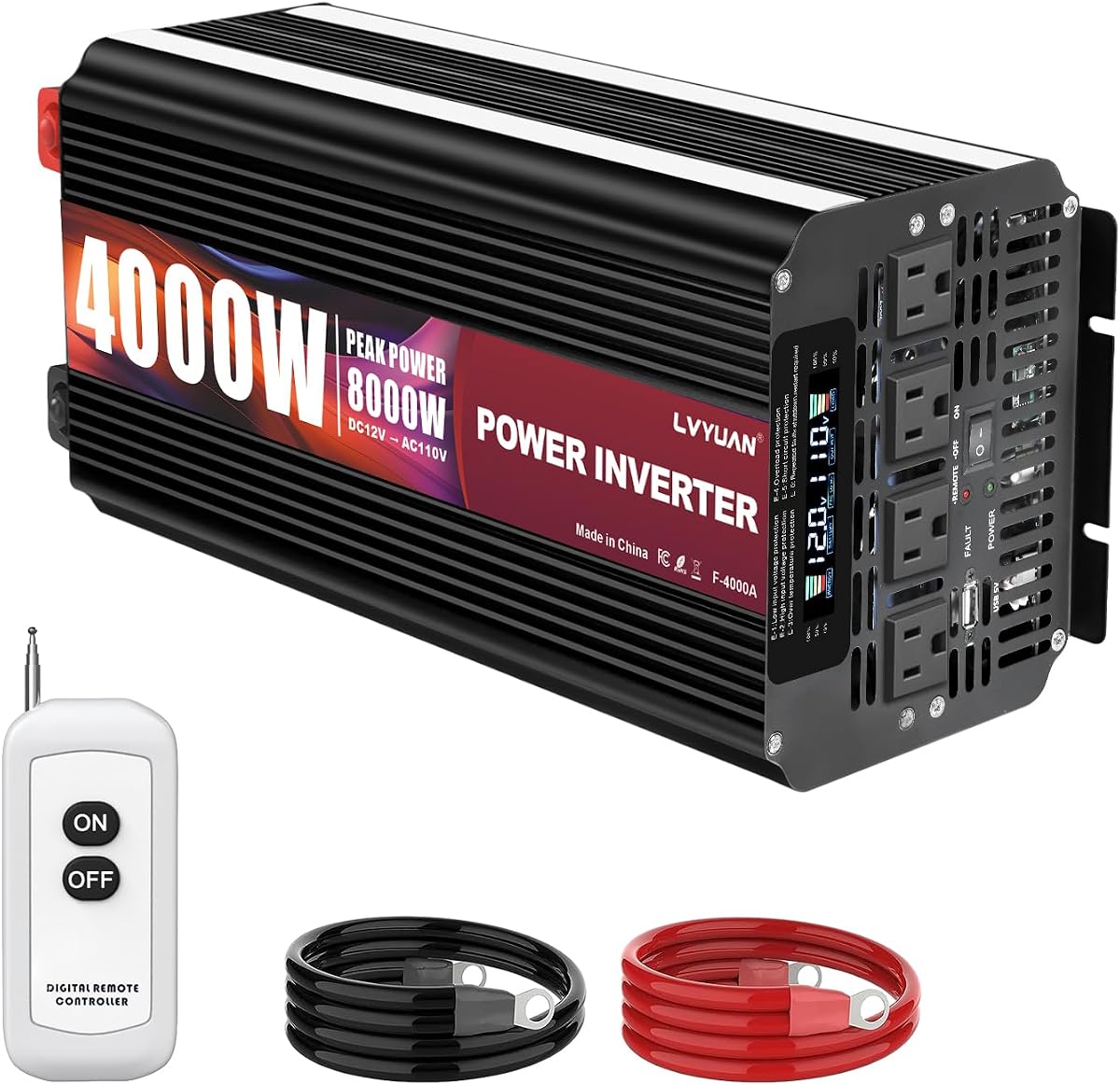
The LVYUAN 4000 Watt Power Inverter combines 4000W continuous output, an 8000W peak rating, four AC outlets, and a wireless remote. The listed 4.5 rating makes it one of the higher-rated models in the roundup, while its hardwired terminal differentiates it from many basic four-outlet inverters. It is intended for vehicles, RVs, trucks, camping, and off-grid solar arrangements.
We may earn a commission when you buy through this link, at no additional cost to you.
Remote control is especially useful when the inverter sits inside a cabinet, beneath a vehicle component, or in another awkward location. The LCD reports voltage, battery level, load, and alerts, so operating status can be checked without opening the installation area. Four AC outlets make it convenient to run several ordinary devices simultaneously, while the hardwired connection gives a dedicated option for suitable equipment.
Protection includes overvoltage, undervoltage, overload, short circuit, reverse polarity, and overheating. The intelligent cooling fan is stated to activate when internal temperature exceeds 104°F or load exceeds 45%, which can keep background noise lower during light operation. The supplied information does not clearly identify the waveform or list dedicated USB charging ports, so users with sensitive-equipment requirements should request those details.
LVYUAN is a good match for RV or truck owners who want both four AC outlets and wireless operation, particularly when a hardwired connection is useful. It is less suitable for buyers who require a confirmed pure sine wave, detailed USB charging specifications, or a specific certification standard. Before installation, check appliance startup demand, battery capacity, and whether the included wiring supports the intended load.
Wireless control simplifies operation when the inverter is mounted in a cabinet, storage compartment, or other location that is inconvenient to reach. It also allows a driver to check status without leaving the vehicle.
The combination of four AC outlets and a hardwired terminal supports both distributed plug-in loads and a more permanent connection. Each circuit and the inverter's total capacity must still be respected.
We may earn a commission when you buy through this link, at no additional cost to you.
This 4000W Pure Sine Wave Inverter supplies 4000W continuous and 8000W peak output at 110V/120V and 60Hz. Its 4.1 rating is the lowest among the ten products, but the feature set is broad: four AC outlets, USB connections, an LCD, and both wired and wireless remote controls. That control combination gives it unusual flexibility for RV, vehicle, solar, and outage use.
We may earn a commission when you buy through this link, at no additional cost to you.
The wired panel includes a 5V 3.1A USB connection and a 20W Type-C port, allowing compatible devices to charge through the remote. A separate wireless remote is also included, although its batteries are not supplied. The inverter is intended for cars, boats, camping, travel, business trips, and emergency scenarios, with listed uses including game consoles, cameras, vacuums, ovens, coffee makers, and refrigerators.
Safety features include a cooling fan, LED indicator, built-in fuse, and protection against overcurrent, short circuit, low load, overload, overheating, and overvoltage. The aluminum alloy housing is described as durable, and the supplied information cites efficiency above 90%. The lower rating suggests that some users have reported a less satisfactory overall experience, although the listing does not identify the reasons. Buyers should read current customer feedback for details before deciding.
This converter is best for someone who values the ability to choose between wired and wireless control, particularly if the installation location is likely to change. It is also attractive for owners who want pure sine wave output and several charging connections in one unit. The missing remote batteries, lower customer rating, and need to verify appliance compatibility are the main trade-offs to weigh.
The wired panel supports status viewing and charging from a fixed position, while the wireless remote provides mobility. Buyers can choose whichever arrangement better suits the vehicle, RV cabinet, or temporary setup.
The pure sine wave format is useful for electronics, entertainment systems, and appliances that may be sensitive to a coarse modified waveform. It still does not guarantee compatibility with every product, so load requirements should be checked.
We may earn a commission when you buy through this link, at no additional cost to you.
The Homkeep 4000 Watt Power Inverter provides 4000W continuous output, 8000W peak power, and conversion efficiency above 90%. It includes four AC outlets, two 3.4A USB ports, and a Type-C port, making its charging selection one of the strongest in the list. The 4.1 rating indicates mixed customer feedback, so buyers should examine current reviews for patterns involving installation, noise, or particular loads.
We may earn a commission when you buy through this link, at no additional cost to you.
The remote can control operation from up to 120 feet away, while the high-definition LCD shows input voltage, output voltage, and protection indications. A pair of smart cooling fans is designed to protect components and extend the expected service life of connected appliances. The aviation aluminum alloy shell provides drop and collision resistance for mobile environments, although physical durability does not replace correct electrical installation.
Six protections cover undervoltage, overvoltage, overload, overheating, short circuit, and reverse connection. The supplied specification lists a no-load draw of 1±0.3A, a point worth considering in a battery-powered installation because standby consumption can affect available runtime. The waveform is not identified in the supplied information, making it unsuitable for a buyer who must have confirmed pure sine wave operation.
Homkeep is most appealing to RV and truck users who want many ordinary outlets plus several USB and Type-C charging options. It is also convenient for mobile users who want remote control without a long control cable. The trade-offs are the lower customer rating and unspecified waveform. Those wanting a documented pure sine model, hardwired output, or a detailed battery cutoff setting should choose an option that clearly lists those features.
Two high-current USB ports and a Type-C connection add flexibility for phones, tablets, and other compatible devices. They reduce the need to occupy an AC outlet with a charging adapter when the inverter is already delivering power.
The large LCD presents voltage and protection information, while two cooling fans manage heat around the power electronics. Together they support more informed operation and more consistent temperature control.
We may earn a commission when you buy through this link, at no additional cost to you.
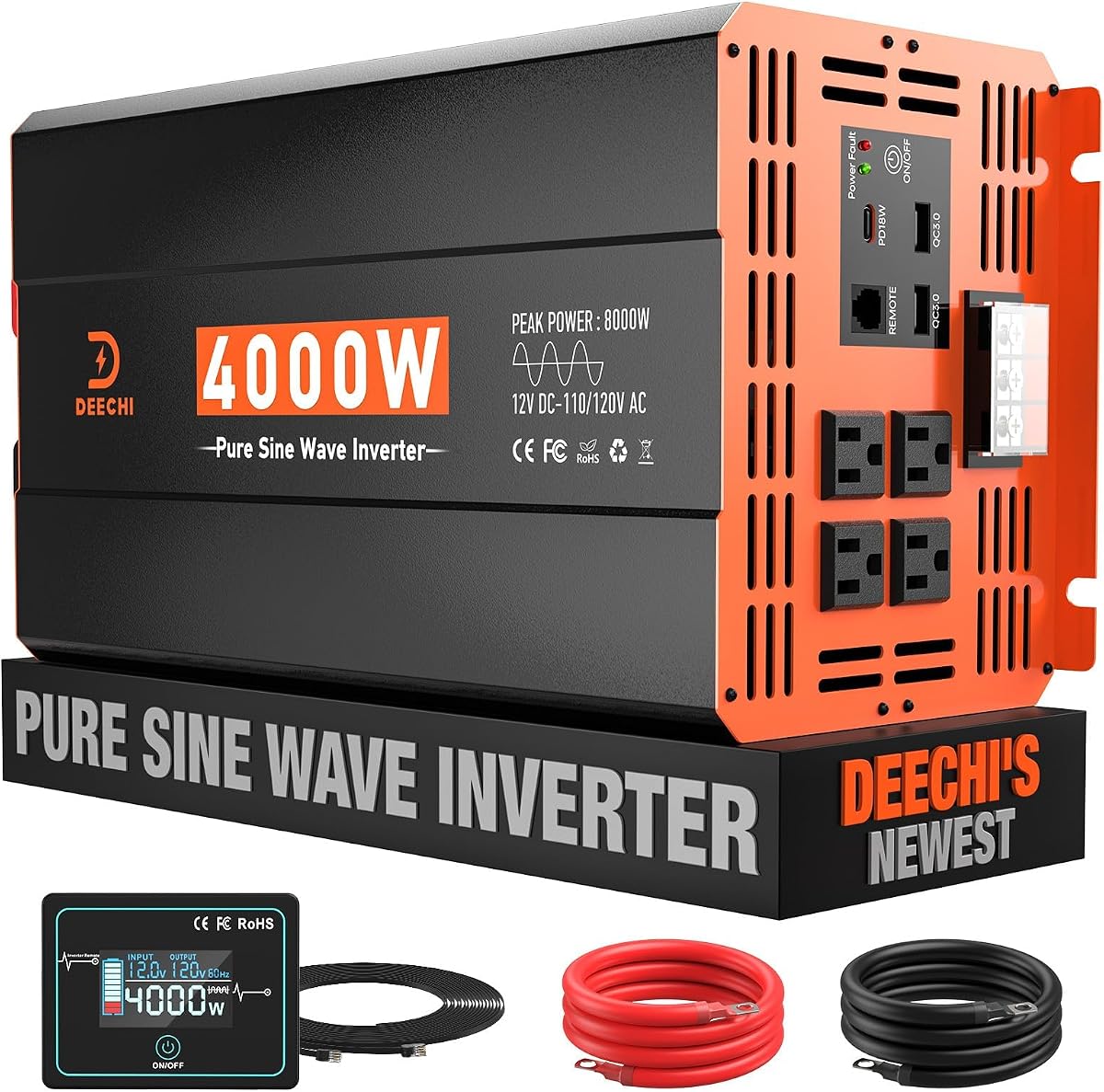
The DEECHI Pure Sine Wave Inverter converts 12V DC into 110V/120V AC, providing 4000W continuous and 8000W peak output. Its 4.4 rating reflects a balanced mix of clean waveform, several outlets, flexible battery support, and a color remote. It is designed for vehicles, RVs, trucks, homes, and solar battery systems where portable grid-style output is needed.
We may earn a commission when you buy through this link, at no additional cost to you.
Four North American AC outlets serve ordinary plug-in equipment, while two USB ports, an 18W Type-C port, and a hardwire kit expand the connection options. The included flexible pure copper cable is intended to support a stable installation. Dual temperature-controlled fans are described as reducing shell heat and keeping operation relatively quiet, which is useful for indoor or close-range use.
The 16.5-foot wired remote has a color display for tracking operating status and provides direct control. The inverter is stated to support 12V and 12.8V batteries, including common battery configurations used in these applications. The main point of comparison is that the product information does not mention a specific safety certification, even though it describes professional-grade construction, 24/7 operation capability, and an aircraft aluminum shell.
This is a well-rounded recommendation for a buyer who wants pure sine wave output and modern charging ports without sacrificing four AC sockets. It works particularly well for RV travel, truck use, and portable household power. The remote is wired, so cable routing must be planned, and fixed installations should be handled with suitable electrical care. It is a fitting final option for buyers who value a clean waveform and clear status monitoring.
Pure sine wave output gives compatible appliances a smoother AC waveform than modified sine models. That makes the inverter more versatile for electronics and motor-driven equipment in mobile settings.
The color wired remote provides a clear view of operating status, while four AC outlets, USB ports, and Type-C charging support several device categories. The system is designed for flexible use rather than a single-purpose installation.
We may earn a commission when you buy through this link, at no additional cost to you.
Choosing a 4000 watt power inverter involves balancing output type, surge behavior, installation flexibility, battery needs, monitoring, and safety. The most capable unit is not automatically the best choice if its waveform, connectors, or form factor do not fit the intended load.
Waveform is one of the most consequential compatibility decisions. Pure sine wave output is generally the more compatible choice for sensitive electronics, audio equipment, medical devices, variable-speed motors, and certain appliances with strict power requirements. Models such as the first-ranked 4000W inverter, LANDERPOW, GIANDEL, the dual-remote pure sine converter, and DEECHI explicitly identify this output type. Modified sine wave units can still handle many resistive loads, power tools, lights, and conventional electronics, but some devices may hum, heat up, run incorrectly, or refuse to start. A buyer should not assume that a high wattage rating guarantees clean output.
The 4000W continuous rating describes the power the inverter can sustain during normal operation, while the 8000W peak rating provides brief headroom for startup. Refrigerators, pumps, compressors, power tools, and some other motor-driven appliances can draw considerably more power momentarily than while running. That demand must be supported by both the inverter and the battery system. An 8000W surge figure does not mean the unit can maintain 8000W continuously, and repeated high-demand starts can deplete a battery quickly. Calculate the running wattage of each device, add them together, and leave operating headroom for the total.
A 4000W inverter can place substantial demand on a 12V battery, and the appropriate cutoff depends on the battery chemistry. The first-ranked model offers an adjustable 9.5V-to-11V low-voltage shutdown, while the Yinleader model supports lead-acid, gel, and lithium systems, and the DEECHI model lists 12V and 12.8V batteries. These statements do not mean every battery at every voltage is ideal. Lead-acid, lithium, and deep-cycle systems have different resting voltages, and a cutoff that is too low can over-discharge a battery while one that is too high can shut the inverter down prematurely.
Four AC outlets provide flexibility for several ordinary devices, but the outlet count does not raise the inverter's total power ceiling. A hardwired terminal offers a dedicated route for a fixed appliance or high-current installation and appears on the LANDERPOW, GIANDEL, LVYUAN, and DEECHI models. USB and Type-C ports are convenient for direct charging, with the strongest examples including USB and Type-C on the first-ranked product, the DEECHI model, the Homkeep model, and the dual-remote pure sine converter. Choose the connection mix that matches the planned load rather than selecting by port count alone.
Controls can make a large installation far easier to operate. Wired remotes, such as the 15-foot panel on the first-ranked model and the 16.5-foot color remote on the DEECHI model, provide a fixed view of operating data. The LVYUAN and Sunivora units use wireless remotes, which are convenient across larger spaces but require batteries and may be affected by obstacles. Displays commonly report input voltage, output voltage, battery level, load, frequency, temperature, and protection status. The most useful panel is the one that remains readable in the intended installation and presents the information needed to diagnose common problems.
A 4000W inverter converts substantial energy and therefore requires heat management. Several products use intelligent fans controlled by temperature or load, while the Sunivora model adds cooling fins and the GIANDEL model uses a full aluminum alloy housing. Fans may become audible under sustained heavy use, which matters in a bedroom, office, or living space. A durable shell helps with impacts and vibration, but it should not be placed in a sealed compartment without the airflow required by the manufacturer. Ventilation around the enclosure and battery cables deserves as much attention as the inverter's advertised capacity.
Every serious inverter should protect against overload, overvoltage, undervoltage, short circuit, overheating, and reverse polarity. The Energizer model stands out for a stated ETL approval under UL 458, and the GIANDEL model is listed as complying with UL 458. Certification can be useful when safety documentation matters, particularly for RV, marine, mobile, or professionally installed systems. Warranty and support terms also vary: the supplied data mentions a two-year warranty for Energizer, 18 months for GIANDEL, 12 months for several other models, and a three-year total coverage package for LANDERPOW. Buyers should verify what the current listing actually includes.
Before connecting anything, identify the inverter's positive and negative terminals, confirm that the battery is a suitable 12V system, and set the low-voltage cutoff according to the battery manufacturer's guidance. Connect the inverter before switching on the remote, and confirm the AC output voltage is appropriate for the appliances. Keep the unit uncovered and place it where airflow can reach its cooling system. Do not exceed 4000W of continuous combined load or rely on the 8000W peak rating for sustained operation.
Allow the inverter to establish a stable connection before starting high-surge appliances, and consider staggering them when possible. Use the LCD to monitor battery voltage, output voltage, load, temperature, and any active protection message. A shutdown marked as overload may require less equipment or a sequential startup plan, while repeated undervoltage shutdowns generally point to battery capacity, cable condition, or an unsuitable cutoff rather than a need to ignore the warning.
For long-term care, keep the terminals secure and clean, inspect cable insulation, avoid moisture and combustible materials, and confirm that ventilation openings remain unobstructed. Shut the inverter down before disconnecting the battery or changing a connection. Store or operate the unit within the manufacturer's environmental guidance, and do not expose it to excessive heat, dust, or impact. Review the manual before using medical equipment, refrigeration systems, heating devices, or other safety-critical loads.
A refrigerator may run within 4000W, but its startup surge can be several times its normal running consumption. Check the appliance's label and manual, keep total continuous demand below the inverter's rating, and use the 8000W peak capability only for brief startup support. A battery with adequate capacity and sound wiring is also necessary.
The 4000W figure is the power the inverter is designed to supply continuously. The 8000W peak rating is short-duration headroom for equipment with high startup demand. It should not be used as a continuous limit, and the battery system must also be capable of delivering the required surge current.
A pure sine wave inverter is generally more broadly compatible with sensitive electronics, audio gear, medical devices, and some motor-driven appliances. A modified sine wave inverter can still work well for lights, many tools, and simple resistive loads. The best choice depends on the equipment and whether a device manufacturer requires a clean waveform.
The inverter can remain connected when properly configured and ventilated, but a battery with substantial draw will eventually reach its cutoff voltage. Unused outlets and charging ports may also consume some standby power, depending on the model. For long storage periods, follow the battery and inverter manufacturers' shutdown and storage recommendations.
Several models in the list support lithium or LiFePO4 battery systems, while the first-ranked model provides an adjustable 9.5V-to-11V low-voltage shutdown. Compatibility also depends on the battery's nominal voltage, chemistry, charge method, and protection circuitry. Confirm the settings with the battery manufacturer and avoid using a cutoff that can deeply discharge the pack.
A hardwired terminal is useful for a permanent installation or an appliance that benefits from a dedicated connection. It is not mandatory for ordinary plug-in loads if the included AC outlets and battery cables meet the job. Because fixed wiring involves additional electrical considerations, professional installation may be appropriate for high-load or safety-critical systems.
A startup message can indicate that the battery was already undervoltage, the surge exceeded available inverter capacity, too many devices were connected, the cables were inadequate, or a protection condition was detected. Read the displayed fault reason, disconnect nonessential loads, verify battery condition, and restart important equipment one at a time. Do not bypass a protection function.
It can power selected appliances when connected to a suitably sized 12V battery bank, but it is not a complete substitute for a grid-tied system or utility-scale backup. Continuous loads, surge requirements, outlet safety, ventilation, and battery runtime all need to be planned. The most critical loads should be checked against their rated power and surge requirements.
The first-ranked 4000W Pure Sine Wave Inverter is the most balanced overall recommendation, combining clean output, an adjustable battery cutoff, four AC outlets, USB and Type-C charging, and an informative 15-foot LCD remote. The GIANDEL model is the premium pick for buyers who prioritize stated low distortion, UL 458 compliance, a hardwired terminal, and strong construction, while the Yinleader model is the budget pick with dual displays and a 5.0 rating.
For the remaining applications, prioritize waveform compatibility, continuous load headroom, and the right connection method. Enenergizer's modified sine wave model offers a documented ETL listing; Sunivora emphasizes wireless range and diagnostics; LVYUAN provides four outlets and a hardwired option; the dual-remote pure sine converter supports both control styles; Homkeep offers several charging ports; and DEECHI combines pure sine output, four outlets, and a color remote.
Before purchasing, verify the current listing, warranty, package contents, connector details, and technical specifications. Product details and prices can change, so compare the inverter against the exact appliances, battery system, installation space, and operating conditions rather than relying only on the headline wattage. A carefully sized installation will deliver more useful and reliable power than simply choosing the model with the most advertised features.