
DUMFUME 12V 200Ah
4.4Editor score
2560Wh deep-cycle capacity
200A continuous smart BMS
IP65 dust and water protection
4-series, 4-parallel expansion
Our 200Ah LiFePO4 Battery guide compares ten options for cycle life, BMS protection, expansion, portability, monitoring, and RV, marine, and solar use.
A 200Ah LiFePO4 battery is a substantial deep-cycle power source for RVs, boats, solar storage, off-grid cabins, backup systems, and demanding mobile electronics. The best model balances usable capacity, continuous output, cycle life, weight, protection, expandability, and practical monitoring rather than relying on capacity alone.
This guide compares ten batteries using the specifications and feature details supplied for each product. It examines LiFePO4 chemistry, energy ratings, BMS limits, temperature controls, enclosure design, expansion options, warranty support, and the use cases each battery appears best suited to handle.
The list includes conventional 12V 200Ah models, a compact Group 22NF configuration, and a higher-capacity 280Ah alternative. Each recommendation explains who the battery may suit and where compromises may arise. Product availability, seller details, configurations, and prices can change, so confirm current specifications before purchasing.
4.4Editor score

4.6Editor score

5.0Editor score
The comparison below highlights the major differences in nominal capacity, rated energy, BMS current, physical design, cycle claims, expansion potential, and standout features across all ten batteries. It is intended to make the trade-offs easier to understand before checking current availability and seller information.
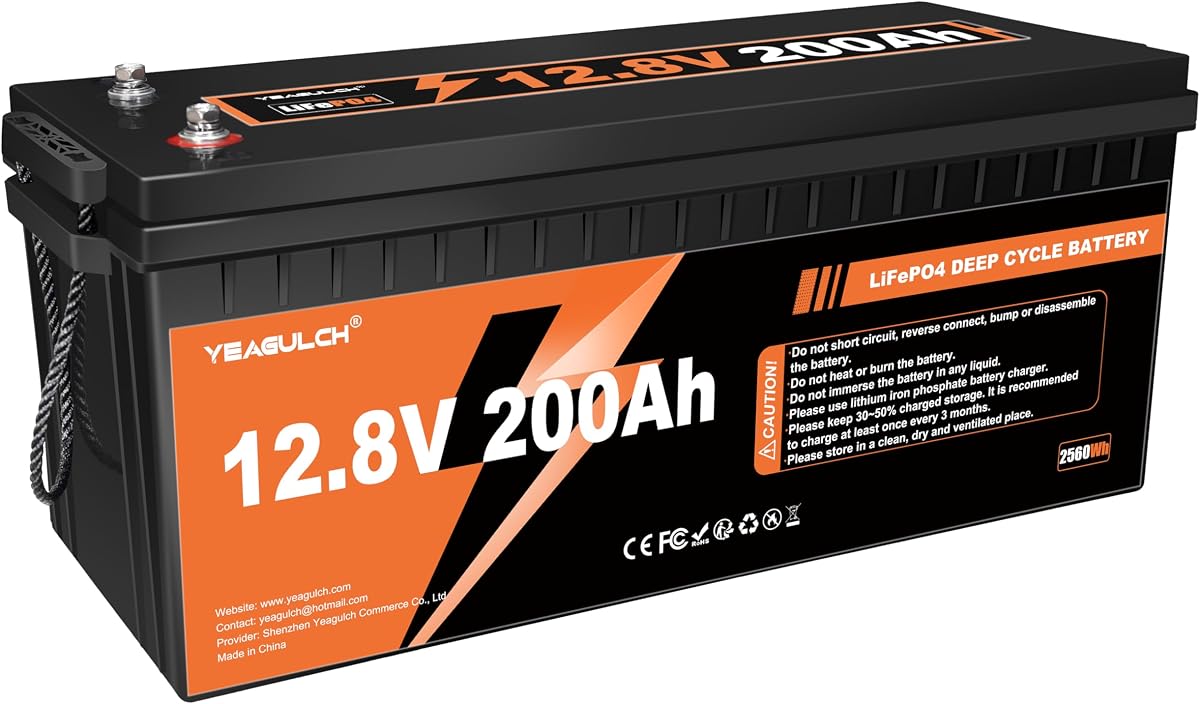




This 12V 200Ah LiFePO4 battery receives a 4.6 rating and offers one of the most balanced specifications in the group. Its 2560Wh nominal energy, built-in 200A BMS, 15000-plus cycle claim at 60% depth of discharge, and expansion support make it suitable for users who want meaningful capacity without moving into a larger or more specialized system.
We may earn a commission when you buy through this link, at no additional cost to you.
The battery weighs about 58.86 pounds and measures 20.08 by 8.07 by 8.46 inches. That footprint is easier to manage than many 200Ah lead-acid alternatives, while the stated 200A continuous BMS capacity provides ample headroom for inverter loads, RV appliances, and other demanding equipment. Protection covers overcharging, overdischarging, overcurrent, overheating, and short circuits, with automatic high- and low-temperature charging cutoffs.
The main limitation is the lack of a stated Bluetooth or app interface. Owners who want remote visibility into state of charge, current, voltage, and temperature will need external monitoring equipment. Temperature protection also means the battery should be kept within its charging limits, and the manufacturer recommends cycling it at least once every six months when it will remain unused.
This is a strong choice for RV owners, boaters, solar-storage users, and off-grid households that value a 200A BMS and expandable architecture. It is not intended for vehicle starting, golf-cart starting duty, or other applications where a deep-cycle battery is inappropriate. Buyers should confirm terminal arrangement, physical clearance, and charger compatibility before installation.
The battery can be combined with up to four units in series for a maximum 48V system or four in parallel for an 800Ah bank at 12V. The stated maximum configuration delivers approximately 10.24kWh of usable energy, making it adaptable to systems that may grow over time.
A built-in 200A BMS makes the battery suitable for substantial inverter and trolling-motor applications. The listed compatibility includes 12V trolling motors rated around 55 to 62 pounds of thrust, provided terminals remain tight, cables are correctly sized, and motor reversal is avoided.
We may earn a commission when you buy through this link, at no additional cost to you.
The DUMFUME 12V 200Ah LiFePO4 battery has a 4.4 rating and stands out for its unusually detailed protection specification. It combines a 2560Wh energy rating, a 200A continuous smart BMS, IP65 dust and water resistance, cold-weather controls, and expansion to as many as 16 batteries, giving it a well-rounded feature set.
We may earn a commission when you buy through this link, at no additional cost to you.
Its BMS reportedly cuts charging at 14.6 volts, cuts discharge at 9.2 volts, triggers overcurrent protection within 50 milliseconds above 200A, and isolates short circuits in less than 100 microseconds. It can discharge to minus 20°C, while charging is disabled below 0°C and resumes once the internal temperature reaches 5°C. These controls make the battery more appropriate for cold-region planning than an unprotected lithium battery would be.
One consideration is that the automatic low-temperature cutoff may frustrate users expecting uninterrupted winter charging. The battery also weighs 58.86 pounds, so it remains a substantial two-person lift unless mounting hardware is used. Bluetooth status monitoring is not listed, and the detailed protection thresholds should be considered in the context of the inverter, charger, and loads being connected.
This is a compelling option for RVs, camper vans, fishing boats, off-grid cabins, and expanding solar installations. The four-series, four-parallel architecture supports a stated 51.2V, 800Ah setup with 40.96kWh total usable energy. It is particularly attractive for buyers who place a high value on defined electrical cutoffs and outdoor protection.
Precision temperature controls prevent charging while lithium plating is most likely and permit discharge down to minus 20°C. In cold climates, the battery should be allowed to warm naturally before charging, and users should confirm that the enclosure and cables are rated for the environment.
With support for 4S4P arrangements, the battery can scale from one 12.8V unit to a 51.2V, 800Ah bank. Matching batteries and a communication protocol designed for synchronized BMS operation are important when constructing a multi-battery system.
We may earn a commission when you buy through this link, at no additional cost to you.
HumsiENK's 12V 200Ah battery carries a 4.6 rating and is among the most technically ambitious options in the list. Its 2560Wh maximum capacity is paired with a 250A smart BMS, a stated 3200W continuous output, a fast recharge claim, Bluetooth monitoring, and support for 4S4P configurations.
We may earn a commission when you buy through this link, at no additional cost to you.
The 250A BMS is the highest continuous current figure among the batteries here, which may appeal to users running air conditioners, refrigerators, inverters, and other high-load equipment simultaneously. The battery also provides protection against overcharge, overdischarge, short circuits, and overheating, while its IP65 enclosure is designed for outdoor and marine-adjacent installations.
Bluetooth remote monitoring provides a meaningful convenience advantage for solar systems, RV electrical systems, trolling-motor banks, and home backup installations. The stated 6000 to 15000 cycle range and four-hour recharge claim are also attractive, although actual charging speed depends on charger output, battery temperature, system configuration, and operating conditions. The product should be treated strictly as a deep-cycle battery rather than an engine-starting unit.
This battery is a strong fit for owners who prioritize output, connectivity, and fast turnaround more than a standard Group 31 footprint. Its dimensions are listed as 20.53 by 9.37 by 8.69 inches, so buyers should measure installations carefully. The five-year warranty and stated round-the-clock support add reassurance, but a complete energy-system design remains more important than any single battery specification.
The Bluetooth interface lets users monitor operating information from a phone, which is especially useful for unattended solar enclosures and backup cabinets. Local gauges or shunt-based monitoring can still be useful when a battery sits in a vehicle or remote installation.
The stated 250A BMS and 3200W continuous output provide a useful operating envelope for energy-intensive RV and off-grid systems. Load surge requirements, inverter sizing, cable gauge, temperature, and state of charge should all be considered before assuming the battery can sustain every possible appliance.
We may earn a commission when you buy through this link, at no additional cost to you.
This 12V 200Ah LiFePO4 battery holds a 5.0 rating and combines 2560Wh of energy with one of the clearest monitoring features in the group. Its integrated Bluetooth module connects to a free smartphone app for real-time state-of-charge, voltage, current, and temperature readings without requiring an extra monitoring module.
We may earn a commission when you buy through this link, at no additional cost to you.
The built-in smart BMS includes more than 20 protections, including overvoltage, undervoltage, overcurrent, short circuit, high-temperature, and low-temperature charging cutoffs. Charging stops below 0°C, and the IP65-rated enclosure is suitable for RV compartments, boat decks, and outdoor solar installations. The battery is also rated for more than 4000 cycles at 100% depth of discharge.
Its public specification does not state a continuous current rating, making it less straightforward to match against high-draw equipment than the 200A or 250A BMS alternatives. Buyers should request the current and power specifications from the seller if their planned inverter or motor load is substantial. Bluetooth also requires a compatible phone and a practical signal path to the installed battery.
The battery is best suited to campers, boaters, off-grid cabin owners, and solar users who want remote battery visibility without another accessory. Its listed uses include an RV refrigerator, fish finder, trolling motor, solar panels, golf cart, and backup power. For stationary systems, remote monitoring is particularly valuable; for portable installations, the simplicity of the app may outweigh the added feature.
Seeing state of charge, voltage, current, and temperature can make battery management more intuitive, particularly in an RV or solar cabinet away from the main living area. Monitoring should still be paired with proper charger settings and periodic physical inspections.
The stated 2560Wh output and 100% depth-of-discharge figure distinguish the battery from lead-acid designs that reserve a substantial portion of their rated capacity. Actual usable energy varies with temperature, discharge rate, age, and the cutoffs selected by the BMS.
We may earn a commission when you buy through this link, at no additional cost to you.
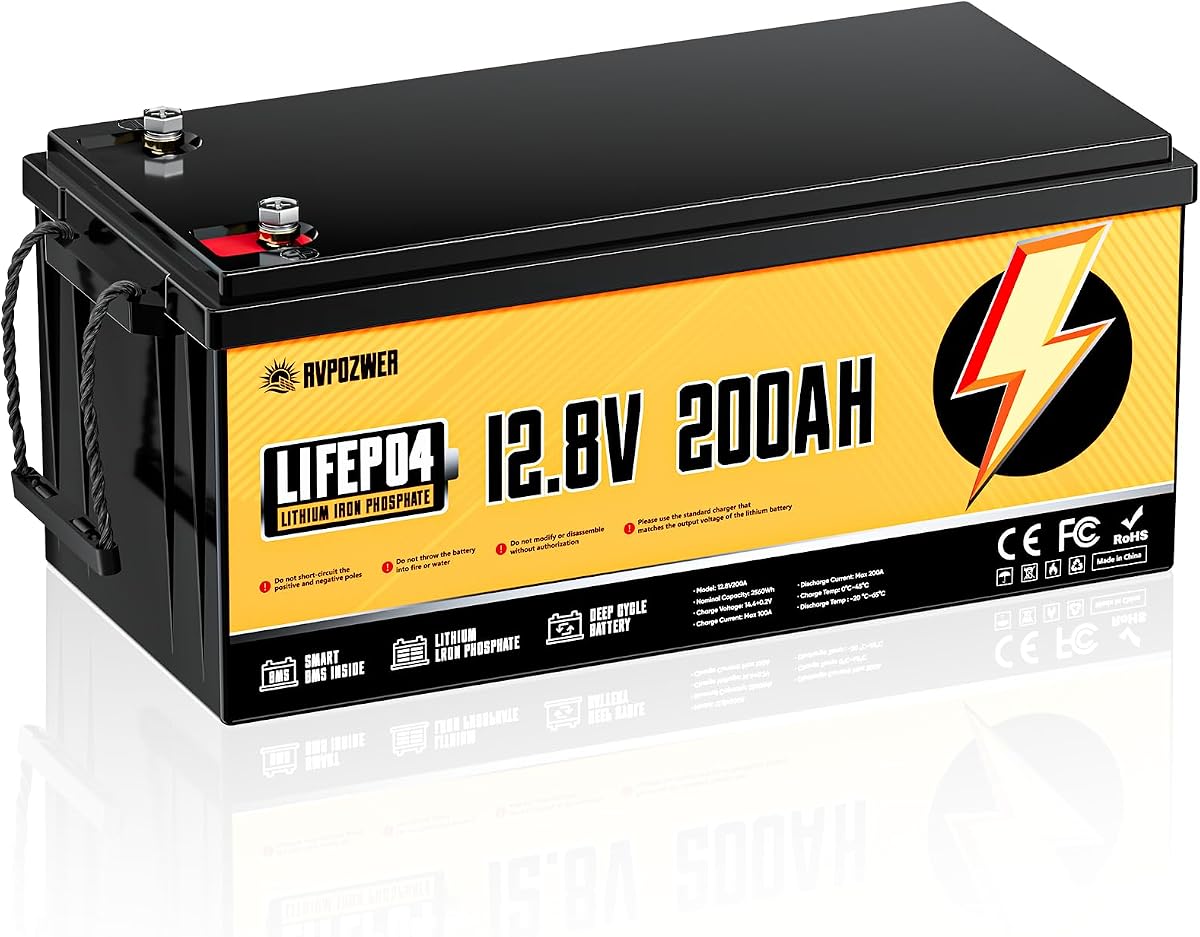
The Rvpozwer 12V 200Ah battery has a 4.0 rating and offers a familiar deep-cycle package centered on 2560Wh of energy, a 200A smart BMS, and 15000-cycle potential at 60% depth of discharge. It is designed as a general-purpose battery for RV appliances, trolling motors, solar systems, boats, campers, and off-grid installations.
We may earn a commission when you buy through this link, at no additional cost to you.
Grade-A LiFePO4 cells are specified, along with protection from overcharge, overdischarge, overcurrent, overvoltage, and short circuits. The battery is described as suitable for operation from minus 20°C to 65°C and can be linked in series for systems up to 51.2V or in parallel for capacities up to 800Ah. Its Group 31 standard design and integrated nylon handle prioritize familiar handling.
The main drawback is its lower customer rating relative to the other options, which may justify checking recent feedback and seller support before buying. Remote status monitoring is not mentioned, and the marketing language refers to a 15-year lifespan while also presenting 4000-, 6000-, and 15000-cycle figures at different depths of discharge. Buyers should understand that cycle totals depend on operating depth and conditions.
This battery makes sense for budget-conscious RV and marine users who want expandable architecture and a 200A BMS without paying for remote monitoring. It is a solid choice when a standard physical footprint and straightforward deep-cycle performance matter more than a compact enclosure or app-based visibility.
Four-series and four-parallel configurations support both higher voltage and greater capacity. A properly engineered system still requires matched wiring, compatible charge controllers, correct fusing, and attention to manufacturer recommendations.
The stated minus 20°C to 65°C operating range is useful for varied climates. Temperature protection will affect charging in cold conditions, so system design should account for the BMS cutoffs rather than treating the broad range as unlimited charge capability.
We may earn a commission when you buy through this link, at no additional cost to you.
The Renogy 12V 200Ah Core Mini has a 5.0 rating and is the most compact-looking conventional 200Ah model in the comparison. It is described as roughly one-third smaller than a standard 12V 200Ah lead-acid battery, making it attractive where compartment space is especially restrictive.
We may earn a commission when you buy through this link, at no additional cost to you.
A 200A BMS provides protection against overcharge, overdischarge, overcurrent, and short circuits, while a low-temperature cutoff prevents charging below 32°F and discharging below minus 4°F. The battery offers up to 5000-plus deep cycles, a 380A peak-discharge figure, IP65 water protection, and enhanced vibration resistance. It also meets stated FCC, UN38.3, RoHS, and UKCA safety standards and carries a five-year limited warranty.
Remote monitoring is possible, but not through an integrated Bluetooth module. The battery is compatible with the Renogy 300A Battery Shunt, Renogy App, and Renogy One Core Monitor, which means buyers seeking phone visibility must budget for and install additional equipment. Its premium positioning is also reflected in a higher cost category than most competitors, even though no price figures are needed to assess the feature trade-off.
This is a compelling premium choice for RV owners, boaters, and off-grid installers who cannot accommodate a full-size Group 31 lead-acid footprint. The trade-off is that integrated connectivity and the most extensive expansion figures are not part of the core feature set. For users prioritizing space, certifications, warranty coverage, and clean deep-cycle power, it is one of the strongest options here.
The mini format is most valuable in battery compartments where every inch matters. Buyers should still leave the specified clearance around terminals and vents, and should secure the battery against movement without blocking required access.
IP65 protection and enhanced vibration resistance make the enclosure appropriate for RV, marine, and off-grid environments. A marine installation still needs suitable cables, fusing, corrosion-conscious connections, and compliance with local electrical requirements.
We may earn a commission when you buy through this link, at no additional cost to you.
The HQST listing uses a 2-by-100Ah format to achieve the advertised 200Ah-class capacity, and it carries a 4.5 rating. Each battery is described as a 12V 100Ah unit with 1280Wh of energy, up to 100A continuous discharge, a Group 22NF format, an LED meter, and a built-in improved BMS.
We may earn a commission when you buy through this link, at no additional cost to you.
The two-unit approach can be attractive when modularity matters more than having one large enclosure. The listed 21-pound weight per 100Ah battery is 65% lighter than lead-acid according to the product information. Each BMS balances cells and protects against overcurrent, overcharge, overdischarge, and short circuit, while temperature controls suspend charging below 23°F or above 140°F and stop discharge below 5°F or above 158°F.
The most important qualification is that the title describes a 12V 200Ah battery while the detailed specifications identify two 100Ah batteries. Buyers should verify the package contents carefully, understand whether both units are included, and determine whether the intended configuration is series, parallel, or separate installation. Its stated 100A continuous discharge is also lower than the 150A, 200A, 250A, and 280A-class alternatives in the list.
The HQST option is best for buyers who want a modular 200Ah-class installation, a visible state indicator, and a lighter Group 22NF format. It can build 12V, 24V, 36V, or 48V banks, as well as larger parallel arrangements. Those wanting one high-current battery with simple wiring may find a single-enclosure 200Ah model easier to integrate.
The two 100Ah units can be arranged to suit different voltage and capacity requirements, and larger installations can combine multiple batteries in series and parallel. Cable gauge, fusing, matched state of charge, and controller voltage settings become increasingly important as the bank grows.
The integrated LED meter offers a quick local indication of battery status without a phone or shunt. For detailed voltage, current, and temperature information, additional monitoring equipment would still be appropriate.
We may earn a commission when you buy through this link, at no additional cost to you.
The Power Queen 12V 200Ah battery earns a 4.5 rating and emphasizes energy density, marine-oriented protection, and long-term use. Its 2560Wh output is accompanied by an energy-density figure of 56Wh per pound, and the listed weight is about one-third that of lead-acid, making it easier to carry than a comparable flooded battery.
We may earn a commission when you buy through this link, at no additional cost to you.
The built-in BMS provides more than 20 protections, while the enclosure is rated IP65 for dust and water resistance and includes salt-spray protection. These attributes are particularly relevant to boat decks and other humid or exposed installations. Automotive-grade LiFePO4 cells support a stated 4000-plus cycles at 100% depth of discharge.
Expansion is a major strength: up to 16 batteries can be arranged in a 4P4S configuration to create a 48V, 800Ah system with a stated 20.48kW load capability and 20.48kWh capacity. Buyers should distinguish the listed load and energy figures carefully and verify the complete system design. Remote monitoring is not included in the stated features, so users who need phone visibility must add compatible equipment.
This battery is a good fit for trailer and motorhome owners, marine users, and off-grid households seeking a robust 200Ah unit with substantial expansion potential. The 10-year service-life positioning and 24/7 online support are useful, but service life and warranty terms should be read separately. In practice, charger compatibility, operating temperature, installation security, and proper battery management will have a greater effect on daily performance.
IP65 sealing and listed salt-spray resistance help the enclosure tolerate the damp and corrosive conditions associated with marine use. Terminal corrosion, cable routing, ventilation, and secure mounting remain the installer's responsibility.
The stated 2560Wh energy and 56Wh-per-pound density provide more usable energy per unit of weight than traditional lead-acid. That can improve payload and handling in a trailer or motorhome, provided the installation remains within the vehicle's electrical and structural limits.
We may earn a commission when you buy through this link, at no additional cost to you.
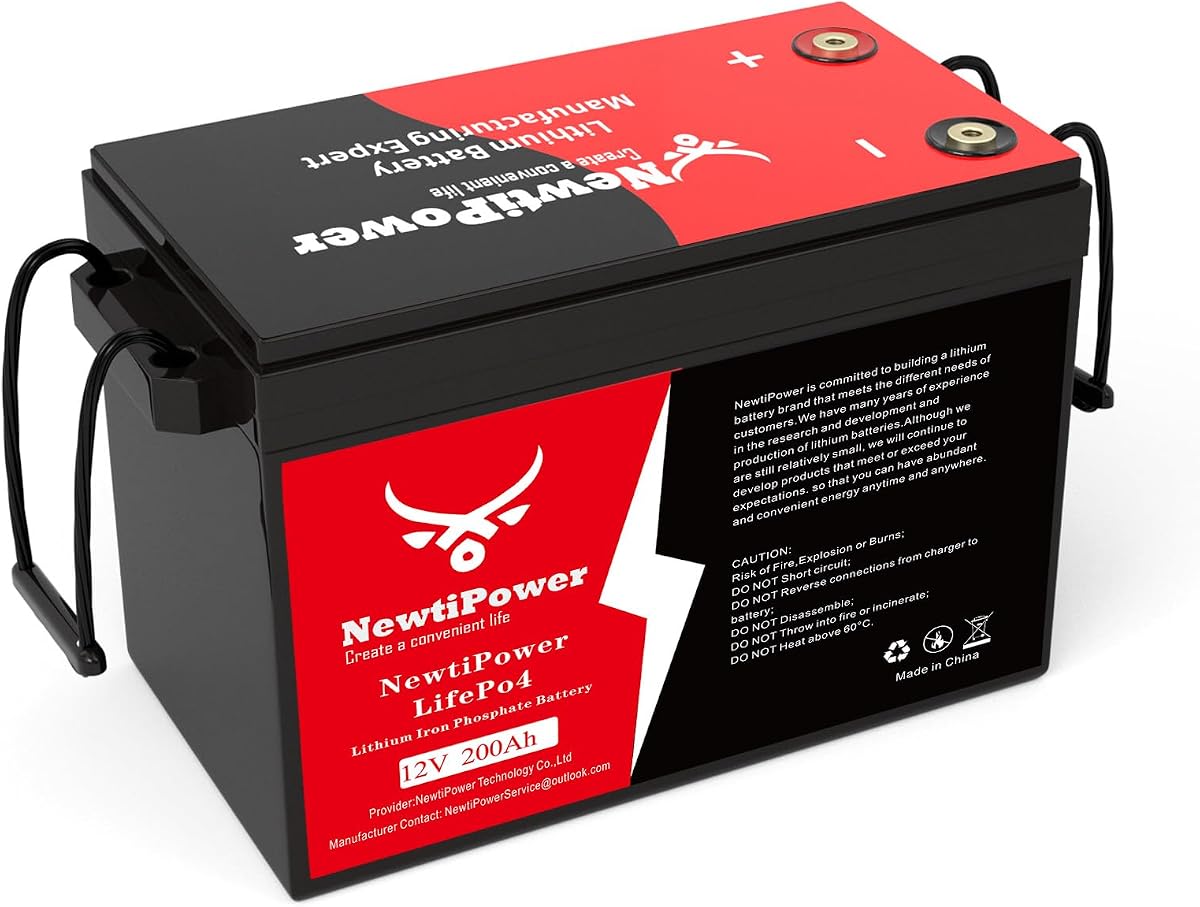
The NewtiPower 12V 200Ah battery carries a 4.2 rating and distinguishes itself with a 150A BMS, a stated maximum load of 1920W, and broader series expansion than most competitors. It supports configurations of up to 6S6P, allowing higher nominal voltages of 24V, 36V, 48V, 60V, or 72V and parallel capacities up to 1200Ah.
We may earn a commission when you buy through this link, at no additional cost to you.
The battery uses new A+ power cells and is described as offering more than 200Ah of actual capacity. The manufacturer also states that it will return or compensate for a unit if its capacity is found to be insufficient under its policy. A built-in BMS protects against overcharging, overdischarge, overcurrent, and short circuit, while the compact format is intended to fit more installation positions.
The 150A BMS is lower than the 200A and 250A options elsewhere in the comparison, and 1920W is a more restrictive maximum-load claim than the HumsiENK's stated 3200W continuous output. Remote monitoring is not listed. The broad 6S6P capability is impressive on paper, but high-voltage configurations require careful DC-DC charging, fusing, controller compatibility, and electrical-safety planning.
This model is best for installers who need more voltage options than a conventional four-series battery can offer, especially for larger solar, marine, RV, or off-grid projects. It also suits buyers who value a stated capacity policy and long warranty support. The buyer should activate the 10-year warranty using the serial number as directed and preserve the purchase documentation.
Supporting as many as six batteries in series creates more design options than a standard 4S configuration. Each added series unit raises system voltage, so charge controllers, converters, fusing, breakers, and load equipment must all be rated appropriately.
The stated return or compensation commitment provides extra assurance for buyers concerned about actual capacity. Keeping receipts, serial-number records, and test results can make any warranty or capacity review more straightforward.
We may earn a commission when you buy through this link, at no additional cost to you.
The ECO-WORTHY EnergyRock 12V 280Ah battery has a 4.6 rating and serves as a higher-capacity alternative for shoppers searching the broader 12V LiFePO4 market. Its heavy-duty metal enclosure, built-in 200A BMS, Bluetooth monitoring, safety switch, and mounting feet set it apart from the conventional 200Ah models in this comparison.
We may earn a commission when you buy through this link, at no additional cost to you.
The metal case is intended to improve heat resistance and fire protection while providing a rugged installation option for RVs, campers, and off-grid systems. A one-touch switch disconnects the discharge circuit to reduce accidental discharge during installation or maintenance. Four mounting feet allow direct installation without a separate battery box, and internal cell holders help resist shock and road vibration.
Bluetooth monitoring reports voltage, capacity, and charge or discharge status through an app. Low-temperature charging protection is built into the 200A BMS. Because this model is rated at 280Ah, it does not offer the same capacity match as the 200Ah batteries and may require different inverter, charger, and cable calculations. Its reinforced metal construction also makes it heavier than many plastic-cased alternatives.
Buyers who prioritize extra reserve energy, a metal enclosure, app-based visibility, and RV installation convenience may prefer this alternative. It is less appropriate for someone who specifically needs a true 200Ah unit or is optimizing every pound of battery weight. The recommended 14.6V LiFePO4 charger settings and disabled float or equalization should be followed in accordance with the manufacturer's instructions.
The metal enclosure and reinforced cell retention are intended to improve heat resistance, impact protection, and stability during travel. A secure mount and correctly sized cables remain necessary because enclosure design alone does not manage electrical movement.
At 280Ah, the battery offers 40% more nominal capacity than a 200Ah model. That additional reserve can reduce charging frequency, but it also changes the current, cable, charger, and inverter requirements of the complete installation.
We may earn a commission when you buy through this link, at no additional cost to you.
The right battery depends on more than the 200Ah label. Capacity, usable energy, continuous current, temperature behavior, physical dimensions, expansion requirements, and monitoring should all be matched to the equipment and environment in which the battery will operate.
A 12V 200Ah battery has a theoretical energy content of 2560Wh when the nominal voltage and amp-hour rating are multiplied. LiFePO4 models are marketed around a high depth of discharge, but actual usable energy still depends on temperature, discharge rate, age, wiring losses, and the voltage points at which the BMS interrupts operation.
Compare nominal watt-hours, not just amp-hours, and account for the load. A battery may support a high daily energy requirement without supplying a particular inverter at its maximum output for long. Systems with large starting surges or sustained high loads require both sufficient energy and an appropriate continuous-current rating.
The BMS current rating indicates the battery's protection and management capacity, while inverter and motor requirements determine the actual current it must deliver. The group ranges from a stated 100A continuous output to 250A, with other models offering a 150A or 200A BMS. Peak-current claims should not be confused with sustained output.
List the largest inverter, compressor, refrigerator, trolling motor, or other load, including startup surges. Then check cable gauge, fuse ratings, temperature, state of charge, and the battery manufacturer's limits. Never select a battery solely from peak output when the system will run high loads for extended periods.
Cycle figures should be read with their corresponding depth of discharge. Several products claim approximately 4000 cycles at 100% DOD, 6000 at 80% DOD, and as many as 15000 at 60% DOD. These values indicate that shallower daily cycling can extend expected service life, although real results depend on temperature, charge method, current, and battery age.
For daily solar or household use, calculate the expected energy throughput and frequency of full depletion. A battery cycled only to 40 or 60 percent may be easier on the cells than one regularly discharged deeply. Warranty language, cell quality, BMS design, and proper charging are also relevant to long-term value.
Cold charging is a major concern for LiFePO4 batteries because charging below freezing can cause damaging lithium plating. Several models block charging at 0°C or another specified threshold, while low-temperature discharge cutoffs help prevent excessive cell stress. Hot-weather protection and high-temperature charging suspension are also useful in unventilated RV, marine, and solar installations.
Choose cutoffs that match the environment and the charger in use. A battery that refuses to charge in cold conditions may require an internal heater, a heated battery compartment, or a charger strategy that warms the pack before charging. Confirm that the enclosure and BMS protection are appropriate for both winter and summer conditions.
Most 200Ah LiFePO4 batteries weigh far less than comparable lead-acid models, but dimensions vary enough to matter in a tight compartment. The listed examples range from conventional Group 31-style bodies to the smaller Renogy Core Mini and the modular HQST Group 22NF format. Measure the bay, terminal clearance, ventilation space, and route for heavy cables before ordering.
Consider handling as well as fit. A battery near 59 pounds may require two people or a secure lifting system. Metal-cased and higher-capacity models can add further weight. Secure retention is essential, and a compact installation should never be achieved at the expense of access to terminals, protection features, or emergency disconnects.
Most batteries can be placed in parallel for more capacity, and many also support series connections for higher voltage. Four-series, four-parallel arrangements can produce a 48V-class bank, while the NewtiPower model states support for 6S6P configurations. Expansion is valuable only when the rest of the system is designed for the resulting voltage and current.
Use matching batteries, appropriately sized interconnects, common fusing, correct charge controllers, and a converter for 12V accessories when operating at a higher system voltage. Check whether the manufacturer requires communication between BMS units. Label connections and document the configuration for future troubleshooting and servicing.
Bluetooth monitoring can provide valuable visibility into state of charge, voltage, current, temperature, and charging status. Integrated apps are convenient for RVs, solar cabinets, and backup systems, while shunt-based monitoring can provide equivalent detail when a dedicated Bluetooth module is not built in.
Remote monitoring is not a substitute for local protection. A reliable system should still include correctly rated fuses, breakers, disconnects, cable protection, and charger safeguards. Consider whether the phone supports the required app, whether Bluetooth reaches the installation, and whether remote access is valuable enough to justify additional accessories.
An IP65 rating improves resistance to dust and low-pressure water exposure, which is valuable in RV compartments, boat installations, and outdoor solar cabinets. Marine use also benefits from salt-spray protection, corrosion-resistant hardware, and secure terminal covers. Safety standards and transport certifications add another layer of confidence, while warranty terms and technical support can affect long-term ownership.
Review the actual warranty and certification documents rather than relying only on listing claims. Confirm shipping requirements for lithium batteries, especially when a shipment may arrive in multiple packages. The seller's support quality, replacement process, and availability of installation guidance are also important because deep-cycle batteries require correct setup to deliver their expected performance.
Install the battery in a stable, ventilated location with terminals protected from accidental contact. Use cables and fuses appropriate for the battery's continuous and possible surge current, tighten terminals to the manufacturer's recommendations, and observe polarity. Before connecting loads, verify that the inverter, charger, solar controller, and converter are configured specifically for 12V LiFePO4 chemistry.
Charge with a compatible LiFePO4 charger and observe the manufacturer's charging profile, including low-temperature restrictions. Do not use a lead-acid equalization routine unless specifically approved, and do not allow a charger to exceed the battery's specified voltage limits. Bluetooth monitoring can help verify state of charge and temperature, but it should supplement rather than replace correct charger configuration and routine inspections.
For long storage, follow the manufacturer's instructions, maintain the battery in a suitable state of charge, and recharge it periodically. The first product in the list recommends charging and discharging it at least once every six months when unused. Check terminals, mounting security, corrosion, enclosure condition, and cable insulation regularly, and investigate unusual voltage, temperature, swelling, odor, or charging behavior promptly.
Yes, a 12V 200Ah LiFePO4 battery can run a compatible 12V refrigerator, often for multiple days depending on the appliance's draw, ambient temperature, and starting cycles. A 2560Wh battery can theoretically provide more usable energy than an equivalent lead-acid battery, but inverter losses, battery age, and low-temperature performance affect results. Run the refrigerator directly when possible or use a pure sine-wave inverter if an AC appliance is necessary.
Most of the listed batteries support four units in series and four in parallel, creating banks up to 48V and 800Ah. The NewtiPower model states support for 6S6P configurations, allowing even higher nominal voltages. The number of batteries is not the only consideration: the charge controller, inverter, converters, fusing, cable size, ventilation, and BMS compatibility must all support the final configuration.
These products are deep-cycle batteries, and the supplied information specifically says they are not intended for engine starting, car batteries, or certain golf-cart starting applications. LiFePO4 chemistry can have different voltage behavior and burst characteristics than lead-acid starter batteries. Use a battery designed and certified for the starting application instead.
Charging a lithium iron phosphate battery while its cells are near or below freezing can cause lithium plating, which may permanently reduce usable capacity. Several products in this list automatically suspend charging below 0°C, or another specified temperature, and resume after the pack warms. In cold climates, use a heated enclosure or another safe method of warming the battery before charging.
Not always. Integrated Bluetooth can make state-of-charge and operating data easy to check, but a dedicated shunt may provide better visibility into current flow, especially with multiple batteries, chargers, and loads operating simultaneously. The Renogy Core Mini relies on a compatible 300A Battery Shunt for its listed app-based monitoring. Choose monitoring based on how much system-level data you need.
The ECO-WORTHY 12V 280Ah model can provide more reserve energy and may suit some RV, camper, and off-grid installations, but it is not capacity-identical to a 200Ah battery. Charger timing, inverter sizing, cable sizing, and system weight calculations should reflect the larger capacity. It is best viewed as a higher-capacity alternative rather than a like-for-like replacement.
Store it in a cool, dry, ventilated location within the manufacturer's recommended state-of-charge range, away from direct heat and sources of ignition. Do not leave it deeply discharged for long periods, and recharge it periodically according to the product instructions. One listed model recommends charging and discharging the battery at least once every six months when it will remain unused.
Use a charger designed for 12V LiFePO4 chemistry and follow the battery manufacturer's recommended charge voltage, current, and termination settings. A quality lead-acid charger with selectable lithium settings can be appropriate, but compatibility must be confirmed. Do not apply lead-acid equalization or a float stage that conflicts with the battery manufacturer's instructions.
The DUMFUME 12V 200Ah is a strong all-around pick for buyers who want defined electrical cutoffs, IP65 protection, cold-weather safeguards, and a large expansion path. The HumsiENK model stands out for its 250A BMS, 3200W continuous output, fast recharge claim, and Bluetooth monitoring, while the Renogy Core Mini is the leading compact premium option with a 5.0 rating.
For most RV, marine, solar, and off-grid systems, prioritize the weakest part of the installation rather than choosing on capacity alone. Match continuous output to the inverter and motors, verify cold-temperature charging behavior, confirm physical clearance, and make sure the planned expansion is electrically supported. Batteries with remote monitoring can simplify management, but robust fusing, cable sizing, and correct charger configuration remain essential.
Product configurations, seller information, availability, and prices can change, so review the current listing before ordering. Confirm the exact capacity, package contents, dimensions, warranty terms, and included accessories. The right 200Ah LiFePO4 battery is the one that meets your load, environmental, space, and expansion requirements without exceeding the limits of the surrounding electrical system.