
Magnadyne AquaVibe Pro AVP1200.5
IP67 wet-rated protection
Five-channel system control
Dedicated subwoofer channel
Remote bass adjustment
Compare 1200 Watt Marine Amplifiers by RMS power, channel count, weather resistance, crossover controls, compact size, and ideal boat setup for every boat.
A 1200 watt marine amplifier can transform a boat audio system by supplying the controlled power needed for full-range speakers, a dedicated subwoofer, or both. The most useful model is not simply the one with the largest headline output, but the amplifier whose channel configuration, protection, controls, and physical dimensions suit your vessel and installation plan.
The products in this guide were compared using their published specifications, including continuous and peak power, channel configuration, marine-treatment details, crossover options, input flexibility, protection circuitry, and mounting considerations. The list covers multichannel marine amplifiers, bridgeable two-channel units, compact monoblocks, and a system-oriented five-channel amplifier.
Each review explains the amplifier's strongest benefits, practical trade-offs, and best-fit installation. The top selections are not the only options for every boater, so readers should also pay close attention to impedance handling and speaker compatibility. As with all consumer electronics, prices and availability change, so confirm current product details before purchasing.
4.3Editor score

4.5Editor score
The comparison below highlights the differences that matter when selecting a high-output marine amplifier: usable RMS power, channel flexibility, environmental protection, system-control features, and the physical space required for installation. Peak wattage is included where supplied, but continuous output and load compatibility deserve more attention.


The Rockville Atom P60 combines a listed 1,200 watts RMS with a two-channel architecture, providing 600 watts per channel under the supplied specification. Its 4.5 rating reflects a generally favorable user response, while the standout feature is the amount of continuous power offered for a compact-style installation. Fully adjustable high-pass and low-pass filters also make it more versatile than a basic fixed-function marine amplifier.
We may earn a commission when you buy through this link, at no additional cost to you.
Durability details include a rustproof stainless-steel heat sink, end panels, and hardware, along with a conformal-coated printed circuit board. Those features are meaningful in an exposed vehicle or powersports environment. A built-in digital voltage display can also make installation monitoring more convenient, while the high-speed MOSFET power supply and bridgeable channels support different speaker arrangements.
The main caution is that the product is identified as a car and ATV amplifier rather than as a model with an explicit marine or IP waterproof rating. Boaters should therefore treat it as a weather-resistant option only after checking enclosure placement, wiring protection, and the manufacturer's installation guidance. The stated protection circuitry, including undervoltage, overvoltage, soft-start, and voltage-related safeguards, helps but does not replace sound marine installation practices.
This is a compelling choice for a boater who wants substantial output and extensive tuning controls at a relatively accessible tier. It works especially well for full-range speakers, a moderately sized subwoofer, or a bridged subwoofer setup when the connected load falls within the published operating specifications. Buyers prioritizing a formally stated wet rating may prefer the IP67-rated Magnadyne or IPX67-rated NVX instead.
The key advantage is usable continuous power rather than headline peak output. The Atom P60 is listed at 600 watts per channel, making it more appropriate for driving demanding marine speakers or a dedicated subwoofer than a typical entry-level head-unit-powered system.
Adjustable 50-250 Hz high-pass and low-pass filters allow one amplifier to serve several speaker roles. This flexibility is particularly useful when combining full-range cabin speakers with a subwoofer.
We may earn a commission when you buy through this link, at no additional cost to you.
The KICKER 48KXMA12002 is a two-channel marine boat amplifier listed at 1,200 watts, and it carries a perfect 5.0 product rating in the supplied data. Its most obvious appeal is the combination of a clear marine designation, high-output positioning, and Class D efficiency. It is aimed at owners who want a powerful dedicated amplifier rather than a modest upgrade over a factory head unit.
We may earn a commission when you buy through this link, at no additional cost to you.
Because the supplied listing provides only the model name and category rather than a detailed feature breakdown, there are many important specifications that must be verified with the manufacturer or seller. These include continuous power at the exact speaker impedance, allowable bridged loads, crossover controls, input types, protection circuitry, and the amplifier's measured dimensions. The title's use of both 1,200 watts and the KXMA1200.2 platform should not substitute for checking the detailed power and load tables.
The lack of published specifications in the provided product information also means claims about damping factor, signal-to-noise ratio, thermal performance, and waterproofing should not be inferred. This model is best evaluated as a high-output marine-platform candidate rather than compared purely by its headline wattage. Confirming its wiring diagram and environmental specifications can prevent an expensive mismatch with the boat's speakers.
For a buyer who values a marine-specific product and a top published rating, the KICKER is a serious contender. It is most appropriate for a high-power two-speaker or bridged installation where the manufacturer confirms that the intended impedance is supported. Prospective owners should obtain the full manual before mounting it and compare its actual RMS output against their speaker requirements.
A model explicitly marketed as a marine boat amplifier gives buyers a clearer starting point than a general car amplifier with no environmental designation. It is better suited to power calculations centered on a wet, exposed installation.
The headline wattage does not identify output at every impedance. Before purchasing, check the official channel-power table, bridge requirements, speaker-wire recommendations, and minimum stable load.
We may earn a commission when you buy through this link, at no additional cost to you.
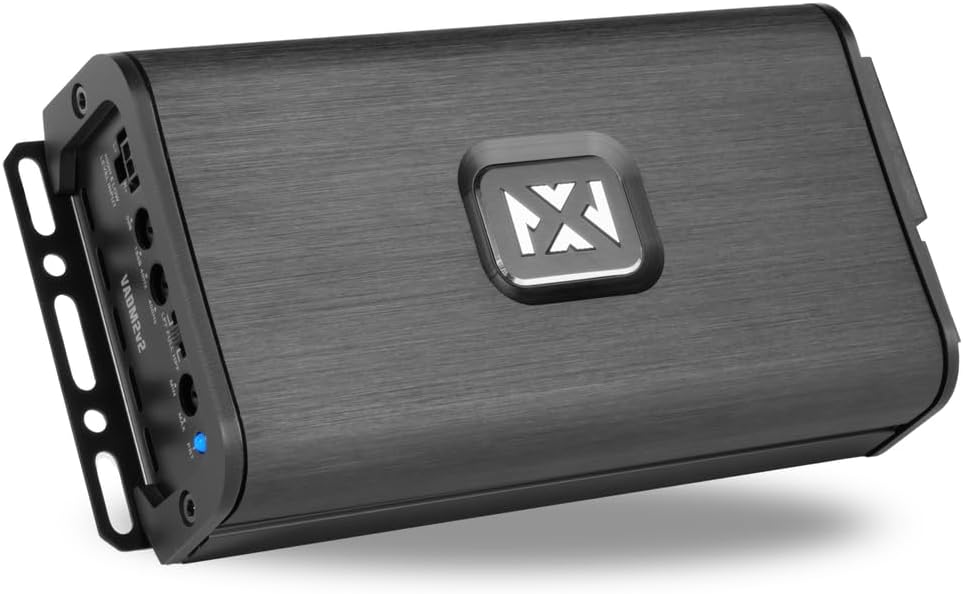
The NVX VADM2v2 is a two-channel Class D amplifier rated at 1,200 watts peak and 600 watts RMS in total. Its 4.3 rating and unusually broad application support make it a strong overall choice for boats, powersports vehicles, and other installations where space is limited. The published output scales from 200 watts per channel at 4 ohms to 300 watts per channel at 2 ohms, with 600 watts available as one bridged channel at 4 ohms.
We may earn a commission when you buy through this link, at no additional cost to you.
Marine readiness comes from a conformally coated circuit board designed to resist moisture and salt. The enclosure measures 6.49 by 3.3 by 1.48 inches, making it easier to place in a compartment where a full-size component would be inconvenient. Four-way protection circuitry covers thermal conditions, overload, speaker shorts, and DC offset, while an LED offers a basic visual indication of power or protection status.
The amplifier is unusually flexible for a compact two-channel unit. Selectable FULL, HPF, and LPF modes allow full-range operation, speaker-level or balanced differential input options aid integration, and variable filters cover 40-400 Hz in both directions. Balanced differential inputs can help reduce unwanted noise, particularly when a motorboat's electrical environment introduces interference through factory-level connections.
Its limitations are mostly matters of system scale. Two channels cannot independently drive four conventional speakers plus a subwoofer without adding another amplifier, and buyers should not assume the 1,200-watt peak figure represents continuous output into a standard speaker load. For a powerful subwoofer or a two-channel marine speaker upgrade, however, the combination of compactness, output options, protection, and crossover control is difficult to dismiss.
The VADM2v2 can serve two conventional speakers, a pair of lower-impedance loads, or one bridged subwoofer. This makes it adaptable to both existing factory speakers and a dedicated bass installation.
Balanced differential inputs, speaker-level inputs, and selectable filtering simplify connection to different source units. These features are especially valuable when matching a new marine amplifier to an established head unit.
We may earn a commission when you buy through this link, at no additional cost to you.
The JBL MA600 is a purpose-built mono marine amplifier for subwoofers, and it combines a 5.0 rating with a clearly stated 350 watts RMS at 4 ohms and 600 watts RMS at 2 ohms. Its maximum power is listed at 1,200 watts, but the continuous ratings are the more relevant figures when matching it to a subwoofer. The low-profile chassis is designed to fit where conventional marine amplifiers are difficult to mount.
We may earn a commission when you buy through this link, at no additional cost to you.
Its input options are among the strongest aspects of the design. Both speaker-level and low-level inputs are available, making it practical to connect the amplifier to a factory marine stereo or an aftermarket head unit. Input-level control is specified separately for those operating ranges, helping reduce clipping and set the amplifier gain appropriately. Balanced differential inputs are designed to lower noise and reduce sensitivity to radiated engine noise.
System tuning receives support through variable electronic crossover and bass-boost circuits. The MA600 also includes onboard protection against shorts, high temperature, overvoltage, and undervoltage, with an LED that indicates when one of those conditions is present. These protections are important in a confined boat compartment where heat, dampness, and fluctuating electrical conditions can complicate an installation.
This is the right premium-style choice when the priority is a powerful, properly protected subwoofer channel rather than broad speaker amplification. Because it is a mono amplifier, owners with several full-range speakers will still need a separate two- or four-channel unit. Its published performance and compact form make it a particularly attractive match for a single JL Audio subwoofer or another appropriately rated marine driver.
A dedicated mono amplifier gives a subwoofer a stable, dedicated source of power without asking a head unit or full-range amplifier to handle low-frequency demands. That can improve both control and system organization.
Speaker-level and low-level inputs provide a practical path for both factory and aftermarket marine systems. The separate sensitivity ranges make the amplifier easier to integrate with different source equipment.
We may earn a commission when you buy through this link, at no additional cost to you.
The Skar Audio RP-1200.1D is a monoblock Class D amplifier listed at 1,200 watts RMS when operating at 1 ohm, with peak power of 1,600 watts. Its 4.6 rating reflects strong user reception, and the specification makes it one of the most powerful continuous-output options in this guide. It is designed primarily to drive a subwoofer efficiently rather than power full-range cabin speakers.
We may earn a commission when you buy through this link, at no additional cost to you.
A remote subwoofer level control gives the driver convenient control over bass from the helm or passenger area. The on-board bass EQ switch offers either 6 or 12 dB of boost at 45 Hz, while the listed 20-250 Hz frequency response concentrates the amplifier's role in the bass range. Four-way protection circuitry and 4-gauge power and ground terminals support reliable operation and high-current connections.
The primary concern is environmental. Although the supplied information does not identify the RP-1200.1D as a fully marinized model, its efficient heatsink design and Class D architecture can still be useful in a protected installation. It should not be assumed suitable for direct spray, standing water, or salt exposure without verification. Boat owners should use a suitably sealed enclosure or place the amplifier in a dry compartment and protect the connections from corrosion.
The amplifier is best suited to a single subwoofer or carefully configured parallel subwoofer arrangement that remains within the manufacturer's stated stable-load requirements. Because stable operation at 1 ohm is explicitly listed, it offers more headroom than a model intended only for 4-ohm speakers. It is an attractive high-output bass option for a dry, enclosed installation where dedicated monoblock control is the priority.
Stable 1-ohm operation gives the RP-1200.1D more continuous power than a typical 4-ohm-only monoblock. This extra headroom can be useful for a demanding subwoofer or a carefully wired pair of low-impedance drivers.
The included remote control places bass adjustment within reach. It is convenient for changing listening levels across different speeds, water conditions, or music genres without repeatedly reaching into the mounting compartment.
We may earn a commission when you buy through this link, at no additional cost to you.
The Skar Audio RP-150.4ABM is a four-channel, full-range marine amplifier with a 1,000-watt model designation and a 4.5 rating. Its published continuous output is 250 watts per channel at 2 ohms and 150 watts per channel at 4 ohms, making it better understood as a high-output four-channel unit than a literal 1,200-watt RMS amplifier. That distinction matters for accurate speaker matching.
We may earn a commission when you buy through this link, at no additional cost to you.
Four channels make this model well suited to a complete cabin-speaker upgrade without requiring separate amplification for every pair. It offers adjustable gain, variable low-pass and high-pass filters, and a bass EQ switch, allowing different channel groups to be tailored for full-range, midrange, or upper-frequency duties. Its 20 Hz-20 kHz frequency response supports broad music reproduction rather than bass-only use.
The construction includes a waterproof coating on the circuit board and rust-resistant paint on the mechanical case. Four-way protection circuitry is another useful feature in a demanding electrical environment. The amplifier also uses 4-gauge power and ground input terminals for maximum current flow, a detail that matters when powering multiple channels simultaneously.
Compared with Class D models, a Class A/B design may produce more heat and draw more power for the same output. It is still a practical choice when four channels and full-range flexibility matter more than maximum amplifier efficiency. This model best suits a boat with several conventional speakers, particularly if the installer wants per-channel crossover access and does not require a separate subwoofer amplifier.
Four independently amplified channels simplify a multi-speaker cabin system. Separate high-pass and low-pass controls also allow the installer to create a clearer transition between full-range drivers and dedicated bass or upper-frequency speakers.
A waterproof-coated board and rust-resistant case make this a more purposeful marine choice than a generic car amplifier. It still requires protected placement and sound connection practices in a wet environment.
We may earn a commission when you buy through this link, at no additional cost to you.
The Magnadyne AquaVibe Pro AVP1200.5 is the most complete system-oriented amplifier in the guide, combining four high-frequency speaker channels with one dedicated subwoofer channel. Its 1,200-watt total RMS rating is divided into 600 watts for the four speaker channels and 600 watts for the subwoofer channel. Published output includes 150 watts per channel at 2 ohms and 600 watts for the mono section at 1 ohm.
We may earn a commission when you buy through this link, at no additional cost to you.
Its strongest differentiator is the formal IP67 wet rating. That designation indicates protection against dust and water immersion under the applicable standard, making it a convincing option for boat compartments, outdoor vehicles, and other exposed installations. The Class D chassis measures 12.6 by 4.4 by 1.9 inches, so it remains compact enough to mount under a boat seat or inside an RV compartment while consolidating several amplification functions.
The amplifier can power four to eight cabin speakers plus a subwoofer from one unit, which simplifies wiring and reduces the number of separate boxes. Variable crossovers, dedicated front and rear gain controls, high-pass and low-pass filters, a subsonic filter, and bass-boost circuits provide a broad tuning platform. A remote bass controller allows the driver to adjust subwoofer level without accessing the amplifier.
Because no user rating was supplied, the AVP1200.5 does not have the established feedback history available for several competitors. The absence of a rating does not make it a poor choice; it simply places more importance on installation care, compatible loads, and verifying the manufacturer's instructions. It is an especially attractive pick for buyers who want one clearly wet-rated amplifier to manage an entire boat audio system.
Combining four speaker channels with a dedicated mono subwoofer channel can simplify a larger installation. Fewer amplifiers mean fewer power connections, less dashboard clutter, and a more compact overall layout.
The IP67 designation provides a clearer environmental standard than general descriptions such as weather resistant. That makes the amplifier easier to shortlist for exposed marine, motorcycle, RV, or off-road locations.
We may earn a commission when you buy through this link, at no additional cost to you.
The NVX MVPA2 is a compact two-channel marine, powersports, and motorcycle amplifier with 600 watts RMS and 1,200 watts peak. Its 3.9 rating is the lowest numerical score among the products with published feedback, making this a more measured recommendation. The amplifier's strongest attributes are its small enclosure, IPX67 waterproof rating, conformal-coated circuit board, and range of connection and control options.
We may earn a commission when you buy through this link, at no additional cost to you.
Its listed frequency response extends from 20 Hz to 20 kHz, signal-to-noise ratio is 90 dB, and total harmonic distortion is stated at 0.3 percent. Auxiliary and RCA inputs provide source flexibility, while power and protection LEDs help diagnose operating status. Short-circuit, thermal, and voltage protection add further safeguards, and top-tune controls plus a remote bass knob support adjustment.
The distinction between 600 watts RMS and 1,200 watts peak is essential. Depending on the channel impedance, buyers may see less continuous output per channel than the total headline figure suggests, so the amplifier should be matched carefully to the speakers. It is also a two-channel design, meaning a larger system with four full-range speakers and a separate subwoofer will still need additional amplification.
The MVPA2 is most compelling for a compact installation where every inch matters. Its IPX67 rating and conformal-coated board are stronger environmental details than those found on many generic car amplifiers, while the remote control and multi-input options improve usability. Buyers should account for its lower published rating by comparing official power, impedance, and protection specifications before committing.
The ultra-mini enclosure can be valuable where a compartment is tight or visibility is limited. Its conformal-coated board and IPX67 rating add environmental confidence in locations that may encounter spray.
Auxiliary and RCA inputs offer choices for different source units. The included bass remote also improves everyday control, particularly in a boat where the amplifier is mounted away from the driver's seat.
We may earn a commission when you buy through this link, at no additional cost to you.
The Fusion Apollo Marine is a four-channel amplifier carrying a 1,200-watt model designation. Its marine-specific branding makes it a natural candidate for an integrated boat entertainment system, particularly for owners already using compatible Fusion marine audio equipment. However, the supplied product information contains no detailed technical specifications, so the amplifier's continuous power, impedance ratings, crossover controls, and environmental protections cannot be evaluated with the same confidence.
We may earn a commission when you buy through this link, at no additional cost to you.
This lack of information affects several important purchasing decisions. Buyers need to know whether the 1,200-watt figure represents combined peak output or continuous RMS power, how the four channels behave at common 4-ohm and 2-ohm loads, and whether the unit can be bridged. It is equally important to confirm input selection, speaker-wire terminal capacity, thermal management, and whether a subwoofer output is available.
The four-channel format remains the model's defining strength. It can power four conventional speakers from one enclosure, reducing the need for multiple amplifier units in a boat cabin. If the Apollo series is designed for seamless pairing with compatible Fusion head units, displays, and speakers, that ecosystem consistency may matter as much as the raw power figure for some buyers.
The Fusion Apollo is best approached as a system-oriented option that requires specification confirmation. It should not automatically be considered equal to an amplifier with a fully documented 1,200-watt RMS rating simply because both use similar headline wording. Check the official manual for continuous output, load stability, crossover range, protection features, dimensions, and mounting guidance before integrating it into a marine installation.
A dedicated Apollo marine series may simplify integration with compatible Fusion source units and speakers. Buyers should confirm ecosystem support and shared control options before finalizing the match.
Four-channel output is useful, but the missing impedance and RMS data prevent a full technical comparison. Obtain the manufacturer documentation so each speaker pair receives an appropriate and stable power load.
We may earn a commission when you buy through this link, at no additional cost to you.
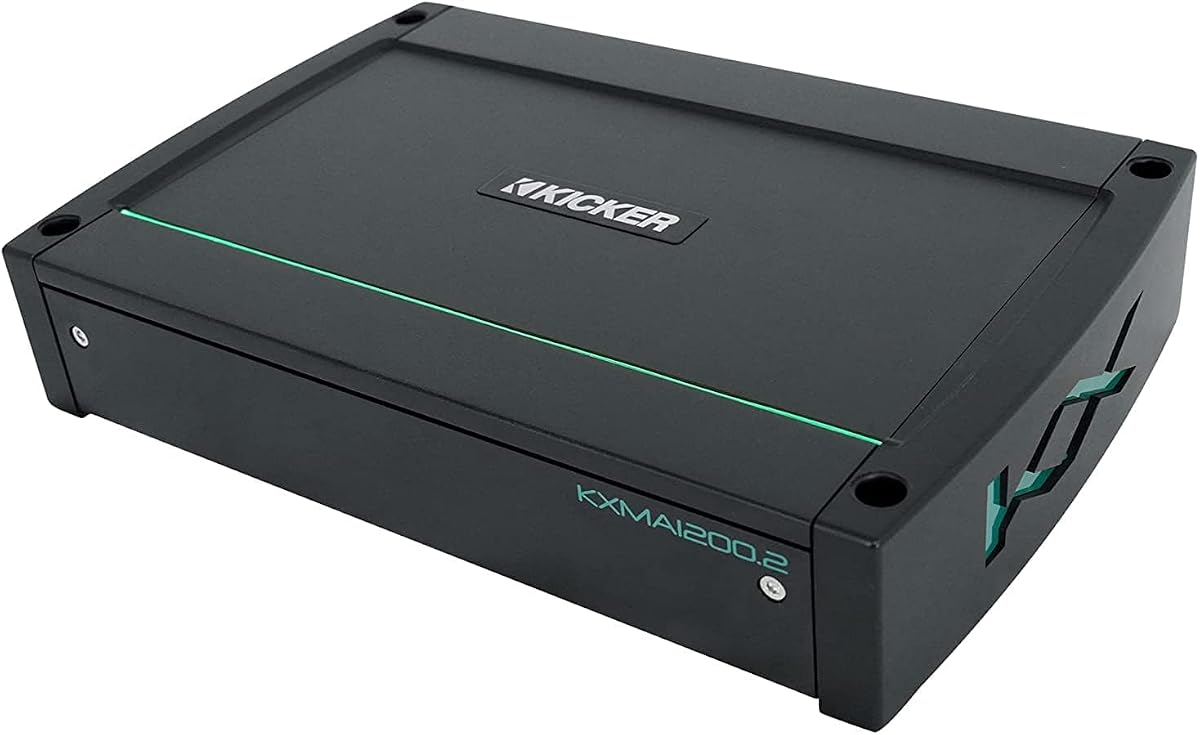
The KICKER KXMA1200.2 is a two-channel Class D marine amplifier with a combined 1,200-watt model designation and two channels listed at 600 watts each. Its 3.3 rating is the lowest published score among the products with numerical feedback, so it deserves careful evaluation rather than selection on brand recognition alone. The core appeal is a straightforward high-output marine-platform design for two speaker channels or a bridged application.
We may earn a commission when you buy through this link, at no additional cost to you.
The supplied data does not include detailed RMS specifications at different impedances, crossover ranges, protection features, signal-to-noise measurements, dimensions, or environmental certifications. Those omissions are important in a marine setting because splash resistance, load stability, heat management, and wiring flexibility can determine whether an amplifier is suitable for a particular compartment. The product title identifies it as marine, which is a useful starting point, but it does not replace documentation.
A two-channel Class D architecture is generally easier to integrate than a large multichannel amplifier. Depending on the verified specifications, it could serve a pair of full-range speakers or a single bridged subwoofer. It may also pair well with a separate four-channel unit for cabin speakers, allowing each amplifier to handle a distinct part of the system without overloading a single enclosure.
This KICKER is best recommended for a buyer who values a recognizable high-output marine platform and can verify the current technical documentation. Prospective purchasers should investigate the user feedback behind the lower rating, confirm the amplifier's exact power at the planned speaker impedance, and review its warranty and protection provisions. With those checks completed, it may still provide a practical two-channel solution, but it should not be chosen without comparing verified specifications.
Two channels can simplify wiring and make amplifier selection easier for a primary speaker pair or one subwoofer. This arrangement also leaves room for a separate multichannel amplifier when cabin and bass needs differ.
The published 3.3 rating is a meaningful warning against making the decision solely from wattage. Reading recent buyer feedback and checking the exact model details can reveal issues that the short listing summary does not show.
We may earn a commission when you buy through this link, at no additional cost to you.
Choosing a 1200 watt marine amplifier involves more than matching a large number to a speaker box. The right choice depends on continuous output, speaker impedance, channel count, crossover flexibility, environmental protection, source connections, and the space available aboard your boat.
In short, match continuous RMS output to your speakers rather than being impressed by peak wattage.
In short, count the speaker channels you need before comparing output numbers.
In short, verify minimum stable load and bridged impedance before wiring speakers.
In short, look for explicit wet ratings and coating, then install the amplifier where runoff cannot reach it.
In short, choose filters that match the role of each channel and the capabilities of the speakers.
In short, choose input options that work with the existing source and help keep the signal clean.
In short, treat protection circuitry and heat management as essential parts of reliability, not optional extras.
In short, plan the complete electrical and physical installation before the amplifier arrives.
Begin with the boat's electrical system and the amplifier's manual. Disconnect battery power while wiring, identify the correct positive and ground locations, and install the required fuse near the power source. Use the specified input connections, connect speakers within the published impedance limits, and secure every terminal. Check that the enclosure, heat sink, and ventilation paths remain unobstructed after installation.
Set the amplifier gain correctly rather than turning it to maximum. Begin with source and amplifier gain low, increase them gradually, and use a familiar track to identify distortion. Adjust crossover frequencies based on speaker capability, then use bass boost sparingly because excessive low-frequency emphasis can cause distortion or reduce headroom. Configure any remote level control within a moderate range and confirm that the protection indicator remains off during normal operation.
Marine amplifiers need routine care even when their construction is highly weather resistant. Inspect connectors for corrosion, check that the mounting remains secure, and look for dust, moisture, or salt deposits. Keep the case and heat sink clean so it can dissipate heat properly. During off-season storage, disconnect the battery if appropriate and ensure the installation remains dry. Address unusual noise, clipping, repeated protection shutdowns, or loose connections promptly rather than masking the symptom with more gain.
No. Some products use 1,200 watts as a peak or maximum figure, while others describe combined RMS output across multiple channels. Look for the continuous power per channel at the impedance of your speakers. If the documentation only provides a headline number, verify it with the manufacturer before making a purchase.
Yes, if the amplifier's specifications permit a bridged mono connection and the subwoofer's impedance is within the allowed bridged-load range. Follow the wiring diagram exactly, including any required speaker-wire configuration. Connecting the wrong channels or exceeding the minimum load can cause instability, overheating, or protection shutdowns.
It is a strong environmental rating, but protection alone does not determine installation suitability. The amplifier should still be mounted away from standing water and direct accumulation of spray, and its terminals should be protected against corrosion. Sealing, cable strain relief, and clean power and ground connections remain essential.
Choose a monoblock for a dedicated subwoofer, a two-channel unit for one speaker pair or a bridged bass channel, and a four-channel unit for two pairs of full-range speakers. A five-channel amplifier is convenient when separate cabin-speaker channels and a dedicated subwoofer channel are needed in one enclosure.
Provide airflow around the heat sink, avoid enclosing the amplifier in an airtight compartment, and keep the load within its rated limits. Clean away salt and dust that can impede heat transfer, secure all connections, and verify that protection circuitry is not being triggered. Persistent overheating can indicate an excessive load or inadequate wiring.
Yes, provided the amplifier supports the type of signal available from the factory unit. Speaker-level inputs make many factory systems straightforward to amplify, while RCA inputs suit most aftermarket head units. A correctly configured external amplifier can reduce distortion and provide cleaner power to the speakers, but the source unit should still be properly adjusted.
The correct amount depends on the subwoofer's power rating, impedance, enclosure design, and the musical output you want without distortion. Aim to match the subwoofer's recommended RMS power and its minimum impedance rather than choosing solely by the largest headline wattage. A stable low-impedance mono amplifier can provide useful headroom when wired correctly.
A remote bass control is a low-level volume knob for the subwoofer channel, usually installed near the helm or passenger area. It lets the driver reduce or increase bass without opening the compartment or reaching the amplifier. It should be set carefully so that higher settings do not create clipping or reduce the headroom needed by the front speakers.
The NVX VADM2v2 stands out as the most versatile overall choice because it combines a compact Class D design, marine-oriented construction, balanced inputs, crossover modes, and useful output options across two channels. The Magnadyne AquaVibe Pro AVP1200.5 is the strongest complete-system option, with five channels and a formal IP67 wet rating, while the Rockville Atom P60 delivers substantial continuous power and extensive tuning in a cost-conscious package.
For a dedicated bass installation, the JBL MA600 is the strongest specialty choice because its compact mono design includes high and low-level inputs, variable crossover controls, and detailed protection. The Skar RP-1200.1D also provides exceptional one-ohm RMS output, although its lack of an explicit marine designation calls for careful placement. Four-channel needs point toward the Skar RP-150.4ABM or further investigation of the Fusion Apollo.
Regardless of the model, prioritize continuous RMS power, correct impedance support, crossover range, environmental protection, and available mounting space. Read the official manual, confirm the speaker wiring plan, and use proper fuse and grounding practices. Current prices, ratings, availability, and product details can change, so verify the latest listing and manufacturer specifications before buying.
