
J T Eaton 076706844002 Spider and Cricket Glue Trap (Pack of 5), White Box
4.7Editor score
Scented, pre-baited adhesive
Non-drying, non-flowing glue
Cold-weather adhesive performance
Five traps per pack
This spider traps guide compares 10 indoor sticky trap options for coverage, adhesive design, target pests, ease of use, and placement flexibility.
Spider traps offer a targeted, low-mess way to deal with spiders and other crawling insects inside the home. The right option depends on trap size, adhesive performance, placement requirements, the pests you encounter, and how discreet the finished setup needs to look.
We compared ten products using their stated features, pack sizes, installation methods, pest coverage, and customer ratings. The list includes foldable glue boards, wall-mountable traps, low-profile designs, and broader glue boards designed for insects, rodents, and other household pests.
Each review explains the product's strongest attributes, practical limitations, and best-fit use case. Ratings and specifications reflect the supplied product information, while prices can change at any time, so shoppers should confirm current availability and cost before purchasing.
4.7Editor score

4.6Editor score

4.4Editor score
The comparison below evaluates each spider trap by its stated pest coverage, pack quantity, installation style, adhesive characteristics, and indoor use case. It highlights the main trade-offs so readers can compare compact spider-specific options with broader glue-board systems.




MaxGuard Spider + Insect Traps use a small box design that creates a dark interior intended to attract and hold spiders. The set includes 12 traps and has a 4.2 rating, with its most distinctive selling point being an industrial-grade adhesive stated to remain effective for up to six months.
We may earn a commission when you buy through this link, at no additional cost to you.
Its pest coverage is broad for a spider-focused product. The manufacturer identifies black widow, hobo, brown recluse, American house, yellow sac, wolf, and jumping spiders among the species it is designed to catch. The adhesive is described as non-toxic and insecticide-free, which makes the traps appropriate for households seeking chemical-free placement options.
The main trade-off is that a box trap is less discreet than a thin glue board and may interrupt the visual continuity of a room. Its stated six-month effectiveness also assumes normal conditions, and a trap should still be replaced if it fills, becomes dirty, or loses tackiness before then. The included 12 traps may require thoughtful distribution around the home.
This is a strong choice for someone who wants a relatively long service period, a dark shelter-like design, and coverage across several spider species. It works particularly well in less visible areas such as closets, utility rooms, basements, and storage spaces where a small box can remain in place without drawing attention.
The stated effectiveness of up to six months makes this option attractive for monitoring areas that are not checked every day. Routine visual inspections are still important, particularly during peak spider activity, because trapped pests and accumulated dust can reduce the available adhesive surface.
Rather than being designed around only one household spider, the trap names several common species, including black widows, hobo spiders, brown recluses, wolf spiders, and jumping spiders. That breadth makes it useful for a mixed-pest monitoring program.
We may earn a commission when you buy through this link, at no additional cost to you.
Catchmaster Spider Sticky Traps provide 30 ready-to-use boards designed to catch spiders along places where they travel rather than only on the floor. With a 4.4 rating, this product stands out for flexible mounting, broad crawling-insect coverage, and a pack size suited to monitoring several rooms.
We may earn a commission when you buy through this link, at no additional cost to you.
The release-paper backing allows the traps to be attached to walls, baseboards, or ceilings near web-building areas. They can also be folded into a tunnel to help keep dust away from the adhesive. No bait needs to be mixed, sprayed, or refilled, which simplifies both initial setup and ongoing monitoring.
The main limitation is that placement accuracy matters. A trap mounted in a room where pests do not travel may remain empty, while several traps in active areas can become visually noticeable. Because the set contains 30 boards, homeowners may need to store unused traps and replace them once they fill or collect dust.
This option is well suited to larger homes, apartments, basements, garages, laundry rooms, and other areas where multiple small pest populations are suspected. It is especially appealing to buyers who want one system that can catch spiders, roaches, crickets, silverfish, and earwigs without using chemical bait.
The peel-and-stick format is valuable because spiders often travel along walls, baseboards, corners, and elevated surfaces. Positioning boards where webs form or where nighttime movement is visible can improve their usefulness without relying on loose floor traps.
Because the insects remain on the adhesive, the boards can also help identify which pests are present and where they are entering or moving through the home. This monitoring function adds value beyond simply removing an occasional spider.
We may earn a commission when you buy through this link, at no additional cost to you.
Terro Spider & Insect Traps 16pk is a straightforward, pesticide-free glue-trap option for indoor spider and insect control. The 16-trim set has a 4.5 rating and focuses on simple deployment, with no mixing, spraying, or chemical bait required to activate the traps.
We may earn a commission when you buy through this link, at no additional cost to you.
The product information emphasizes that the traps are safe to use, contain no chemicals, and are intended to trap and kill unwanted insects. The 16-count format is distributed as four packs of four, making it easier to place smaller groups in several rooms without opening an entire large supply at once.
The main drawback is that the supplied details are less specific than those of several competitors. There is no named-species list, placement illustration, or stated service period in the product information, so buyers must rely on the general spider and insect positioning. It also offers fewer mounting options than products that explicitly describe wall, baseboard, or folding configurations.
This is a practical pick for consumers who value simplicity and want a chemical-free trapping system without complicated setup. It works well as a general indoor monitoring tool in bedrooms, offices, kitchens, basements, and other spaces where occasional spider activity needs to be contained.
The absence of chemical pesticides and bait makes this set appealing for users who prefer a mechanical approach. Its effectiveness depends more heavily on identifying travel routes and placing each trap where crawling pests are likely to encounter it.
Four smaller packs of four traps offer practical flexibility for distributing coverage around a home. Uneused packs can remain closed, which helps avoid unnecessary exposure to dust or accidental contact with the adhesive.
We may earn a commission when you buy through this link, at no additional cost to you.
The J T Eaton Spider and Cricket Glue Trap is a pre-baited, scented trap made for crawling, jumping, and slithering pests. It has the highest customer rating in this guide at 4.7, with its strongest differentiators being attractant performance and an adhesive designed to remain functional in cold conditions.
We may earn a commission when you buy through this link, at no additional cost to you.
Each of the five traps measures 10 inches long by 2.5 inches wide. The nonpoisonous adhesive is scented to attract insects, crickets, and spiders, while the manufacturer states that the glue remains non-drying and non-flowing across a variety of temperatures. That cold-weather consideration is particularly relevant in garages, basements, and seasonally cool rooms.
The smaller pack size can be a limitation for a large home with widespread activity, and the scent may not be desirable in every bedroom or living space. Although the trap is pre-baited, the product information does not provide a specific long-term duration claim, so regular checks remain sensible.
This is the top choice for buyers who want a ready-to-use trap with scent and temperature-resistant adhesive, particularly in cooler indoor spaces. Its established brand history and straightforward design make it a strong option for targeted seasonal monitoring rather than indiscriminate placement.
The scented pre-bait is intended to draw crickets, spiders, and other insects toward the glue while remaining nonpoisonous. This creates a useful mechanical approach for households that want to avoid conventional insecticide spraying around frequently occupied rooms.
A non-drying, non-flowing adhesive is especially valuable in locations where ordinary glue traps can become less effective. Basements, mudrooms, and unheated storage areas are sensible places to consider this option.
We may earn a commission when you buy through this link, at no additional cost to you.
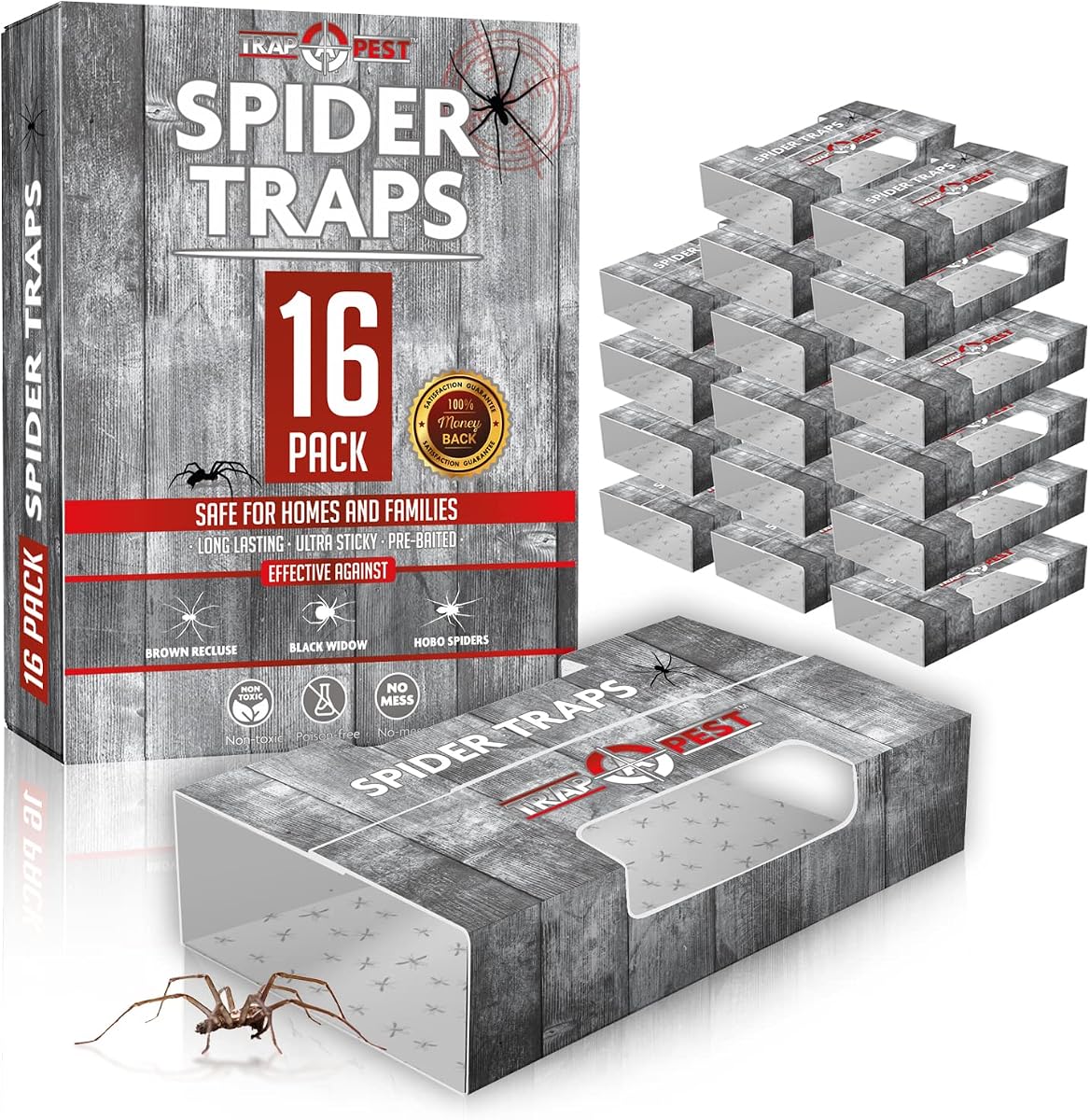
Trap a Pest Indoor Sticky Traps offer 16 large glue boards designed to catch spiders and a wider collection of crawling insects. The product has a 4.2 rating and emphasizes non-toxic, poison-free, insecticide-free adhesive along with a straightforward peel, fold, and place setup.
We may earn a commission when you buy through this link, at no additional cost to you.
The traps are marketed for brown recluse, black widow, and hobo spiders, as well as scorpions, roaches, and other crawling insects. Their larger size can provide more adhesive area than a narrow strip, while the folding format can create a protected edge or make the trap easier to position.
The product information specifically recommends placing the glue side up and against the wall, which works for floor-level movement but may be less suitable for spiders traveling across ceilings or upper walls. Sixteen traps may also be modest for a large property with many active hotspots, and the product has no stated longevity figure.
This is a sensible choice for homes dealing with several floor-dwelling pests at once. Buyers should place the boards where droppings, tracks, webbing, or repeated sightings indicate regular traffic, and rotate them as they collect dust or catches.
The larger glue surface may be useful in rooms where multiple insects cross the same floor edge. Positioning the trap against the wall reduces the chance that a pest will bypass it by following the center of the room.
Folding the trap gives the user a way to shape the board for the available space. It can also help reduce direct exposure to the adhesive, although households with curious children or pets should keep the folded surface inaccessible.
We may earn a commission when you buy through this link, at no additional cost to you.
Catchmaster Max-Catch Glue Traps are broad-purpose indoor boards designed for insects, ants, mice, rats, roaches, spiders, crickets, and other pests. The 36-count set has a 4.3 rating and is best known for its large supply, no-bait design, and coverage beyond spiders alone.
We may earn a commission when you buy through this link, at no additional cost to you.
These traps are intended to be placed along known or suspected pathways, preferably against walls. Leaving the paper covering on briefly lets pests acclimate to the trap before it is fully exposed, a placement technique intended to improve the chance of interception along a travel route.
Because the boards are designed for rodents as well as insects, they are larger and more conspicuous than dedicated spider traps. A household with a mild, isolated spider issue may find that a smaller or more discreet product better matches the situation. The stated one-year duration applies in normal indoor conditions, not necessarily through every seasonal change.
This product is best for larger homes, garages, basements, storage buildings, and mixed-pest situations where one glue-board system needs to serve multiple species. It can be particularly useful where rodenticides or snap traps are undesirable or prohibited, according to the supplied product information.
The ability to catch rodents, roaches, crickets, ants, and spiders makes this a practical choice when a single issue is not limited to a single species. A larger board can also provide a more visible catch than a narrow insect strip.
Placing boards along suspected routes supports a monitoring strategy that can reveal where activity concentrates. The traps should still be checked periodically and replaced when full, dusty, or no longer tacky.
We may earn a commission when you buy through this link, at no additional cost to you.
Catchmaster Spider & Insect Traps provide 12 ready-to-use boards in a format intended for monitoring indoor crawlers. The 4.4-rated product is a practical budget selection because it combines a manageable pack size, pesticide-free construction, and placement flexibility without requiring bait.
We may earn a commission when you buy through this link, at no additional cost to you.
The traps are designed for known or suspected pest pathways and can be placed against walls. Their sticky surface catches insects and spiders, while the no-mess adhesive approach avoids spraying. The manufacturer states that the boards can last up to one full year in normal indoor conditions.
Compared with 30- and 36-trap sets, twelve boards require more careful allocation across a home. Effectiveness depends on identifying where pests travel, and a stationary trap in an inactive room may not provide useful monitoring. Long duration also should not be interpreted as a reason to ignore filled or dirty traps.
This is an excellent choice for a small apartment, single-room infestation, or homeowner who wants a manageable first supply. It is also suitable for targeted placement in several key areas, such as a garage, basement corner, bathroom, or room with a known spider route.
Twelve boards are enough to create a useful monitoring network in a typical apartment or several targeted areas of a home. The smaller count also makes it easier to replace traps regularly without maintaining a large surplus.
The traps use adhesive rather than a conventional insecticide and require no bait. This keeps the setup simple, although it also means the trap must be located directly along the travel path to be effective.
We may earn a commission when you buy through this link, at no additional cost to you.
RESCUE! Spider Traps combine a spider-specific adhesive pattern with a decorative plastic shell designed to blend into existing décor. The 3-pack contains nine traps, and its 4.3 rating reflects a product whose main distinction is a discreet, double-sided design.
We may earn a commission when you buy through this link, at no additional cost to you.
The traps are ready to use without assembly and can be placed where spiders typically travel. A long-lasting glue-dot pattern covers two sides, and the shell can be flipped when one side fills. This dual-sided approach extends the useful life of each unit without requiring a replacement immediately.
The main disadvantages are limited pack size and the space required by the decorative housing. Nine traps may not be enough for extensive whole-home coverage, and the shell is less adaptable to very tight spaces than a flat glue board. The product information does not provide a specific overall service period.
This is the preferred option for homeowners who prioritize appearance and a compact, ready-to-place solution. It works especially well in occupied rooms where an exposed industrial glue board would be conspicuous, while still targeting brown recluse, hobo, black widow, sac, and wolf spiders.
The decorative plastic shell is designed to blend with existing interior elements, making the trap more appropriate for visible rooms than a plain board. That makes the product useful where appearance matters nearly as much as pest capture.
Flipping the trap after one side fills effectively doubles the available catching surface. Users should inspect both sides regularly because a full, dusty, or contaminated surface can reduce performance even if the reverse side remains available.
We may earn a commission when you buy through this link, at no additional cost to you.
Catchmaster Super Glue Traps are extra-strength, no-bait boards intended to catch a wide range of household pests, including spiders, insects, ants, roaches, crickets, mice, and rats. The 30-count set has a 4.4 rating and emphasizes strong adhesive performance, broad coverage, and long-lasting indoor monitoring.
We may earn a commission when you buy through this link, at no additional cost to you.
The product is designed to be placed along walls and known or suspected travel routes. Its sticky boards are mess-free and pesticide-free, allowing them to be used in residential, commercial, or industrial buildings where other pest-control methods may be undesirable.
Because mouse and rat capture is part of the product's stated use, these boards are bulkier than dedicated spider traps and may stand out in occupied rooms. Buyers seeking an inconspicuous solution for a living area may prefer the RESCUE! option, while larger mixed-pest concerns suit this broader design.
This is a good choice for buyers who want one extra-strength adhesive system to cover both spiders and other crawling or wandering pests. Its 30-trap supply and one-year claim make it practical for broader monitoring, subject to regular inspection and replacement when needed.
The extra-strength adhesive is aimed at locations where pests move frequently, including wall edges, corners, under furniture, and storage areas. Placement along confirmed paths is still more important than simply spreading boards evenly through unused rooms.
This set is more versatile than a spider-only trap because it is also marketed for mice, rats, roaches, ants, crickets, and insects. That versatility can simplify supply management when several mechanical trapping needs overlap.
We may earn a commission when you buy through this link, at no additional cost to you.
Terro Spider & Insect Traps 24ct. offer a versatile balance of coverage, pack quantity, and protective folding. The set contains 24 traps arranged as six packs of four and has a 4.6 rating, making it a strong all-around recommendation for indoor spider management.
We may earn a commission when you buy through this link, at no additional cost to you.
The traps catch spiders, ants, cockroaches, crickets, and other crawling insects, with specific claims for brown recluse, black widow, and hobo spiders. They can be used flat or folded, and the folded configuration helps prevent children and pets from touching the adhesive surface.
The product information gives no specific service-life claim, so buyers should not assume that a trap will remain effective indefinitely. Performance still depends on the spider's route, the amount of debris on the glue, and whether the trap is placed where crawling pests are likely to encounter it.
This is the most versatile option for a household seeking both broad pest coverage and a family-conscious installation method. The 24-trim supply can be divided among rooms, while the folding option makes it easier to protect the sticky surface in areas where accidental contact is likely.
The ability to choose a flat or folded setup allows traps to fit different household conditions. A flat board may suit a protected corner, while a folded trap can help shield the adhesive around edges.
The product specifically identifies brown recluse, black widow, and hobo spiders, which gives shoppers a clearer sense of its intended focus than a general insect trap. It also expands to ants, roaches, and crickets for mixed indoor monitoring.
We may earn a commission when you buy through this link, at no additional cost to you.
The most effective spider trap is one that matches the target species, fits the activity route, and can be maintained without creating a larger pest-control problem. Evaluate coverage, adhesive design, placement, safety, and supply size before choosing.
A trap can be designed for a narrow group of species or marketed as a broad solution for spiders, insects, and sometimes rodents. Products naming brown recluse, black widow, and hobo spiders may be more relevant to a buyer who has positively identified those species, while general-purpose boards are useful when the pest is still uncertain. Check whether the adhesive is intended to catch jumping spiders as well as spiders that travel along walls and floors.
Spiders do not remain on the floor. Peel-and-stick traps that attach to baseboards, walls, or ceilings are more versatile than floor-only boards, while foldable traps can fit corners, baseboards, and areas near doors. Look for the exact installation method and surface requirements. A product that can be positioned vertically or in a tunnel may cover more travel routes than a rigid trap designed for one location.
Glue performance depends on the formulation, surface cleanliness, temperature, and how often the trap is exposed to dust or moisture. Some products use scented, pre-baited adhesive, while others rely on a dark interior or simple surface attraction. Cold-resistant, non-drying, and non-flowing glue can be valuable in basements and garages, but every trap should still be replaced when it fills, gathers debris, or loses tackiness.
Pack counts range from five to 36 traps across this guide, but the most economical choice depends on the number of areas that need monitoring. A larger pack is helpful for whole-home coverage, garages, or multiple pest hotspots, while a smaller set is easier to deploy in a single apartment or targeted room. Consider not only the number of traps but also how many separate packs are included, since smaller packs can be distributed without exposing all traps at once.
Glue traps should be placed where children and pets cannot touch the adhesive. Folded designs can create a protective barrier, while enclosed box traps may limit direct access. A low-profile or decorative shell can also reduce the chance of accidental contact in occupied rooms. No adhesive should be handled directly, and traps should be positioned beyond reach even when the product is described as non-toxic.
Appearance is important in bedrooms, living rooms, offices, and other visible spaces. A decorative shell can blend with furnishings, while a thin glue board can fit more discreetly along a baseboard. Larger boards intended to catch mice and rats may be conspicuous and are better suited to utility areas, garages, basements, and other less visible locations.
Long stated durations should be treated as best-case conditions rather than a guarantee. Dust, moisture, full surfaces, and physical damage can make a trap less effective sooner. A product claiming up to one year may remain useful for a long time in a protected indoor environment, but frequent checks in basements, garages, and high-activity rooms are still advisable. Replace traps as soon as they become full or dirty.
Sticky traps are valuable for monitoring low-level activity, identifying travel routes, and capturing individual spiders. A large infestation may require additional sanitation, exclusion, professional identification, or a broader integrated pest-management approach. Products that reveal the number and type of caught pests can help determine whether the issue is declining or whether additional measures are needed.
Begin by identifying where spiders are active, where webs form, and where you have noticed repeated movement. Basements, garages, closets, corners, baseboards, behind furniture, laundry rooms, and areas near doors are common candidates. Wipe away loose dust from the mounting surface, then place each trap where the crawling route is likely to intersect the adhesive.
Follow the product-specific folding or mounting instructions. Some designs are intended to sit flat on the floor, others attach to a wall or baseboard, and some can be folded into a tunnel to keep dust off the glue. Use the release-paper acclimation technique only when it is part of the manufacturer's directions, and keep every trap away from children, pets, and accidental handling.
Inspect traps regularly, especially in dusty or humid rooms. Replace one as soon as it fills, loses tackiness, or becomes covered with debris. Dispose of used traps carefully, wash your hands after handling them, and avoid placing additional adhesive over an active glue surface. If catches continue to increase despite multiple placements, consider broader exclusion, sanitation, and professional pest-identification measures.
Many options use non-toxic, pesticide-free adhesive, but the sticky surface can still be uncomfortable or potentially harmful if a child or pet touches it. Choose a folded, enclosed, or otherwise protected design and place the trap where it cannot be reached. Do not handle the adhesive directly, and keep used traps away from curious animals.
Durability depends on the product, room temperature, dust, moisture, and how many pests it catches. Some products claim effectiveness of up to six months or one year under normal indoor conditions, but those figures are not guarantees. Replace a trap as soon as it fills, becomes dirty, dries out, or no longer holds pests securely.
Place traps along active travel routes, including baseboards, corners, behind furniture, near doors, beside webs, and along walls. Many spiders travel above floor level, so vertical placement can be more useful than a trap in the center of a room. Stairs, closets, basements, garages, bathrooms, and laundry rooms are also common monitoring locations.
The listed products are glue traps that trap and kill spiders and other insects when they contact the adhesive. They do not use conventional insecticidal bait, and several explicitly advertise pesticide-free or non-toxic construction. A caught trap still needs to be handled and disposed of according to the product instructions.
Yes, many products in this category are designed for more than spiders. The Terro, Catchmaster, MaxGuard, and Trap a Pest options list various combinations of roaches, crickets, ants, silverfish, earwigs, and other crawling insects. Check the stated target list because a dedicated spider trap may not offer the same coverage as a broader glue board.
It depends on the design and location. Some traps can be folded to create a tunnel, protect the adhesive from dust, or block access by children and pets, while others are intended to remain flat. Follow the product instructions and choose the configuration that fits the travel route without preventing the trap from contacting the pest.
The right number depends on the size of the home and the number of active routes. A small apartment may need only a handful of well-placed traps, while a larger home with multiple hotspots may use two dozen or more. Concentration matters more than even spacing, so fewer traps in confirmed activity areas can be more effective than many unused boards.
The trap may be outside the spider's travel route, covered with dust, positioned in an area that is too dry or disturbed, or placed too high or low relative to normal movement. Move it closer to webs, droppings, sightings, corners, and baseboards. Rotating flat and vertical placements can help identify the route the spider is using.
The J T Eaton Spider and Cricket Glue Trap stands out for scented attraction and cold-resistant adhesive, the Terro 24-count set offers the most flexible flat-or-folded installation, and the 12-pack Catchmaster provides a practical budget balance. Each serves a different need, so the ideal choice depends on location, appearance, and pest coverage.
Prioritize accurate placement, the pests you need to target, and protection from children and pets. A smaller trap is often better for a single visible room, while larger or broader boards make more sense for basements, garages, mixed insect activity, and whole-home monitoring. Regular inspection is essential because a long advertised service life does not excuse a full or dirty trap.
Ratings provide a useful snapshot of customer feedback, but product design and household conditions ultimately determine results. Confirm the current product details, availability, and cost before purchasing, since prices and seller conditions can change. A small set of correctly positioned traps is usually a better starting strategy than a large number placed without a plan.