
AIMS 10000W 12V Modified Sine Inverter
4.0Editor score
10000W continuous output
20000W surge capability
Four AC outlets included
Front-panel monitoring meters
Explore the best 10000W inverter choices for home backup, RV travel, solar systems, and mobile power, compared for output, features, and compatibility.
A 10000W inverter can transform battery power into household AC electricity, but the right unit depends on output quality, battery voltage, surge capacity, and installation demands. The best models support everything from camping equipment and tools to substantial home or solar systems, so matching the inverter to the actual load is essential.
We compared ten inverters by examining continuous and peak output, waveform type, voltage configuration, charging functions, monitoring controls, protection features, and supported applications. The list includes portable 12V models, modified-sine converters, pure-sine systems, and integrated solar hybrid inverters for different scales of use.
Each review highlights the most useful capability and any important limitation of the product, from output waveform to battery requirements. The top selections represent different priorities, including high-capacity backup, flexible solar charging, and value-oriented mobile power. Product availability and prices can change, so confirm current details before purchasing.
4.0Editor score
5.0Editor score

4.5Editor score
The table below compares all ten inverters across power class, output type, system voltage, and major features, making it easier to distinguish portable battery converters from whole-system solar hybrid units.




The Wagan EL3748 Proline combines a 10000W continuous rating with a 20000W surge peak, making it a substantial option for RV, van, camping, and off-grid power. It earns a 4.2 rating, and its standout qualities include true continuous output, multiple household outlets, a high-current terminal block, and an included remote control.
We may earn a commission when you buy through this link, at no additional cost to you.
The inverter uses modified sine wave output, which is practical for many tools, pumps, and standard household appliances. Its front-panel input and output LEDs provide basic operating feedback, while a cooling fan, overload protection, overvoltage shutdown, overheat protection, short-circuit protection, and reverse-polarity protection add useful safeguards. The terminal block is especially relevant for higher-current hardwired equipment.
The main limitation is waveform quality. Sensitive electronics, variable-speed motors, some medical devices, and certain audio or kitchen equipment may perform better with pure sine wave power. Its 10000W continuous rating also demands an appropriately robust 12V battery configuration, heavy cabling, good ventilation, and careful attention to polarity during installation.
This is a practical choice for buyers who need substantial continuous output and strong surge performance in a vehicle or portable system. It is especially appropriate for conventional appliances and power tools that tolerate modified sine wave output. Buyers prioritizing clean power for sensitive electronics should consider one of the pure sine wave alternatives instead.
The 20000W surge peak gives motors and compressors additional startup headroom above the 10000W continuous rating. That margin can prevent nuisance shutdowns when pumps, saws, or other demanding loads switch on.
Four 120V AC outlets serve ordinary household-style devices, while the high-output terminal block supports a hardwired connection. Input and output LEDs and the included remote improve control and operating visibility.
We may earn a commission when you buy through this link, at no additional cost to you.
This upgraded pure sine wave inverter is listed at a 5.0 rating and offers a 10000W configuration for mobile, RV, home, and solar applications. Its primary attraction is a claimed 95% conversion efficiency, pure sine wave AC output, and an LED display that presents detailed operating information rather than only basic status lights.
We may earn a commission when you buy through this link, at no additional cost to you.
The display can show battery power, battery input voltage, AC output voltage, output power, and warnings for overvoltage, undervoltage, overload, and short-circuit conditions. A soft-start system is designed to ease the transition when loads begin, while automatic power-off and intelligent controls add protection against voltage, current, temperature, and short-circuit problems.
The aluminum alloy housing and built-in fan help manage heat and support durability. One important point is that the product title lists several possible wattages and input voltages, while the selected configuration is 10000W, 12V to 220V. Buyers should confirm the delivered configuration, supported output connections, and regional electrical requirements before ordering.
The inverter is attractive for users who want clean output and detailed monitoring without moving to a full integrated solar system. It suits RV appliances, electronics, tools, and portable household loads where pure sine wave behavior matters. Confirm the 220V output and available socket format before installation, particularly when traveling internationally.
Pure sine output is the defining advantage over modified sine models. It is generally a more natural match for sensitive electronics, variable-speed equipment, and appliances with strict power-quality expectations.
The built-in display consolidates input voltage, output voltage, power, battery status, and fault warnings. This makes it easier to diagnose a load or battery problem without relying entirely on separate meters.
We may earn a commission when you buy through this link, at no additional cost to you.
The SUNGOLDPOWER SPH10048P is a 10000W pure sine wave solar inverter designed for 48V battery systems. It has a 4.5 rating and combines an inverter, up to 200A battery charger, and two MPPT solar controllers in one enclosure, reducing the number of separate components needed for a substantial renewable-energy installation.
We may earn a commission when you buy through this link, at no additional cost to you.
Its output can be configured as 120/240V split phase or 120V single phase. Maximum peak power is 20000W, and the listed loaded motor capacity is 6HP. Four charging modes and four output modes allow the operator to choose among hybrid, utility-priority, solar-priority, solar-only, inverter-priority, and related operating strategies.
The tradeoff is system complexity. A 48V installation is not a drop-in replacement for a simple 12V vehicle inverter, and the listed 500VDC maximum open-circuit PV voltage requires careful string design. Time-slot charging and discharging adds valuable utility-rate management, but it also calls for deliberate programming rather than a simple on/off installation.
This model is well suited to buyers building a serious off-grid, backup, or solar system that needs split-phase power and integrated charging. It is less appropriate for a traveler who only needs a few outlets from a vehicle battery. For that narrower use case, a 12V portable inverter would be more straightforward.
Two MPPT controllers can optimize separate solar arrays, including panels facing different directions. Integrating tracking and charging functions simplifies the balance of a larger renewable-energy system.
The available charging and output modes let the owner prioritize utility power, solar production, battery charging, or inverter supply. Time-slot controls add another layer of control for changing energy needs.
We may earn a commission when you buy through this link, at no additional cost to you.
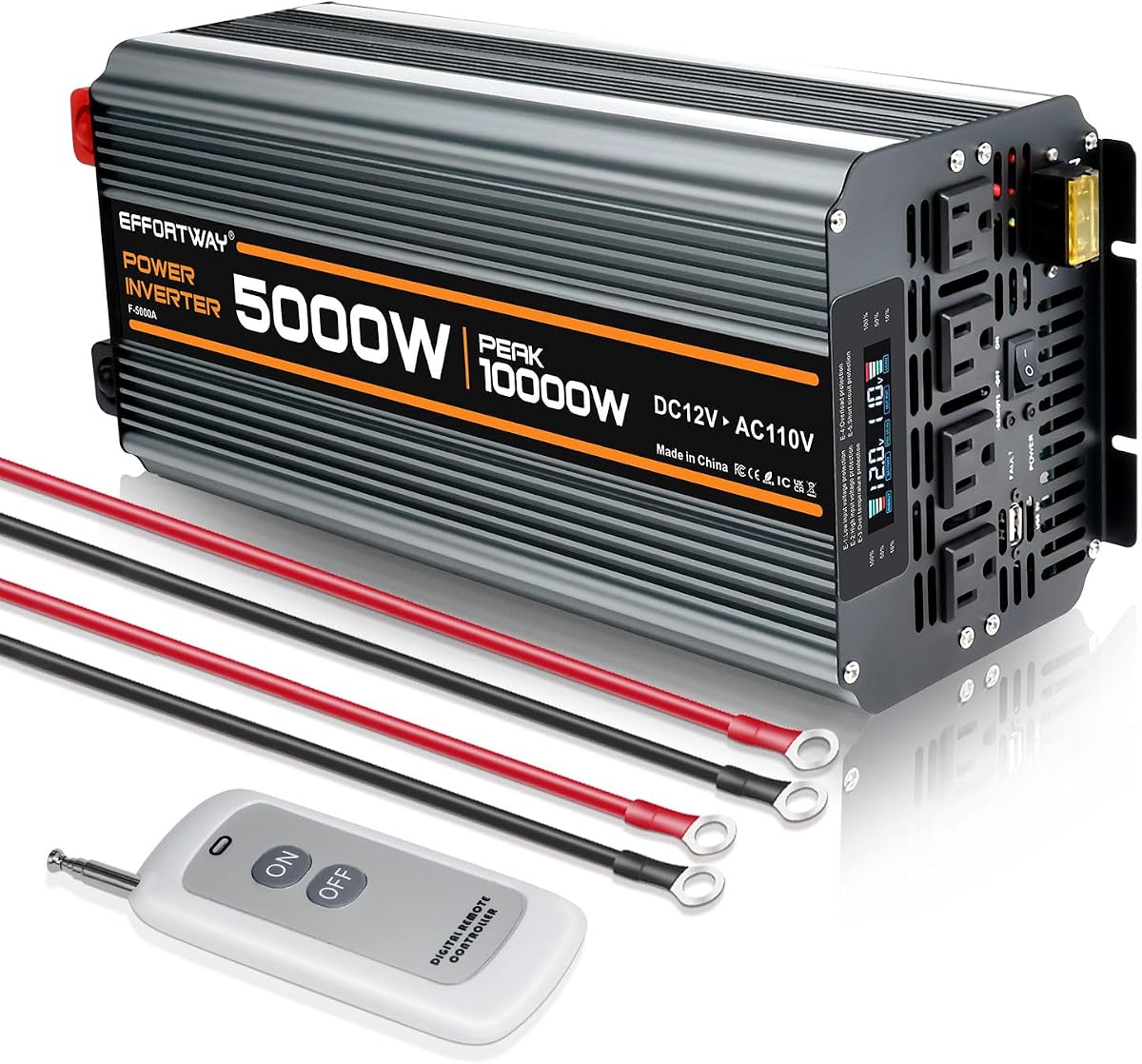
This 12V inverter provides 5000W of continuous output and a 10000W peak, so it meets the keyword through surge capacity rather than a 10000W continuous rating. It has a 4.4 rating and is positioned for RVs, motorhomes, trucks, camping, emergency supply, and off-grid solar use where 5000W continuous power is more practical.
We may earn a commission when you buy through this link, at no additional cost to you.
Its standout features are the LCD display and 150-foot wireless remote. The screen shows input and output voltage, battery capacity, load capacity, and error codes, while the remote allows operation without walking to the inverter. Four AC outlets and one USB port provide a practical mix of connection options for travel and household equipment.
Protection features cover overcurrent, short circuit, low load, overload, overheating, and overvoltage. The supplied guidance maps common error codes to likely causes, including low battery, high charging voltage, overheating, overload, and short circuit. That troubleshooting support is useful, although the product should still be installed with proper airflow and correctly sized cables.
This is a strong choice for RV occupants who need moderate continuous output, convenient remote operation, and clear status information. It is not suited to running multiple high-power appliances simultaneously when their combined draw approaches 10000W. Buyers whose main requirement is sustained 10000W should examine the continuous-rated models instead.
The 150-foot wireless controller makes the inverter practical when it is mounted out of reach in an RV cabinet, storage bay, or workshop. The display can be checked without approaching the power connections.
A supplied guide connects common error codes with probable causes and corrective steps. That makes common battery, temperature, overload, and wiring issues easier to address at a basic level.
We may earn a commission when you buy through this link, at no additional cost to you.
The SUNGOLDPOWER 48V solar inverter is one of the strongest options for buyers building a high-capacity off-grid or backup system. It combines a 10000W rated pure sine wave inverter, 20000W maximum peak output, up to 200A battery charging, and two MPPT solar controllers. Its 4.5 rating reflects a capable and feature-rich design.
We may earn a commission when you buy through this link, at no additional cost to you.
The output can operate as 120/240V split phase or 120V single phase, making it adaptable to whole-home loads, workshops, and dedicated 240V equipment. It supports parallel operation with up to six units, providing a clear route to higher system capacity. Maximum solar open-circuit voltage is listed at 500VDC, so array planning must account for that limit.
Its main disadvantage is that it is not a simple portable inverter. A 48V battery bank, high-current DC conductors, careful fusing, proper grounding, and code-compliant electrical work are important. Although time-slot control, communication ports, and multiple operating priorities are valuable, these functions reward careful configuration rather than immediate plug-and-play use.
This is the pick for a serious solar or home-energy buyer who values integration, expandability, and split-phase capability. It offers more system-level control than a conventional 12V converter. Those wanting a straightforward RV appliance inverter should choose a lower-voltage portable product instead.
Support for up to six parallel units lets an installer design for present needs and future expansion. It is especially relevant to workshops and homes where loads may grow over time.
The unit is compatible with 48V AGM, sealed, gel, flooded, and lithium batteries, plus a user mode. CAN, USB, and RS485 communication also support compatible battery management systems.
We may earn a commission when you buy through this link, at no additional cost to you.
The AIMS 10000W 12V modified sine inverter delivers 10000W continuous output and up to 20000W surge capability. It holds a 4.0 rating and offers a straightforward route to substantial off-grid power for users who do not need the cleaner waveform of a premium pure sine inverter.
We may earn a commission when you buy through this link, at no additional cost to you.
Four 120V AC outlets and a terminal block provide both convenient and hardwired options. Front-panel voltage and amperage meters allow the operator to monitor battery condition and current power use. PWM soft start and phase correction help manage startup behavior for compatible loads such as motors, pumps, and tools.
The compromises are significant. Modified sine wave output is less suitable for sensitive electronics and may produce audible noise or greater heat with some loads. The product data also states that it is not intended for standard vehicle use and requires a robust battery configuration to sustain its 10000W continuous output. Ventilation and cable sizing remain essential.
The AIMS model makes sense for cost-conscious buyers powering conventional tools, pumps, motors, and basic appliances from a stationary 12V battery system. It is less suitable for sensitive electronics, compact mobile installations, or turnkey home backup. Buyers should calculate load demand carefully and provide the battery bank this class of inverter requires.
A true 10000W continuous rating and 20000W surge capability make this a high-output option at a comparatively accessible price point. It is targeted at value-conscious buyers building a dedicated stationary power system.
Built-in voltage and amperage meters provide useful information about battery condition and load consumption. This helps an installer spot an undersized battery bank or an overloaded circuit during operation.
We may earn a commission when you buy through this link, at no additional cost to you.
The OLTEANP inverter is a 5000W continuous pure sine wave unit with 10000W surge capacity. Its 4.6 rating makes it a strong mobile-power option, particularly for travelers who need more than basic outlets and want an accessible remote monitoring display.
We may earn a commission when you buy through this link, at no additional cost to you.
The connection mix includes four AC outlets, a hardwired terminal for high-current appliances or tools, a 5V/3.1A USB port, and a 30W Type-C PD port. Dual LCD screens on the inverter and remote show input and output voltage, battery status, and fault alerts. The pure sine waveform is also more suitable than modified sine for many modern electronics and variable-speed devices.
It works with common 12V batteries, including LiFePO4, AGM, gel, and lead-acid types, which makes integration into RV, truck, van, car, or solar setups straightforward. Its five-layer protection system addresses undervoltage, overvoltage, overload, overheating, and short circuits, while built-in fuses provide an additional layer of interruption.
The main limitation is that continuous capacity is 5000W, not 10000W. Although the surge rating can assist with startup, users should not plan to run a collection of high-wattage appliances at full output simultaneously. This model is a good fit for mobile kitchens, remote work, travel, and moderate emergency loads.
AC outlets, a hardwired output, USB-A, and Type-C provide a convenient mix for computers, phones, tools, and standard appliances. A single inverter can therefore serve a broad collection of daily loads.
A local display and a separate remote screen allow the operator to check voltage, battery condition, and faults from different positions. This is particularly convenient in an RV or mobile workshop.
We may earn a commission when you buy through this link, at no additional cost to you.
The TOPBULL 5000W inverter combines 5000W continuous power, 10000W peak capability, and pure sine wave output for vehicles, RVs, camping, mobile offices, and off-grid use. Its 4.6 rating reflects a well-equipped design with a color display, remote control, and unusually broad protection coverage.
We may earn a commission when you buy through this link, at no additional cost to you.
It provides four 20A AC sockets, two 3.4A USB charging ports, a 30W Type-C interface, and three AC terminal blocks. The high-definition display reports voltage, power, and operating status, while the 200-foot remote lets users switch the unit on or off without approaching the installation. High-frequency transformers and copper cabling support efficient, practical battery conversion.
Protection functions include low and high voltage, overload, short circuit, overheating, reverse polarity, grounding, overcurrent, leakage, and battery protection. A temperature-controlled dual-fan system is designed to maintain appropriate operating temperature. These are useful safeguards, but they do not replace correct cable sizing, secure connections, or adequate airflow.
This inverter is well matched to travelers and installers who want more ports and visible operating information than a basic vehicle converter. It can support refrigerators, coffee makers, ovens, televisions, and other appropriate loads within its capacity. Buyers should treat the 10000W figure as surge allowance and plan continuous loads around the 5000W maximum.
Four AC outlets, three terminal blocks, two USB ports, and one Type-C port provide unusually broad connectivity. The mixture supports both standard household loads and high-current hardwired equipment.
The listed safeguards cover electrical, thermal, battery, grounding, and leakage concerns. The metal housing and intelligent dual fans further support stable operation in mobile environments.
We may earn a commission when you buy through this link, at no additional cost to you.
The POWLAND 10000W grid-tied hybrid solar inverter combines grid power, solar production, and optional battery support in a single 48V system. It has a 5.0 rating and stands out for its battery-free design, 250A MPPT controller, 120/240V split-phase output, and ability to operate without a battery installed.
We may earn a commission when you buy through this link, at no additional cost to you.
Its stated MPPT efficiency reaches 99.9%, and the wide 90–485VDC solar input range supports substantial array configurations. Grid integration can prioritize home consumption and send surplus energy to the grid, with an optional current transformer for the relevant setup. Users can also combine grid, solar, and battery sources for backup of critical loads.
This is not a simple plug-in inverter, even though battery-free operation can simplify the energy-storage portion. Grid-tied installation, anti-backflow configuration, breaker selection, and local electrical requirements all matter. The IP65 casing helps with outdoor exposure, while overload, short-circuit, reverse-polarity, and voltage protections support safer operation.
For a buyer who wants maximum solar integration without committing immediately to a large battery bank, the battery-free design is the defining benefit. It is best suited to a properly planned residential or RV-park installation. A plug-and-play traveler should instead select a portable 12V unit with simpler wiring.
The unit can operate from solar and grid power without batteries, allowing a system to begin producing usable energy before a storage bank is added. This separates inverter procurement from the full cost and footprint of battery installation.
The 250A MPPT controller and broad 90–485VDC input range are intended for large solar arrays. A clear LCD and status LEDs help operators review power flow and operating conditions.
We may earn a commission when you buy through this link, at no additional cost to you.
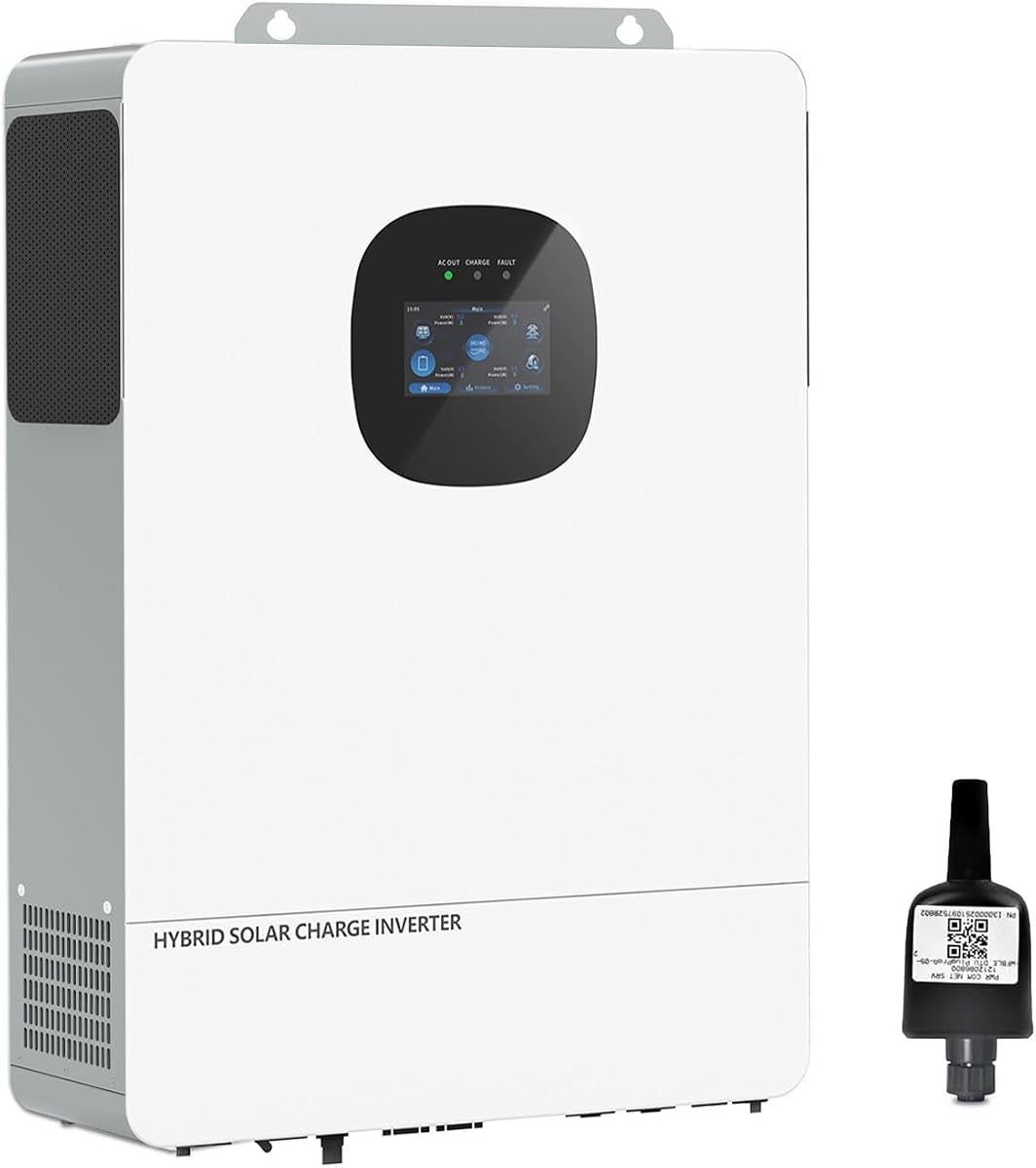
The HumsiENK hybrid inverter combines a 10000W pure sine wave inverter, 12000W MPPT solar charger, and 220A battery charger in one unit. Its 4.7 rating and feature set target demanding home backup, off-grid, and workshop applications rather than simple vehicle use.
We may earn a commission when you buy through this link, at no additional cost to you.
Native 120/240V split-phase output can operate heavy 240V equipment without requiring a separate external transformer, and the output can be switched to 120V single phase for RVs or cabins. A grid-transfer time of 10 milliseconds or less is designed to support computers, routers, and other sensitive equipment that may react poorly to a prolonged outage.
Two independent MPPT channels allow separate solar arrays to be managed simultaneously, including arrays with different orientations. The unit supports four charging modes, time-of-use scheduling, and up to six parallel units for a stated maximum of 60kW. WiFi, Bluetooth, USB, RS485, and CAN communication create a strong monitoring and battery-management foundation.
Its complexity is justified for a professionally planned energy system but would be excessive for basic camping. A 48V battery architecture, high-current wiring, firmware configuration, and local electrical requirements should be handled carefully. The listed UL1741 and FCC Part 15 Class B standards are useful points to verify with the seller and installer before deployment.
The stated UPS transfer time of 10 milliseconds or less is aimed at keeping sensitive electronics running during a grid interruption. Actual performance depends on installation, load behavior, and system configuration.
Combining pure sine inversion, MPPT solar charging, and 220A battery charging reduces equipment count. The compact wall-mount design also helps preserve space in whole-home or workshop installations.
We may earn a commission when you buy through this link, at no additional cost to you.
Selecting the right inverter starts with the loads, electrical architecture, and operating environment. The most important distinction is whether a product provides true 10000W continuous output or reaches 10000W only as a surge rating.
Continuous output describes the power an inverter can sustain during normal operation, while surge capacity covers brief startup peaks from motors, compressors, and pumps. A listing that says 10000W may refer to either figure. Models with 5000W continuous and 10000W peak power are suitable for moderate equipment, while a genuine 10000W continuous inverter can run a much larger collection of loads without relying on short-duration headroom.
Choose continuous capacity above the combined running wattage of your equipment, with reasonable headroom for future additions. Treat surge ratings as temporary starting support rather than additional everyday capacity.
Pure sine wave output more closely resembles utility electricity and is generally the safer choice for sensitive electronics, variable-speed motors, medical equipment, and some audio or kitchen appliances. Modified sine wave inverters are less expensive and can run many conventional tools, pumps, and resistive loads, but they may cause noise, heat, or malfunction in more demanding devices.
Choose pure sine wave when load compatibility matters more than minimizing cost. Choose modified sine only when every connected appliance is known to work with a less refined waveform.
A 12V inverter is convenient for vehicles, RVs, and small mobile systems, but pushing 10000W through a 12V battery bank creates very high current and requires substantial cabling. A 48V architecture is more efficient for high-capacity stationary systems because it carries the same power at lower current. Some hybrid units also support 24V configurations.
Match the inverter to the battery bank, charge controller, fusing, and cable system. Do not assume a nominal wattage rating means the same battery configuration will work in every installation.
North American equipment commonly uses 120V, while many larger appliances require 240V. A split-phase inverter can provide both 120/240V output and is more appropriate for central air, water pumps, electric ovens, and workshop machinery. Some portable units offer 220V output for international use, but socket type, frequency, and regional compatibility must be checked carefully.
Verify every intended load before buying. A 120V-only unit may run many household appliances, but it cannot replace a properly configured 240V circuit for heavy equipment.
An integrated MPPT controller can improve solar energy capture by tracking the panel array's optimal operating point. Integrated battery charging also reduces the number of separate devices and wiring connections. Look for configurable charging priorities, solar-only and utility-priority modes, and time-slot scheduling if energy tariffs or changing production levels matter.
For a simple battery-powered application, charging controls may add little value. For a solar installation, they may be the main reason to choose one integrated hybrid model over another.
A useful inverter shows input voltage, output voltage, battery state, load consumption, and fault codes. Remote controls and separate displays improve convenience when the unit is mounted inside a cabinet, vehicle, or distant wall location. Color screens can make status easier to interpret, while LED indicators provide a simpler and less expensive indication of operating condition.
Choose the level of monitoring that matches the installation. A basic status light is sufficient for occasional use, while detailed remote monitoring is valuable in an RV, workshop, or permanently installed solar system.
Overload, overvoltage, undervoltage, overheat, short-circuit, reverse-polarity, and low-battery protection help prevent damage to connected equipment and the battery. Cooling fans and temperature-controlled designs are especially important at high continuous loads. The number of protections matters, but correct operation also depends on proper ventilation, secure terminals, and correctly rated cables and breakers.
Prioritize units with comprehensive protection and active cooling. Treat the safety list as one layer of a properly engineered installation rather than a substitute for sound electrical design.
Grid-tied hybrid inverters can coordinate utility power, solar generation, batteries, and critical loads. Battery-free operation can make solar usable before a storage system is installed, while fast UPS transfer can help sensitive electronics remain online during outages. These functions require correct grid integration, anti-backflow configuration where applicable, and compliance with local electrical rules.
Choose a hybrid model if continuous grid support and solar integration are priorities. Choose a portable battery converter if the system only needs reliable AC from a vehicle or standalone battery bank.
Begin by identifying every load, its running wattage, and its startup requirement. Add up expected simultaneous demand, then confirm that it remains below the inverter's continuous rating. Check the battery voltage, AC output configuration, and total load before connecting equipment, and never allow a DC-to-AC converter to be treated as a direct substitute for a correctly engineered electrical system.
Installation quality determines inverter performance and safety. Use properly rated battery cables, secure the connections, install appropriate fusing near the battery, confirm polarity, and provide the ventilation required by the manufacturer. For high-current 12V systems, undersized wiring can create voltage drop and heat. Grid-connected or whole-home installations should use qualified electrical professionals and comply with local requirements.
Operate the inverter within its documented limits and monitor the display for high voltage, low battery, overload, temperature, and short-circuit warnings. Do not ignore repeated fault codes, and do not place the unit where heat can accumulate. When it is not needed, switch it off according to the manual, maintain battery charge, and inspect cables, terminals, fans, and ventilation openings periodically for corrosion, looseness, or damage.
Not always. Some products provide 10000W only as a surge or peak rating while continuous output is 5000W. Check the continuous-rated output before purchasing, and size the inverter so the combined running load remains comfortably below that limit.
It often is when sensitive electronics, variable-speed motors, medical equipment, or certain kitchen appliances are involved. Pure sine output reduces compatibility concerns and generally provides cleaner power. Modified sine models can still work well for ordinary tools, pumps, and resistive appliances.
It depends on their combined running watts and startup surges. A refrigerator and room air conditioner may fit a genuine 10000W continuous model but overload a 5000W unit. Check the nameplate wattage of each appliance and its surge requirement, then leave operating headroom.
The correct battery depends on the inverter voltage, how long it must run, and how much surge current the loads require. A 12V system draws extremely high current at full output, while a 48V bank is generally more practical for sustained high power. Use deep-cycle batteries with adequate capacity and current rating.
Only models with an integrated MPPT solar controller and appropriate PV voltage specifications should be connected directly. Other inverters require a separate compatible charge controller. The solar array's open-circuit voltage must remain below the inverter's stated limit, and battery compatibility also needs confirmation.
A 120V output is intended for ordinary household receptacles and many portable appliances. A 240V or 120/240V split-phase output supports high-power equipment such as central air, well pumps, electric ovens, and workshop machinery. Confirm the load, plug type, and local electrical standard before selecting a configuration.
A backup inverter is valuable when it can safely operate essential loads from batteries, solar energy, or another stored source. Choose pure sine wave output for sensitive critical equipment, size it for startup surges, and coordinate any grid-connected or whole-home wiring with a qualified electrician.
The battery voltage may have fallen below the inverter's operating threshold, or the battery bank may not be delivering enough current under load. Check connections, battery condition, cable sizing, and the charging system. Repeated low-voltage warnings should be resolved before adding more loads.
The AIMS 10000W model offers the most budget-focused route to high continuous output, while the POWLAND hybrid inverter stands out for battery-free solar operation and flexible grid integration. The SUNGOLDPOWER 48V model is the premium selection for buyers seeking dual MPPT tracking, high-capacity charging, split-phase output, and expansion through parallel units.
Prioritize the distinction between continuous and surge ratings, then choose the battery voltage and AC output configuration that match the installation. Pure sine wave models are safest for sensitive and variable-speed equipment, while portable 12V units are easier to integrate into RV and vehicle systems. Permanently installed solar and grid-tie projects require careful component matching and professional electrical work.
Ratings and technical details provide a useful starting point, but product configurations can change over time. Check the current listing, output format, regional plug compatibility, included accessories, warranty terms, and manufacturer instructions before ordering. Prices and promotions also change, so compare current offers rather than relying on a previously seen amount.