
Jackery HomePower 3600 Plus
4.6Editor score
3584Wh base capacity
3600W continuous output
Up to 43kWh expanded
Dual-voltage home support
Compare the best portable power station Starlink setups for home backup, camping, and remote work, reviewing capacity, output, charging, and connectivity.
A portable power station can keep a Starlink system online when the grid fails, but only when its capacity, output, ports, and charging options match the demands of the dish, router, and everyday devices. The right setup should offer enough reserve for overnight use, quiet operation, and a dependable way to recharge away from home.
This guide compares ten relevant products using the supplied specifications, including battery capacity, continuous and surge output, port selection, recharge methods, UPS behavior, weight, expansion potential, and projected equipment life. It covers portable stations for travel and outages as well as larger home-backup systems, plus a dedicated Starlink Mini power cable.
Each review explains where the product stands out, where buyers may encounter compromises, and which users are most likely to benefit. Ratings and specifications can change over time, so readers should verify the latest listing details, compatibility information, and current price before making a purchase.
4.6Editor score

4.7Editor score

4.7Editor score
The table below compares all ten options by capacity, output, power-management features, and portability, making it easier to identify a setup suited to Starlink use, travel, or home emergencies.


The EF ECOFLOW DELTA 3 combines a 1024Wh battery with 1800W of continuous output, giving it enough capability for a Starlink setup, networking equipment, phones, laptops, and selected household loads. Its 4.7 rating reflects a favorable balance of charging speed, expandability, and output flexibility, making it the most versatile all-around option in this guide.
We may earn a commission when you buy through this link, at no additional cost to you.
Fast charging is the DELTA 3's defining advantage. It can reach an 80% charge in 30 minutes using its 500W solar input and 1500W maximum AC input, while a full charge is stated at 56 minutes. That means a user can restore meaningful reserve quickly after an outage rather than waiting through a long recharge. The LFP battery is rated for 4,000 cycles to 80% and a 10-year lifespan for daily use.
The power station can operate 13 appliances simultaneously, and X-Boost supports resistive appliances demanding more than 2600W continuously. Expansion to as much as 5kWh with compatible EcoFlow battery packs is another major strength, allowing buyers to increase runtime without replacing the base unit. The limitation is that the standard 1024Wh capacity offers less endurance than the larger models in the roundup, particularly if several appliances run alongside Starlink.
This is a strong recommendation for campers, remote workers, and homeowners who want rapid recharging and a clear expansion path. It also suits buyers who want a portable power station that can serve as a compact emergency reserve. For a setup intended to operate Starlink continuously for several days without recharging, however, one of the 2kWh-or-larger options may be more appropriate.
The ability to add 80% charge in 30 minutes is especially valuable when utility service returns briefly or the user needs to move the station between backup and travel applications. It also reduces the amount of time a Starlink system must remain disconnected from a power source during recharging.
The EcoFlow expansion ecosystem gives buyers a practical way to increase energy storage over time. Compatible DELTA 3, DELTA Pro 3, and DELTA 2 Max battery packs can raise the installation to 5kWh, making the base unit a starting point for more demanding emergencies.
We may earn a commission when you buy through this link, at no additional cost to you.
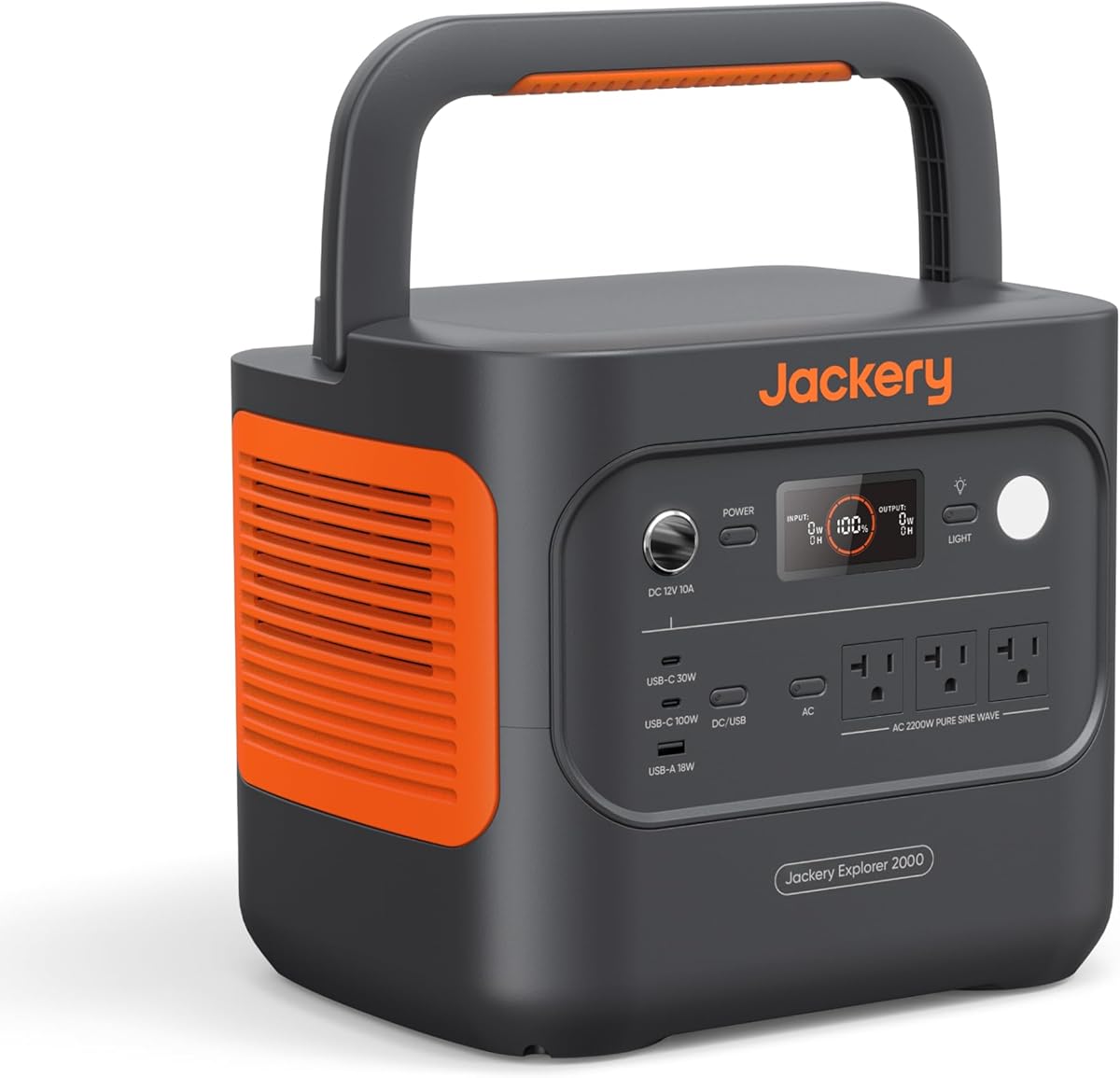
The Jackery Explorer 2000 v2 is a 2042Wh station with 2200W of AC output and a 4.4 rating. It occupies a useful middle ground in this roundup: large enough to power a Starlink system and common household electronics for a meaningful period, yet specified at just 39.5 pounds for easier transport than many similarly capable units.
We may earn a commission when you buy through this link, at no additional cost to you.
Its three AC outlets and 100W USB-C PD port provide a varied output selection. The listed charging performance includes a 0-to-80% AC fast charge in 66 minutes, a 102-minute full charge through the app's Emergency Super Charging mode, and solar charging in as few as six hours with 400W panels. Silent Charging offers a full charge in five hours at 30dB or less.
The 20ms seamless switching and UL1778 certification for uninterruptible power systems make it relevant to users who want more than simple outage support. A router, Starlink terminal, and essential communications equipment may continue operating with little perceived interruption. The trade-off is that this is a portable station rather than a split-phase home system, so it is not designed to replicate an entire household's electrical service.
The Explorer 2000 v2 works well for weekend camping, mobile work, tailgating, and short-to-medium outages. Buyers wanting a balance of capacity, manageable weight, quiet charging, and UPS behavior will find it more versatile than a smaller unit. Those planning to run Starlink for long periods should also plan for portable solar charging or access to an AC outlet.
The listed 39.5-pound weight and 2042Wh capacity make this station well suited to users who need more runtime than a small camping unit but do not want the footprint of a home backup system. Its pure practical balance is one of the most attractive features in the group.
Silent Charging at less than 30dB is useful in bedrooms, tents, and quiet work environments. Smart temperature control adjusts fan speed to conditions, helping maintain low noise while the battery recharges.
We may earn a commission when you buy through this link, at no additional cost to you.
The Jackery Explorer 1000 v2 earns a 4.8 rating, the highest in this selection, while retaining a relatively modest footprint. Its 1070Wh capacity and 1500W AC output are suitable for Starlink, a router, laptops, phones, lighting, and other low-to-moderate electrical loads. At 23.8 pounds, it is easier to move than most of the larger stations here.
We may earn a commission when you buy through this link, at no additional cost to you.
Three pure sine wave AC outlets support more sensitive equipment, and the port selection includes two USB-C ports, one USB-A port, and a 12V car port. Two USB-C ports can deliver 100W PD charging, allowing compatible devices to recharge without a separate adapter. The 3000W surge rating adds flexibility for appliances with brief startup demands.
The app can activate emergency charging from zero to full in one hour, although the unit defaults to a 1.7-hour full charge to protect battery health. A quiet mode operates at 30dB, and an energy-efficiency mode is also available. LiFePO4 cells retain more than 70% of original capacity after 4,000 cycles, supporting a lifespan extending beyond 10 years.
This is a particularly good fit for a minimal Starlink backup, weekend trips, and users who prioritize portability. Its lighter weight and foldable handle make placement around a campsite, vehicle, or temporary workspace easier. The main trade-off is that 1070Wh does not provide the extended runtime of the 2kWh and 3kWh alternatives, so charging accessories and other high-draw devices should be used selectively.
The 23.8-pound weight, foldable handle, and 1500W output create a practical balance for travel. A user can keep the station near a Starlink dish, place it in a vehicle, or carry it to a picnic location without managing a much larger battery.
App controls let users choose between rapid emergency charging, a battery-health-oriented default, quiet overnight charging, and energy efficiency. That flexibility is useful because the best charging mode depends on whether the priority is immediate availability, longevity, or low noise.
We may earn a commission when you buy through this link, at no additional cost to you.
The Jackery HomePower 3600 Plus is the premium home-backup choice in this guide, combining 3584Wh of capacity with 3600W of continuous output. It can provide 7200W in parallel and supports both 120V and 240V when configured in parallel. Those characteristics go well beyond the requirements of Starlink and make the unit relevant to households that want to maintain essential appliances during a longer outage.
We may earn a commission when you buy through this link, at no additional cost to you.
The supplied information states that one unit can power a three-person household for more than two weeks, while capacity expands to 21kWh per unit and 43kWh with multiple units. The station can also support pumps, heaters, and dryers, although exact runtime always depends on load, temperature, battery condition, and how much energy remains after Starlink and other devices are powered.
Recharging is flexible: a full 0-to-100% charge is stated at two hours using hybrid AC and DC, 2.5 hours through AC, four hours through solar, and 2.5 hours using a gas generator. Its ceramic membrane battery cells are tested at 302°F, with 6,000 cycles and a 10-year lifespan. These specifications support the premium position, although the user must provide appropriate power and connection equipment.
This system is best for homeowners seeking more than a temporary communications reserve. Its luggage-style chassis, wheels, and telescopic handle make it movable from room to room, though the substantial size and weight make it less suitable for backcountry camping. For a portable Starlink lead, the tradeoff is that this model provides far more capacity than required, but also occupies considerably more space.
A 3584Wh starting capacity gives users room to run Starlink, networking, lighting, refrigeration, communications, and selected high-load appliances. Dual 120V and 240V capability provides a more flexible installation than most portable stations in the roundup.
Expansion to 21kWh per unit and 43kWh with multiple units makes it possible to scale the installation as household energy needs change. That is a significant advantage for buyers who want one power platform to serve both travel and extended emergencies.
We may earn a commission when you buy through this link, at no additional cost to you.
The Starlink Mini Cable 10.2FT is not a portable power station, but it is one of the most directly relevant accessories in this roundup. It connects a Starlink Mini to a compatible USB-C PD power source, allowing a suitable power bank or portable station to supply the required 20V power without a complex adapter arrangement.
We may earn a commission when you buy through this link, at no additional cost to you.
The 10.2-foot length gives users room to place the dish in a better location while keeping the power source in a sheltered or more convenient position. That flexibility can improve a setup where the cable would otherwise be stretched tightly or where a longer run is needed to reach a vehicle, picnic table, campsite, or window.
The cable uses 18AWG wiring, supports up to 5A, and is described as waterproof and built for outdoor exposure involving rain, dirt, and other challenging conditions. It is designed for 100W or greater PD sources, so buyers should confirm that their selected power station or bank can provide the appropriate output through the relevant port.
For an existing portable power station owner, this is a focused and economical way to make a Starlink Mini setup more practical. It is not a standalone solution for buyers who still need a battery, inverter, or other output ports. The recommendation therefore depends on whether the priority is a specialized cable or a complete integrated power system.
A 10.2-foot run can move the Starlink Mini away from the power station without forcing both items into the same tight location. This is especially helpful when one device needs direct sky exposure and the other needs protection from weather or easy access for recharging.
The stated 18AWG construction and 5A rating are designed for dependable power delivery and reduced energy loss. Waterproof materials also make the cable more appropriate for outdoor travel than a short, basic charging lead.
We may earn a commission when you buy through this link, at no additional cost to you.
The GRECELL H1200 is the most compact main power station in this list, with a 672Wh battery, 1200W continuous output, and a net weight of 9.5 kilograms. It carries a 4.3 rating and is aimed at users who want a lightweight station for Starlink, laptops, televisions, small refrigerators, and everyday emergency devices.
We may earn a commission when you buy through this link, at no additional cost to you.
Its standout feature is the 10ms UPS switch, which is designed to transfer to battery power almost instantly after grid failure. That makes it a good match for routers, security cameras, and other equipment that benefits from a rapid transition. The port array supports nine devices through two AC outlets, two 100W USB-C ports, two 18W USB-A ports, a 12V DC port, and a 120W car socket.
The H1200 accepts up to 400W of solar input, with compatible panels connected through an Anderson-to-MC4 cable sold separately. AC recharging is rated at 600W, while car charging uses the 192W outlet. Its LiFePO4 battery is rated for more than 3,000 charge-discharge cycles and includes protection against overcharging, overheating, and short circuits.
This model makes sense for a small, focused Starlink reserve, especially where carrying 2kWh or 3.5kWh would be inconvenient. The trade-off is substantial: 672Wh offers limited runtime once Starlink, a router, a laptop, and other essentials are running. It is better suited to short outages and rechargeable daily use than to prolonged emergency operation without another energy source.
The 10ms switching specification helps connected equipment continue operating with minimal disruption. It is a compelling feature for Starlink users who also depend on a router, network switch, camera system, or communications equipment.
At a stated 9.5 kilograms with a foldable handle, the H1200 is easier to carry and store than the larger alternatives. Its operating range of -14°F to 104°F also supports use across varied camping and work environments.
We may earn a commission when you buy through this link, at no additional cost to you.
The EBL Acc2400 combines 1843.2Wh of capacity with 2400W of output and a 4.4 rating. It is particularly well equipped for a Starlink setup surrounded by other devices, offering 12-device charging support and a broad selection of AC, USB-A, USB-C, car, DC, and wireless charging connections.
We may earn a commission when you buy through this link, at no additional cost to you.
Two fast-charging USB-C ports support modern phones, tablets, and laptops, while four AC outlets serve conventional appliances. A 12V car port, two DC ports, and a wireless charging panel broaden its usefulness for camping and vehicle-based work. The stated 2400W maximum output is enough for kettles, hair dryers, coffee makers, and certain power tools, provided each device is operated within the unit's limits.
Backup activation takes 0.1 seconds, making it suitable for helping protect computers and file devices from data loss. The battery is specified for more than 3,500 charge-discharge cycles and a service life of more than 10 years, with built-in protection against overcharging, over-discharging, short circuits, and excessive temperatures.
This is a good option for families or groups that need to keep numerous devices online alongside Starlink. Its main drawback is physical: at 55 pounds and 16.9 by 11.8 by 11 inches, it is neither the lightest nor the most compact member of the group. The 0.1-second transfer is also slower than the sub-20ms UPS claims of several competing systems.
Twelve-device support and the wide port mix allow a Starlink terminal, router, laptops, phones, and entertainment equipment to share one station. This reduces the need for multiple wall adapters and makes the system convenient for group outings.
Shock-resistant and flame-retardant construction, along with the battery protection system, targets demanding outdoor and backup environments. A four-mode LED further improves its usefulness during camping and nighttime outages.
We may earn a commission when you buy through this link, at no additional cost to you.
The UDPOWER S2400 pairs 2083Wh of capacity with 2400W of rated output and a 4.1 rating. Although its rating is the lowest among the listed power stations, the product offers a useful combination of high capacity, abundant ports, rapid AC charging, and backup switching within 0.01 seconds.
We may earn a commission when you buy through this link, at no additional cost to you.
Its port list includes six AC outlets, two USB-C ports, four USB-A ports, two DC5521 ports, one car port, and a solar input, allowing up to 15 devices to operate at once. That makes it attractive for a mobile office or family camp where Starlink shares the system with numerous computers, phones, lights, and other devices.
The unit can recharge from zero to full in 1.3 hours through its 1600W AC input. Solar charging supports up to 440W and works with the UDPOWER 210W solar panel. Its LiFePO4 battery is rated for more than 4,000 cycles and up to 15 years of use, while the 41-pound weight and dual handles help with transport.
The S2400 is best for users who value abundant connectivity and fast recovery more than the highest customer rating. The 0.01-second transfer is particularly useful for sensitive equipment, although users should independently verify the exact behavior of their networking and Starlink devices. The station is less suitable for operating heavy household appliances continuously, and compatible solar equipment is an additional purchase.
A 1.3-hour full recharge through 1600W AC input helps restore capacity quickly. This is useful for travel users who recharge at a hotel, home, or other suitable outlet and need the station ready when conditions change.
Fifteen supported devices and six AC outlets make the S2400 particularly useful for busy camps, shared workspaces, and family emergency kits. Dual handles and a 41-pound weight keep it more manageable than many similarly equipped stations.
We may earn a commission when you buy through this link, at no additional cost to you.
The Anker SOLIX C2000 Gen 2 has a 4.7 rating and combines 2048Wh of capacity with 2400W rated output. It also offers 4000W of peak power, giving it enough headroom for window and RV air-conditioning units in addition to Starlink, routers, computers, and household electronics.
We may earn a commission when you buy through this link, at no additional cost to you.
Charging speed is a major strength. AC and solar charging can bring the station to full in 58 minutes, while the 800W UltraFast Alternator Charging system can recharge a vehicle system to full in three hours. The unit offers six charging methods in total, creating flexibility for home, road, and solar-powered applications.
Efficiency is another distinguishing feature. The station uses only 9W in standby and is stated to run a dual-door refrigerator for up to 32 hours. Adding an expansion battery increases total capacity to 4kWh and the stated refrigerator runtime to 64 hours, which also increases the available Starlink runtime.
At 41.7 pounds and 18.1 by 9.8 by 10.1 inches, it is listed as 25% lighter and 29% smaller than similar products. That makes it a balanced option for travel and home use. The main trade-off is that the expansion battery is an additional component, and the supplied information does not specify a cycle count or exact long-term capacity-retention figure.
The stated 58-minute full charge through AC and solar is among the fastest in this roundup. It reduces downtime and makes it easier to maintain a meaningful reserve for Starlink during changing weather conditions.
Low 9W standby consumption is beneficial for systems that remain connected overnight. The unit can support refrigeration and communications equipment, while expansion to 4kWh extends the runtime available for an outage.
We may earn a commission when you buy through this link, at no additional cost to you.
The Jackery HomePower 3000 combines 3072Wh of capacity with 3600W of continuous output and a 4.5 rating. It is designed as a home-emergency system that can also serve outdoor and RV applications, making it a strong choice for users who want Starlink supported alongside refrigerators, fans, Wi-Fi routers, lights, and other essentials.
We may earn a commission when you buy through this link, at no additional cost to you.
Its UL-certified UPS switches in 20 milliseconds or less, supporting smooth continuity for security cameras, medical refrigerators, online calls, and pet feeders. The unit can keep a household supplied for up to 15 hours and run a refrigerator for one to two days under the conditions represented by the listing. Actual runtime varies with appliance demand and remaining capacity.
Recharging options include a full hybrid AC-and-DC charge in 1.7 hours or an AC charge in 2.2 hours. Two SolarSaga 200W panels can bring the battery to 80% in nine hours, while car-charger and gas-generator support add further flexibility. Dual 100W USB-C ports serve modern devices, and the built-in TT-30 RV port offers direct RV connectivity.
This is a compelling choice for homeowners who need a larger and faster-recharging backup platform. It may be overkill for a small Starlink-only kit, and its CTB-based 3kWh form remains primarily intended for stationary or vehicle-adjacent use. Buyers should confirm their appliance, transfer, and connection requirements before installation.
The 1.7-hour hybrid charge and 2.2-hour AC charge allow a substantial 3kWh reserve to be restored quickly. This is valuable for extended grid interruptions when AC access becomes available again.
The TT-30 RV port and multiple USB outputs let one system support a household, vehicle, or mobile setup. Combined with 3600W output, it offers useful flexibility for travelers who carry substantial electronics.
We may earn a commission when you buy through this link, at no additional cost to you.
The right portable power station Starlink setup depends on runtime, portability, output, recharge options, and the equipment that must remain online. Use the following factors to narrow the field before comparing the final choices.
Begin by calculating the combined draw of the Starlink terminal, router, and every other device that will operate at the same time. Compare that figure with the station's continuous output rating, then divide usable energy by the total load to establish a rough runtime. A 1000Wh battery is not the same as 1000Wh of continuously available energy because conversion losses, temperature, battery age, and reserve settings can reduce usable capacity. A station carrying a Starlink system for an overnight emergency should also include a margin for startup surges and devices left running continuously.
Prioritize usable capacity and efficient electronics over a large headline watt-hour number. A compact 2kWh station may serve a small Starlink installation better than a smaller model burdened by unnecessary outputs.
Continuous output is the level the station can sustain, while surge output covers brief startup peaks. Starlink equipment usually consumes less power than large appliances, but the same station may also need to run a refrigerator, router, lighting, tools, or a medical device. A unit with 1800W to 2400W continuous output offers comfortable headroom, while the HomePower models provide 3600W for heavier emergency loads. Check every appliance's label and avoid assuming that a higher surge figure permits sustained operation at that level.
Choose continuous output that exceeds the expected combined load. Surge capacity is a useful safety margin, but it should not be used to describe the station's normal operating limit.
Starlink is most valuable during outages when conventional cellular service or wired internet is unavailable. A rapid-transfer UPS can keep a router, network switch, and satellite terminal running through a brief interruption. Specifications in this roundup range from 0.1 seconds to 10 milliseconds, with the Jackery Explorer 2000 v2 and HomePower 3000 offering 20ms switching and the GRECELL H1200 claiming 10ms. Confirm that the entire system, not only the power station, is compatible with uninterrupted transfer.
Faster switching is generally preferable for networking and communications. It is especially valuable when the station supports security systems, remote work calls, or other equipment sensitive to sudden power loss.
A high-capacity station is only as useful as its ability to regain energy. Wall charging is the most convenient option at home, while 400W to 600W solar input can support extended travel when weather and sunlight are favorable. Vehicle charging broadens the options for road trips, and gas-generator input offers another emergency recovery path for larger home systems. Review the stated full-charge time, input wattage, and required adapters or cables before choosing a method.
For frequent travel, prioritize a unit that can recharge quickly through AC and accept compatible solar panels. For fixed home backup, hybrid charging and generator input may be more valuable than portability.
A Starlink Mini setup may need a USB-C-to-DC cable that supplies the correct 20V PD output, while other Starlink equipment may use conventional AC power. Inspect the supplied port list for AC outlets, USB-C PD ratings, USB-A, 12V DC, and automotive sockets. More ports can be helpful in a group, but they should not compromise the output available to critical equipment. Confirm whether the Starlink Mini cable is included with the station or must be purchased separately.
Match the port format and voltage to the device before buying. A station can have excellent capacity but still require an additional cable or adapter for a clean installation.
The most capable unit is not automatically the easiest one to use away from home. Listed weights range from about 9.5 kilograms for the compact GRECELL to 55 pounds for the EBL, with larger Jackery HomePower systems occupying additional space. Starlink setups in vehicles, camps, and worksites require a manageable lift, secure placement, and enough ventilation. Home users may prioritize wheel handles, dual-voltage support, and expansion capacity instead.
Choose the smallest system that credibly covers the expected load and outage duration. Carrying extra capacity adds weight unless the emergency plan genuinely requires it.
LFP battery chemistry is used throughout the main portable stations, with stated cycle counts ranging from more than 3,000 to 6,000 cycles. Expansion is another important factor: EcoFlow supports up to 5kWh, Jackery HomePower 3600 Plus reaches 43kWh with multiple units, and Anker SOLIX C2000 Gen 2 can reach 4kWh with an expansion battery. These systems allow buyers to increase runtime without replacing the inverter and controls, although added batteries require more space and expense.
Look for expansion compatibility, physical stackability, and a clear upgrade path. A long cycle rating is valuable, but correct charging habits and operating temperature also influence battery life.
Starlink installations near bedrooms, offices, or camps require consideration of fan noise. The Jackery Explorer 2000 v2 and Explorer 1000 v2 provide dedicated silent charging modes, while the latter lists a 30dB quiet setting. Weather resistance also matters when the power source is placed outdoors, and a purpose-built Starlink Mini cable can provide a more dependable connection than an improvised lead. Review built-in protections against overcharging, over-discharging, short circuits, and excessive temperature before regular use.
Keep the power station in a dry, ventilated location and follow the manufacturer's temperature guidance. Outdoor suitability for the station itself is separate from the weather resistance of a connecting cable.
Begin by confirming the Starlink terminal and router power requirements, then connect them directly to the appropriate station output. For Starlink Mini equipment, use a compatible USB-C-to-DC power cable that provides 20V PD power. Charge the station fully before travel or an expected outage, and use the manufacturer's app where applicable to select a normal, quiet, or emergency charging mode. Avoid exceeding the continuous output rating when adding other household loads.
Position the dish where it has an unobstructed view of the sky while keeping the power station protected from direct rain, excessive heat, and dust. Route cables so they cannot be crushed or tripped over, and do not extend the cable beyond its intended rating. For extended outages, preserve capacity by prioritizing the Starlink system, router, communications equipment, lighting, and essential medical needs over nonessential appliances.
Recharge the station during available sunlight or through wall power, and keep some reserve for unexpected interruptions. Store it partially charged when it will not be used for an extended period, and avoid leaving it in a vehicle or exposed location where temperatures can become extreme. Periodically inspect cables, connectors, ventilation openings, and battery status. Follow the manufacturer's charging, storage, and battery-care instructions to preserve long-term performance.
A station with at least 1000Wh of capacity is generally sufficient for a focused Starlink backup, while a 2kWh model provides more room for a router, computer, lighting, and other essentials. The correct choice depends on the combined device draw, required outage duration, and how frequently the battery can be recharged.
Starlink Mini can work with a compatible portable power source when the station or power bank supplies the required 20V PD connection. The dedicated Starlink Mini USB-C-to-DC cable in this guide is designed for 100W or greater PD sources. Buyers should confirm that their power station provides the correct port and output.
Yes, if a router, security camera, remote-work connection, or other sensitive device must remain active during an outage. Fast switchover prevents a visible interruption and can protect equipment from sudden shutdowns. Check that the station's UPS function and transfer time match the needs of the connected devices.
Runtime depends on the Starlink equipment, router, other connected loads, and conversion losses. A 2000Wh-class station may run only the satellite system and router for a prolonged period, but adding a refrigerator, lighting, computers, or heaters can reduce that time substantially. Calculating total hourly load provides a more useful estimate than relying on battery capacity alone.
Most of the listed stations support solar charging, but input limits and connector requirements vary. The ECOFLOW DELTA 3 accepts up to 500W solar input, while the GRECELL H1200 and UDPOWER S2400 support 400W and 440W respectively. Compatible panels and appropriate cables may need to be purchased separately, and real charging time depends on sunlight and conditions.
A larger system is better when the goal is to operate household essentials for days or support 240V loads. A compact camping station is more convenient for travel, quick outages, and a minimal Starlink-and-router setup. The right comparison is based on runtime, permitted load, recharge access, and how often the system must be moved.
They provide the AC, USB, DC, or PD outputs commonly needed for Starlink-related equipment, but the exact connection depends on the terminal model and included power lead. Starlink Mini users may need a USB-C-to-DC cable, while standard setups may use an AC outlet. Check the equipment labels and station port ratings before installation.
Use the recommended charging modes, avoid exposing the battery to extreme heat or cold, and keep the unit dry and ventilated. Charging less frequently at very high temperatures or completely depleting the battery repeatedly can reduce long-term capacity. Periodic inspection of cables, connectors, and battery condition also helps identify problems before they interrupt an emergency setup.
The EF ECOFLOW DELTA 3 is the most balanced overall recommendation because it combines rapid charging, useful continuous output, a long cycle-rated LFP battery, and expansion to 5kWh. The Jackery HomePower 3600 Plus stands out for buyers who need premium home-backup capacity, high output, and dual-voltage support, while the Starlink Mini Cable 10.2FT is the focused budget choice for connecting a compatible PD power source directly.
Prioritize the complete energy system rather than watt-hours alone. Include the Starlink terminal, router, simultaneous loads, required cable, recharge method, expected outage duration, and the importance of uninterrupted transfer. Smaller units are easier to carry, while 2kWh and 3.5kWh systems provide more endurance, and full-size home systems can support substantially more equipment.
Ratings, bundle contents, charging claims, and current prices can change, so check the latest product listing before ordering. Confirm the dimensions, weight, output limits, battery expansion options, and Starlink power requirements to ensure the selected model fits the intended location and remains practical for every planned use.
