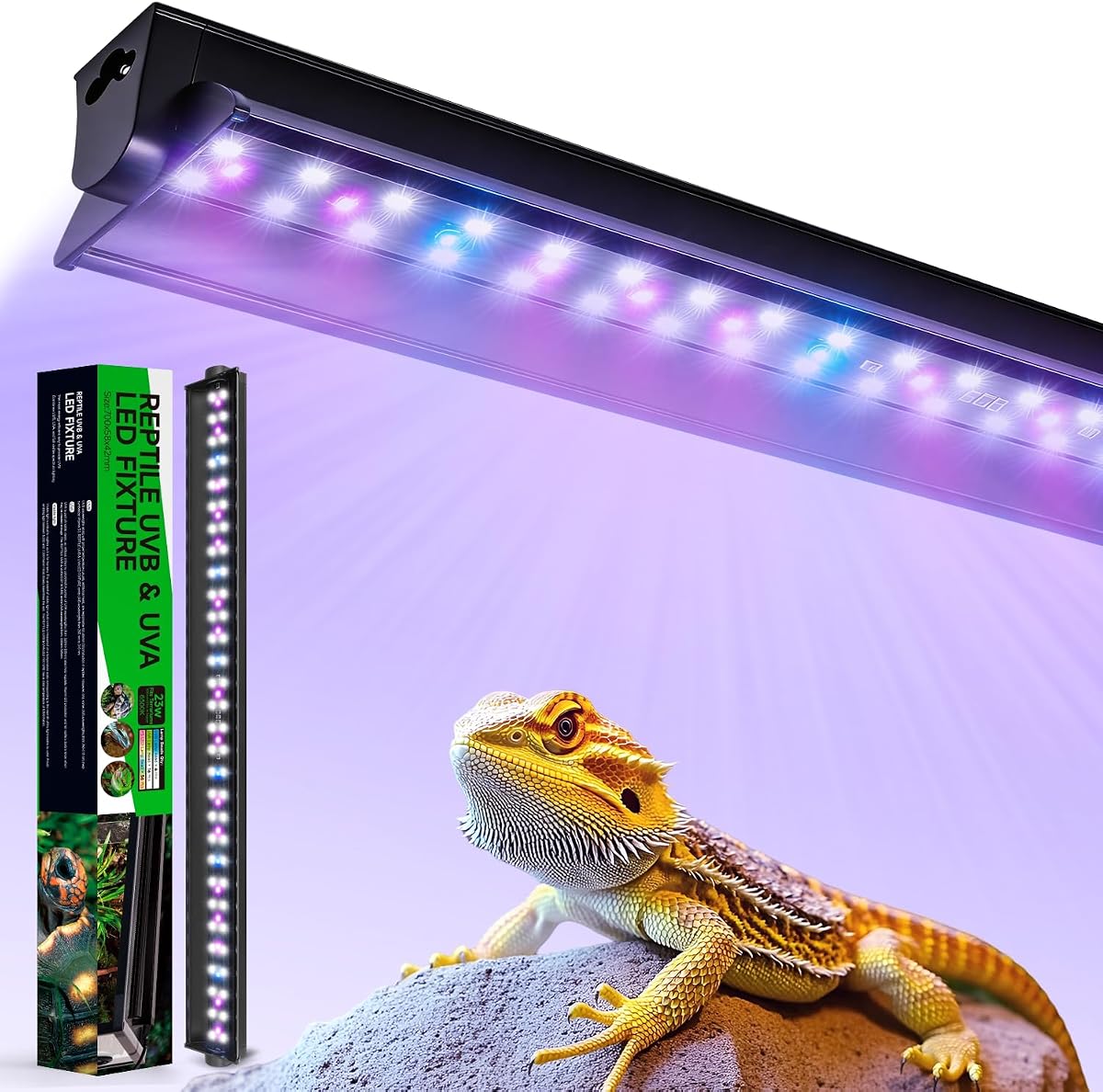
23W UVB Light for Reptiles
4.9Editor score
Over 10,000-hour lifespan
Steady LED UVB output
Low-heat T5 fixture design
LED UVB reptile lighting helps create a balanced captive environment while reducing the power draw associated with many traditional fluorescent bulbs. A useful fixture must do more than look bright: it should provide useful ultraviolet output, support a consistent day-night rhythm, mount securely, and suit the dimensions and behavior of your enclosure.
The products in this guide were compared using the supplied specifications, including power, lamp length, spectral features, lighting modes, dimming, timers, installation methods, stated UVB duration, and compatibility information. The list covers options for tropical and desert reptiles, from compact 8-inch fixtures to longer 16-inch, 18-inch, and 27.5-inch units.
Each review explains the product's strongest benefits, practical limitations, and likely enclosure fit. Ratings and product details reflect the supplied listing information, while current availability and prices can change. UVB cards are not accurate scientific measuring tools, so professional UV meters remain the better option for precise setup and monitoring.
4.9Editor score

4.6Editor score

4.4Editor score
As an Amazon Associate we earn from qualifying purchases.
The comparison highlights the differences in fixture size, wattage, controls, installation, and stated UVB performance, helping readers match each light to an enclosure and species rather than choosing on appearance alone.


The REPTITRIP 16-Inch LED UVB Reptile Light combines UVA, UVB, and visible illumination in a fixture designed for bearded dragons, turtles, and snakes. Its 4.6 rating reflects a generally well-received balance of adaptable lighting modes, automatic scheduling, and flexible installation. The four UVI-oriented presets and separate manual control stand out among similarly sized options.
We may earn a commission when you buy through this link, at no additional cost to you.
The fixture provides M1, M2, M3, and M4 modes intended to correspond with different environmental needs and Ferguson zones. That makes it more structured than a simple on-and-off lamp, especially for keepers who want to select a starting profile for a species or enclosure. A preset day-night cycle, manual intensity adjustment, and an update allowing the night-light brightness to reach zero add useful control over the daily routine.
Installation flexibility is another strength. The light may sit on mesh, hang inside the enclosure with the included brackets, or be suspended from a wooden board. Its aluminum alloy body is designed for efficient heat dissipation and a service life stated at more than 7,000 hours. The main trade-off is its 16-inch footprint, which may be excessive for a small terrarium, and the light should not be mistaken for a heat source.
This is a strong all-around choice for a medium or large enclosure where the keeper values presets and scheduling rather than only manual intensity control. It is especially relevant for bearded dragon habitats and mixed reptile setups that need a structured day-night cycle. Pair it with an appropriate heating device, position it at the recommended distance, and confirm UVB levels with professional equipment when precise dosing matters.
The four preset modes offer a convenient starting point for different reptile requirements, while manual mode gives owners more control over intensity. Rather than treating a single output level as suitable for every animal, the controller lets the keeper begin with a defined profile and then adjust as the enclosure and animal change.
Mesh-top, inside-hanging, and board-mounted options reduce installation constraints. This matters because mounting height affects both usable UVB exposure and the spread of visible light across the basking area.
We may earn a commission when you buy through this link, at no additional cost to you.
The 23W UVB Light for Reptiles is a long T5-style LED fixture with a listed 4.9 rating, the highest among the ten products. Its most significant advantages are the claimed output of more than 10,000 hours and a design intended to maintain steadier UVB than conventional fluorescent bulbs. The 27.5-inch format makes it most appropriate for larger habitats.
We may earn a commission when you buy through this link, at no additional cost to you.
The balanced spectrum is described as mimicking natural sunlight and supporting vitamin D3 synthesis, calcium metabolism, healthy growth, and normal behaviors. Because the fixture operates at a much lower temperature than standard bulbs, it can also be placed more safely in a terrarium without adding substantial heat. Solid-state construction is said to resist vibration and shock, while mercury-free construction distinguishes it from many older fluorescent systems.
The important limitation is its size. A 27.5-inch lamp may be too long for compact gecko, frog, or juvenile enclosures, and the supplied description does not highlight a dimmer, timer, or multiple preset programs. Those omissions make it less attractive when fine scheduling control is the priority. Owners should also treat the listed lifespan as a product specification rather than a guarantee of unchanged output under every environment.
Buy this fixture when the enclosure is large enough to benefit from broad coverage and long-term LED efficiency matter more than elaborate controls. It is a compelling premium option for desert or tropical setups requiring a full-length lighting bar. Correct placement, an independent heat source where needed, and periodic UVB measurement remain necessary for a responsible setup.
The 27.5-inch length can distribute light more evenly across a broad reptile habitat than a compact bar. Enclosure width and the location of the basking zone should guide placement, since more output does not automatically mean a more suitable exposure level.
Running cooler than conventional bulbs gives keepers more flexibility when selecting mounting height. UVB still needs a suitable distance from the animal, so the reduced heat should be treated as a placement benefit rather than permission to ignore exposure requirements.
We may earn a commission when you buy through this link, at no additional cost to you.
The Hygger Zoo 6W UVB Light is one of the most configurable fixtures in the guide. It combines UVB, UVA, and FR LEDs, supports independent brightness adjustment for each channel, and provides sunrise and sunset ramp periods. No rating was supplied for this listing, so its value is best evaluated through its documented feature set rather than a numerical customer score.
We may earn a commission when you buy through this link, at no additional cost to you.
Four illumination modes cover different habitat needs: UVB 2.0 for animals requiring less sunlight, Tropical UVB 5.0, Desert UVB 10.0, and UVB 12.0 for tortoises, bearded dragons, green iguanas, leopard geckos, and chameleons. A 2-, 8-, or 12-hour ramp-up and ramp-down schedule can make the daily transition more gradual, while separate UVB, UVA, and FR controls offer fine-tuning.
Installation can be handled by placing the unit on mesh with a non-slip mat, mounting beneath the mesh with a magnet, or securing the magnet to a wooden tank with screws. That flexibility is useful for different enclosure materials. The drawback is that the number of settings may be more involved than a new keeper wants, and selecting a mode should never replace species-specific husbandry research or measured UVB verification.
This fixture is well suited to keepers who want detailed spectrum control without moving to a large, premium bar. It works especially well for a terrarium that needs tropical, desert, or graduated lighting adjustments and where gradual dawn and dusk transitions are priorities. It is not a heating lamp, so plan the thermal environment separately.
Adjusting UVB, UVA, and FR separately lets the keeper shape both ultraviolet exposure and the visible environment. This is more granular than basic dimming and can help match a light to a specific enclosure while still preserving a natural-looking day cycle.
The two-, eight-, or twelve-hour ramp options create a less abrupt change between darkness and full daylight. A gradual transition may make the lighting schedule feel more natural and gives the keeper a structured way to build a consistent routine.
We may earn a commission when you buy through this link, at no additional cost to you.
The 16-Inch UVB Reptile Fixture offers one of the broadest control packages in the comparison. It combines UVB, UVA, and FR LEDs with an LCD remote, an in-line controller, a 24/7 timer, and five one-touch presets. Its 4.2 rating indicates a generally favorable reception, though the abundant options require some setup.
We may earn a commission when you buy through this link, at no additional cost to you.
A ten-minute ramp-up and ramp-down cycle helps create sunrise and sunset effects while the timer supports a consistent daily routine. Users can select a preset for common reptiles such as bearded dragons and leopard geckos, or independently adjust the W, UVA, UVB, and FR channels to support Ferguson Zones F1 through F4. The LCD also makes current settings easier to read than a minimal button panel.
The fixture is described as having a fully potted internal structure, a high-transmittance quartz glass lens, and a rated use life of up to 12,000 hours. Four installation methods accommodate mesh-top, mounted-above, directly-on-mesh, and wooden-enclosure setups. The trade-off is complexity: the remote, local controller, presets, and independent channels can feel excessive for a first simple habitat.
This model is best for owners who want remote control and broad customization within a medium-sized enclosure. It is a good match for keepers balancing species profiles, basking zones, and a stable photoperiod. Select a suitable preset as the starting point, avoid unnecessary adjustments, and use a UV meter to confirm that the final setup delivers an appropriate exposure.
An LCD remote makes checking and changing the timer, channels, and preset easy without reaching over the enclosure. That convenience is useful for tall setups or for keepers who want to make small refinements without disturbing the habitat.
The stated high-transmittance quartz glass lens and fully potted internal structure are intended to preserve output and resist moisture. These attributes are particularly relevant in humid habitats, although routine inspection remains important.
We may earn a commission when you buy through this link, at no additional cost to you.
The 4W Dimmable LED Reptile UVB Lamp provides a compact and economical option for tortoises, geckos, and other reptiles kept in smaller habitats. Its 4.4 rating suggests a solid reception, and the useful combination of four modes, three lighting periods, and four intensity levels gives it more capability than a basic bulb.
We may earn a commission when you buy through this link, at no additional cost to you.
The fixture is described as producing approximately 300 nm UVB to support vitamin D3 synthesis and calcium absorption. Its non-integrated UVB module operates separately from the UVA LEDs, which the manufacturer credits with extending UVB duration to as much as 8,000 hours. M1 through M4 automated modes support different intensity patterns, while 4-, 8-, and 12-hour cycles offer practical scheduling choices.
The S-size format and 4W power draw make this model attractive for a small terrarium or a supplemental setup where broad coverage is unnecessary. However, size and wattage are not substitutes for output measurements. A compact light may perform well in a modest enclosure yet be inadequate for a tall, wide habitat, and the product description does not detail the included mounting hardware.
Choose this lamp when enclosure size, power efficiency, and programmable output matter more than advanced remote control. It is a sensible budget pick for geckos, smaller tortoises, and suitably sized habitats. Begin with a conservative program, increase or decrease only while observing the animal and checking UVB levels with professional equipment.
The UVB module is said to run independently of the UVA LEDs, allowing the UV portion to remain useful longer. A stated eight-thousand-hour UVB duration is attractive for owners who prefer infrequent replacement over disposable bulbs.
The four-watt rating and small format are well suited to a compact enclosure. The light remains capable of supporting a structured cycle with four modes and three photoperiod options without the footprint of a full-length fixture.
We may earn a commission when you buy through this link, at no additional cost to you.
The 8-Inch Dimmable UVB Reptile Light is a compact automatic option for tropical or desert reptiles. Its 4.6 rating matches the REPTITRIP fixture's score, while the eight-inch size makes it especially useful for smaller or medium enclosures. It combines 4800K visible light with UVA and UVB and offers three operating modes.
We may earn a commission when you buy through this link, at no additional cost to you.
L1 combines UVA, UVB, and LED for full-spectrum daytime lighting, L2 uses UVA and UVB without the white LED, and L3 provides visible light without ultraviolet radiation. A 24-hour looping timer includes four-, eight-, and twelve-hour auto-off periods. Five brightness levels, adjustable in 20% increments, and separate UVB, UVA, and LED controls give the keeper a useful degree of control over exposure.
The dedicated UVB module is stated to maintain output for up to 10,000 hours, and the housing uses V0-grade flame-retardant material. As with most LED UVB fixtures, it does not generate heat and must be combined with a heating lamp. Its compact length may also limit the light's reach in a broad enclosure, and no remote is described despite the otherwise detailed controls.
This is a compelling pick for a compact terrarium where automatic scheduling matters and a full-length bar would be awkward. It works well for keepers who want several UVI modes and precise dimming without handling a remote. Choose it when the enclosure dimensions allow the eight-inch bar to cover the intended basking and activity areas.
The looping 24-hour timer can run four-, eight-, or twelve-hour schedules without daily manual switching. That automation helps maintain a stable rhythm and is convenient for keepers with busy routines.
Five levels in 20% increments allow visible and ultraviolet output to be adjusted separately. This offers a useful starting point for hatchlings, juveniles, adults, and reptiles with different tolerances for light intensity.
We may earn a commission when you buy through this link, at no additional cost to you.
The 18-Inch UVA UVB Light for Reptiles with Controller is a medium-to-large fixture that balances automatic modes with manual control. It has a 4.2 rating and provides rainforest, desert, and reproduction presets, allowing keepers to begin with a general habitat profile and then customize the output.
We may earn a commission when you buy through this link, at no additional cost to you.
UVA and UVB are paired with white and blue visible LEDs, all intended to resemble natural daylight without harmful UVC. The aluminum alloy housing promotes heat dissipation and supports a stated lifespan of more than 8,000 hours. A telescoping bracket supports different mounting methods, which can be useful when the basking zone needs to be positioned precisely.
The strongest compromise here is between guided operation and detailed customization. Three automatic modes are easier to understand than a large bank of presets, but the product data does not list a specific timer, ramp duration, or independent dimming range. It is also a non-heating fixture, and the manufacturer recommends professional equipment for accurate output checks because UVB cards are not reliable.
This light is a good fit for a medium or large enclosure that needs a straightforward controller and UVA/UVB illumination. It suits tropical and desert reptiles as well as keepers who want a reproduction-oriented preset, subject to the animal's husbandry requirements. It is best for someone who values simple mode selection and adjustable mounting more than remote operation or a 24/7 schedule.
Rainforest, desert, and reproduction modes give a keeper a clear starting point without requiring constant adjustment. The manual mode is useful when the enclosure, mounting height, or animal's needs differ from the preset assumptions.
An adjustable bracket can help align the light with the enclosure's usable zone. Since UVB exposure changes with distance and angle, the ability to refine mounting position is an important functional feature rather than just a convenience.
We may earn a commission when you buy through this link, at no additional cost to you.
The 10W HO LED UVB Fixture combines a 12-inch format, automatic timer, and five adjustable brightness levels in a compact unit. Its 4.2 rating provides a positive customer signal, and the listed compatibility includes bearded dragons, turtles, snakes, crested geckos, and chameleons. The 10W power draw sits between the smallest and highest-output fixtures in the guide.
We may earn a commission when you buy through this link, at no additional cost to you.
A 12-inch bar may be easier to accommodate than a 16-, 18-, or 27.5-inch model, particularly in a compact or irregular enclosure. The automatic timer simplifies the daily schedule, while five brightness levels allow the keeper to adapt the visible illumination to different times of day or husbandry conditions. Its size makes it a potential middle ground for a medium terrarium.
The main limitation is the limited factual detail supplied for this listing. It does not state a UVB duration, number of illumination presets, ramp behavior, mounting method, or detailed spectrum control. Without those specifications, it is difficult to compare the fixture's UV performance precisely with more fully documented models. It also should not be assumed to supply heat.
Choose this fixture when a compact scheduled light with several brightness levels is the priority and the enclosure dimensions align with a 12-inch bar. Confirm the full product details and placement guidance before purchase, especially if the animal depends heavily on UVB. It may be a convenient middle option, but owners should not rely on the listing's broad species list as a substitute for habitat-specific research.
An integrated timer reduces the need to switch the lamp manually every day. A repeatable schedule can support a clearer day-night rhythm and make the enclosure easier to maintain consistently.
The 12-inch format and five brightness settings can suit medium habitats where a very small bulb feels insufficient and a long bar is impractical. The best results still depend on correct distance and the species' actual UVB requirement.
We may earn a commission when you buy through this link, at no additional cost to you.
The REPTI ZOO UVB Light is a six-watt fixture with a simple two-mode design: Tropical UVB 5.0 and Desert UVB 10.0. Its 4.3 rating reflects a generally positive reception, and the listing provides a specific UVB output of up to 303 microwatts per square centimeter at four inches. That measurable detail helps buyers compare it more meaningfully than listings that only use broad sunlight claims.
We may earn a commission when you buy through this link, at no additional cost to you.
The fixture is designed to simulate natural sunlight and support vitamin D3 synthesis, calcium absorption, bone development, and general health. Adjustable brightness allows the visible output to be reduced during nighttime or sunset periods, while the habitat modes offer a basic choice between tropical and desert requirements. Its six-watt power draw is described as comparable in brightness to a 90-watt incandescent lamp.
Simplicity is the main appeal and the main limitation. Two modes are easier to manage than complex preset banks, but there is no explicit timer, remote, or ramp function in the supplied information. The stated output also depends on a four-inch distance, so mounting height must be controlled. The two included hanging options allow placement above or below mesh.
This is an appealing choice for beginners who want two recognizable habitat modes and a documented output figure without navigating many controls. It is suitable for chameleons, bearded dragons, turtles, lizards, geckos, snakes, and other amphibians when the selected mode matches the animal's needs. For users wanting a timer, the lack of a listed schedule should be checked before purchase.
A stated output of up to 303 microwatts per square centimeter at four inches provides a useful reference point. It should still be verified under actual enclosure conditions, since screen material, distance, angle, and lamp aging can alter the exposure received by the animal.
Tropical and desert selections reduce the risk of choosing among numerous overlapping controls. This straightforward approach is practical for a keeper who already understands the species' preferred UV level and wants uncomplicated brightness adjustment.
We may earn a commission when you buy through this link, at no additional cost to you.
The Hygger Zoo Two-Pack UVB Light is distinctive because it includes two complete fixtures rather than a single unit. With a 4.4 rating, adjustable brightness, UVA and UVB output, and a curved reflector, it may be especially useful for keepers maintaining multiple habitats or a divided enclosure.
We may earn a commission when you buy through this link, at no additional cost to you.
Each light uses an aluminum housing intended to dissipate heat and extend the service life of the light board. The curved reflector is designed to concentrate UVB rays and provide bright illumination, while the stated UVA-to-UVB balance is intended to resemble natural sunlight. Listed applications include bearded dragons, chameleons, turtles, lizards, snakes, ball pythons, leopard geckos, tortoises, hermit crabs, crested geckos, and frogs.
The two-pack format can be excessive for a single small terrarium, and the supplied details do not clearly explain timer functions, individual mounting hardware, dimming steps, or UVB duration. Concentrated light can also make careful distance control especially important. A reflector that increases useful output is beneficial only when the animal can retreat from the exposure area and the lamp is positioned at an appropriate distance.
This package is best for a keeper with two compatible enclosures, a segmented setup needing separate zones, or a preference for having a spare fixture available. It is less compelling for one small habitat, where a single compact bar may be easier to position. Confirm the contents, timer operation, and mounting requirements before purchase, and use a UV meter to establish a safe distance.
A pair can provide dedicated lighting for two habitats or distinct sections of a larger enclosure. This is useful when each area needs different height, intensity, or a different photoperiod.
The curved reflector is intended to direct more UVB and visible light toward the target area. That focus can improve efficiency, but it also makes measured placement and an unobstructed basking zone more important.
We may earn a commission when you buy through this link, at no additional cost to you.
Choosing an LED UVB light requires balancing animal requirements, enclosure dimensions, ultraviolet output, heat management, controls, and mounting method. The most useful fixture is not necessarily the brightest or most advanced; it is the one that delivers an appropriate exposure at a safe distance and fits the keeper's routine.
Fixture length should correspond to the width of the usable habitat rather than simply to the animal's adult size. The guide includes an 8-inch light for compact setups, 10- and 12-inch options for small or medium enclosures, 16- and 18-inch bars for broader habitats, and a 27.5-inch fixture for larger installations. A compact fixture may leave edges poorly illuminated in a wide tank, while an oversized bar can create intense hotspots, restrict basking space, and be difficult to position.
Reptiles differ greatly in the amount of ultraviolet exposure they need. Tropical species may require less intense UVB than many desert-dwelling animals, and some nocturnal or shelter-oriented keepers choose UVB levels according to the animal's documented husbandry rather than forcing basking behavior. Look for a fixture with adjustable output and recognizable habitat modes, but also consult reliable species-specific care guidance.
Dimmable LEDs allow the keeper to soften visible light, create evening transitions, and avoid a harsh all-or-nothing cycle. Automatic timers make daily operation more consistent, while sunrise and sunset ramps offer a more gradual transition. The strongest systems let UVB, UVA, and visible channels be adjusted independently, although simpler controls may be sufficient for a straightforward habitat.
UVB output is meaningful only when the animal can reach the light at the intended distance. Listings may quote output at four inches, describe a Ferguson Zone, or provide a UVI-oriented preset, but the value changes with mounting height, screen material, angle, fixture condition, and enclosure geometry. UVB cards are not accurate instruments, so professional UV meters offer a much more reliable basis for setup and periodic checking.
The LED UVB fixtures in this guide are lighting products, not complete heating systems. Several explicitly state that they do not generate significant heat, and the REPTITRIP model should be combined with a heating pad or heating lamp when warmth is required. Keep the UVB source and heat source positioned to create a usable gradient, and ensure that neither creates a burn risk or prevents the reptile from reaching a comfortable temperature.
The most capable light is not useful if it cannot be secured safely. Mesh-top, under-mesh, above-enclosure, magnetic, and wooden-tank installations are represented in the guide. Check the enclosure material, available clearance, bracket range, and whether a cord can be routed without creating a moisture or chew hazard. The mounting height must still allow proper UVB exposure and safe basking-area temperatures.
LED fixtures are marketed with long operating lives ranging from about 8,000 to more than 10,000 hours, but a rated lifespan is not the same as guaranteed output. UV modules can decline even while the visible LEDs continue to work. Choose a fixture with replaceable or independently operating components when available, clean the lens according to the manufacturer's instructions, and periodically recheck UVB output rather than waiting for a visible failure.
Presets, remotes, timers, and independent spectrum channels can make a lighting system more flexible, but they can also make it harder to maintain consistently. Beginners may benefit from two clear habitat modes, while advanced keepers may prefer separate UV controls and a remote. Choose the interface you will actually understand and use, and avoid adding complexity when a simpler schedule will meet the animal's documented requirements.
Before installation, read the product instructions and identify the fixture's specified mounting options, input requirements, and recommended distance. Clean the enclosure and choose a location that supports the reptile's basking behavior without creating a temperature or electrical hazard. A metal or wooden support may be more suitable for a heavier fixture, while a mesh fixture may require the supplied brackets or anti-slip accessories.
Program the photoperiod using the species' documented requirements and the manufacturer's guidance. Use automatic modes and dimming to create a gradual transition where possible, then check the setup at several points during the day. Do not infer the correct UVB level from brightness alone; measure UV output at the animal's typical basking location with professional equipment and adjust the height or settings as needed.
Keep the lens clean and dust-free, inspect wiring and mounting hardware, and verify the timer after any interruption. Monitor the animal for normal basking, movement, feeding, and posture, and make husbandry adjustments based on the species' behavior rather than a fixed universal schedule. If a separate heat source is used, confirm that the two lamps do not create unsafe heat accumulation or make the animal unable to retreat.
There is no single correct distance for every fixture, species, or enclosure. Begin with the manufacturer's guidance, then use a professional UV meter to measure the output where the reptile actually basks. A lamp that looks bright can still provide too much or too little UVB. Recheck after changing the mounting height, screen material, room conditions, or enclosure layout.
The LED UVB lights in this guide are primarily lighting products, and several explicitly state that they do not produce significant heat. They should generally be paired with an appropriate heat source when the species needs environmental warmth. Position both sources carefully so the basking area is safe and the animal can move to cooler areas.
A UVB card is useful for confirming that a lamp emits ultraviolet light, but its color and reading are not a reliable measurement of intensity. The product information for several lights specifically warns that card results are not accurate. Use professional UV equipment to establish the initial dose and to monitor meaningful changes over time.
UVB supports vitamin D3 synthesis and calcium metabolism, while UVA can encourage natural behaviors and contributes to the overall daylight spectrum. Many quality fixtures provide both, often with independent controls. A visible white lamp is not automatically a full-spectrum UVB source, so keepers should verify the product's stated output and measure it in the enclosure.
The appropriate photoperiod depends on the species, its natural activity pattern, enclosure setup, and the UVB level available. Many fixtures offer four-, eight-, or twelve-hour options, and the product descriptions identify these as common choices. Start from reliable species-specific husbandry guidance and adjust the schedule while monitoring the animal's behavior and measured exposure.
The listed products have stated service lives of approximately 8,000 to more than 10,000 hours, which may translate to several years depending on daily use. UVB output can decline before the visible light fails, so visual brightness is not a dependable warning. Periodically measure the UV level and follow the manufacturer or seller's replacement guidance.
The correct placement depends on the fixture design, screen material, enclosure height, and the location of the basking zone. Some products support above-enclosure, on-mesh, and under-mesh mounting, while others use hooks, magnets, or telescoping brackets. Use the recommended method, secure the fixture firmly, and verify UVB exposure after installation.
A single fixture usually cannot provide appropriate exposure across multiple separate enclosures because distance, screen material, and enclosure height differ. Lighting one enclosure with a bar intended for another can produce uneven or unsafe exposure. The two-pack option in this guide is more appropriate for two compatible setups, each with its own measured placement and schedule.
The REPTITRIP 16-Inch LED UVB Light is the strongest overall option for keepers who value four UVI-oriented presets, automatic cycling, manual dimming, and flexible mounting. The 23W T5-style fixture stands out for large enclosures, steady LED output, and a stated lifespan above 10,000 hours, while the compact 4W dimmable lamp offers an efficient starting point for smaller habitats.
Before buying, prioritize the reptile's documented UVB requirement, the enclosure's dimensions, and the distance at which usable UV can be delivered. A timer, gradual ramp, and independent dimming can make routine care easier, but none of them compensates for an inappropriate output or poor mounting position. Separate heat management and a professional meter remain essential parts of a reliable setup.
Product availability, listings, and prices can change, so check the current details and accessory information before ordering. Compare the fixture with the full enclosure rather than judging it from wattage alone, and confirm that the included hardware supports your tank design. A carefully chosen light, correctly positioned and regularly monitored, offers the best foundation for a consistent reptile lighting routine.