
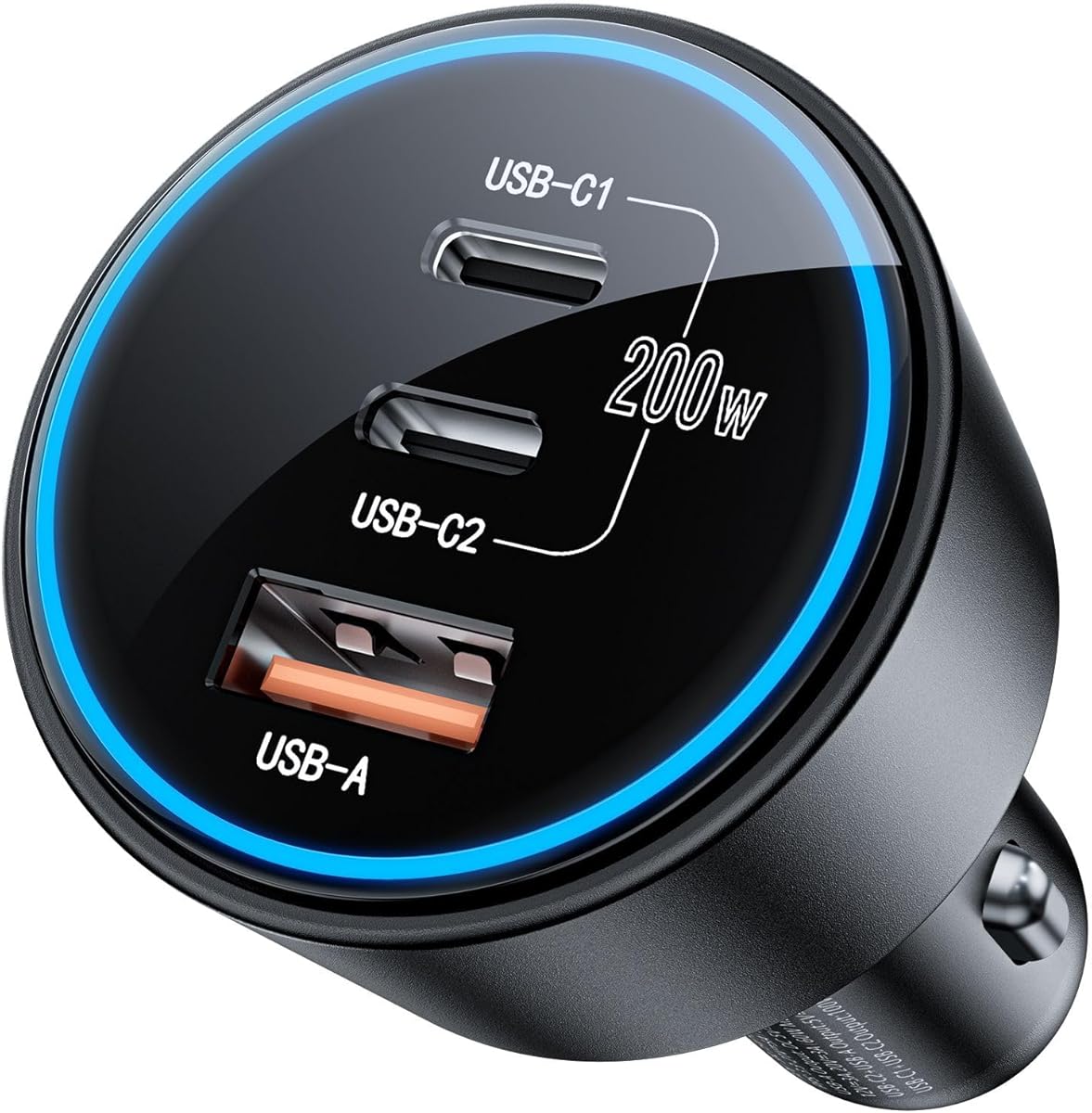
LISEN 200W GaN Car Charger
4.6Editor score
140W primary USB-C port
GaN full-metal construction
240W cable included
Discover the best 200W USB car charger options, comparing power, ports, protocols, safety, cables, compatibility, and design for every road trip.
A 200W USB car charger can power phones, tablets, laptops, and accessories quickly, but headline wattage alone does not reveal real-world performance. The best models combine sensible port allocation, broad fast-charging support, effective heat management, secure vehicle contact, and enough physical flexibility for different seating positions.
We compared all ten chargers by examining their stated maximum output, individual port capabilities, supported charging protocols, built-in cables, safety features, device compatibility, and practical design details. The list includes compact three-port adapters, multi-device power stations, and models with integrated coiled cables for easier reach.
Each review identifies the circumstances where that charger makes the most sense, from laptop charging during a commute to powering several phones on a family trip. Ratings and specifications can change over time, and current availability, vehicle fit, cable requirements, and pricing should be checked before purchasing.
4.6Editor score
4.6Editor score

4.2Editor score
The comparison below shows how the ten chargers differ in port count, maximum output, cable convenience, and practical strengths, helping you identify the model best aligned with your devices and trips.



The ROADRESS 200W USB C Car Charger earns the Editor's Choice position because it offers one of the most balanced specifications in the group. Its 4.6 rating reflects strong customer satisfaction, while two 100W USB-C ports, a 60W USB-A connection, and a stated 200W total ceiling give it genuine flexibility for phones, tablets, and USB-C laptops.
We may earn a commission when you buy through this link, at no additional cost to you.
The strongest feature is its port layout. Both USB-C connections can handle high-output device classes, while the USB-A port remains useful for older accessories, cables, and power banks. Fast-charging support includes PD 3.0, PPS, QC 4.0, QC 3.0, SCP, FCP, and AFC, reducing the likelihood that a compatible phone will be limited to a slower protocol.
Thermal management and protection are also prominent. The product description cites a revised heat-dissipation process, over-current protection, over-voltage protection, over-temperature protection, and an intelligent trickle mode. Its ice-blue ambient ring improves port visibility at night, while 12-to-24-volt compatibility broadens its use across common passenger vehicles.
This is a strong choice for a driver or passenger who regularly combines one laptop with one or two smaller devices. It is less convenient than a charger with a permanently attached cable, and its 200W figure is a maximum rather than a guarantee for every combination. Even so, the combination of dual high-power USB-C ports, broad protocol support, and practical nighttime visibility makes it an especially well-rounded recommendation.
The charger is best appreciated by travelers who do not need every port to behave like a dedicated 100W laptop charger. Its stated outputs cover a wide range of phones, tablets, laptops, handhelds, and smaller accessories, with power allocation determined by what is connected.
The ice-blue ring does more than add visual character. It makes the connection points easier to locate when entering a vehicle at night, which is particularly helpful for drivers who need to attach a cable without fumbling in a dark cabin.
We may earn a commission when you buy through this link, at no additional cost to you.
The LISEN 200W GaN Car Charger is the premium-oriented member of this group, combining a 4.6 rating with a 140W primary USB-C connection. That makes it particularly interesting for USB-C MacBook users and other high-power devices that benefit from the newest PD 3.1 output level.
We may earn a commission when you buy through this link, at no additional cost to you.
The main port is intended for laptops, while the second USB-C port supplies up to 30W and the USB-A port adds up to 30W. A 240W USB-C cable is included, eliminating the need to source a separate cable for high-power charging. The product description also highlights 60W Samsung Super Fast Charging support, PPS, QC 4.0+, and Apple Fast Charge compatibility.
Its GaN construction and full-metal body form the key premium feature. The manufacturer states that GaN improves efficiency and reduces heat by as much as 30% compared with standard chargers, while the metal housing helps dissipate heat during long journeys. Over-voltage, over-current, and short-circuit protection add another layer of reassurance, and the listed 24-month replacement warranty is more substantial than many competing warranties.
The LISEN model is most appropriate for someone who needs a genuinely high-output laptop port, values an included cable, and wants a metal-bodied design built around sustained use. It is not necessary for ordinary phone charging, and the 140W maximum belongs to the designated primary port rather than every USB-C connection. For high-end mobile workflows, however, it offers the most specialized performance in the list.
The 140W primary connection gives compatible laptops and demanding tablets more headroom than conventional phone chargers. The stated charging examples make the intended use clear, while the included 240W cable ensures the full capability is accessible immediately.
The full-metal housing and GaN technology are especially relevant during extended high-output use. Faster heat dissipation helps maintain stable performance and makes the charger a logical fit for commuters who regularly top up a laptop.
We may earn a commission when you buy through this link, at no additional cost to you.
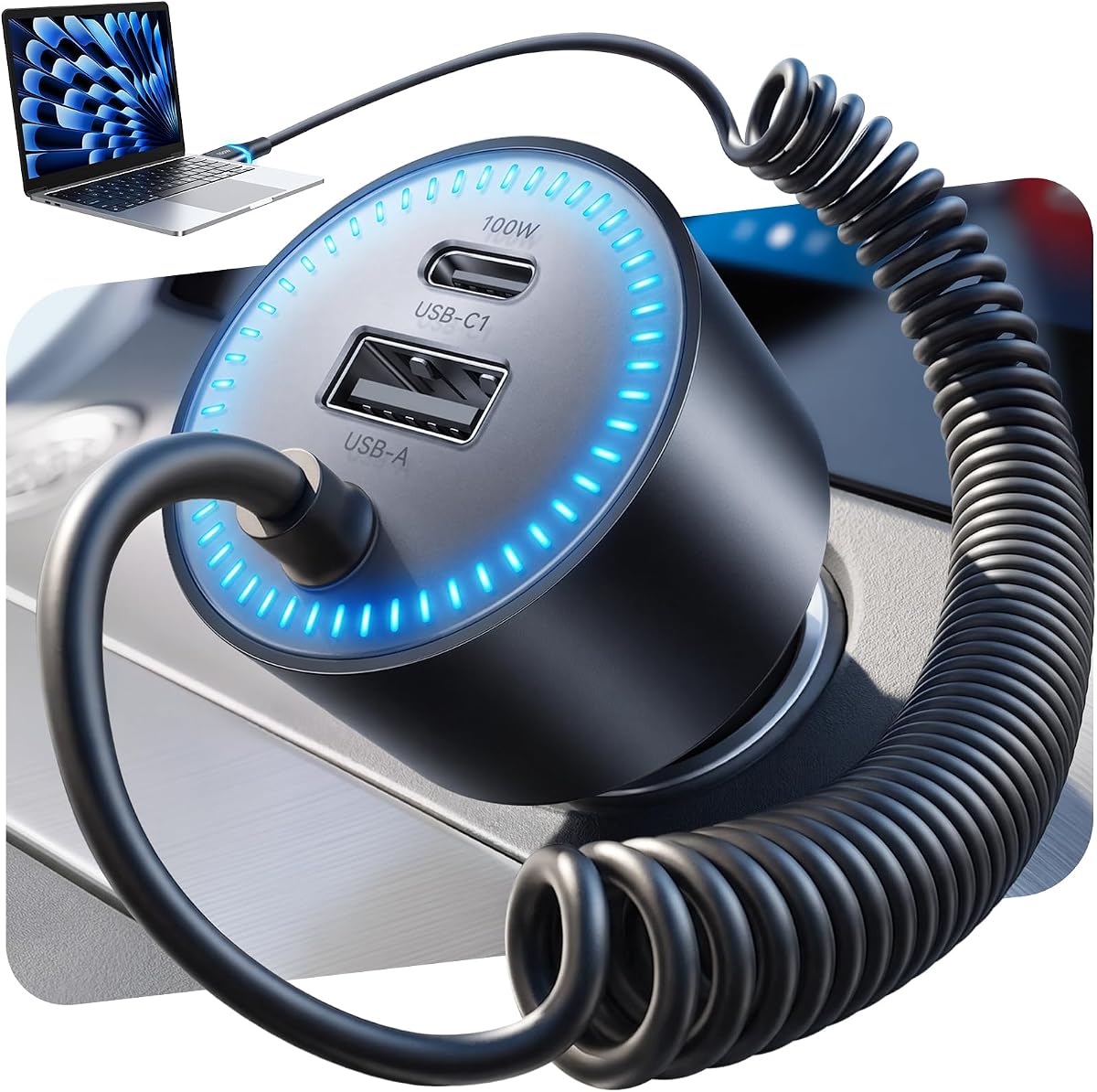
The FLYLEAD 200W GaN Car Charger stands out for pairing two 100W USB-C outputs with an integrated five-foot coiled cable. Its 4.6 rating indicates a favorable response, and the design directly addresses two common problems: carrying a separate cable and reaching a phone mounted near the windshield.
We may earn a commission when you buy through this link, at no additional cost to you.
The fixed cable and standalone USB-C port can each provide up to 100W, while the USB-A port is listed at up to 60W. Smart allocation supports combinations described as 100W plus 100W for two devices or 100W plus 24W across three. PD 3.0, QC 4.0, and PPS support cover modern phones, tablets, laptops, cameras, and other USB-powered accessories.
The coiled cable extends toward a dashboard-mounted phone and retracts when not needed, reducing loose cable clutter. Safety features include flame-retardant PC construction, temperature-control technology, ventilation, widened metal contacts, and protection against overcurrent, overvoltage, overload, overheating, and short circuits. Those reinforced contacts are a thoughtful addition for vehicles where road vibration can loosen accessories.
FLYLEAD is a compelling option for drivers who want fast laptop charging and phone reach without managing a separate cable. The cable's five-foot length may be more than necessary in compact cabins, and fixed-cable designs are less convenient if you need to move between several vehicles. For a dedicated daily driver with a windshield-mounted phone, though, the combination is highly practical.
The built-in coiled cable remains attached to the charger while extending only as far as needed. That makes it a good match for dashboard phone mounts, rear-seat passengers, and drivers who dislike loose cords around the center console.
Having both the integrated cable and the standalone USB-C connection capable of high output creates flexibility for a laptop and phone combination. The exact speed of each device still depends on its own charging requirements and the selected power allocation.
We may earn a commission when you buy through this link, at no additional cost to you.
The Rocoren 200W USB C Car Charger carries a 4.8 rating, the highest listed score in this roundup. Its defining feature is a built-in PD 100W coiled USB-C cable that extends to 5.2 feet, providing ample reach for a dashboard mount, rear seat, or center-console device placement.
We may earn a commission when you buy through this link, at no additional cost to you.
The charger has a second standalone USB-C port rated up to 100W and a USB-A port with a 30W peak. Its allocation table distinguishes two-device combinations from three-device use, where power is distributed as 100W plus 20W. This makes the product flexible for a laptop-plus-phone setup or a broader collection of smaller devices.
Safety receives detailed attention through FCC, CE, and RoHS certification, flame-retardant PC construction, and an intelligent integrated circuit that recognizes connected devices. Protection includes over-voltage, over-current, over-charging, overheating, and short-circuit safeguards. The product also lists broad compatibility with current phones, tablets, laptops, game consoles, cameras, dash cams, and other vehicle accessories.
Rocoren is an excellent selection for anyone who values reach and consistently high customer ratings. Buyers should understand that adding all three outputs changes the power distribution, and the built-in cable cannot be detached. Even with those caveats, the long cable, dual USB-C capability, documented protections, and flexible device support make this one of the most complete options here.
The 5.2-foot extension gives back-seat users and dashboard-mount owners more freedom than a short fixed lead. Retracting the cable after use also helps keep the center console tidy.
Published combinations clarify what to expect when multiple devices are connected. It is still wise to confirm your devices' protocol and cable requirements before relying on a particular output arrangement.
We may earn a commission when you buy through this link, at no additional cost to you.
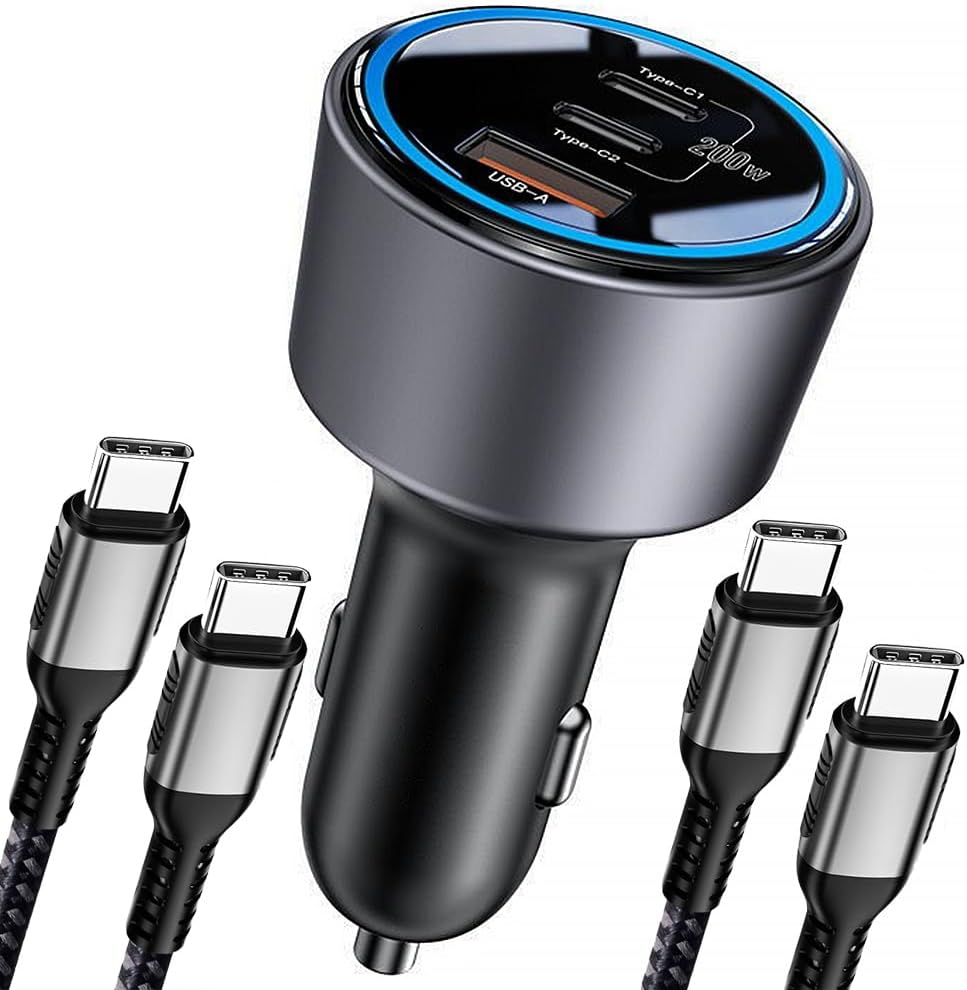
This 200W USB C Car Charger is one of two products in the roundup with a 4.8 rating, and it offers a generous accessory package. It includes two 100W USB-C-to-USB-C cables, each described as 3.3 feet long, so owners can charge multiple modern devices without buying separate leads.
We may earn a commission when you buy through this link, at no additional cost to you.
The charger has two USB-C ports and one USB-A port with a combined maximum of 200W. A USB-C port can deliver up to 100W, while the description also identifies SCP output up to 60W. It supports PD 3.0, PPS, QC 4.0, QC 3.0, SCP, and AFC, allowing compatible devices to negotiate suitable charging rates.
The included cables are a meaningful advantage because high-output laptop charging depends on cables capable of carrying the required power. Their E-marker chip supports PD fast charging and battery protection, while the stated TPE construction and bend-test figure suggest attention to daily wear. The charger's broad compatibility covers major phone families, tablets, and several popular USB-C laptop platforms.
This is a strong all-in-one choice for a family that wants two USB-C cables and a three-port charger in one package. The tradeoff is that the cables are detachable and can still become tangled, while connected devices share the available power. For users who value a complete, ready-to-use laptop charging kit rather than a permanently attached lead, the convenience is substantial.
Including two high-output cables removes a common source of frustration: discovering that a basic cable cannot support a demanding laptop. Their relatively compact length is also suited to shorter in-car cable runs.
Support for PD, PPS, QC, SCP, and AFC gives the charger a better chance of engaging fast charging across different phone ecosystems. Actual results still depend on the connected device and the protocol it exposes.
We may earn a commission when you buy through this link, at no additional cost to you.
The Dzytnsy 200W Car Fast Charging Station is the most connection-oriented product here, with three USB-C and three USB-A ports. Its 4.6 rating and six-port layout make it a natural fit for families, shared vehicles, and road trips where several people need to charge at once.
We may earn a commission when you buy through this link, at no additional cost to you.
The primary USB-C port can supply 100W, while the two other USB-C ports deliver 25W each. The three USB-A connections provide 18W, 15W, and 15W according to the product data. This distribution favors one demanding laptop or tablet alongside numerous phones and smaller accessories rather than giving every port laptop-level output.
The compatibility list spans current iPhone generations, Samsung Galaxy models, Google Pixel devices, AirPods, smartwatches, dashcams, navigation units, car vacuums, and power banks. A six-layer protection system addresses over-voltage, over-current, heat, short circuits, surges, and overload, while the PC body and scratch-resistant finish support long-term use.
Choose this model when port count is your priority. It is less appropriate for someone who wants two or three simultaneous high-output USB-C connections, and its six-port housing may need more dashboard space. For a family vehicle carrying several passengers, however, the ability to connect a laptop plus numerous phones in one place is unusually convenient.
Six ports reduce competition for the vehicle's available accessory outlets. This is particularly useful when children, passengers, cameras, navigation units, and two phones all need power during a longer journey.
A smart chip adjusts output automatically, and the six listed protection layers cover common electrical and thermal risks. The soft blue LED also makes the connection bank easier to find at night.
We may earn a commission when you buy through this link, at no additional cost to you.
The four-port 200W USB C Car Charger is the value-focused top pick because it combines four connections with two notable USB-C outputs. Its 4.2 rating is the lowest in the list, but it still offers a broad feature set for anyone who wants more ports without moving to a larger six-port station.
We may earn a commission when you buy through this link, at no additional cost to you.
The port lineup includes a 100W PD USB-C connection, a 65W PD USB-C connection, and a 35W QC USB-A output, with a fourth connection supporting additional USB-powered devices. PD 3.0, PPS, and QC protocols are supported, and the manufacturer states that four independent smart chips help maintain steady output when multiple ports are active.
GaN semiconductors and full-body heat dissipation are designed to control heat during sustained multi-device use. The safety list covers overcurrent, overvoltage, overload, overheating, and short circuits. Compatibility extends to recent phones, tablets, MacBook models, the Nintendo Switch, cameras, and many other portable devices.
This adapter is ideal for shared vehicles, family road trips, and mobile work situations where four simultaneous connections are more useful than two maximum-output laptop ports. Its main limitations are the lower customer rating and the fact that only one port reaches 100W. For users who prioritize flexible connection count and broad everyday compatibility, it remains a compelling option.
Four dedicated connections make it easier to keep several devices charging without repeatedly swapping cables. The individual smart chips are intended to preserve stable behavior when the charger is working across several device classes.
The 100W USB-C port handles demanding tasks, the 65W port can serve many tablets and phones, and the 35W USB-A connection covers conventional accessories. This hierarchy is more flexible than an all-low-output design.
We may earn a commission when you buy through this link, at no additional cost to you.
The UYUXIO 6-in-1 car charger is distinctive for combining six USB charging connections with a built-in voltage display. Its 4.1 rating trails most of the products reviewed, but the monitoring feature and broad phone-protocol support offer a different kind of utility.
We may earn a commission when you buy through this link, at no additional cost to you.
Maximum USB-C output is listed at 100W, while the product description references fast charging for Huawei, OPPO, OnePlus, Samsung, Vivo, Google, and current iPhone models. The six-port format can charge multiple phones at once and reduce the need for additional adapters within the vehicle.
The voltage display continuously monitors the vehicle's electrical system when the charger is plugged into the cigarette-lighter socket. That can provide an at-a-glance indication of battery condition and a warning if voltage drops, making the adapter more useful for long trips or older vehicles. A metal body is used to limit heat during extended charging.
This is the right choice for a vehicle that regularly carries many phones or for someone who values electrical-system monitoring. The weaker rating and less explicit port-by-port allocation require more attention before purchase, especially if you plan to run a high-power laptop alongside several phones. For broad phone charging and useful diagnostics, however, the feature set is distinctive.
The integrated meter provides information that ordinary chargers omit. It is useful for noticing electrical changes while traveling, though it should not replace a vehicle's own battery-monitoring system.
The product description calls out vendor-specific fast-charge modes alongside broad phone support. This makes it appealing to mixed-device households where one company may favor a different protocol than another.
We may earn a commission when you buy through this link, at no additional cost to you.
The 200W Triple-Port Car Charger combines a strong 4.7 rating with two 100W USB-C outputs, a 60W USB-A connection, and a 200W total maximum. This makes it a balanced option for a laptop, a phone, and an accessory sharing one adapter.
We may earn a commission when you buy through this link, at no additional cost to you.
Smart power allocation adjusts the output according to connected devices. The description highlights MacBook Pro charging and simultaneous phone power, while compatibility includes PD 3.0, QC 4.0, PPS, SCP, FCP, and AFC. An automatic trickle mode is said to reduce charging intensity after a phone reaches 90%, intended to support long-term battery health.
Safety and physical stability receive strong emphasis. A six-point protection system covers over-current, over-voltage, over-temperature, short circuits, surges, and overload, while an aluminum heat-dissipation design and air-cooled structure are claimed to run 35% cooler than standard chargers. Extended 12-millimeter contact pins and an anti-slip grip are intended to prevent disconnection over rough roads.
The product is well suited to daily commuters who need strong laptop output and stable physical installation. It lacks the built-in cable convenience offered by several competitors, and the claimed battery-life benefit depends on the phone, battery condition, and charging behavior. Even so, the output balance, protocol coverage, and road-focused design are compelling.
Longer contact pins and an anti-slip grip address a common complaint with compact cigarette-lighter chargers. Stable electrical contact is especially valuable when rough roads create continuous vibration.
Automatic power management makes the adapter easier to share among different device types. A demanding laptop can receive priority while phones and smaller accessories draw from the remaining allocation.
We may earn a commission when you buy through this link, at no additional cost to you.
The Qidoe 200W PD USB C Car Charger Adapter is a hybrid accessory splitter with a 4.4 rating. Unlike the laptop-focused models in the roundup, its most important feature is a pass-through cigarette-lighter socket capable of supporting other vehicle electronics while USB devices charge.
We may earn a commission when you buy through this link, at no additional cost to you.
Its charging side is more modest. The maximum USB-C output is 30W, and the two USB-A connections provide up to 18W each. That is enough for many phones, tablets, earbuds, GPS units, and similar devices, but it does not match the 100W laptop charging available from several other picks.
A digital voltmeter monitors the vehicle's electrical system and displays warnings when voltage drops below 12V. The socket's 90mm body is designed to reach deep receptacles, while a rubber ring helps maintain a firm connection on uneven roads. A blue LED improves visibility when plugging in a cable at night.
This adapter is most useful for older vehicles or anyone who needs the original accessory socket to remain available for a dash cam, vacuum, refrigerator, or other powered accessory. It is not the right choice for charging a modern USB-C laptop at full speed. Its appeal lies in combining a monitoring display, three USB connections, and a usable accessory outlet in one long plug.
The built-in powered socket allows another car accessory to operate while phones and smaller devices charge. That versatility makes this a useful alternative to a dedicated USB-only adapter.
The digital display gives users immediate feedback about the vehicle's electrical state. Its warning function is particularly relevant to long journeys, older vehicles, or drives that leave the engine off for extended periods.
We may earn a commission when you buy through this link, at no additional cost to you.
The right 200W car charger depends on the devices you use, how many must charge at once, and how your vehicle's sockets and cables are arranged. Output ratings, protocol support, thermal design, and physical construction are more meaningful than the headline wattage alone.
A 200W maximum describes the total output available under the right conditions, not the amount every port can deliver simultaneously. Some models can place nearly the entire allowance on one USB-C connection, while others divide output among several ports. A laptop-focused charger should offer a dedicated high-wattage USB-C port, whereas a family charger may benefit from a larger number of moderate outputs.
Compare both total and individual ratings. Check whether a USB-C port can reach 100W or 140W, what the USB-A port supports, and how the listed allocation changes when all connections are occupied.
PD, PPS, QC, SCP, FCP, AFC, and vendor-specific fast-charge modes can determine how quickly a compatible phone or tablet accepts power. A charger with broad support is more adaptable to a mixed household, but the connected device must also support a matching protocol. USB-A connections may remain useful for older accessories even when every new device uses USB-C.
Prioritize PD for USB-C devices, PPS for compatible Android phones, and the appropriate proprietary standard for your chosen ecosystem. A universal label is helpful, but protocol coverage is the more precise comparison point.
Three ports suit most driver-and-passenger combinations, four ports are useful for shared vehicles, and six ports can consolidate a phone-heavy family setup. More ports are not automatically better because a crowded adapter can be difficult to position and individual outputs may be modest. A charger with fewer but stronger ports may serve a laptop user better.
Count the devices that regularly travel with you, then add one connection for occasional passengers. Also consider whether a built-in cable or separate leads are more convenient for your mounting and storage habits.
Built-in coiled cables reduce the chance of leaving a charging lead in the house and can reach a dashboard-mounted phone without excessive slack. Long extensions are helpful for rear seats but may crowd a compact cabin. Cable-free models are more flexible across vehicles, provided you carry suitable USB-C or USB-A cables with the required capacity.
Choose an attached cable for a dedicated vehicle and a fixed reach suited to your phone mount. For multiple vehicles, detachable high-output cables may be more practical. Confirm that any included cable can support the charger and device you intend to use.
High-output charging generates heat, and a crowded center console can make that heat harder to dissipate. GaN components, full-metal housings, ventilation, and dedicated heat-dissipation structures are relevant because stable output depends on controlling temperature. Look for protection against over-current, over-voltage, overheating, overload, and short circuits as well as credible certification marks.
Favor chargers with multiple thermal-management features and documented electrical protections. A certification mark alone is not a performance guarantee, but it provides useful evidence that the product has been evaluated against recognized requirements.
Most listed chargers support 12-to-24-volt vehicle systems, but the physical shape of the accessory socket varies. A long plug body can reach recessed sockets, while a wider face may be difficult to install around a crowded console. Contact pins, rubber grips, and anti-slip bases help maintain a secure connection as the vehicle moves over uneven roads.
Check the socket type, available clearance, and whether another accessory needs the original outlet. If stability is a concern, prioritize a charger with extended contacts or a firm-fit rubber ring, especially for dash cams and continuous-navigation devices.
Charging a USB-C laptop requires more than a nominal USB-C connection. The charger must support a suitable power profile, and the cable must be capable of carrying the required current. Tablets may have lower requirements, but their manufacturers' protocol and cable specifications still matter. Product compatibility lists are helpful, though the safest approach is to verify the exact device model.
For a demanding notebook, prioritize a 100W or higher dedicated USB-C port and a high-rated cable. For occasional tablet use, a 30W to 65W connection may already be sufficient, especially when several other devices are charging.
A voltage display can help users monitor the vehicle's electrical condition, while an ambient LED makes ports easier to locate in darkness. Included cables, warranties, and customer support add convenience but should not displace core considerations such as protocol support and stable output. A quiet or understated design may be preferable to colorful lighting.
Treat extras as supporting benefits. Give priority to safety, fit, output allocation, and the charging needs of your actual devices before choosing a model based on a display or indicator light.
Confirm that your vehicle's accessory socket operates on a compatible voltage and inspect the charger, plug contacts, and any built-in cable before installation. Push the adapter firmly into the socket until it is stable, then connect devices one at a time when practical so that the charger can identify each device and allocate power appropriately.
For best results, use cables rated for the output required by the connected device. A cable that supports ordinary phone charging may not carry 100W or 140W safely and effectively. Connect the most demanding device to the designated high-power USB-C port, and avoid forcing incompatible or damaged connectors into a socket.
During long or high-output drives, monitor the charger for unusual heat, looseness, or unstable connections. Keep the unit and its ventilation paths unobstructed, and do not leave heat-generating devices charging in a hot, enclosed vehicle. Unplug the charger when it is not needed, periodically clean the socket and plug contacts, and replace the unit if the body, contacts, or cable shows damage.
Yes, provided the laptop uses USB-C charging, the charger includes a high-output USB-C port, and the connected cable supports the required wattage. Models with 100W or 140W primary outputs are the most appropriate. Charging speed also depends on the laptop, its power-management system, and whether other devices are drawing from the charger.
No. The 200W figure is normally the combined maximum under supported conditions. A charger may provide 100W through one USB-C port while the others deliver lower outputs or share the remaining allowance. Always examine the per-port ratings and the manufacturer's stated power-allocation combinations.
A properly implemented high-wattage charger is designed to negotiate an appropriate rate with each connected device. Features such as over-current, over-temperature, over-voltage, and overload protection help manage the connection. Use compatible cables and avoid continuing to use a charger that has been damaged or behaves abnormally.
It depends on the model. Some products include one or two USB-C cables, while others provide a permanently attached cable, and several include no charging lead at all. Check the package contents and ensure any separate cable can handle the output needed by your largest device.
Multiple devices can be connected, but their available output is generally shared. A charger with intelligent allocation can prioritize a high-power device and reduce output to the others as needed. Review the product's allocation table and avoid expecting every phone or laptop to receive maximum output simultaneously.
A built-in coiled cable stays with the charger, reducing the chance of forgetting it and keeping the cabin neater when the cable is retracted. Its length can also reach a dashboard-mounted phone or rear-seat passenger. The trade-off is less flexibility across vehicles and somewhat more permanent bulk around the plug.
They can be advantageous because GaN components and metal housings are generally designed to improve efficiency and heat dissipation. That can support steadier output during sustained charging. They are not automatically better in every situation, so port allocation, protocol coverage, and vehicle fit remain equally important.
Most compatible chargers support 12-to-24-volt systems, but the product's stated range should still be confirmed. A built-in voltage display can also help identify electrical changes during use. If the display shows a persistent warning, check the vehicle's battery and charging system rather than relying on the adapter to resolve it.
The ROADRESS model leads with a balanced three-port layout, two 100W USB-C outputs, broad protocol support, and useful nighttime lighting. LISEN stands out for its 140W primary port, GaN metal construction, and included 240W cable, while the four-port adapter delivers the best top-pick value for drivers who prioritize connection count.
The right alternative depends on your routine. Rocoren and FLYLEAD are compelling when a built-in coiled cable makes dashboard mounting easier. The two-port 100W charger includes two useful cables, Dzytnsy serves phone-heavy families, and Qidoe preserves an accessory socket while adding voltage monitoring. Prioritize safe heat management, protocol support, and the output your largest device actually needs.
Before purchasing, verify the current product details, vehicle fit, included accessories, and latest customer feedback. Specifications and ratings can change, and prices also vary over time. Compare the charger with your exact devices, pass the correct cables, and confirm that the listed protection and safety features meet your needs.