
evelor 6-Pack A19 LED Light Bulbs
4.7Editor score
9W 60W equivalent
800-lumen daylight output
15000+ hour lifespan
Non-dimmable E26 base
Discover the best Energy Efficient products for lighting, heating, dehumidification, and household power, with feature comparisons and practical buying advice.
Energy-efficient products can reduce unnecessary electricity use while preserving the comfort, brightness, and convenience you expect from modern home equipment. The right choice depends on the job, installation, available power, and how much control you want, rather than a single efficiency claim.
This guide compares ten options across LED lighting, portable and wall-mounted heating, dehumidification, and household power optimization. We examined the stated wattage, output, thermostat or smart-control features, safety functions, compatibility, and intended environments to show what each product actually offers.
Each review identifies the standout benefit, practical limitations, and the type of home or workplace most likely to benefit. Product details and availability can change, so verify the latest specifications, fixture requirements, certifications, and current pricing before purchasing.
4.7Editor score
4.7Editor score

4.5Editor score
The table below compares the ten featured products by category, energy-related specifications, output, control features, and important installation or compatibility considerations.


This 24-pack of A19 LED bulbs is an efficient choice for replacing multiple incandescent lamps at once. It carries a 4.7 rating and uses just 8.5 watts while producing 800 lumens, making it particularly attractive for households that want to reduce lighting consumption without replacing familiar fixtures.
We may earn a commission when you buy through this link, at no additional cost to you.
The 5000K daylight spectrum is bright and crisp, making it useful in kitchens, home offices, utility rooms, basements, garages, and other areas where visibility matters. Its 230-degree beam angle distributes light broadly, while CRI 80 supports reasonably natural-looking color. The frosted construction and stated flicker-free, non-dazzling output are also useful for frequently occupied rooms.
The main limitation is that these bulbs are not dimmable, so they cannot be paired with a standard dimmer switch. The fixed 5000K color is another tradeoff for people who want warmer evening illumination. However, for a straightforward one-for-one incandescent replacement in compatible E26 fixtures, the simplicity, broad pack size, and low power draw make those restrictions easy to accept.
This option is best for homeowners, landlords, or facility managers replacing a large number of standard bulbs. It is particularly compelling when every fixture is used regularly, because the 8.5-watt consumption compounds across the entire installation. For shoppers seeking a versatile balance of output, efficiency, and bulk convenience, it is a strong overall recommendation.
Using 8.5 watts for an output of 800 lumens is the central efficiency proposition. The 24-bulb count makes it easy to improve lighting throughout an entire home, office, rental property, or shared commercial area without replacing fixtures or rewiring the space.
The 5000K color temperature and 230-degree beam are well suited to work areas and rooms needing crisp visibility. A CRI rating of 80 helps colors remain vivid, while the stated flicker-free output supports comfortable everyday use.
We may earn a commission when you buy through this link, at no additional cost to you.
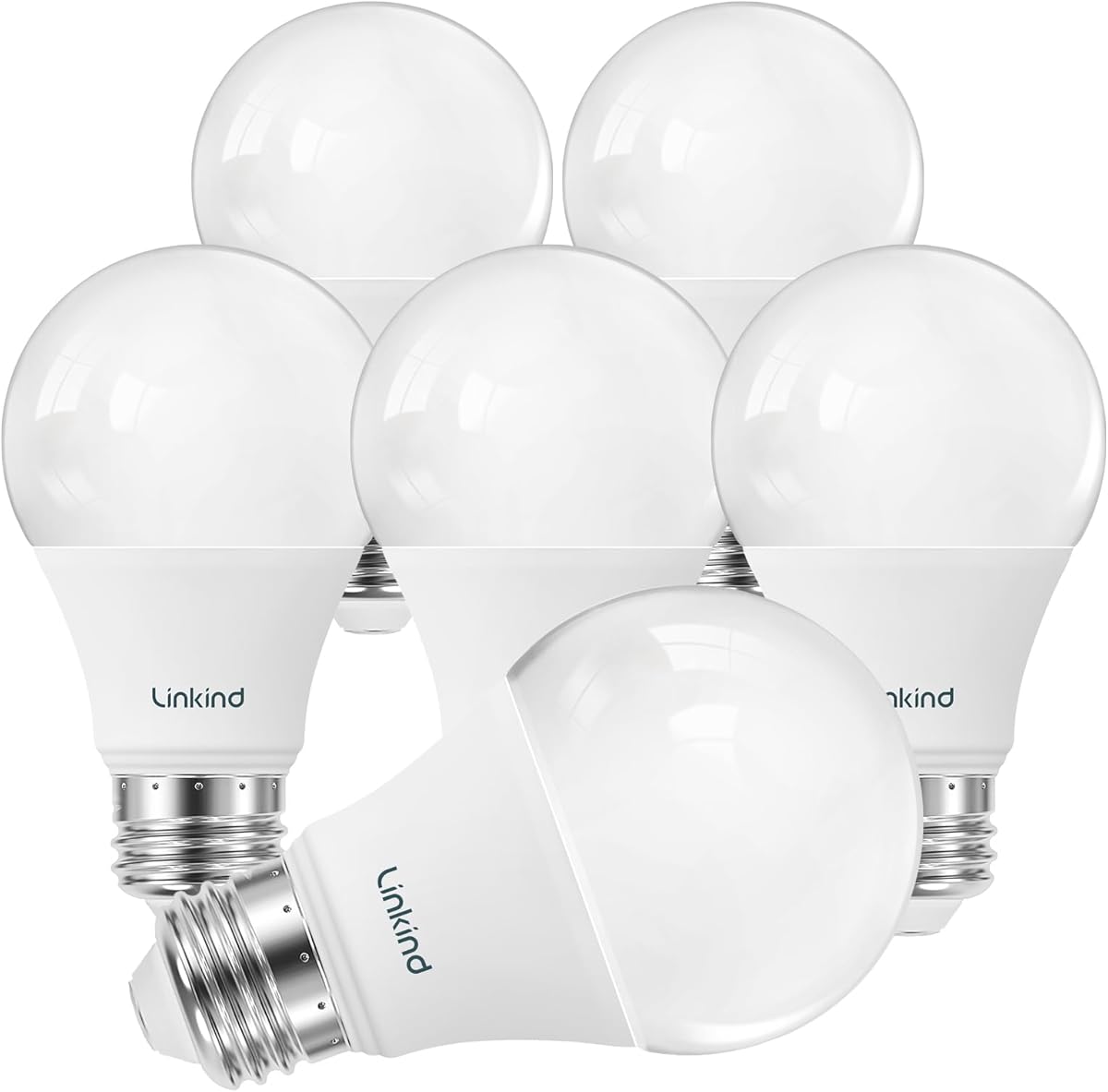
Linkind's six-pack combines a 4.7 rating with an 8.5-watt power draw and 840 lumens of 5000K daylight output. That slightly higher lumen figure than many 60-watt-equivalent bulbs can make the product useful in rooms that need clear illumination without moving to a higher-wattage fixture.
We may earn a commission when you buy through this link, at no additional cost to you.
The listed energy-saving claim reaches up to 85% when replacing 60-watt incandescent bulbs. A rated lifespan of up to 15,000 hours also reduces replacement frequency, making the pack useful in fixtures that are difficult to access. The non-dimmable bulbs fit standard E26 medium screw bases and switch on immediately without a warm-up delay.
Users who want adjustable brightness must look elsewhere, and the stated non-dimmable status should be considered carefully if the intended room already has a dimmer. The fixed daylight color is less suitable for intimate or sleep-oriented spaces than a warmer bulb. Even so, the combination of strong output, low consumption, familiar fitting, and broad intended room coverage makes these bulbs straightforward for efficient general lighting.
The Linkind pack is a good choice for kitchens, offices, living areas, and homes undertaking a room-by-room lighting upgrade. It may be the more practical pick when six replacement points are sufficient and buyers want a compact multipack rather than a very large installation package.
The 840-lumen output provides a bright working level while retaining an 8.5-watt draw. That balance is useful where task visibility matters and where replacing fixtures would be inconvenient or unnecessary.
An operating life of up to 15,000 hours means fewer bulb changes than conventional incandescent options. That is especially valuable in high ceilings, outdoor-covered fixtures, and other locations where replacement is inconvenient.
We may earn a commission when you buy through this link, at no additional cost to you.
The QQT heater is designed to deliver targeted warmth to a small indoor zone rather than heat an entire home. It has a 4.4 rating, a maximum working power of 1200 watts, and low and high settings that let users match output to their immediate comfort needs.
We may earn a commission when you buy through this link, at no additional cost to you.
PTC ceramic heating is combined with a smooth airflow design intended to reduce turbulence and distribute warmth evenly. The stated noise level below 30 decibels makes it suitable for desks, bedrooms, and quiet work areas. A compact 8.2-by-5.9-by-5.5-inch body, hidden handle, and high-temperature-resistant outlet further improve portability and everyday usability.
Unlike more sophisticated heaters, this model has no thermostat, timer, remote, or oscillation. That means it cannot automatically lower power as a room warms, and its portability is constrained by the need to remain near a suitable outlet. Users must also remove the transportation anti-vibration cover before operating it, as the instructions warn that the cover may activate overheating protection.
This heater suits individuals seeking a quick, quiet source of personal warmth during cool weather. It works well in an office, bedroom, home office, or small living area where localized heating is preferable to running a whole-house system.
The low and high options provide a simple way to moderate energy use and heat output. While they are not automatic, they let users respond quickly to changing comfort needs without navigating a complicated control panel.
Tip-over shutdown, 45-degree tilt detection, overheat protection, an insulating shell, and an enhanced safety plug provide multiple layers of protection. The heater should still be operated on a stable surface and used according to the supplied instructions.
We may earn a commission when you buy through this link, at no additional cost to you.
The AEOCKY RHEA-001 is the most technically advanced product in this guide and is built for substantial moisture-control needs. It has a 4.5 rating, covers up to 5500 square feet, and is described as an ENERGY STAR Most Efficient 2025 compressor dehumidifier with a maximum extraction rate of 80 pints per day under the manufacturer's stated test conditions.
We may earn a commission when you buy through this link, at no additional cost to you.
Its efficiency credentials extend beyond the label. The product listing cites a rotor compressor, 7-millimeter pure-copper heat-exchange tubing, hydrophilic aluminum foil, dynamic humidity detection, and a proprietary compensation algorithm. A power-off memory function allows operation to resume after power restoration, which can be useful with a smart socket or in specialized installations such as an RV.
Its larger size, 31-pound weight, and compressor-based construction are less convenient than a small portable dehumidifier. The listing also makes ambitious comparative efficiency and savings claims, so consumers should interpret them as manufacturer statements rather than guaranteed household results. Actual performance depends on humidity, temperature, building conditions, maintenance, and usage patterns.
This model is a compelling premium option for basements, large homes, and persistently humid regions. Buyers should confirm room dimensions, drainage plans, clearance requirements, and current certification details before purchase. For a larger property with substantial year-round moisture pressure, its high capacity, low-temperature operation, and efficiency certification justify the larger footprint.
The ENERGY STAR Most Efficient 2025 designation, high-efficiency compressor design, and copper heat-exchange components target lower operating demands in large moisture-removal jobs. The listing also claims improved efficiency compared with non-ENERGY STAR alternatives, making certification an important comparison point.
Millisecond-level humidity detection and compensation are designed to keep readings closer to the selected level. Defrost sensors help the unit continue operating in cooler conditions where many compressor dehumidifiers can accumulate frost and lose performance.
We may earn a commission when you buy through this link, at no additional cost to you.
The DREO Atom One is a portable heater that combines a 4.6 rating with more precise control than basic two-speed models. Its 1500-watt maximum output supports fast heating, while a digital thermostat adjustable from 41 to 95°F gives users a more specific target than an unrestricted low or high setting.
We may earn a commission when you buy through this link, at no additional cost to you.
ECO mode is the defining efficiency feature because it automatically adjusts heat output as the space approaches the selected temperature. A 70-degree oscillation distributes warmth across a broader area, and the nine-blade brushless DC motor is listed as operating at a low 37.5 decibels. Those characteristics make the heater suitable for bedrooms, offices, basements, and garages where quiet, directed warmth is useful.
The 1500-watt ceiling is higher than that of the smaller QQT heater, so it can draw more electricity when operating at full output. ECO mode mitigates unnecessary consumption, but the heater is still intended for supplemental indoor heating rather than complete-home temperature replacement. Its portable form also means it occupies floor or desk space and must be positioned carefully.
This is a strong option for anyone who values automatic temperature regulation over the simplest possible control. It is particularly appealing for home offices and sleeping spaces, where a stable target, broad oscillation, and low operating noise can improve comfort.
The digital thermostat and ECO mode make this heater more responsive to changing room conditions. Instead of continuing at a fixed high output, it can reduce power after the selected temperature is reached, which is a meaningful advantage over basic manual heaters.
Seventy-degree oscillation moves the heating direction across a broader area, while the brushless motor and aerodynamic blades are designed to reduce turbulence. The stated low-noise operation supports use during work, reading, or sleep.
We may earn a commission when you buy through this link, at no additional cost to you.
The Universal Energy-Saving Box is a plug-in device intended to stabilize voltage, balance current, filter harmonics, and improve power factor for connected appliances. It has a 3.5 rating, the lowest among the ten products, and the two-unit pack is easy to position in a home, office, café, restaurant, or small commercial setting.
We may earn a commission when you buy through this link, at no additional cost to you.
Its installation requirement is minimal. Each unit connects to a standard wall outlet and displays a green operating indicator, while the low-profile design is intended not to block adjacent outlets. The manufacturer also lists overheat, overload, and overvoltage protection, with automatic cutoff and resumption after the unit cools.
The central concern is that the device's real effect on household electricity consumption is heavily dependent on the connected load and the electrical system. Many modern household appliances already include their own power-factor correction, so an external box may have little meaningful effect. The product's vague claims and modest rating make independent verification especially important before relying on projected reductions.
The device may be worth considering for shared spaces with multiple lower-power appliances, particularly where voltage fluctuations are an issue. For a typical home seeking major energy savings, however, replacing inefficient appliances, using smart power strips, and selecting properly sized efficient equipment are generally more understandable measures with measurable results.
The plug-and-play format requires no rewiring or specialist installation. Two units are included, and the compact form is convenient for offices, reception areas, cafés, and other environments where outlet space is limited.
Overheat, overload, and overvoltage protections are useful additions for a device intended to sit between wall power and connected equipment. These safeguards do not replace sound electrical practices, grounded outlets, or appropriate appliance load management.
We may earn a commission when you buy through this link, at no additional cost to you.
The ASOMST bulb offers the highest stated lumen output among the A19 options in this guide while keeping energy use low. It has a 4.6 rating, draws 11 watts, and is marketed as a 100-watt-equivalent bulb producing 1100 lumens of 5000K daylight light.
We may earn a commission when you buy through this link, at no additional cost to you.
Its efficiency claim reaches over 90% compared with a 100-watt incandescent bulb. The stated lifespan of up to 25,000 hours is also the longest among the featured LED options, reducing replacement frequency in homes, offices, shops, and other high-use locations. CRI 85 supports more vivid and natural-looking color than the CRI 80 products in the guide.
The bulb is not dimmable and cannot be paired with a standard dimmer. Its 5000K spectrum is energetic rather than warm, making it better for task and commercial lighting than for bedrooms or intimate dining areas. As with any replacement lamp, the existing fixture, socket type, voltage, and enclosure requirements should be checked before ordering.
This product is a good fit for buyers who want more brightness than a standard 60-watt-equivalent LED without moving up to a specialized fixture category. It works particularly well in floor lamps, pendant lights, vanity fixtures, chandeliers, and other indoor A19/E26 installations that need crisp, high-output light.
The 1100-lumen output is useful in locations that need more illumination than a conventional 60-watt replacement without using the higher heat and consumption of a 100-watt incandescent lamp.
CRI 85 helps objects and interior colors appear more vivid and natural. A rated lifespan of up to 25,000 hours adds a maintenance advantage, particularly in fixtures that are high or otherwise difficult to reach.
We may earn a commission when you buy through this link, at no additional cost to you.
The evelor six-pack delivers an approachable combination of efficiency, brightness, and compact pack size. It has a 4.7 rating and uses nine watts to produce 800 lumens, offering a standard 60-watt-equivalent output while remaining compatible with the widely used A19 shape and E26 medium screw base.
We may earn a commission when you buy through this link, at no additional cost to you.
The listed energy-saving figure reaches up to 90% compared with a traditional 60-watt incandescent bulb. A 15000-plus-hour lifespan reduces replacement frequency, while CRI 80 and a flicker-free design support steady, visually comfortable illumination. The bulbs are also marketed for a broad range of indoor and outdoor locations, including gardens, garages, porches, and patios.
The bulbs are explicitly non-dimmable, and buyers should verify that the exact product listing carries any required wet-location rating before installing them in exposed outdoor areas. The fixed 5000K color is also less suitable for restful spaces. Otherwise, the product keeps installation uncomplicated and does not require new fixtures or rewiring.
This is a practical pick for households replacing several bulbs in stages or for anyone who prefers a smaller pack than the 24-bulb options. It is well suited to hallways, kitchens, bedrooms, workspaces, and compatible outdoor fixtures where a bright, consistent light is wanted.
The nine-watt draw is substantially lower than a 60-watt incandescent lamp, and the manufacturer states savings of up to 90%. When many bulbs operate for extended periods, the cumulative reduction in energy use can be meaningful.
The A19 profile and E26 base allow direct replacement in many common household fixtures. Checking the base, shape, voltage, dimmer compatibility, and any wet-location requirements beforehand helps prevent installation problems.
We may earn a commission when you buy through this link, at no additional cost to you.
The dalattin 24-pack is a comprehensive lighting upgrade for homes, offices, cafés, and other spaces with numerous compatible fixtures. Its 4.7 rating reflects strong customer satisfaction, while the nine-watt bulbs deliver 800 lumens each and are described as 60-watt-equivalent daylight replacements.
We may earn a commission when you buy through this link, at no additional cost to you.
The manufacturer states energy usage can be reduced by up to 85% compared with incandescent lamps. UL listing adds a visible compliance credential, and the listed life of up to seven years at three hours of daily use provides a more understandable maintenance estimate than many packaging claims. CRI 80 supports accurate-enough color rendering, and the stated non-flicker, non-dazzling output is designed for comfortable viewing.
The bulbs are not dimmable, and the one-size-fits-all 5000K color means a household seeking warm evening light would need a separate warm-white option. The long-life estimate depends on use, voltage, temperature, and switching patterns. Buyers should also ensure that every intended fixture accepts A19 bulbs and E26 screw bases.
This is a strong choice for a whole-home or shared-property lighting conversion where purchasing bulbs individually would be inconvenient. It is especially appealing for landlords, property managers, and offices that can use a standardized fixture and do not need dimming.
Twenty-four bulbs cover a meaningful number of compatible fixtures in one order. That simplifies coordinated upgrades and helps ensure consistent daylight color and brightness throughout a home or commercial interior.
UL listing, an E26 base, 120V operation, and a stated life of up to seven years at typical daily use make the product straightforward to evaluate. Confirming fixture specifications before ordering remains the most important installation step.
We may earn a commission when you buy through this link, at no additional cost to you.
The JNDRO wall-mounted heater is designed for convenient, remotely controlled heating with a 4.4 rating. Its wall placement keeps the heating unit off the floor, while an ECO thermostat mode automatically adjusts power according to ambient temperature as it works toward the selected target.
We may earn a commission when you buy through this link, at no additional cost to you.
The thermostat covers a 41-to-95°F range. A remote control operates temperature, timer, fan speed, and oscillation, and a clear LED display presents current settings. A 24-hour timer can turn the heater off after a selected interval, adding another way to avoid unnecessary operation when nobody is expected to use the room.
Three oscillation angles of 60, 90, and 120 degrees let users match coverage to the room. Installation is more involved than with a portable heater, however, and the product should be installed according to its instructions and appropriate safety clearances. The remote also requires two AAA batteries, which are not included.
This heater is well suited to households that want automatic, remotely managed warmth without placing a portable appliance in the room. It is especially useful in offices, garages, finished basements, and living spaces where a wall location can provide stable positioning and broader distribution.
The remote can adjust temperature, fan speed, timer, and oscillation, while the LED display confirms the current settings. This convenience is particularly useful in bedrooms, offices, and spaces where reaching the wall unit is inconvenient.
Users can select among three oscillation widths and use the 24-hour timer to limit unnecessary heating. The ECO mode complements those controls by adjusting output as the room approaches the selected temperature.
We may earn a commission when you buy through this link, at no additional cost to you.
The most energy-efficient product is the one that meets your actual heating, lighting, moisture-control, or electrical needs without unnecessary features, incompatible installation, or operating practices that waste power.
Start with the room, fixture, appliance, or moisture problem you need to solve. Lighting buyers should count sockets and identify fixture types, while heater buyers should estimate the area requiring supplemental warmth. For dehumidification, consider square footage, baseline humidity, temperature, drainage access, and how often water must be removed. A product designed for a much larger or more demanding job may be unnecessarily inefficient for the space, while an undersized unit may have to run continuously and consume more energy than expected.
Wattage alone does not reveal lighting quality, and lumens alone do not show how much heat or electrical demand accompanies the output. For bulbs, compare watts, lumens, color temperature, CRI, beam angle, and rated life together. For heaters, review maximum power alongside thermostat control, ECO behavior, and intended zone size. Dehumidifiers should be assessed by stated extraction rates under defined conditions, coverage, fan noise, and energy certification rather than tank capacity alone.
A bulb that is efficient but incompatible with the fixture is not a useful purchase. Confirm the A19 shape, E26 base, voltage, wattage, dimmer status, and any wet-location requirements. Heaters require stable surfaces or proper wall mounting, adequate clearance, and a suitable outlet. The JNDRO model also needs the remote's two AAA batteries, which are not included. Installation restrictions should be checked before focusing on secondary features.
Thermostats, ECO modes, timers, and responsive humidity controls can prevent equipment from continuing to operate after the desired condition has been reached. These functions are often more dependable as efficiency measures than a vague savings promise. The DREO heater adjusts output in ECO mode, the JNDRO heater combines thermostat control with a 24-hour timer, and the AEOCKY dehumidifier includes dynamic detection, compensation, and power-off memory.
Energy efficiency should be considered alongside service life, replacement frequency, and expected maintenance. A higher-efficiency bulb with a long rated lifespan can reduce both electricity use and replacement labor. A dehumidifier's compressor efficiency, defrost performance, and service coverage affect operating costs. Equipment that operates quietly may also be easier to shut down when a room is not occupied, supporting practical conservation.
Recognized certifications can provide stronger evidence than marketing language. The AEOCKY dehumidifier carries an ENERGY STAR Most Efficient 2025 designation, the dalattin bulbs are listed as UL Listed, and the DREO heater's Shield360° system is described as ETL-listed. Buyers should still read the certification's scope and verify the product model rather than assuming every feature from a brand or family is covered.
Every LED bulb in the guide offers a 5000K daylight spectrum, which is bright and useful for work areas but may feel too cool for bedrooms or evening relaxation. Color temperature affects comfort and perceived quality without changing the core energy benefit. If a household requires warm light, dimming, or a different atmosphere, it should choose a corresponding product rather than forcing a daylight bulb into every location.
Portable heaters need stable placement, tip-over protection, overheat protection, and clear space around the outlet. Wall-mounted heaters require correct installation and suitable clearances. Dehumidifiers need continuous drainage or regular tank emptying, adequate airflow, and clean coils. Outdoor lighting must meet the relevant wet-location requirement, and power-optimization devices should be used only within their stated electrical limits.
Begin every installation by confirming compatibility. Replace incandescent lamps only with bulbs that match the fixture's shape, base, voltage, and dimmer requirements. Install portable heaters on a stable, hard surface with clearance around the body, and place wall-mounted heaters according to their instructions. Position a dehumidifier with unobstructed airflow and plan how collected water will be drained.
Use the available controls to their intended advantage. Select a thermostat target for the DREO and JNDRO heaters, activate ECO mode where appropriate, and set a timer when a room will be empty. For the AEOCKY dehumidifier, set the desired humidity and maintain the coils, filter, and drainage path. Replace LED lamps before they fail and clean dusty fixtures so they operate at their intended output.
Use the devices only within their stated limits. Never put the non-dimmable bulbs on a dimmer switch, and do not operate the QQT heater with its transportation cover installed. Keep the energy-saving boxes within their stated electrical ratings and avoid overloading outlets. For any product showing unusual heat, odor, sound, moisture leakage, or damaged power components, stop using it and consult the manufacturer or a qualified technician.
Replacing frequently used incandescent bulbs with compatible LED lamps is usually one of the simplest starting points because the fixtures and controls do not need to change. Look for the correct base, shape, color temperature, and dimmer compatibility, then compare wattage and useful light output. Heating and dehumidification upgrades can also help, but they are most effective when capacity and operating schedules are matched to the home.
A 60-watt-equivalent LED generally provides a familiar level of brightness for general-purpose rooms, provided it produces around 800 lumens and the fixture is appropriate. The products in this guide range from 800 to 840 lumens at low wattages. Consider beam angle, color temperature, and room size when choosing among them, especially for task lighting or large spaces.
No, not unless the exact product is specifically labeled as dimmable. Every LED bulb featured in this guide is described as non-dimmable, and using one with a standard dimmer can cause flickering, reduced output, or compatibility issues. If a room needs dimming, select a bulb explicitly designed and certified for that control.
A portable heater can be moved to whichever occupied area needs warmth, making it flexible for renters and changing spaces. A wall-mounted heater takes up less floor area and can be easier to control remotely, but installation is more involved. Both should be operated within their clearance and electrical requirements, with tip-over or overheat protections considered for portable models.
It is a more demanding efficiency designation than the general ENERGY STAR label and indicates that the model met applicable energy-efficiency criteria. The AEOCKY unit in this guide is described as holding the Most Efficient 2025 designation. Certification supports comparison, but actual electricity use still depends on humidity, temperature, settings, maintenance, and operating time.
No. A power factor device may help under particular electrical and load conditions, but many modern appliances already include effective power-factor correction. Results vary by equipment, so buyers should treat broad savings claims cautiously. Improving the efficiency of the actual appliances, using appropriate operating schedules, and eliminating standby loads can provide more transparent benefits.
They can be, because 5000K bulbs are designed to provide crisp, bright illumination, but they are generally cooler and more energizing than warm-white bulbs. People who prefer a relaxing evening atmosphere may want warmer options or separate lighting controls. The bulbs in this guide are also non-dimmable, so they do not provide brightness adjustment.
LED bulbs generally need little maintenance beyond occasional cleaning and eventual replacement, though their stated life depends on usage and operating conditions. Dehumidifiers need more regular care: empty the tank when indicated, keep the filter and coils clean, maintain drainage, and check for airflow obstructions. Following the manufacturer's cleaning schedule helps preserve efficiency and equipment life.
The evelor six-pack is a budget-minded lighting choice, the Linkind six-pack stands out for its higher 840-lumen output and up-to-85% savings claim, and the AEOCKY dehumidifier is the premium selection for large-scale moisture control and recognized efficiency certification. Each serves a distinct need, so the strongest recommendation depends on the category and operating environment rather than a single universal winner.
Prioritize compatibility, useful output, automatic controls, and long service life. LED shoppers should pay as much attention to base, brightness, and color as wattage. Heater buyers should look for thermostat behavior and suitable coverage, while dehumidifier buyers should examine capacity, energy certification, drainage, and low-temperature performance. Avoid relying on broad savings claims without considering how the product will actually be used.
Finally, check the current listing details, availability, certification, and price before ordering. Product specifications and promotions can change, and electrical requirements vary by home. Reviewing those details at the time of purchase helps ensure that the selected energy-efficient product fits the intended space and delivers the expected function.