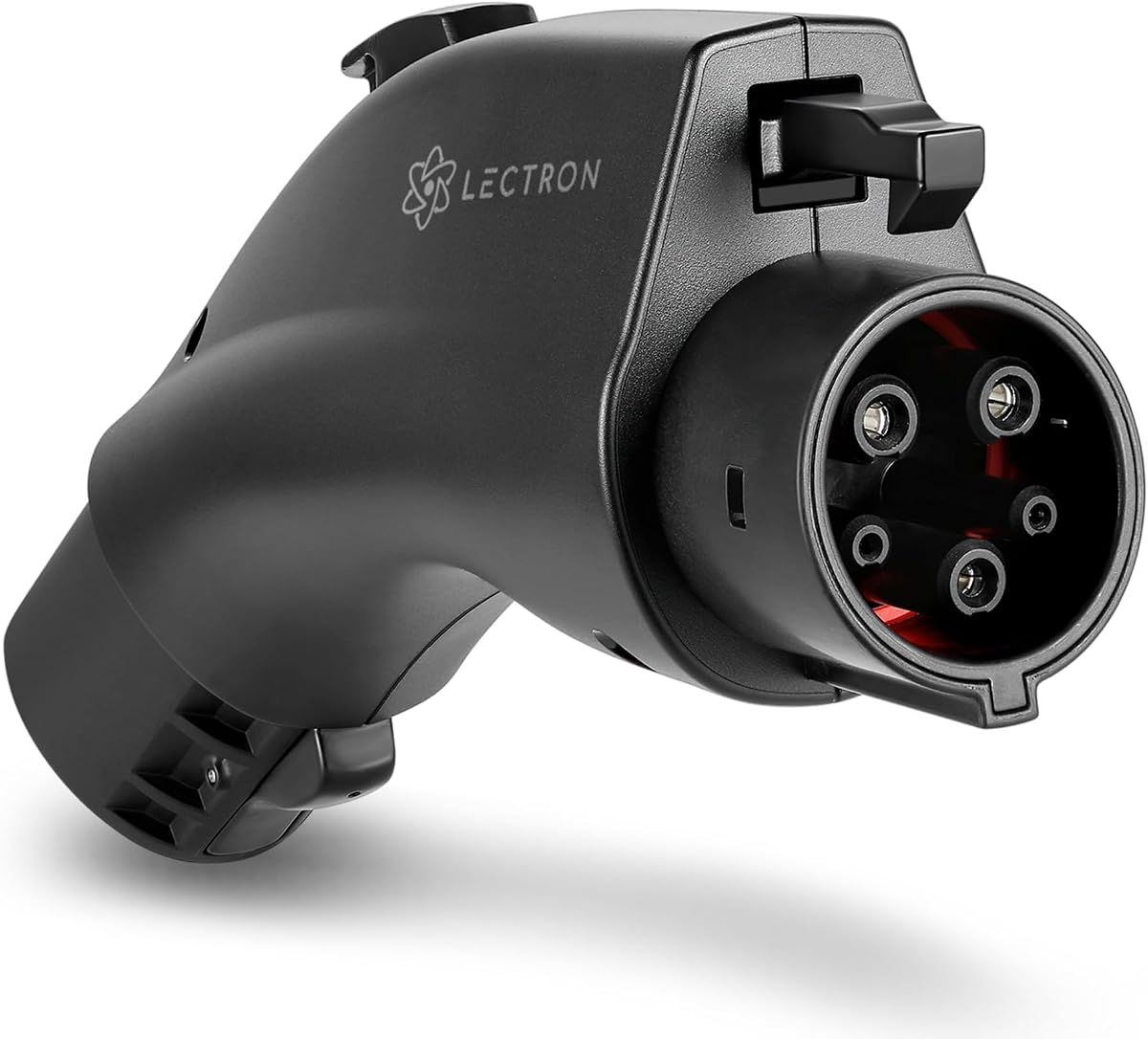
Lectron NACS to J1772 Adapter
4.7Editor score
Up to 80A at 240V
UL 2252 certified
Built-in temperature monitoring
Our Nacs to J1772 Adapter guide compares charging speed, connector compatibility, safety certifications, portability, and weather resistance across ten models.
A Nacs to J1772 adapter lets a vehicle with a J1772 charging inlet use compatible Tesla or NACS alternating-current charging equipment. A worthwhile adapter balances electrical ratings, secure connections, safety certifications, portability, and clear compatibility without trying to make every vehicle and charger combination possible.
We compared all ten products by connector direction, supported amperage and voltage, charger compatibility, safety standards, environmental ratings, locking mechanisms, and practical portability. The list includes both 48A and 80A designs, portable adapters for vehicles, and heavier-duty options intended for regular AC charging use.
Each review explains the adapter's strongest benefits, limitations, and ideal user, helping distinguish a convenient travel accessory from a high-current home-charging solution. Ratings reflect the supplied customer feedback and can change over time, while prices, promotions, and availability also fluctuate, so compare current listings before buying.
4.7Editor score

4.6Editor score

4.6Editor score
The comparison below highlights each adapter's charging direction, maximum electrical rating, charger compatibility, and outdoor-use features. Specifications represent product capabilities rather than guaranteed charging speed, which also depends on the EV, charging equipment, and installation.


The Lectron J1772 to Tesla Adapter is a versatile option for owners of a Tesla or another vehicle equipped with the NACS-style inlet who need access to SAE J1772 charging equipment. Its 4.6 rating reflects broadly positive feedback, while its 80A and 240V specifications make it suitable for capable Level 2 installations as well as lower-powered Level 1 locations.
We may earn a commission when you buy through this link, at no additional cost to you.
Its primary strength is flexibility. The adapter is listed as compatible with Tesla Model S, Model 3, Model X, Model Y, Cybertruck, and electric vehicles in the NACS alliance. It supports both Level 1 and Level 2 J1772 sources, making it useful at home, work, hotels, and public charging locations. The IP67 enclosure and -22°F to 122°F operating range suit outdoor use, while UL 2251 and TUV certifications add visible safety credentials.
The plug-and-play format also deserves attention. Rather than requiring a permanent installation, this lightweight adapter can move with the vehicle and fit in a glove box or small storage area. The main trade-off is its direction: it converts a J1772 charger for a NACS-equipped vehicle, not a NACS charger for a J1772 vehicle. It also cannot increase the output available from a Level 1 charger or overcome an EV's onboard charging limit.
This is a strong recommendation for Tesla and NACS owners who want one portable adapter covering numerous J1772 locations. Verify the port on the vehicle and the type of charging equipment you plan to use before ordering. It is less relevant to a J1772 car owner seeking access to Tesla Destination Chargers, Wall Connectors, or other NACS charging hardware.
Support for Tesla models, Cybertruck, and the NACS alliance makes this adapter useful across a wider group of current and emerging electric vehicles. Check the supplied compatibility information before connecting a new model.
The IP67 rating provides a stronger degree of dust and water protection than many competing designs. Its broad temperature specification also makes it practical for exposed parking areas and changing seasonal conditions.
We may earn a commission when you buy through this link, at no additional cost to you.
The Lectron Tesla to J1772 EV Charging Adapter is designed for J1772-equipped vehicles that need to use Tesla-compatible AC charging hardware. It carries a 4.0 rating and supports up to 48A at 240V, a rating that can be sufficient for many EVs while remaining below the maximum offered by several 80A alternatives in this guide.
We may earn a commission when you buy through this link, at no additional cost to you.
Compatibility is the main attraction. The adapter is listed for Tesla High Powered Wall Connectors, Destination Chargers across generations, and Mobile Connectors. Its SGS certification under UL 2251 provides a useful safety reference, and the compact enclosure makes it practical to keep in a vehicle for work trips, hotel charging, or unexpected compatibility needs.
Its limitation is electrical throughput. A 48A adapter cannot deliver the full 80A capability of higher-rated alternatives. Actual charging time still depends on the connected charger, EV onboard charger, battery temperature, state of charge, and other conditions. It is also an AC charging accessory, not a means of using Tesla Superchargers or other DC fast-charging systems.
The Lectron is most appropriate for someone whose vehicle or regular charging source operates at or below 48A and who values proven connector compatibility and a compact form. Buyers seeking maximum speed from a high-output Tesla Wall Connector may be better served by an 80A model, subject to their EV's accepted input rating.
The adapter supports several common Tesla AC charging formats, including high-powered wall equipment, destination equipment, and mobile connectors. This makes it useful for extending access without changing the vehicle.
Its compact design is easy to carry and store. Keeping it onboard gives a J1772 driver a practical fallback when a compatible Tesla AC charging connector is available but the vehicle's usual J1772 cable is not.
We may earn a commission when you buy through this link, at no additional cost to you.
The Lectron NACS to J1772 EV Charging Adapter combines a high 4.7 rating with 80A and 240V specifications. It is intended for J1772 electric vehicles using Tesla Wall Connectors, Destination Chargers, and Mobile Connectors, making it one of the most technically ambitious choices for owners seeking access to high-output NACS AC charging hardware.
We may earn a commission when you buy through this link, at no additional cost to you.
UL 2252 certification, automaker approval language, and built-in temperature monitoring distinguish it from simpler adapter designs. The reinforced housing and IP67 protection rating support regular indoor or outdoor use. Its stated goal of reducing heat buildup and improving charging efficiency is particularly relevant for higher-current use, although the connected EV and charging source must support the same level of AC input.
The obvious limitation concerns charging systems rather than the connector itself. Tesla Superchargers operate on a direct-current fast-charging architecture and are explicitly outside this adapter's scope. The product's strong electrical claims also should not be interpreted as a guarantee that every J1772 vehicle can accept 80A; many EVs have lower onboard charging limits.
This is a compelling premium option for a J1772 EV owner who regularly uses compatible NACS Wall Connectors and wants a high-current adapter with prominent safety credentials. It is especially compelling for drivers with an EV that supports high-current Level 2 charging. For ordinary travel needs, less powerful adapters may be sufficient and easier to justify.
UL 2252 certification and temperature monitoring provide stronger reasons to consider this model than appearance alone. These attributes are relevant because higher-current adapters create more heat that must be managed consistently.
The 80A rating allows the adapter to take full advantage of suitably equipped Wall Connectors and other AC sources. The EV's onboard charger remains the final limit on accepted power.
We may earn a commission when you buy through this link, at no additional cost to you.
The Raylix Tesla to J1772 Adapter is a portable 80A, 250V option for J1772 EVs and plug-in hybrid vehicles seeking access to Tesla AC chargers. Its 4.5 rating indicates generally favorable customer feedback, and its 0.53-pound weight makes it one of the easiest adapters in the list to carry regularly.
We may earn a commission when you buy through this link, at no additional cost to you.
The product lists compatibility with many recognizable vehicle brands, including Ford, Hyundai, Chevrolet, Honda, Cadillac, Rivian, BMW, Volkswagen, and Toyota. It works with Tesla Wall Connectors, Destination Chargers, and Mobile Connectors. The listed 80A capability is meaningful for EVs able to accept high-current Level 2 input, while the lightweight shape is appealing for glove-box or trunk storage.
Compatibility documentation is unusually important with this model. The manufacturer excludes Jeep Cherokee 4xe, Chevrolet Bolt, Chrysler Pacifica Hybrid, and all Tesla vehicles. It also does not support Tesla Superchargers. The claimed durability testing includes plug-in cycles, drop resistance, and drive-over testing, while the product includes a two-year warranty and stated customer support.
The Raylix is a practical recommendation for a J1772 owner who wants an 80A adapter without carrying a bulky accessory. Its exclusions prevent it from being a universal solution, so check both the vehicle and charging equipment before ordering. Owners of the excluded models should choose an adapter specifically listed for their vehicle instead.
At just over half a pound, the adapter can remain in a glove box, center console, or small carry bag. Portability matters for travelers who cannot rely on carrying a full charging cable everywhere.
The manufacturer identifies specific unsupported vehicles and charging systems. Those details make it easier to avoid an incompatible purchase and clarify that the product is for Tesla AC charging rather than Supercharger access.
We may earn a commission when you buy through this link, at no additional cost to you.
The NACS to J1772 Charger Converter delivers an 80A, 240V connection for J1772 electric vehicles and plug-in hybrids. Its 4.6 rating places it among the stronger-reviewed products in the guide, while the secure locking mechanism, carrying bag, and broad charger compatibility make it a balanced, value-oriented option.
We may earn a commission when you buy through this link, at no additional cost to you.
The converter is designed for NACS Destination Chargers, Wall Connectors, and Mobile Connectors across North America. It supports up to 80A and 240V, with a stated maximum output of 19.2kW, giving compatible EVs access to high-current Level 2 charging. A locking mechanism is intended to reduce accidental disconnects, and the listed test for more than 10,000 plug-and-unplug cycles supports its positioning for regular use.
Its IP55 rating provides protection against dust and water jets, though it is not as sealed as the best IP67 models here. It should also be understood that it cannot work with NACS Superchargers, which use DC fast charging. As with every high-current adapter, the vehicle's charging electronics and the source equipment determine the actual power delivered.
This is a good pick for budget-conscious buyers who still want an 80A connector, a locking mechanism, and a travel bag. It is particularly useful for J1772 owners who regularly encounter NACS AC charging hardware. Confirm that the vehicle accepts the necessary input and use only compatible Level 1 or Level 2 charging sources.
The locking mechanism helps keep the connection stable in parked vehicles, garages, and public locations. A secure fit is valuable whenever cables may be moved or lightly disturbed during a charging session.
A compact body and included storage bag make this straightforward to keep with charging cables. That makes it easy to have compatible NACS access available during commutes, hotel stays, or longer trips.
We may earn a commission when you buy through this link, at no additional cost to you.
The LENZ J1772 to NACS Adapter serves Tesla and other NACS-equipped vehicles that need to use J1772 Level 1 or Level 2 charging locations. It carries a 4.4 rating, an 80A and 250V rating, and a glove-box-sized form, offering a well-rounded option for both home and public charging scenarios.
We may earn a commission when you buy through this link, at no additional cost to you.
Compatibility is a major strength. The manufacturer lists every Tesla model, including Cybertruck, and numerous non-Tesla NACS vehicles, including examples from Hyundai, Kia, Rivian, Toyota, and Lexus. The adapter's UL 2251 and CSA C22.2 No. 282-17 compliance, silver-plated copper alloy pins, and IP54 rating make the specifications particularly easy to compare.
The direction of conversion remains the key consideration. This adapter helps a NACS vehicle charge from a J1772 source rather than helping a J1772 vehicle use a NACS charger. It is also designed for AC charging, not DC fast charging. Actual charging speed remains limited by the lowest-rated component in the connection.
LENZ is well suited to Tesla or NACS owners who want a portable adapter backed by a two-year protection plan and broad vehicle coverage. Buyers should still confirm the exact port on the vehicle and consult the product instructions before first use. It is not the right direction for a J1772 vehicle seeking Tesla charging access.
Beyond Tesla, the listed support for several NACS-equipped brands makes this relevant as more manufacturers adopt the connector. The product's compatibility language includes future NACS-equipped vehicles.
Silver-plated copper alloy pins are designed to support conductivity and repeated contact. UL 2251 and CSA compliance provide useful standards context when comparing this model with alternatives.
We may earn a commission when you buy through this link, at no additional cost to you.
The Portable Tesla to J1772 Adapter is aimed at J1772 drivers who want access to Tesla Wall Connectors, Mobile Connectors, and destination charging equipment. It has a 4.2 rating and supports up to 80A at 250V, combining a high-current rating with a relatively portable 0.9-pound body and a storage bag.
We may earn a commission when you buy through this link, at no additional cost to you.
A one-touch locking design is intended to create a stable connection and simplify removal. The enclosure is made from nylon and fiber materials and carries an IP65 rating. Its listed operating range of -40°F to 85°F is broad on the cold side, and the manufacturer states that the connector can withstand more than 20,000 insertions.
The listing describes charging power of up to 15kW, which may differ from the apparent maximum implied by an 80A, 250V input. It also notes that charging speed is affected by the EV, battery, onboard charger, and source. Because compatibility wording and power figures should be interpreted carefully, buyers should follow the included manual and confirm that their exact equipment is supported.
This adapter is a sensible choice for commuters and travelers who value a locking design, IP65 protection, and a compact package. It is less compelling for someone seeking exceptionally high-output charging, since its stated power figure is lower than that of several 80A competitors. Verify both voltage and charger compatibility before purchasing.
The locking design is intended to keep the adapter seated and make removal more convenient. Always confirm the connection is fully latched before beginning a charging session.
A stated 20,000-insertion capability and rugged nylon-and-fiber construction suit an accessory expected to travel. Proper storage and careful connector handling remain important to long-term reliability.
We may earn a commission when you buy through this link, at no additional cost to you.
The Tesla to J1772 Charging Adapter is a 48A, 240V solution for J1772 vehicles seeking access to Tesla and NACS AC charging hardware. Its 5.0 rating is the highest listed in this guide, although a small review base should be considered alongside that score. The product is simple, portable, and focused on widely used Tesla charging formats.
We may earn a commission when you buy through this link, at no additional cost to you.
Compatibility includes Tesla High Powered Wall Connectors, Destination Chargers across generations, and Mobile Connectors. The adapter is constructed with high-strength nylon and fiber and is rated for more than 15,000 plug-in cycles. Its IP65 protection, -104°F to 185°F stated temperature range, and SGS certification under UL 2251 make its specifications robust for outdoor AC charging.
The central trade-off is its 48A ceiling. Vehicles capable of taking more current will not charge faster simply because the source is rated higher. The adapter also cannot be used with Tesla Superchargers or Tesla DC chargers, and it does not change the charging architecture of the connected vehicle.
For a J1772 EV with a 48A onboard charging limit, this is an appealingly simple adapter with an excellent customer rating and conspicuous safety features. It is also a reasonable choice as a portable fallback rather than a dedicated high-current home solution. Review the instructions, confirm the charger type, and follow the vehicle manufacturer's charging guidance.
The supplied 5.0 rating is notable, though fewer customer observations can make a rating less stable than one supported by a larger number of reviews. The core specifications remain the better basis for a long-term decision.
The advertised temperature tolerance covers severe cold and heat, while IP65 protection guards against dust and water jets. These features make the adapter suitable for exposed parking and varied climates.
We may earn a commission when you buy through this link, at no additional cost to you.
The ELEGRP 80A Tesla to J1772 Adapter is a high-current accessory for J1772 EVs using Level 2 NACS charging equipment. Its 4.5 rating and advertised 80A capacity place it among the stronger performance-oriented options, while the included carry bag and warranty-backed support add value for regular travelers.
We may earn a commission when you buy through this link, at no additional cost to you.
It supports Tesla High Powered Connectors, Destination Chargers, and Mobile Connectors. Electrical specifications extend to 80A and 250V, and the product includes overheat-prevention features. The stated -22°F to 122°F operating range and IP54 rating suit outdoor use, while the lightweight carry bag helps protect the adapter from scratches and dust during transport.
As its title makes clear, the product is for AC Level 2 charging rather than direct-current fast charging. The EV's own acceptance limit still governs real-world speed, and a source with a lower output rating will reduce available power accordingly. The IP54 rating is also lower than the IP65 or IP67 ratings offered by some alternatives, making sheltered storage prudent during severe weather.
This is a good recommendation for J1772 vehicle owners who frequently use Tesla-compatible AC charging hardware and want an 80A option with organized storage and U.S.-based support. It is particularly suitable for road trips because the adapter is portable and protected by a carry bag. Confirm compatibility with the exact vehicle and charger before ordering.
The 80A and 250V ratings allow use of suitably powerful NACS charging equipment. Vehicle onboard limits, battery conditions, and charger output determine the actual charging rate.
The stated two-year replacement warranty and U.S.-based support team make this a reassuring choice for buyers who value ongoing assistance. Warranty terms still vary depending on the cause of the issue.
We may earn a commission when you buy through this link, at no additional cost to you.
The Tesla to J1772 Adapter is a high-current option for J1772 EVs and plug-in hybrids that need access to Tesla Level 1 and Level 2 chargers. It holds a 4.4 rating, supports up to 80A and 250V, and emphasizes secure retention and thermal monitoring as its primary features.
We may earn a commission when you buy through this link, at no additional cost to you.
Dual locking latches are designed to keep the connection tight and reduce the chance of accidental disconnection. An AI temperature-control chip is listed as monitoring heat in real time, while FCC certification supplies a separate safety and compliance reference. The adapter is compatible with Tesla Wall Connectors, Destination Chargers, and Mobile Connectors, subject to vehicle and source limitations.
The manufacturer's compatibility notice is especially important. Jeep Cherokee 4xe, Chevrolet Bolt, Chrysler Pacifica Hybrid, and all Tesla vehicles are excluded, and the adapter does not support Tesla Superchargers or other Level 3 DC fast chargers. Calling it a universal J1772 adapter would therefore be misleading.
This model is well matched to a J1772 owner seeking 80A capability and especially secure connector retention. It is a sensible travel accessory because it eliminates the need to carry a complete cable-and-adapter combination. Purchase only after checking the listed vehicle exclusions and confirming that the charging equipment operates at the appropriate AC level.
Dual locking latches address a common practical concern in public and roadside settings. Ensure both ends are fully secured before relying on the vehicle's charging indicator.
The listed temperature-control chip is intended to support stable charging and reduce overheating risk. It complements, rather than replaces, sound connector care and compatible charging equipment.
We may earn a commission when you buy through this link, at no additional cost to you.
The right adapter depends first on connector direction and then on electrical, safety, and practical requirements. Use the following factors to avoid an expensive mismatch and to choose equipment suited to daily charging, travel, or occasional access to an alternative charger network.
A J1772 to NACS adapter starts with a J1772 charging cable or connector and connects to a Tesla-style or NACS vehicle inlet. A NACS to J1772 adapter does the opposite, allowing a J1772 vehicle to connect to a NACS charger. The names are easy to reverse, but the direction must match both the vehicle and the charging equipment. Buying the wrong direction makes the product unusable regardless of its amperage or construction.
An 80A adapter is designed to handle high-current Level 2 AC charging, while a 48A model can suit vehicles or charging sources with lower limits. The adapter's rating is a maximum capacity, not a promise of a specific charging speed. The EV's onboard charger, the connected wall equipment, the circuit, and battery conditions all influence the final result. Maximum voltage also matters, particularly when comparing 240V and 250V specifications.
Most adapters in this guide work with AC equipment such as Tesla Wall Connectors, Destination Chargers, and Mobile Connectors. They do not make DC fast charging possible, and nearly every listing expressly excludes Tesla Superchargers. A destination charger may also have connector-specific cables. Check the physical plug type and the charger's published operating level rather than relying only on the broad term NACS.
Standards such as UL 2251 and UL 2252 provide useful evidence that an EV charging adapter has been evaluated for relevant safety expectations. SGS certification and FCC certification offer additional reference points, but markings do not eliminate the need for correct use. Look for recognized certification information, clear operating instructions, thermal protection, and secure connector retention. Certification should complement—not replace—compatibility checks.
A charging connection may be exposed to movement, vibration, or accidental contact in a parking lot. Locking mechanisms, fixed latches, or dual latches can keep the interface stable. One-touch locking systems can also simplify removal after charging. The mechanism must work correctly without forcing the connector, and users should always confirm that both ends are seated before leaving a vehicle connected.
IP54, IP55, IP65, and IP67 describe different levels of protection against solids and water. A higher rating is generally better for exposed parking, rain, snow, and road splash, but it does not make the connector suitable for immersion. Also consider the stated operating temperature range. Outdoor AC charging equipment is common, so environmental specifications help distinguish travel adapters from models better suited to exposed installations.
An adapter can be more convenient than carrying a complete charging cable, particularly when a compatible charger already has its own attached lead. Weight, dimensions, locking design, and included storage bag all affect usability. Products around half a pound are particularly easy to keep in a glove box, while slightly larger units may still suit a trunk. Choose a size that you will actually carry rather than one that merely looks compact.
Some manufacturers list specific vehicles that cannot use an adapter even though they normally use a J1772 inlet. These exceptions may relate to charging architecture or vehicle-specific requirements. Warranty length, replacement coverage, and customer-support availability also distinguish otherwise similar products. Save the manual and packaging, and keep purchase documentation so that compatibility questions or warranty claims can be handled efficiently.
Before first use, identify the vehicle inlet and charging source, then confirm that the adapter's direction, voltage, current, and connector format match. Read the included manual and the vehicle manufacturer's charging instructions. Inspect both ends for moisture, dirt, bent contacts, or damage, and make sure the charger is a compatible AC source rather than a DC fast charger.
Connect the charging equipment to the vehicle in the sequence recommended by the adapter manufacturer. Push each connector fully into place and engage any lock or latch without forcing it. Confirm that the vehicle's charging indicator shows an active connection before walking away. Charging speed will be governed by the adapter, charger, vehicle onboard electronics, and battery conditions.
To disconnect, follow the vehicle's charging-screen or app instructions, stop the session, and release any locking mechanism before removing the adapter. Wipe the connector with a clean, dry cloth, avoid compressed water and aggressive solvents, and let the contacts dry completely before storage. Keep the adapter in its case or a clean dry bag away from sharp objects and prolonged direct sunlight.
It lets a vehicle with a J1772 charging inlet connect to a compatible NACS-style AC charger. It changes the physical connector interface so a J1772 vehicle can use Tesla Wall Connectors, Destination Chargers, or Mobile Connectors that are otherwise incompatible. It does not convert the charging method from AC to DC, and it cannot be used with Tesla Superchargers.
No. The adapters in this guide are intended for alternating-current charging equipment. Tesla Superchargers and other DC fast-charging systems use a different communication and power architecture. Always check the charger labeling and the adapter manual before attempting a connection.
It can, but only when the EV and charging equipment also support that level. The adapter's 80A rating is an upper limit rather than an automatic charging speed. A 48A vehicle, a lower-output charger, an undersized circuit, battery temperature, and other conditions can reduce the delivered power.
No. Several manufacturers identify specific J1772-equipped vehicles as incompatible, including the Chevrolet Bolt in certain product listings. Always review the exclusions for the specific adapter and confirm compatibility with your exact model and model year before purchase.
That depends on the charging equipment. If a compatible NACS charger already has an attached NACS plug, the adapter provides the connection to the J1772 vehicle inlet. If the source uses a different cable arrangement, a suitable charging cable may still be required. Check the connector and cord supplied with the charger.
Many listed adapters have IP54, IP55, IP65, or IP67 protection, indicating varying resistance to dust and water. That makes outdoor charging practical under normal conditions, but the rating is not a guarantee against standing water, impact, or damaged seals. Inspect the connector, keep it dry when possible, and follow the manufacturer's weather guidance.
Some adapters, including the J1772-to-NACS Lectron, explicitly support both Level 1 and Level 2 sources. Others focus on high-current Level 2 equipment or specify Tesla Level 1 and Level 2 chargers. Confirm both charging levels before ordering, especially if you plan to use a basic household outlet.
Do not force the latch or continue charging until the connection is secure. Check that both plugs are fully inserted, remove any visible debris, and inspect for physical damage. The charger's own lock mechanism may also need attention. If the adapter remains loose or refuses to latch, stop using it and contact the manufacturer or seller for assistance.
The Lectron J1772 to Tesla Adapter is the most versatile choice for NACS-equipped vehicles because it covers Tesla models and alliance members, supports Level 1 and Level 2 charging, and carries an IP67 rating. For J1772 vehicles seeking premium high-current performance, the Lectron NACS to J1772 model stands out with 80A capacity, UL 2252 certification, and temperature monitoring.
Value-oriented buyers can consider the NACS to J1772 Charger Converter, which combines 80A support, a locking mechanism, a storage bag, and a solid customer rating. Prioritize connector direction before anything else, then match current and voltage ratings to the vehicle and charger. Safety certification, locking retention, environmental protection, and the clarity of compatibility exclusions should guide the final decision.
Ratings, promotions, product availability, and prices can change, so review the current listing and detailed product documentation before purchasing. Do not rely on an adapter's maximum electrical rating to predict charging speed. Confirm the vehicle, charger, connector direction, charging level, and local electrical requirements for a safe and satisfying result.