
Official Creality Ender 3 V2 Heated Bed
4.5Editor score
Official Creality replacement
24V 220W heating
235 × 235mm aluminum platform
Preinstalled cable included
Our heated bed for 3D printer guide compares 10 replacement beds by size, power, voltage, compatibility, heating design, and installation suitability for
A heated bed gives a 3D printer the stable, evenly heated surface needed to keep filament from lifting and help the first layer adhere. A good replacement must match the printer’s dimensions, voltage, wattage, connector, thermistor arrangement, and control hardware rather than simply resemble the original part.
This guide compares ten heated beds and silicone heating pads listed for 3D printing. We considered size, heating power, operating voltage, platform material, temperature capability, mounting details, included wiring, sensor provisions, and stated printer compatibility to identify the most practical option for different builds.
Each review explains the product’s strongest use case and important limitations, from compact Creality replacements to large aluminum platforms and high-voltage silicone mats. Ratings and product details can change, so verify the current listing, printer specifications, and electrical requirements before ordering.
4.5Editor score

4.5Editor score

5.0Editor score
The comparison covers conventional aluminum hotbeds, large-format heated platforms, and silicone heating mats. Their electrical systems and printer compatibility differ substantially, so the table is best used to identify the correct form factor before checking mounting and wiring details.

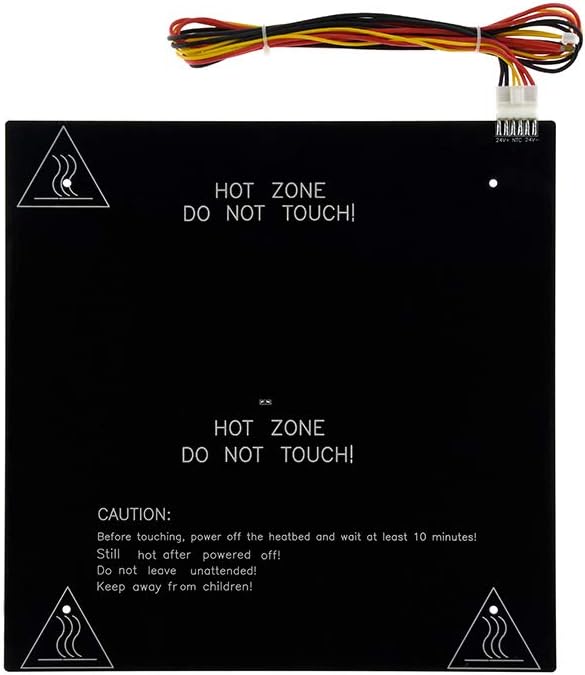


The Official Creality Ender 3 V2 Heated Bed is a straightforward replacement for owners of compatible Ender machines. It has a 4.5-star rating and combines a 235 × 235 × 3mm aluminum platform with DC 24V 220W heating. The assembled cable is included, reducing one common source of installation difficulty when replacing a failed original bed.
We may earn a commission when you buy through this link, at no additional cost to you.
Its most convincing feature is the combination of manufacturer provenance and clearly stated compatibility. The listing names the Creality Ender 3, Ender 3 Pro, Ender 3 V2, Ender 3 Neo, and Ender 3 V2 Neo. That makes it easier for a buyer to identify whether the physical dimensions and mounting arrangement are likely to match, provided the printer version and electrical system are confirmed before installation.
The trade-off is that this is a conventional Creality-style replacement rather than a universal upgrade. It does not advertise a wider temperature rating, revised insulation, an integrated sensor, or a full upgrade kit. The thermistor arrangement is not specified in the supplied product information, so owners should compare the original assembly, cable routing, and sensor placement before removing a working bed.
This is the most sensible budget-oriented selection for an Ender owner whose original heated bed has failed. Its official status, included cable, familiar 24V 220W specification, and strong customer rating make it more compelling than an unverified generic substitute. Confirm the exact printer revision and compare mounting points before purchasing.
The benefit of this bed comes from preserving a known platform format: 235 × 235 × 3mm with DC 24V 220W heating. For a compatible Ender printer, that familiar specification can make the swap less speculative than choosing a bed based on size alone.
The assembled cable is a useful convenience because it removes the need to source and terminate a separate heater lead. The installer still needs to disconnect power, support the bed, protect wiring from hot sections, and confirm sensor compatibility before reassembly.
We may earn a commission when you buy through this link, at no additional cost to you.
The HICTOP Ender 3 Heated Bed is an appealing choice for anyone replacing a bed in one of several Ender-family printers. It carries a 4.5-star rating and uses the familiar 235 × 235 × 3mm aluminum format. Its DC 24V 220W heater includes a cable, while the listed maximum temperature of 110°C provides a clear operating ceiling.
We may earn a commission when you buy through this link, at no additional cost to you.
The standout advantage is the breadth of the stated compatibility. In addition to the Ender 3, Ender 3 Neo, Ender 3 Pro, Ender 3 V2, and Ender 3 V2 Neo, the listing includes the Voxelab Aquila X2. That range makes the product useful for owners comparing several common desktop platforms, though physical measurements and connector arrangements should always be verified because a model name alone does not guarantee identical assemblies.
The specified 110°C maximum is reasonable for many conventional thermoplastics but is lower than some specialty options discussed in this guide. Buyers working with materials that require a hotter surface should not assume that every filament is safe at the limit. Care is also required around exposed hot surfaces, and installation should follow the printer manufacturer's guidance for grounding, cable routing, and thermal protection.
This is the strongest general-purpose pick for a compatible Ender or listed Voxelab machine. It combines a strong rating, a complete cable, widely understood dimensions, and unusually explicit compatibility details. It is especially attractive for repairing a bed that no longer heats evenly, as long as the owner confirms the sensor layout and mounting holes against the original unit.
This bed's strongest selling point is the number of named platforms it is intended to support. The wide list reduces the chance of overlooking an Ender variant, but the installer should still compare hole spacing, cable orientation, and thermistor placement with the failed assembly.
The stated 110°C maximum gives buyers a more useful limit than a vague description of high-temperature resistance. It also provides a reference point when selecting filament and when comparing this compact aluminum bed with silicone mats rated for different operating environments.
We may earn a commission when you buy through this link, at no additional cost to you.
The Tosuny Silicone Heated Bed provides a 200W 24V heating surface measuring 235 × 235mm, making it a flexible alternative to a conventional rigid hotbed. Its 5.0-star rating reflects a strong customer reception, and the listing specifically mentions Ender 3 and Ender 3 Pro use along with CRX compatibility.
We may earn a commission when you buy through this link, at no additional cost to you.
A silicone heating mat offers a different installation approach from an aluminum platform. The product information describes fast heating, uniform heat transfer, low power, high thermal efficiency, and durable silicone construction. A 3M rubber backing is also advertised, potentially helping with mounting, although the exact arrangement of adhesive and backing should be confirmed for the individual printer.
The major caution is heat. The listing states that silicone limits the heating plate to approximately 200°C and warns that exceeding this limit may damage it. In addition, the product information advises taking precautions against hot surfaces. The absence of a rigid metal build plate also means it may not be suitable where an aluminum surface is required for a particular magnetic sheet, mounting method, or structural application.
This heated pad is most attractive to an experienced maker comfortable adapting a flexible heater into a compatible Ender-style machine. Its 5.0 rating, fast-heating design, and exact 235mm dimensions make it a compelling specialized option. It is less convenient for a simple drop-in repair and should be selected only after confirming the heater's mounting, sensor arrangement, and heat limits.
At 235 × 235mm, the pad matches the footprint used by many Ender-family machines. Its 200W rating and silicone construction can be useful in custom or repaired bed assemblies where a thin heater is easier to route than a rigid replacement platform.
The stated resistance to approximately 200°C is a material limit, not an instruction to operate continuously at that temperature. Keeping the controller within a conservative range and monitoring the surface helps preserve the silicone heater and reduce the risk of damage.
We may earn a commission when you buy through this link, at no additional cost to you.
This 310 × 310mm aluminum heated bed is designed specifically for the Creality CR-10. It has a 3.8-star rating, a 24V 220W heater, and a rigid 3mm-thick platform. The listing supplies unusually useful mounting details, including 240mm center hole spacing and an approximately 4.2mm mounting-hole diameter.
We may earn a commission when you buy through this link, at no additional cost to you.
Those dimensional specifications are the key benefit. A large replacement bed can appear interchangeable until the installer realizes that center spacing, cable placement, or thermal expansion differs. By describing the platform size, thickness, and hole geometry, this listing gives CR-10 owners the information needed to compare the new assembly with the original before ordering.
The lower 3.8-star rating is worth considering, particularly if customer feedback raises concerns that are not visible in the provided specifications. Another limitation is the narrow printer focus. Although the dimensions may resemble beds used by related builds, the listing specifically designates the CR-10 and does not establish broad cross-platform compatibility.
For a CR-10 owner, this is a purpose-built replacement that should be compared carefully against the existing bed and its wiring. The included power wire kit is useful, but a complete replacement may also require separate thermistor and wiring checks. Buyers should review the current listing details and recent customer feedback before finalizing the installation.
Center spacing and hole diameter are critical details on a rigid heated bed. Providing 240mm spacing and approximately 4.2mm holes makes it easier for an installer to confirm that the platform will physically fit before removing the original assembly.
The included wire kit addresses part of the replacement process, although it does not guarantee that every electrical connection is identical. Sensor type, connector order, grounding, and cable routing should all be checked against the printer documentation.
We may earn a commission when you buy through this link, at no additional cost to you.
The YWBL-WH 500mm heated bed is designed for large-format work and uses a 500 × 500mm aluminum alloy platform. Its 24V 350W heating system is more powerful than the compact Ender and CR-10 replacements in this guide. The product information emphasizes rapid heating, uniform temperature distribution, structural durability, and improved first-layer adhesion.
We may earn a commission when you buy through this link, at no additional cost to you.
One particularly relevant design feature is the countersunk mounting holes. Keeping screw heads below the printing surface avoids raised obstructions that could catch the nozzle or interfere with a print. The integrated heating plate and aluminum substrate are also presented as a way to improve heat conduction and maintain consistent power output, which can help reduce edge curling and other thermal inconsistencies.
Its 2.8-star rating is the main weakness. The provided listing description does not explain the rating or offer specific customer feedback, so buyers should examine recent reviews for issues involving installation, thermistor placement, connector compatibility, or heat uniformity. The bed's substantial power draw also makes it unsuitable for a printer whose power supply or control board was not designed for a 350W load.
This platform is best considered by builders working on a suitably large and powerful machine. The flat, large surface and integrated construction are meaningful advantages, while the low rating calls for extra diligence before installation. Confirm mounting geometry, sensor arrangements, controller limits, and power delivery before committing to it.
A 500mm platform gives large-format builders considerably more usable area than a standard Ender bed. That additional surface must be matched by sufficient frame stiffness, level adjustment, and print clearance so the full dimensions translate into practical build capacity.
Countersunk holes maintain a more continuous surface around mounting points. This design detail can reduce nozzle collisions and makes it easier to position removable sheets without uneven screw heads interrupting the first layer.
We may earn a commission when you buy through this link, at no additional cost to you.
The FYSETC Silicone Heating Plate is a feature-rich 300 × 300mm upgrade for Voron 2.4 and R2-Trident 300 builds. It has a 5.0-star rating and uses AC 110V 750W heating. Unlike a simple heater-only mat, it includes an XH2.54 two-pin connector, a 3950 100K thermistor, and a bimetal thermal fuse for additional over-temperature protection.
We may earn a commission when you buy through this link, at no additional cost to you.
The heated area covers more than 95% of the original hotbed plate without requiring holes. At approximately 1.8mm thick, it is designed to replace a stock rubber mat while extending the heated region. This can support more uniform bottom heating, which is valuable for larger Voron builds where localized cold zones can contribute to uneven first layers.
Its AC supply is the decisive caveat. The product information specifically warns that the machine must have a solid-state relay. It also states that the mat should not be trimmed or drilled because doing so can damage performance. Although the included fuse opens above approximately 120°C, the recommendation is not to exceed 100°C during normal use, preserving the service life of the silicone.
This is the premium option for a compatible Voron builder who wants a broad heated area and integrated sensing and fusing. It is not a generic replacement for common Ender beds because the voltage, connector, relay, and mounting arrangement differ. For the specified high-voltage build, however, it offers an unusually complete package backed by a perfect rating.
Extending the heating mat beyond 95% of the plate can improve thermal coverage compared with a smaller stock heater. The benefit is most meaningful on large prints, where the center and corners can otherwise experience different heat levels.
The included 3950 100K thermistor and bimetal fuse add monitoring and over-temperature protection. They still require correct wiring and controller configuration, and the fuse should be treated as a protective measure rather than a substitute for conservative temperature settings.
AC 110V 750W heating is a fundamentally different installation from a low-voltage 24V bed. A suitable solid-state relay, sound grounding, protected wiring, and enclosure design are essential. The warning against cutting or drilling the mat makes planning especially important.
We may earn a commission when you buy through this link, at no additional cost to you.
The Anet Aluminum MK2 MK3 hotbed is a compact 12V replacement aimed at Anet A8 and A6 machines, with the A2 also listed among compatible printers. It has a 4.5-star rating, a 220 × 220mm aluminum substrate, and a 120W rating. The package includes the hotbed plate and a separate hotbed wire cable.
We may earn a commission when you buy through this link, at no additional cost to you.
Its 1.2-ohm resistance specification is particularly useful for electrical planning. On a 12V system, that power level and resistance align with the compact-platform format used by many MK2 and MK3-style machines. Because the bed is materially smaller than the 235mm Ender replacements, it is not simply a universal substitute; printer-specific dimensions and mounting details remain decisive.
The most important safety point is voltage. A 12V 120W bed must never be connected to a 24V control system, even if the physical plate looks similar. The seller describes straightforward installation, but that should not be interpreted as permission to alter connectors or omit thermal protection. The supplied cable should be checked for pin order and paired with the correct thermistor configuration.
This is a good choice for an Anet owner whose original bed has warped, cracked, or stopped heating uniformly. Its 4.5-star rating, sturdy aluminum construction, explicit resistance, and included lead make it a practical targeted replacement. Confirm the exact Anet revision, connector arrangement, sensor type, and mounting points before ordering.
The 12V rating makes this bed fundamentally different from most entries in this roundup. Matching the printer's voltage and heater resistance is essential, and using the wrong electrical specification can cause rapid failure or create a serious safety hazard.
The aluminum plate provides a firm, flat printing surface within a compact footprint. When paired with a compatible removable sheet, this can offer stable first-layer geometry for many standard desktop prints.
We may earn a commission when you buy through this link, at no additional cost to you.
The 400mm Aluminum Heated Bed Kit sits between compact desktop replacements and the very large platforms in this guide. It measures 400 × 400mm and uses a 24V 280W heating system. The listing describes an aluminum alloy hotbed kit with integrated heating, a flat surface, and countersunk mounting holes for improved print clearance.
We may earn a commission when you buy through this link, at no additional cost to you.
Its primary appeal is size combined with moderate power demand. A 400mm platform offers more room than a standard Ender bed without reaching the scale or power requirements of a 500mm assembly. The countersunk holes avoid raised screw heads, while the integrated heating plate and substrate are intended to provide stable output and reduce warping caused by uneven heating.
The absence of a customer rating means buyers have less social evidence to consider. The title names the Ender 3 Pro and CR-10, but compatibility is not enough to identify safe electrical use on every revision of those machines. The product information does not state the thermistor model, connector type, exact hole spacing, or included sensor, so those details should be verified with the seller and compared with the target printer.
This kit is worth considering for a custom large-format build with a 24V system that can accommodate 280W of bed heating. It offers a useful balance of footprint and thermal capacity, but its unrated status and limited installation details justify more verification than the official Creality or well-documented CR-10 replacements. Check every interface before installation.
The 400mm footprint may fit builders who want more usable area than a compact bed without committing to the space, weight, and power demands of a 500mm platform. Frame dimensions and Z-axis clearance must be checked carefully.
Combining the heating element with an aluminum substrate is presented as a way to distribute heat and maintain consistent power output. Real performance still depends on insulation, sensor placement, controller calibration, and the sheet attached to the surface.
We may earn a commission when you buy through this link, at no additional cost to you.
This 500mm heated-bed product combines a 24V 350W aluminum alloy bed with a separately described 3800W silicone heating pad. The listing states that the silicone pad can reach 100°C in 90 seconds and is intended to improve first-layer quality and support higher-temperature materials. Its countersunk mounting holes preserve a flat surface and reduce nozzle-clearance issues.
We may earn a commission when you buy through this link, at no additional cost to you.
The hybrid concept is unusual in this product category. A rigid aluminum substrate can provide a stable mounting structure while the silicone layer adds broad heating coverage. That arrangement may be attractive to custom builders seeking a large heated area, although the claimed rapid heating depends on insulation, the controller, the power supply, and the actual installation.
The product information presents both 24V 350W and 3800W figures without adequately clarifying how they relate to one assembled system. That ambiguity matters because a buyer cannot safely plan electrical capacity from conflicting descriptions. There is also no customer rating available, which leaves fewer real-world indications about temperature consistency, installation, and long-term durability.
This product is best treated as a project for experienced builders willing to verify every electrical detail before use. Its 500mm surface, aluminum structure, and silicone heating concept are attractive, but the lack of a rating and inconsistent power descriptions argue against making it the default choice. Obtain a wiring diagram, connector details, sensor information, and a clear power specification before installation.
Combining a silicone heating layer with an aluminum substrate aims to combine flexible heating coverage with structural support. This can be useful in custom structures, but it also creates more interfaces that must be installed without trapping heat or damaging the pad.
The stated 90-second rise to 100°C is attractive, yet heating speed cannot be judged from wattage alone. Insulation, starting temperature, bed mass, voltage, and control settings all influence the result, so real-world checks should follow installation.
We may earn a commission when you buy through this link, at no additional cost to you.
The Voron Trident Silicone Heating Pad is intended for Voron 2.4 R2 and Trident 3D printer builds. It is offered in 300mm and 350mm dimensions with 220V power options of 750W or 1000W. Its perforated design is presented as a way to balance installation convenience with heat dissipation needs.
We may earn a commission when you buy through this link, at no additional cost to you.
The two size choices are useful because the ideal footprint depends on the exact build configuration and available space. The listing says the design permits installation without additional modifications and that the perforated pattern helps with heat dissipation. It also claims quick, even heating and a stable power supply that minimizes temperature fluctuations.
This is among the least approachable options for a typical desktop printer because it uses 220V rather than the 24V found in most compact FDM machines. The heater also requires a properly engineered electrical path, appropriate switching hardware, safe insulation, and careful grounding. The product description does not provide enough interface information to assume that it can replace the FYSETC Voron mat or another 110V system.
This silicone pad is most relevant to builders working on a high-voltage Voron or Trident configuration who can confirm dimensions, mounting geometry, sensor arrangement, and electrical requirements. Its lack of a customer rating and broad power options warrant careful seller clarification. It should not be selected solely because the printer family name matches.
Offering 300mm and 350mm versions can make it easier to fit the available bed area, but the correct choice depends on the actual plate and mounting points. A printed dimension should not be confused with the complete heating footprint.
A 220V heater draws far more current than a 24V desktop bed and should only be installed in a machine designed for that power level. Safe wiring, switching, grounding, enclosure, and thermal-fuse or cutoff provisions belong in the build plan.
We may earn a commission when you buy through this link, at no additional cost to you.
The correct heated bed is the one that physically fits, uses the printer's expected electrical system, and can be controlled accurately. Start with the failed assembly rather than a product image, then compare dimensions, mounting holes, connectors, sensor type, heating requirements, and the printer's support for an aftermarket heated bed.
Compatibility is more than a matching product family name. The bed must match the printer's usable area, mounting-hole pattern, center spacing, cable path, sheet-retention method, and available Z-axis clearance. Even when two beds have the same width and length, the position of screws, thermistor, heater leads, and connector can differ. Measure the original bed and compare it with the replacement dimensions before removing the installed unit.
In short, verify the physical fit rather than relying on the listing headline. Compatibility names are useful starting points, but revision-specific differences can otherwise lead to drilling, rewiring, or an unusable platform.
Voltage is a hard boundary: a 12V bed, 24V bed, 110V system, and 220V system are not interchangeable. Wattage and resistance also affect heat-up time, current draw, and whether the printer's power supply and switching electronics can handle the load. A 24V 220W bed has different requirements from a 24V 350W bed, while an AC silicone mat requires specialized control and protection.
Choose a replacement whose electrical ratings match the printer or planned build. Never energize a heater merely because its connector appears to fit, and confirm the rated supply, controller output, grounding, and thermal cutoff before installation.
Bed size determines much more than the available footprint. A larger platform changes the center of gravity, increases the thermal mass, requires a rigid frame, and may interfere with the nozzle at low Z positions. Standard desktop replacements in this guide are approximately 220mm or 235mm across, while larger platforms measure 300mm, 310mm, 350mm, 400mm, or 500mm depending on the model.
Choose the smallest platform that meets your print needs and that the printer can support structurally. For upgrades, verify travel limits and bed clearance rather than assuming that a larger square bed will fit everywhere.
Aluminum platforms are rigid, easy to level, and commonly paired with removable flexible or magnetic printing surfaces. Silicone heaters can offer broad coverage and rapid heating, but their thermal limits and mounting requirements differ. The products here include an aluminum bed stated to reach 110°C and a silicone pad with material resistance stated at approximately 200°C, though those figures should not be treated as operating recommendations.
Match the heater to the filament and the printer's control system. Use conservative temperature limits, particularly with silicone products, and avoid assuming a material's resistance rating means it should be operated continuously at that extreme.
A heated bed usually includes or depends on a thermistor, and the sensor's resistance curve and physical position influence calibration. Some products include a sensor, while others assume that the original sensor is reused. Connectors may also differ in pin order, which can damage a controller if the heater is connected where the sensor is expected.
Confirm the sensor model, connector type, pinout, and calibration range before installation. If the replacement includes both thermistor and fuse, verify that the controller supports the sensor curve and that the fuse is correctly positioned in the electrical path.
The mounting pattern determines whether the bed can be installed without modification. Countersunk holes are especially useful because their heads sit below the surface, reducing interference with removable sheets and the nozzle. For a replacement, compare hole diameter, center spacing, and whether the bed uses springs, screws, clips, or another leveling arrangement.
Prefer a bed with documented mounting dimensions and a surface design that preserves print clearance. Ensure that the bed remains rigid when heated and that expansion does not pull the heater, sensor, or mounting points out of alignment.
A reliable controller, correctly calibrated sensor, insulated wiring, secure connections, and an emergency cutoff are essential. High-voltage silicone mats require even more care, including suitable switching hardware, grounding, physical protection, and enclosure design. The FYSETC product includes a thermal fuse, but no included fuse replaces sound wiring and conservative control limits.
Prioritize protection over headline wattage. Use the lowest temperature that produces a good first layer, inspect cables periodically, keep connectors away from hot surfaces, and never continue using a heater that has curled, cracked, discolored unevenly, or developed damaged insulation.
A preinstalled heater cable, separate power wire kit, thermistor, connector, and thermal fuse can make a replacement substantially easier to install. However, an included lead is only helpful if its length, pinout, and connector match the printer. A complete package does not remove the need to compare sensor type or check the original mounting arrangement.
Look for components that fit the intended printer without adaptation. The best installation is usually the one that requires no cutting of the heater, no drilling of a silicone mat, no improvised high-voltage connections, and no permanent alteration of factory safety systems.
Begin by fully unloading the printer, disconnecting its power, and allowing the bed and hotend to cool. Remove any removable sheet according to the printer's procedure, photograph the original wiring and mounting layout, and label connectors before disconnection. Compare the replacement's dimensions, hole pattern, sensor, connector pinout, voltage, and resistance with the old assembly before removing hardware.
Mount the new bed securely while avoiding overtightening screws, which can twist the platform or distort its flatness. Route the heater and sensor cables away from sharp edges and hot zones, retain appropriate insulation, and reconnect each lead to the correct controller terminal. If the product includes a thermistor or thermal fuse, follow the provided wiring diagram and never bypass a protective component. Check for loose connections before restoring power.
Run the printer through its normal bed-leveling and calibration process, then heat the bed gradually while observing it from a safe distance. Verify that the sensor reading changes smoothly and that the platform reaches its target without unusual odor, smoke, discoloration, or a failed fuse. Lower the nozzle carefully to check clearance, especially around recessed screws and mounting points. Clean the surface with material-appropriate methods, avoid scraping it with sharp tools, and routinely inspect wiring, insulation, connectors, and the surface for damage.
Only if the printer's frame, motion system, electronics, power supply, and Z-axis clearance can support the larger assembly. A larger bed also changes heat-up requirements and may affect stability. Because the listed Ender-compatible large beds vary in interface details, verify mounting holes, sensor placement, voltage, and power capacity before attempting the conversion.
No. Each voltage requires a matching power system, switching arrangement, and controller connection. Using a higher-voltage heater on a lower-voltage system can cause immediate damage or create a fire hazard. Conversely, a lower-voltage product may not heat sufficiently or may not be controlled correctly by the original electronics.
An aluminum hotbed combines a rigid platform with a heating system, making it convenient for leveling and removable printing surfaces. A silicone heating pad is a flexible heater that may cover more area and heat quickly, but it can have different mounting and temperature constraints. The right choice depends on the printer's construction and heating needs.
It depends on the product and printer. Some replacement beds include a thermistor, while others expect the original sensor to be transferred. Never assume the thermistor is interchangeable because its resistance curve, connector, and pin order may differ. Check the sensor specification and calibrate the bed temperature after installation.
An incorrect reading can result from an incompatible thermistor, reversed or incorrect connector pins, poor contact, a damaged sensor, or a calibration issue. Disconnect the power before inspecting wiring and verify the sensor model and resistance curve. If the hardware is correct, follow the printer or controller's calibration procedure and check for an overheated or faulty component.
The FYSETC listing specifically warns not to trim or drill the silicone mat because doing so can damage its performance. The same caution applies broadly to integrated silicone heaters: punctures may sever heating elements or create unsafe hot spots. Modify the surrounding mounting structure instead, or select a correctly sized product.
Re-level the platform, confirm that the nozzle clears raised hardware, and check the bed's actual temperature with the printer's sensor after calibration. The printing surface should be clean, flat, and correctly attached. If adhesion remains inconsistent, inspect the nozzle height, Z-offset, sheet tension, and material settings rather than assuming the new bed is defective.
No. Higher wattage may shorten heat-up time, but only when the power supply, wiring, controller, and thermal system can support it safely. A mismatched heater can overheat, draw excessive current, or behave inconsistently. Match the replacement to the printer's electrical design and use the lowest temperature that provides reliable first-layer adhesion.
The official Creality Ender 3 V2 Heated Bed is the leading practical choice for a compatible Ender replacement because it combines manufacturer provenance, familiar dimensions, an included cable, and a strong 4.5-star rating. The HICTOP option stands out for its broader stated printer support and explicit 110°C maximum, while the FYSETC silicone plate is the premium selection for compatible Voron builders seeking extensive coverage, a thermistor, and a thermal fuse.
Prioritize exact electrical and mechanical compatibility over wattage or size. Measure the existing bed, identify the thermistor curve, verify connector pin order, compare mounting holes, and confirm that the power system can safely carry the heater. A physically impressive large platform is not useful if the sensor, control board, frame, or Z clearance cannot support it.
Ratings, availability, construction details, and prices can change over time, so consult the current product listing before ordering. Compare the replacement with the failed assembly, check recent customer feedback for installation patterns, and never compromise on correct voltage, thermal protection, or careful wiring to save time or money.