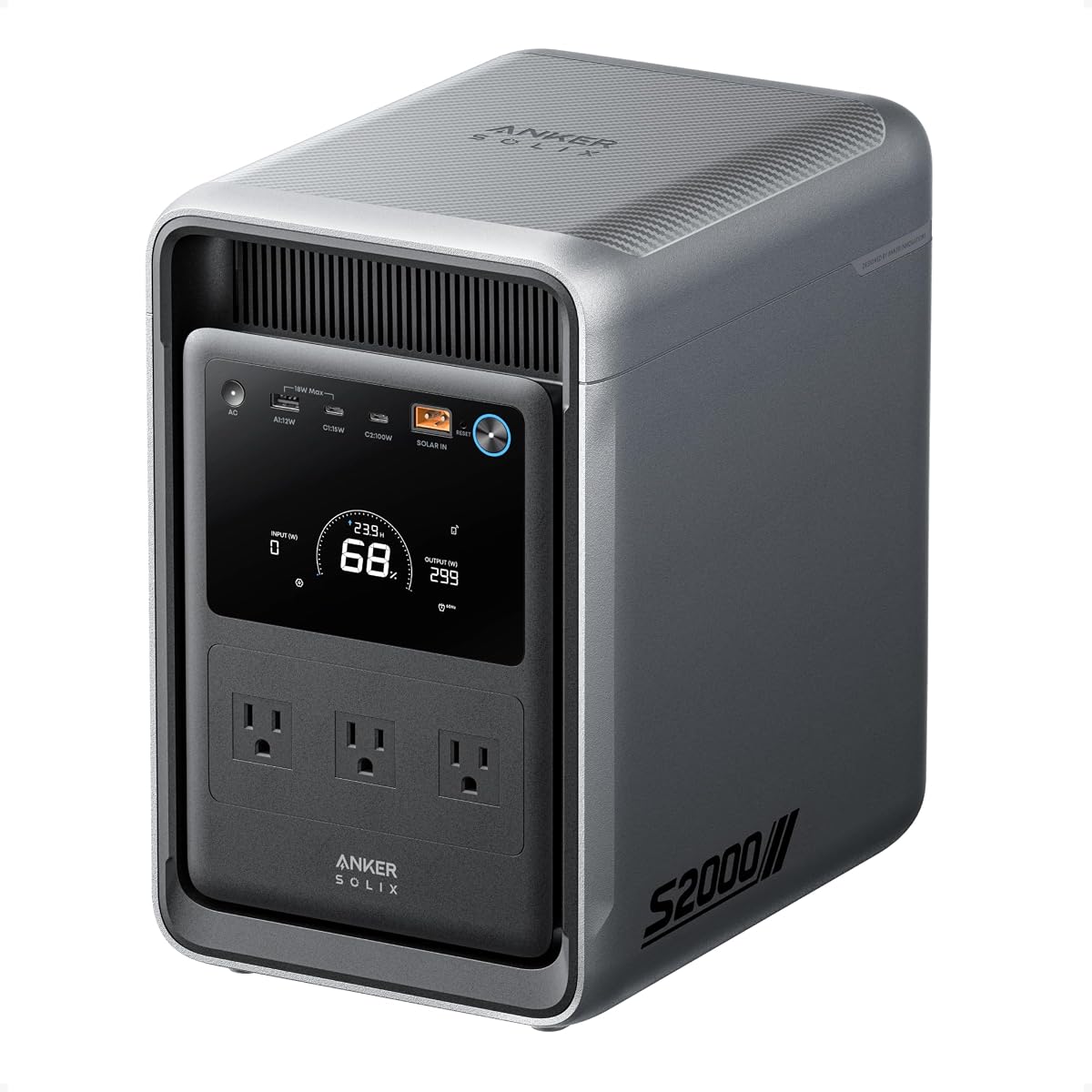
Anker SOLIX S2000
4.7Editor score
2,010Wh battery capacity
1,500W continuous output
35-hour fridge runtime
Six flexible charging methods
Explore the best Anker power stations for camping, backup power, RV travel, and off-grid use, compared across capacity, output, charging, and portability.
Anker power stations combine battery storage, household-style outlets, and flexible recharging to provide dependable electricity away from the grid. The right model depends on the devices you need to run, how quickly the system must recharge, and how much space you can carry or store. Good models balance usable capacity, continuous output, port selection, longevity, and app-based control.
This guide compares ten Anker SOLIX models ranging from compact 288Wh units to expandable 3.84kWh systems for whole-home backup. We evaluated the supplied specifications for capacity, continuous and surge output, charging options, port variety, battery technology, expansion support, and intended applications. The list includes options for phones and laptops, camping electronics, refrigerators, RVs, electric vehicles, and extended outages.
Each review identifies the model that best serves a particular use case, while the comparison table makes the core differences easier to scan. Our top picks highlight the strongest balance of portability, output, and useful features. Prices and availability can change, so confirm the current listing and verify that your planned appliances fall within the unit's continuous output and switching limits.
4.7Editor score
4.7Editor score

4.6Editor score
The table below compares capacity, continuous output, recharging flexibility, and the most relevant feature of every Anker SOLIX power station in the guide.


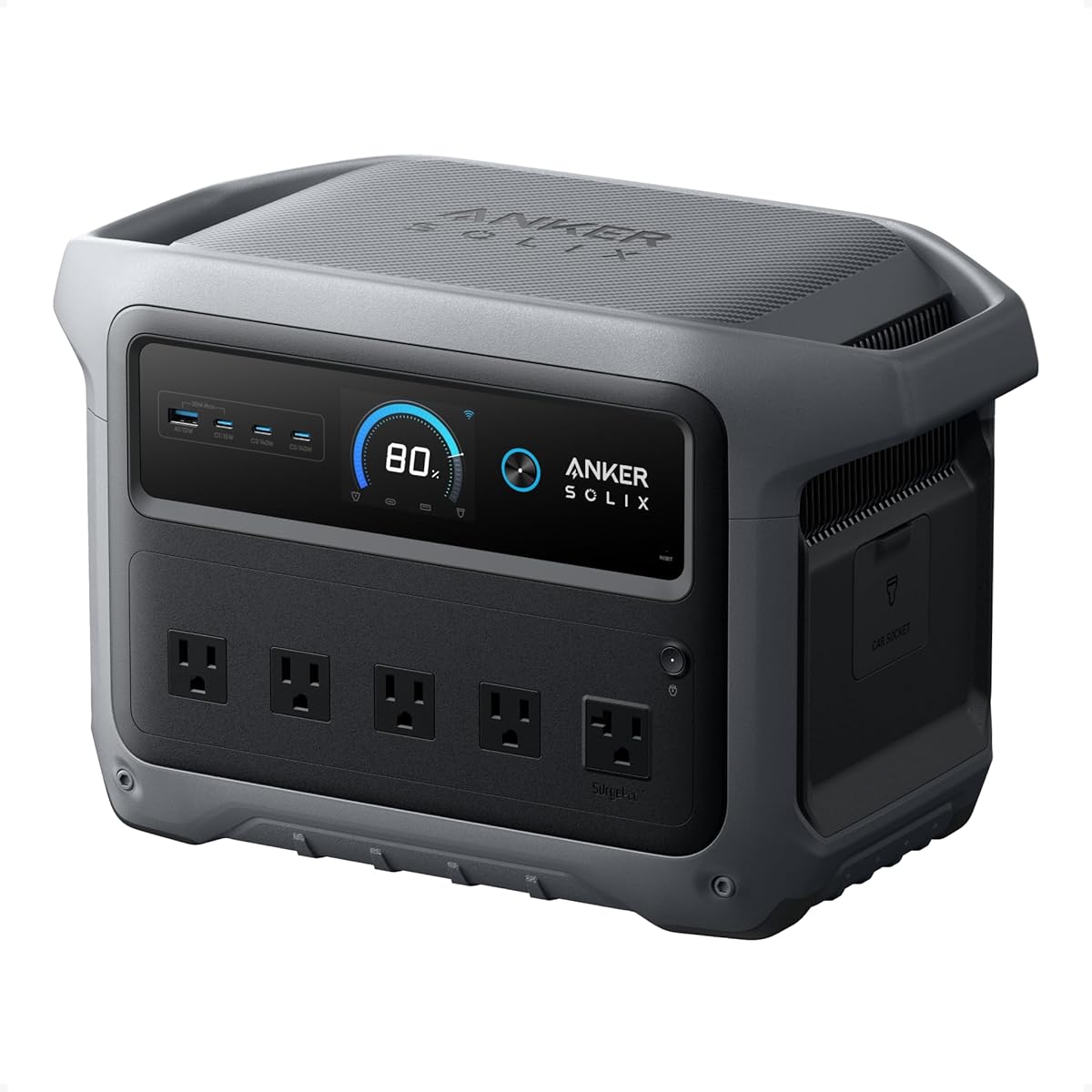
The Anker SOLIX C1000 Gen 2 combines 1,024Wh of capacity with 2,000W of continuous output, giving it enough flexibility for both travel and household backup. Its 4.7 rating reflects a well-rounded package, including ten ports, 3,000W peak output, rapid recharging, and a 10ms UPS mode. It stands out as the most versatile option in this guide without moving into the weight and complexity of a full home system.
We may earn a commission when you buy through this link, at no additional cost to you.
Its charging flexibility is particularly impressive. The unit can reach a full charge in 49 minutes when HyperFlash is enabled through the Anker app, while a 600W solar input can recharge it in 1.8 hours under the specified conditions. Ten ports allow phones, laptops, lights, kitchen equipment, and other essentials to remain connected without requiring multiple power banks. The 2,000W output is also strong enough for many common camping and emergency appliances.
There are reasonable compromises. At 1,024Wh, it will not provide days of electricity for an entire home, and the maximum solar result depends on suitable sunlight, panel compatibility, and operating conditions. Some high-draw appliances may need 2,400W or more, which exceeds the continuous output even though surge power can help with brief startup loads. It is also larger and heavier than the 288Wh C300 models, so travelers must balance capacity against carrying convenience.
This is the strongest general recommendation for people who want one system for power outages, RV trips, remote work, and occasional camping. Choose it when fast recharging, broad device support, and a useful balance of capacity and output matter more than minimum weight. It is particularly appealing for users who need sensitive electronics to continue operating during brief utility interruptions.
The 49-minute AC recharge makes it practical to replenish the battery the evening before a storm or during a short window between uses. Enabling UltraFast mode in the app allows users to prioritize speed when they need to be ready quickly.
The 10ms UPS switchover is designed for continuity-sensitive devices such as laptops and CPAP equipment. Users should still test their individual devices and understand that the UPS function is intended to bridge short outages rather than replace a full generator.
We may earn a commission when you buy through this link, at no additional cost to you.
The Anker SOLIX S2000 is a refined 2kWh-class system with a 4.7 rating, 2,010Wh capacity, and 1,500W continuous output. Its defining advantage is efficiency: the stated 6W idle draw helps it run 20% longer than other 2kWh systems, and Anker cites up to 35 hours for a compatible refrigerator. It is designed for users who want more endurance than a compact camping unit without moving to a permanently installed home system.
We may earn a commission when you buy through this link, at no additional cost to you.
The battery is built around 314Ah LFP cells and is rated for a 15-year lifespan, equivalent to 10,000 charge cycles. The enclosure is stated to be 30% smaller and 25% lighter than the industry average, with dimensions of 8.2 by 11.1 by 12.7 inches and a weight of 35.7 pounds. Charging options are broad: AC, solar up to 400W, a generator, an alternator charger, and a car outlet can all be used in different combinations.
Its port arrangement is less comprehensive for some users. There is no dedicated 12V DC port, and only two AC outlets are provided, so a family with several classic wall-plug appliances may need an appropriate power strip. The 1,500W continuous limit is also lower than the C1000 Gen 2's 2,000W rating. Actual fridge runtime varies with the appliance model, operating habits, and ambient temperature, so the quoted figure should be treated as a useful benchmark rather than a guarantee.
The S2000 is ideal for refrigerators, routers, lighting, office equipment, and selective loads during an outage. It is also attractive for campers and van travelers who value low idle consumption and long battery life. Choose it over the C1000 Gen 2 when runtime, LFP longevity, and a roughly 2kWh capacity are more important than having many AC sockets or the highest continuous output.
Low idle consumption is especially valuable when a power station is stored for months and then used for a refrigerator, communications equipment, or security systems. A unit that wastes less energy between larger loads can provide meaningfully more usable backup time.
The LFP battery and 10,000-cycle rating support long-term ownership. Actual longevity still depends on storage conditions, temperature, charge management, and the depth of regular discharge, so the product should be maintained according to Anker's instructions.
We may earn a commission when you buy through this link, at no additional cost to you.
The Anker SOLIX C300 is a compact 288Wh power station designed primarily for travel, camping, and small electronics. Its 4.6 rating is supported by a capable 300W output, 600W surge rating, and eight ports. At a 15% smaller size than similar designs, it offers a more practical option for users who want to keep their campsite powered without carrying a larger 1kWh system.
We may earn a commission when you buy through this link, at no additional cost to you.
Two 140W two-way USB-C ports make the C300 particularly useful for modern phones, tablets, and laptops. It also includes three AC outlets, a 120W car socket, another 15W USB-C port, and a 12W USB-A connection. The station reaches 80% charge in 50 minutes from a wall outlet and can also recharge through compatible solar panels or a car. A specified operating noise of 25dB from 3.3 feet makes it suitable for quiet campsites.
The limitations are important for anyone expecting to power large appliances. Its 300W continuous output is far below the F-series models, while 288Wh of capacity will disappear quickly through a refrigerator, electric heater, or other sustained high-draw device. The strap is not included, and the recommended 60W or 100W Anker panels are separate purchases. The unit also is not compatible with the Anker SOLIX PS30, other 5V-to-3A USB-C panels, PS200, or PS400.
The C300 is our pick for campers, travelers, and remote workers who mainly need to recharge phones, cameras, drones, and laptops away from an outlet. It also works well as a small emergency battery for lighting and essential electronics. Choose a larger C1000 or F-series system if you need to run a fridge, power tools, or several higher-draw appliances continuously.
The pair of 140W USB-C ports gives the C300 more relevance for current travel equipment. These connections can charge compatible high-power devices efficiently while reducing the need to carry multiple dedicated adapters.
At a stated 25dB from 3.3 feet, the C300 is designed to operate discreetly. That makes it better suited to tents, cabins, and shared campsites than a larger system with louder cooling fans, although noise can vary with load and temperature.
We may earn a commission when you buy through this link, at no additional cost to you.
The Anker SOLIX F3000 is a high-output home backup system with 3,072Wh of starting capacity and up to 6,000W of output. Its 4.5 rating reflects a feature set aimed at households that need to run substantial loads, recharge rapidly after an outage, and expand beyond a single battery. It occupies a different category from the portable C-series because it is designed to remain installed or transported only when necessary.
We may earn a commission when you buy through this link, at no additional cost to you.
Three-phase pass-through charging allows the station to be recharged by a 120V generator while it continues supplying full output. Solar input can reach 2,400W using the appropriate 165V or 60V connections. With optional expansion batteries, usable capacity can grow to 24kWh, while combining two power stations provides 240V output for demanding appliances. The stated six-hour essential-load runtime and 42-hour 190W refrigerator runtime show the intended scale.
This model is not the easiest to move. Its high power, high-voltage charging, and large battery make it more appropriate for a garage, utility room, or prepared home backup installation. The smart energy features also require compatible Anker components, including the Bi-Directional Inlet Box and Smart Meter, for automated storage of free solar energy or off-peak electricity. Buyers should confirm their electrical panel, generator, and solar equipment before installation.
Choose the F3000 when a basic portable battery cannot meet your needs and you need substantially more household power. It is especially relevant to users preparing for extended outages who want generator-like starting support without relying on fuel during every interruption. The lower rating compared with the top picks reflects a specialized role rather than a lack of core performance.
Pass-through charging is valuable during extended grid failures because the station can replenish from a generator without shutting down connected loads. This reduces interruptions and is especially helpful for refrigerators, communications equipment, and essential household systems.
Expansion to 24kWh makes the F3000 more adaptable than a fixed 3kWh station. The added flexibility lets owners increase outage duration as their household needs change, subject to compatible expansion batteries and safe installation.
We may earn a commission when you buy through this link, at no additional cost to you.
The Anker SOLIX F3800 starts with 3.84kWh and provides 6,000W of AC output, positioning it as a comprehensive home and RV energy platform. Its 4.5 rating is backed by expandable capacity, dual 120V/240V support, direct electric-vehicle charging, and compatibility with a Smart Generator 5500 for hands-free runtime. It is a premium-scale system for people who need more than emergency phone charging.
We may earn a commission when you buy through this link, at no additional cost to you.
Up to six expansion batteries increase capacity to 26.9kWh, while a more extreme arrangement can combine another F3800 and 12 batteries for approximately two weeks of power. Two F3800 units can be paired for 12,000W of maximum AC output. Its NEMA 14-50 connection allows EV charging at up to 6,000W, and NEMA 14-50 or L14-30 connections support RV power inlet use, subject to RV compatibility.
The trade-off is size, weight, and installation complexity. This is equipment for a garage, home backup arrangement, or large RV rather than a carry-on camping battery. Users must carefully size circuits and loads because many household appliances and heating equipment have high startup or continuous demands. Expansion batteries also increase the footprint and require compatible components, correct configuration, and adherence to electrical safety guidance.
The F3800 is best for households seeking extended backup, RV owners with substantial electrical needs, or users planning to charge an EV from stored energy. The app provides Wi-Fi and Bluetooth monitoring and control, helping users understand power sources and consumption. It is a strong option when long-term resilience and multi-day energy are priorities, but it is excessive for ordinary device charging.
The NEMA 14-50 and L14-30 connections make the F3800 more useful than a standard backup station for large mobile systems. They can support RV appliances or EV charging when the vehicle, power station, and installation all meet compatibility requirements.
The 3.84kWh base capacity is substantial, but the expansion system is the more important feature for long outages. Owners can scale stored energy without replacing the primary unit, although each addition also requires space, charging time, and compatible equipment.
We may earn a commission when you buy through this link, at no additional cost to you.
The Anker SOLIX C300 DC is built around modern USB-C charging rather than conventional household outlets. It supplies 300W and 288Wh of capacity through a car socket, multiple USB-C connections, and two USB-A ports. Its 4.5 rating makes it a practical travel battery for users whose devices use USB-C and who do not need to power standard wall appliances.
We may earn a commission when you buy through this link, at no additional cost to you.
Two USB-C ports support up to 140W each, and a separate 100W USB-C port adds flexibility for laptops, tablets, and other compatible electronics. Dual PD 3.1 USB-C input can recharge the unit to 80% in an hour, while solar and car charging provide alternatives when away from an outlet. The 30% smaller design is intended to simplify carrying, and the optional strap can be purchased separately.
The key constraint is the absence of AC outlets. Devices that require a conventional wall plug cannot be connected directly, and the 300W output ceiling also restricts heavier portable appliances. Before first use, the unit must be activated with an 18W-or-higher USB-C wall charger, and only USB-C2 and USB-C3 can be used for that initial process. As with the AC-equipped C300, recommended 60W or 100W Anker solar panels are compatible, while PS30, PS200, and PS400 panels are not.
Choose the C300 DC for frequent travelers, photographers, drone users, and remote workers centered on high-power USB-C devices. It is a specialized alternative to the standard C300, not a replacement for it. Buyers who need to support a small fan, conventional adapter, or other AC-powered gear should choose the full C300 instead.
Concentrating on USB-C makes the C300 DC especially useful for modern travel kits. Users can connect several compatible devices without occupying a single scarce AC outlet or carrying separate wall chargers.
The 80% recharge in one hour makes short stops more convenient. The first-use activation requirement is an important setup step, and users should complete it before relying on the battery during travel or an outage.
We may earn a commission when you buy through this link, at no additional cost to you.
The Anker SOLIX C1000 combines 1,056Wh of capacity with 11 ports and a stated 2,400W SurgePad output. Its 4.7 rating places it among the strongest all-around products here, particularly for users who need broad device support. The ability to power up to 99% of appliances, as stated in the supplied listing, makes it useful for RV travel, camping, and selective home backup.
We may earn a commission when you buy through this link, at no additional cost to you.
Recharging is one of its strongest features. UltraFast technology can bring the battery to 80% in 43 minutes and complete a full charge in under an hour when the function is enabled through the app and the operating temperature is within the specified range. A compatible 600W solar panel can recharge it in 1.8 hours. The app also provides real-time statistics and customized charging speeds, while the LFP battery is designed for 3,000 cycles over a ten-year lifespan.
Users should interpret the 2,400W figure in the context of SurgePad output and confirm the continuous requirements of every appliance. It is not a substitute for checking a device's startup and running draw. The 15% size reduction helps with portability, but the unit remains larger and heavier than the C300 family. A smartphone is required to activate UltraFast recharging, and the stated solar time depends on suitable equipment and environmental conditions.
The original C1000 remains an attractive option for buyers who value its 11-port selection, app controls, and fast recharge. It is particularly suitable for RVs, mobile offices, and households that want more than a small travel battery. The newer C1000 Gen 2 may be preferable for buyers prioritizing a larger set of updated features, but the original model remains a compelling 1kWh choice.
The 43-minute charge to 80% reduces downtime between trips or outages. Fast recharge is especially useful when a user wants to restore a mostly depleted battery before leaving for a camping trip or when weather warnings make a backup system more relevant.
Real-time power statistics and adjustable charging speeds make the unit easier to manage across different routines. App access adds convenience, although core charging functions should not be treated as dependent on a phone connection.
We may earn a commission when you buy through this link, at no additional cost to you.
The Anker SOLIX F3800 Plus is a 3.84kWh home backup system with 6,000W of continuous output and a 3,200W solar input rating. Its 4.3 rating distinguishes it as a specialized option for households seeking fast recovery from outages and extensive solar recharging. Like the standard F3800, it supports dual-voltage appliances, expansion batteries, and pairing with a second station for up to 12,000W.
We may earn a commission when you buy through this link, at no additional cost to you.
Its standout feature is solar input. Compatible solar panels can recharge the system quickly, and the stated 63-minute outage-ready recovery combines solar with a generator. Recharging is possible through solar, a generator, a home power panel, or an AC outlet, which provides useful redundancy. A 240V generator can be connected through a 6,000W bypass, allowing the battery to support the home while recharging.
These capabilities require careful planning. A 3,200W solar input is substantial, so compatible panels, proper cable sizing, sunlight exposure, and an appropriate installation are essential. The unit is also physically large and intended for a prepared backup location rather than regular portable use. The F3800 Plus carries a lower rating than several smaller models, but its performance target is greater output and faster energy replenishment, not lightweight travel convenience.
Choose the F3800 Plus when reliable high-voltage output, generator support, and aggressive solar charging are central to your backup strategy. It is well suited to extended outages and households seeking to store substantial amounts of energy. Users who do not have suitable solar or generator equipment may receive better value and convenience from a smaller C1000-class or S2000 system.
The 3,200W solar input can shorten recovery time when multiple compatible panels receive strong sunlight. This is valuable for owners who want the station to refill rapidly between outages or during daylight backup operation.
Combining the F3800 Plus with up to six batteries raises capacity to 26.9kWh. It can therefore serve as the foundation of a multi-day system rather than a limited short-duration reserve, provided space, ventilation, and equipment requirements are met.
We may earn a commission when you buy through this link, at no additional cost to you.
The Anker SOLIX F2600 combines 2,560Wh of capacity with 2,400W of continuous output, providing a useful middle ground between the portable C1000 and the larger F3000 and F3800 systems. Its 4.4 rating is supported by 3,600W surge power protection, app-based controls, and flexible HyperFlash or solar recharging. It is a strong choice for campers who need to run more than a collection of small electronics.
We may earn a commission when you buy through this link, at no additional cost to you.
The F2600 can reach 80% charge in 1 hour and 40 minutes using HyperFlash or in two hours with the stated solar configuration. Its 2,400W output is high enough for many portable appliances, while the 2.56kWh battery provides more endurance than a 1kWh station. Bluetooth and Wi-Fi app control adds low-battery alerts, discharge-limit customization, and recharging-speed adjustment, making it easier to preserve capacity during an outage.
The trade-off is physical size. It is intended for car camping, van travel, tailgating, or a fixed backup location rather than backpacking. Surge power is temporary and should not be confused with a sustained 3,600W capability. The stated ten-year durability relies on LFP batteries, smart temperature control, industrial-grade components, and an impact-resistant design, but owners must still follow charging, storage, and temperature guidance.
The F2600 suits users who want a meaningful balance of storage and output. It can serve a portable refrigerator, power tools, cooking equipment, or a collection of household electronics with fewer compromises than a compact model. If your priority is easy hand carrying, select the C300; if your priority is multi-day home backup and EV charging, move up to the F3800 family.
A 2,400W continuous rating gives the F2600 more headroom for portable refrigerators, tools, and cooking equipment. Checking startup requirements prevents a high-draw appliance from tripping protection when connected to a partially charged battery.
Custom discharge limits can help reserve energy for critical uses and reduce unnecessary depletion. These settings are especially helpful for users who want the station to remain in storage between short adventures without repeatedly cycling it.
We may earn a commission when you buy through this link, at no additional cost to you.
The Anker SOLIX F1500 is a 1,536Wh home-use power station with 1,800W of output and room for up to 13 devices. Its 4.3 rating reflects a practical focus on simultaneous charging and straightforward backup rather than the extreme output or expandability of the largest Anker systems. It is a useful middle option for households that need to keep many smaller devices connected at once.
We may earn a commission when you buy through this link, at no additional cost to you.
Six AC outlets, four USB-A ports, and one car outlet provide broad connectivity. With a compatible 600W solar panel, the supplied specification states that the battery can recharge to 80% in 1.4 hours using HyperFlash technology. The LFP-based design is intended to last over a decade, and the product includes a five-year full-device warranty, AC and car charging cables, a solar charging cable, and a user manual.
The 1,800W limit means high-draw appliances need careful evaluation, and the 1.536kWh capacity is modest beside the 2.56kWh F2600 and 3.84kWh F3800. It does not provide the 120V/240V architecture or EV charging capabilities of the high-end systems. The solar result depends on compatible equipment and favorable sunlight, while a 13-device maximum describes connection count rather than simultaneous high-power operation.
The F1500 is best for homes that want to maintain numerous phones, laptops, lights, routers, and other essentials while keeping a manageable capacity. It may also suit campers who need more ports than a C1000 but do not need home-sized storage. For extended outages, appliance-specific runtime estimates are more informative than the number of devices the unit can connect.
The mix of six AC outlets, four USB-A connections, and a car outlet makes the F1500 useful for households with many low- and medium-draw devices. It reduces cable clutter while keeping chargers accessible in one location.
The stated 80% solar recharge in 1.4 hours is particularly attractive where reliable sunlight is available. A suitable 600W panel and proper conditions are necessary to achieve that result, making solar a realistic rapid-recovery option for prepared users.
We may earn a commission when you buy through this link, at no additional cost to you.
Choosing an Anker power station starts with the loads you expect to run, then depends on recharge speed, battery longevity, portability, and expansion. Comparing those needs against the specifications prevents a high-capacity unit from being unnecessarily heavy or a compact unit from being overloaded.
Battery capacity determines how much energy is available, while the energy demands of connected devices determine how quickly that reserve is consumed. Phones and small electronics use much less power than refrigerators, tools, heaters, and medical equipment. A 288Wh model is well suited to travel charging, a 1kWh model can support more camp and office loads, and 2kWh or larger systems provide more meaningful outage endurance. Manufacturers often publish headline runtimes for a particular appliance, but those figures vary with temperature, appliance settings, and the age of the battery.
Continuous output is the level a power station can sustain, while surge or peak output briefly supports startup demands. A model with 300W may charge phones and run a small fan but will not support most kitchen appliances. A unit with 1,500W to 2,400W can cover more demanding camping and backup loads, while 6,000W systems are intended for major household equipment. Always check the label on the appliance, include startup surges in the calculation, and leave some headroom rather than operating continuously at the maximum.
Fast wall recharging is valuable when an outage gives only a short preparation window, while solar, car, and generator inputs provide resilience when the grid is unavailable. The C1000 Gen 2 and C1000 offer particularly fast AC charging, while the F3800 Plus accepts up to 3,200W of solar input. Check connector type, maximum input voltage, panel compatibility, and whether inputs can operate together. A stated recharge time is most meaningful when it identifies the starting charge, the source, and the conditions required.
USB-C ports are essential for modern phones, tablets, and many laptops, while AC outlets serve conventional appliances and USB-A ports remain useful for older accessories. The C300 DC concentrates on USB-C but omits household outlets, whereas the F1500 provides a particularly broad mix. Consider whether you need an always-on refrigerator socket, a high-power charging port, a 12V car connection, or enough outlets to avoid a crowded power strip. Port count should be balanced against the number and power draw of the devices you will actually connect.
LFP batteries are used across the lineup and are associated with long cycle life, thermal stability, and lower degradation concerns than some alternatives. Published figures range from 3,000 designed cycles for the C300 to 10,000 for the S2000, with several F-series products designed for ten-year service. The cycle rating is not the same as a calendar warranty, and real longevity depends on temperature, depth of discharge, charging habits, and storage. Follow the manufacturer's guidance and avoid leaving a unit in extreme heat or deeply depleted for long periods.
The C300 and C300 DC are the easiest to carry because each has 288Wh of capacity, multiple fast USB-C ports, and a design 15% or 30% smaller than comparable units. The 1kWh C1000 models remain reasonably portable but are more substantial. The 2kWh S2000 weighs 35.7 pounds, and the 3kWh-to-3.84kWh F-series systems are primarily stationary. Decide whether the unit must fit in a daypack, car trunk, RV compartment, or garage. A shoulder strap sold separately is not a substitute for a proper cart or two-person lift.
UPS mode bridges brief outages for sensitive equipment, and the C1000 Gen 2 specifies a 10ms switchover. Pass-through charging is different: it allows a generator or another source to recharge the battery while the station continues supplying loads, which is valuable during extended events. Expansion is useful for households that expect their needs to grow. The F3800 and F3800 Plus support up to 26.9kWh with six batteries, while the F3000 can reach 24kWh. Confirm that expansion batteries, installation hardware, ventilation, and compatible charging equipment are available before relying on that capability.
Begin by reading the included quick-start guide, identifying the input and output ratings for every device you intend to connect, and fully charging the station before a trip or known outage. For first use of the C300 DC, use an 18W-or-higher USB-C wall charger and the designated USB-C2 or USB-C3 ports. If enabling an app-controlled fast-charging mode, make sure the station is connected to a compatible charger and remains within the stated operating temperature range.
Connect loads gradually rather than switching on several high-draw appliances at once. Use the appropriate port for each device, keep ventilation openings clear, and do not exceed the continuous output. For brief outages, enable UPS mode after confirming that the connected equipment is compatible. For longer events, use pass-through charging only with a suitable generator or other input, and monitor charging, battery level, temperature, and remaining capacity through the Anker app when the function is available.
Store the unit in a dry, cool, ventilated place and follow Anker's guidance for partial or full charge during extended storage. Recharge it periodically, avoid extreme heat and cold, and inspect cables and connectors for damage. Solar charging should use a compatible panel with the correct voltage and connector configuration. For safety, stop using the station if it becomes unusually hot, swollen, damaged, or smells abnormal, and contact Anker or a qualified service provider.
The C300 is the most compact option in this guide and is well suited to phones, cameras, laptops, and other travel electronics. The C1000 Gen 2 is a better choice when you want faster recharging, more ports, and enough output for suitable larger appliances. Consider the weight, device list, and whether the unit must fit in a pack or car before deciding.
Start by checking the refrigerator's running and startup power requirements, then account for how many hours you want it to remain off-grid. A 2kWh-class unit such as the S2000 is specifically cited for as much as 35 hours with a compatible refrigerator, but actual runtime varies by model, temperature, and usage. Confirm both the wattage and startup surge before connecting it.
The C1000 Gen 2 includes a stated 10ms UPS switchover for compatible sensitive equipment such as laptops and CPAP machines. A UPS is designed to bridge brief utility interruptions, not operate heavy household loads for long periods. Test every device before relying on it and keep the station charged.
Continuous output is the power the station can sustain during normal operation. Peak output is a brief surge allowance intended to help start motors, compressors, and other high-draw devices. A refrigerator or power tool may start above its running wattage, so confirm both figures and allow operating headroom.
They work only with panels whose voltage, connector, and charging protocol are compatible. The C300 and C300 DC recommend 60W or 100W Anker panels and specifically exclude the PS30, other 5V-to-3A USB-C panels, PS200, and PS400. Higher-capacity models use different solar inputs, so check the model's charging specifications and included cables.
That depends on the model, the charging state, and Anker's guidance. Leaving a unit connected to AC can help maintain readiness, but storage practices and battery management should follow the manual. Avoid keeping a battery in extreme heat and periodically verify its charge level if it will be stored for a long time.
Several high-capacity F-series models support expansion batteries. The F3800 and F3800 Plus can reach 26.9kWh with up to six batteries, and the F3000 can expand to 24kWh. Expansion requires compatible Anker batteries, adequate space, and correct setup, so verify compatibility before planning an extended outage system.
A power station with a fast UPS mode can be useful for sensitive equipment, but users should verify device compatibility and test the setup in advance. The C1000 Gen 2's stated 10ms switchover is designed for brief outage continuity. Equipment with unusual power requirements may still need a regulated UPS or another protection strategy.
The Anker SOLIX C1000 Gen 2 is the strongest all-round recommendation because it combines 1,024Wh of capacity, 2,000W of continuous output, ten ports, rapid recharging, and 10ms UPS support. The S2000 is the premium choice for users who prioritize efficiency and longer appliance runtime, while the C300 is the most practical option for compact camping and travel charging.
For heavier backup needs, the F3000, F3800, and F3800 Plus provide substantially more output, expansion, and high-voltage capability. The F2600 sits between portable and home-scale use, and the F1500 favors numerous device connections. Prioritize continuous output, usable capacity, compatible recharge sources, and the weight you can realistically manage before comparing features that do not affect your intended use.
Finally, review the current product listing before purchasing, since prices, availability, bundle contents, and specifications can change. Confirm the unit's continuous and surge output, verify solar-panel compatibility, and check what is included with the package. Those checks will help ensure that the chosen Anker power station fits both your device requirements and your storage or travel environment.
