
Televes Ellipse Mix
4.6Editor score
Band-specific automatic amplification
High VHF and UHF optimization
Flexible attic or outdoor mounting
Deep Fringe TV Antenna guide compares range, gain, filtering, mounting, and features to help you choose a reliable over-the-air receiver in reception areas.
A deep fringe TV antenna is designed to pull over-the-air broadcasts through long distances, heavy obstructions, and challenging interference conditions. The right model needs more than a dramatic range claim: gain, directional control, filtering, gain management, and installation flexibility all influence whether distant stations remain stable during wind, rain, or changing signal conditions.
We compared the ten featured antennas by examining their stated reception distance, VHF and UHF coverage, amplification approach, interference filtering, directional design, mounting requirements, and included installation equipment. The guide covers outdoor, rooftop, attic, and indoor options for households trying to replace subscription television with local broadcasts.
Each review identifies the product's strongest attribute and the compromises that may affect a particular installation. Range figures are manufacturer claims rather than guarantees, because tower distance, terrain, trees, buildings, and antenna placement can dramatically change real-world results. Product details and availability also change over time.
4.6Editor score

4.6Editor score

4.4Editor score
This side-by-side comparison highlights each antenna's architecture, stated reception reach, signal management, installation approach, and practical strengths so readers can find the most suitable model for their particular over-the-air television setup.



The Stellar Labs HDTV 80 Mile Deep Fringe Bowtie is a straightforward option for viewers who need a dedicated antenna aimed at distant broadcast towers. Its 4.2 rating reflects a generally positive reception among users, while the product identity centers on a deep fringe bowtie format and an 80-mile stated reach. It is intended for installations where the signal path is long and dependable directional pickup matters more than a compact indoor design.
We may earn a commission when you buy through this link, at no additional cost to you.
The central appeal is its specialized positioning. A bowtie antenna uses opposed receiving elements to capture broadcasts arriving from a chosen direction, which can make it useful in rural areas, beyond suburban edges, or anywhere terrain separates the home from transmitters. The supplied information is limited compared with the more technically detailed Televes listings, so buyers should consider the product's straightforward approach and stated deep fringe purpose rather than expecting a long list of advanced features.
There are practical trade-offs. The available product data does not describe automatic gain control, cellular filtering, included mounting hardware, dual-output capability, or detailed VHF and UHF gain figures. That makes it harder to compare the model with feature-rich alternatives. It also means a shopper with multiple towers, nearby cellular equipment, or a need to serve several televisions should verify those requirements before ordering. A high mount with an unobstructed view toward the station cluster remains important.
This antenna is best for a buyer who values a focused, uncomplicated deep fringe solution and can position it toward a known group of towers. It is less compelling for indoor placement, multichannel direction requirements, or highly interference-prone environments where automatic gain and advanced filtering would be useful. Among simpler directional options, its stated range and explicit deep fringe focus make it a credible choice, particularly when the broadcast signal comes from one general direction.
The bowtie configuration is intended to concentrate reception toward the broadcast direction rather than gather signals equally from every side. That makes precise placement and a clear path to the towers especially important. It may suit a single-direction installation better than a user whose stations are distributed widely around the compass.
The product offers a simpler proposition than the Televes antennas in this guide. Buyers who do not need automatic amplification, sophisticated filtering, or multi-panel adjustment may appreciate that focus, but they should confirm the station direction, mounting requirements, and connection needs before installation.
We may earn a commission when you buy through this link, at no additional cost to you.
The GE Outdoor HD Digital TV Antenna combines a stated 70-plus-mile reception capability with broad compatibility and flexible mounting, giving it the balance that earns our Best Budget designation. Its 4.4 rating is among the stronger results in the group. It can receive local over-the-air channels without subscription fees and is built to work with televisions and converter boxes that use a standard coaxial connection.
We may earn a commission when you buy through this link, at no additional cost to you.
Signal coverage is designed around both VHF and UHF broadcast bands, the two principal groups of channels available through over-the-air television. The antenna also supports ATSC 3.0 broadcasts where available, while its 1080p HD capability and stated readiness for higher-resolution formats make it relevant to current and evolving broadcast systems. A tuner supporting ATSC 3.0 is still required to take advantage of NextGen TV reception.
The most useful installation feature is its flexibility. It can be hidden in an attic for a less conspicuous setup or mounted outdoors on a roof or mast. It is weather resistant and outdoor rated, which allows users to increase the antenna's height when indoor placement cannot provide a useful line of sight. The trade-off is that no detailed gain figures, automatic overload controls, or advanced interference-filtering specifications are provided for this model.
This is a strong starting choice for households within a moderate distance of broadcast towers, particularly when they want a familiar brand, straightforward coax connectivity, and freedom from recurring television service. It is less ideal when signals originate in very different directions or when nearby cellular infrastructure causes persistent interference. For many fringe-area buyers, however, the GE provides a practical combination of range claims, mounting options, and uncomplicated setup.
Attic mounting can help homeowners keep the antenna out of sight, while rooftop or mast placement offers more clearance from roofing materials and other obstructions. Moving the antenna higher is often as valuable as adding electronic features, especially where the home sits below the transmitter's line of sight.
Standard coax connectivity makes the antenna suitable for many televisions and converter boxes without a specialized connection. Its stated ATSC 3.0 readiness also provides future compatibility where the relevant broadcast infrastructure and tuner support are available.
We may earn a commission when you buy through this link, at no additional cost to you.
The Televes DAT BOSS Mix LR stands out as the most capable deep fringe antenna in this guide, combining a stated 100-mile range with a sophisticated gain system, high-band gain figures, integrated filtering, and a tightly directional triple-boom design. Its 4.6 rating ties for the highest in the group. The antenna is explicitly designed for rural and fringe locations where weak, distant signals need both collection power and control.
We may earn a commission when you buy through this link, at no additional cost to you.
Its TForce intelligent gain system is one of the most important differentiators. Instead of applying one blanket amplification level, the BOSS-Tech system adjusts independently by band, with listed gains of 38 dBi for High VHF and 46 dBi for UHF. The supplied information says this helps prevent both weak reception and overload. A stacked triple-boom layout focuses reception toward towers, while listed front-to-back ratios of 12 dB for High VHF and 25 dB for UHF help reduce unwanted multipath signals.
Filtering for FM, LTE, 4G, and 5G sources is another meaningful advantage in crowded reception environments. The antenna also continues passing signals in passive mode if external power is unavailable, reducing the risk that a power failure leaves the household with no reception. Its aluminum elements, stainless steel hardware, and ABS components are designed for outdoor exposure, and the package includes a UL-listed power inserter, mast clamps, wrench, and weather boot.
Installation is the main commitment. This is a professional-grade outdoor directional model rather than a convenient indoor panel, and it is best aimed directly at the primary tower cluster. It is a particularly strong recommendation for rural households, severe obstructions, or unstable weak signals where automatic gain and rejection of multipath interference are priorities. The listed 4.6 rating and detailed engineering features support our Editor's Choice designation.
The independent High VHF and UHF gain adjustment is especially valuable when one band arrives cleanly while another is weak. Rather than continuously overdriving already strong channels, the system adapts to changing conditions. That balance can be more useful than maximum amplification in areas close to powerful transmitters.
The stacked triple-boom arrangement concentrates its response toward broadcast towers and offers meaningful front-to-back separation. Those characteristics help the antenna reject reflected signals and cellular interference arriving from other directions, making careful aiming an essential part of setup.
We may earn a commission when you buy through this link, at no additional cost to you.
The Televes Ellipse Mix combines a 75-mile stated range with automatic band control, comprehensive filtering, and an installation-friendly directional shape. Its 4.6 rating matches the highest rating in the guide. The result is a premium antenna for viewers who need more signal intelligence than a basic amplified panel but may prefer a more compact format than a large multi-bay system.
We may earn a commission when you buy through this link, at no additional cost to you.
The built-in TForce preamplifier uses independent High VHF and UHF control, with listed gains of 36.5 dBi and 40 dBi respectively. This approach is designed to stabilize output as reception conditions change, reducing the chance of either under-amplifying weak stations or overloading stronger ones. FM and LTE, 4G, and 5G filtering helps improve clarity in areas where the broadcast spectrum shares space with cellular equipment.
The curved triple-boom reflectors focus reception toward the tower direction and reduce multipath interference. The weather-resistant construction uses corrosion-resistant aluminum, stainless steel hardware, and durable ABS plastic, while the compact footprint makes rooftop, wall, balcony, or attic placement more realistic. Included items include a UL-listed 12V dual-output power inserter and mast clamp, and the stated assembly process can be completed without tools in under a minute.
Its biggest limitation is directional behavior: a single aimed pattern is less accommodating when broadcast towers are spread across different parts of the sky. The antenna can still operate passively if power is unavailable, although its strongest feature is the intelligent amplified mode. For viewers with a clear primary tower direction, it offers an excellent combination of gain control, filtering, construction quality, and mounting flexibility, making it our Best Premium pick.
The Ellipse Mix delivers sophisticated band control in a footprint that is less imposing than many multi-bay antennas. That makes it a sensible premium choice for homeowners with limited roof space who still want automatic gain and strong directional performance.
Integrated rejection of FM and cellular sources can reduce interference that otherwise causes pixelation, freeze frames, or lost channels. It is particularly useful near roads, industrial areas, or other locations where cellular transmitters may be close to the home.
We may earn a commission when you buy through this link, at no additional cost to you.
The Televes 8-Bay BOSS Mix is the guide's most flexible multi-panel antenna, using two independent four-bay sections to capture signals from one or two broad directions. It has a 4.3 rating and a stated range of 70 miles. Its dual-panel arrangement is intended for suburban, rural, and fringe locations where stations may arrive from the same direction or from separate tower clusters.
We may earn a commission when you buy through this link, at no additional cost to you.
When both panels face the same way, their elements combine to provide higher gain. Alternatively, one panel can be rotated toward a different broadcast area, allowing simultaneous reception from two directions. Each panel contains four stacked dipoles and a 12-element flat reflector, while the layout specifically includes proper High VHF elements for channels 7 through 13 as well as UHF reception for channels 14 through 36.
Automatic gain is managed independently by band, with listed total system gains of 36 dB for High VHF and 44 dB for UHF. LTE, 4G, and 5G filtering helps reduce cellular interference, and the antenna can operate without power in passive mode. Weather-resistant aluminum, Zamak hardware, and ABS construction suit outdoor use. The supplied power inserter and mounting hardware are included, but a mast is not.
This model is best when tower locations are not perfectly concentrated in one direction or when the user wants the option to optimize two approaches at once. The trade-off is a larger and more involved installation than the compact premium and indoor models. It is also important to avoid the assumption that more bays automatically guarantee better reception: placement, alignment, obstruction levels, and transmitter spacing still determine the outcome.
Independent rotation gives the antenna unusual flexibility. Pointing both panels toward one cluster emphasizes gain, while separating them can serve towers in different directions. This makes the product useful in uneven terrain where a single narrow orientation cannot cover all local stations.
The separation and arrangement of the High VHF dipoles are designed to multiply their reception effect. That attention to lower-numbered VHF channels distinguishes this model from designs that emphasize UHF capacity while giving less consideration to High VHF.
We may earn a commission when you buy through this link, at no additional cost to you.
The Ophirs 2026 Digital TV Antenna is a large amplified panel designed for flexible placement, a long coaxial run, and a user-selectable amplification mode. Its 3.7 rating is the lowest in this comparison, so buyers should examine the product's physical design and installation flexibility more closely than treating its headline range claim as a guarantee.
We may earn a commission when you buy through this link, at no additional cost to you.
The supplied information states a range of more than 7,500 miles, which should be understood as a marketing claim rather than a realistic expectation for any conventional consumer television antenna. Actual over-the-air reception depends on broadcast infrastructure, distance, terrain, obstructions, and the view toward towers. More useful practical details include a 212-square-inch receiving surface, a built-in amplifier, and an LED indication system associated with the short- and long-range settings.
The antenna includes a 52-foot coaxial cable, USB power adapter, amplifier, mounting accessories, and an instruction manual. Its moisture-resistant cover supports indoor or outdoor use, and it may be placed horizontally or vertically on walls, windows, cabinets, railings, or similar surfaces. The list also includes cellular and FM filtering to reduce interference, along with the ability to serve a range of common local broadcast networks when they are available in the area.
This model may suit a renter, RV owner, or apartment resident who cannot mount a permanent rooftop antenna and needs a long cable to reach a better window or elevated position. Its 3.7 rating is the clearest reason to set expectations carefully. Confirm the physical dimensions, amplifier behavior, and connection requirements before buying, and use the official broadcast maps to identify available stations.
The instruction to begin with the short-range setting and change to long range if needed can prevent excessive amplification near stronger towers. This approach is more considered than applying maximum boost regardless of conditions, although actual performance still depends on placement.
The included 52-foot RG6 cable gives users room to move the panel away from electronics or toward a higher window. It can be particularly helpful in apartments, houses with limited attic access, and temporary installations where mounting a directional outdoor antenna is impractical.
We may earn a commission when you buy through this link, at no additional cost to you.
The Five Star Outdoor Yagi uses an extended directional design to reach local television and FM broadcasts, with a stated reception range of up to 200 miles. Its 4.3 rating indicates a generally favorable user response. The antenna is designed for a clear directional view, making it most appropriate for homes beyond the normal coverage of a compact indoor panel.
We may earn a commission when you buy through this link, at no additional cost to you.
The Yagi structure provides longer receiving elements intended to create stable, strong signal pickup while reducing noise interference. It supports VHF and UHF television channels and is compatible with 4K, 1080p, 1080i, and 720p broadcasts when those formats are transmitted in the user's area. The construction is described as weather resistant and lightning protected, with design features intended to withstand wind and heavy rain.
The package is notably complete for a basic outdoor installation. It includes the Yagi antenna, a 40-foot coaxial cable, and a 20-inch mounting pole. Some assembly is required, and the antenna can be placed on a roof, in an attic, on a chimney or eave, or on another mast outside the home. As with all highly directional designs, the viewing angle and height will influence which stations are received most effectively.
This antenna is a good option for a dedicated outdoor installation where the transmitter direction is known and the homeowner wants a traditional Yagi-style receiver without advanced automatic gain controls. The 200-mile figure is highly dependent on conditions and should be treated as a maximum claim rather than a promise. It is less flexible for users whose local towers sit in several unrelated directions or who need a simple indoor installation.
The extended element structure concentrates reception along the antenna's main direction. Compared with a broad indoor panel, this can produce a stronger, more focused signal when the element geometry is aligned correctly with the transmitter.
A 40-foot cable and 20-inch pole can simplify the first setup. The pole may provide enough elevation for some homes, although towers, tall buildings, or especially deep fringe locations may require a separate suitable mount for a better line of sight.
We may earn a commission when you buy through this link, at no additional cost to you.
The Antennas Direct ClearStream 4V combines four receiving loops with dedicated Hi-VHF and UHF elements in a compact package that can be installed indoors, in an attic, or outdoors. It carries a 4.4 rating, placing it among the better-rated products here. Rather than depending on a long Yagi boom, it offers a more compact multi-directional approach for suburban and rural reception.
We may earn a commission when you buy through this link, at no additional cost to you.
Its 43-degree horizontal reception pattern is designed to capture signals across a useful area while still focusing the antenna's response. Reflectors add forward gain and help protect incoming television signals from interference that can cause pixelation or complete picture loss. Dedicated Hi-VHF elements and UHF elements support the two major broadcast groups, while the four patented loops form the core of the receiving structure.
Installation flexibility is another strength. The antenna measures 17.4 inches high by 27.8 inches wide by 6 inches deep, and the included 20-inch mast has a pivoting base for vertical or horizontal mounting. Reflectors, a Hi-VHF kit, all-weather mounting hardware, an adjustable mast clamp, and instructions are included. The product is compatible with NEXTGEN TV, 4K, 8K UHD, and Full HD 1080p broadcasts when the relevant services and tuners are available.
The ClearStream 4V is a strong option for users who want more directional focus than an indoor panel without committing to a large boom antenna. It is less suitable when every station is located in a completely different direction or when a very weak, highly obstructed signal requires extensive band-specific amplification. The complete hardware package and compact dimensions, however, make setup and placement relatively approachable.
The loop-and-reflector layout captures signal directionally while keeping the antenna physically manageable. It is useful on smaller roofs, balconies, sidewalls, or in attics where a long Yagi assembly would be difficult to position.
Support for NEXTGEN TV and multiple high-definition formats is useful for households building an over-the-air setup intended to last. As with other antennas, actual channel availability still depends on local broadcast coverage and the capabilities of the connected television or tuner.
We may earn a commission when you buy through this link, at no additional cost to you.
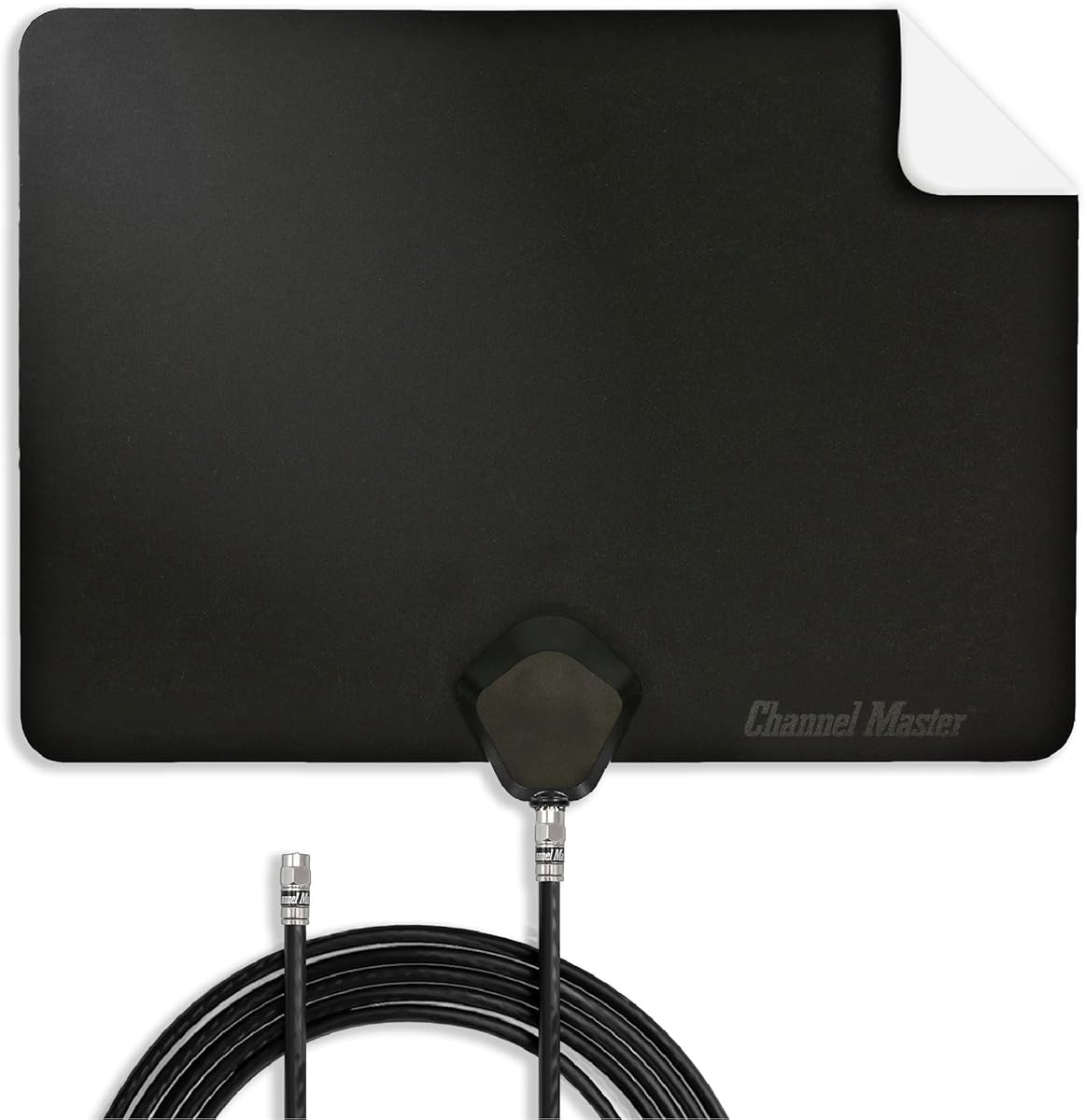
The Channel Master FLATenna is a compact indoor option for urban and suburban homes near broadcast towers. It has a 4.1 rating and a realistic stated range of 35 miles, with the product information explicitly acknowledging the effects of obstructions and interference. Its thin, reversible black-and-white face lets it fit neatly against a wall, window, or tabletop without the visual bulk of a conventional outdoor antenna.
We may earn a commission when you buy through this link, at no additional cost to you.
The antenna captures HD and digital signals and provides access to common local network groups such as ABC, CBS, FOX, NBC, PBS, Univision, and Telemundo when they are broadcast in the area. It supports ATSC 3.0 NextGen TV and 4K broadcasts with a compatible tuner. A 12-foot professional-grade RG6 cable with enhanced shielding provides enough reach to position the panel more effectively around a room.
The principal strength is convenience. There is no mast assembly, complex aiming procedure, or separate amplifier described in the supplied specifications. Reversibility and multiple mounting options mean users can test different orientations quickly, which is important when nearby walls and windows contain different amounts of metal or structural material.
The FLATenna is best for viewers with moderately strong local signals who value a tidy installation more than extreme range. It is not the strongest choice for severe fringe reception, a tall house surrounded by dense trees, or towers located far in different directions. In those conditions, an outdoor directional antenna with greater gain and an unobstructed view will usually be more appropriate.
The ultra-thin, lightweight form can sit near a window or mount to a wall without visually dominating the space. Reversing the face also helps the user find the orientation that produces the clearest reception results during channel scanning.
The included 12-foot RG6 cable lets the antenna move away from obstructions or troublesome electronics. Its enhanced shielding can help maintain signal integrity, while the cable length gives apartment residents more freedom to find a better window position.
We may earn a commission when you buy through this link, at no additional cost to you.
The PBD Amplified Outdoor TV Antenna differentiates itself with motorized 360-degree rotation, allowing users to adjust its direction with a wireless remote rather than climbing onto the roof. It has a 4.3 rating and a stated 150-mile range. The high-gain, low-noise amplifier is intended to improve reception for 4K and 1080p local broadcasts.
We may earn a commission when you buy through this link, at no additional cost to you.
Remote positioning is particularly helpful for antennas mounted where manual adjustment is inconvenient. The operator can sweep the unit through different directions, rescan televisions, and identify the orientation that produces the best set of stations. Weatherproof construction is designed for year-round outdoor use in both urban and rural settings, while the listed NextGen TV readiness supports ATSC 3.0 broadcasts where available and a compatible tuner is used.
The antenna also provides two television outputs, allowing two screens to be connected without the buyer adding a separate splitter. The installation kit includes 40 feet of RG6 coaxial cable, mounting hardware, and a guide. Because the directional pattern and amplifier are adjusted electronically, the setup remains more involved than attaching a passive indoor panel or a manually positioned compact antenna.
This model suits a household that wants remote aiming, especially if the roof is difficult to access or the broadcast towers are spread across several directions. Its main trade-offs are the need for power and the additional mechanical complexity of the rotating system. It is best for users who value convenient directional control and multiple-screen flexibility more than a minimal or fully manual installation.
The remote-controlled motor is a meaningful convenience for elevated installations. Users can experiment with different orientations from indoors, rescan their televisions, and retain the best position without repeatedly climbing a ladder or manipulating a mast-mounted antenna.
Dual television outputs provide a convenient way to distribute the antenna to two screens. This is especially useful in homes where family members watch in separate rooms, provided both locations have suitable coax connections and the signal remains strong at both displays.
We may earn a commission when you buy through this link, at no additional cost to you.
The best deep fringe television antenna depends on distance, tower direction, obstructions, local interference, and installation access. Reviewing these factors before buying is more reliable than selecting solely on the largest stated range.
Begin by identifying the broadcast towers serving the home and their direction from the property. Official over-the-air channel maps can show which stations are available, but they do not guarantee that every home can receive them. Distance is only one variable: terrain, hills, buildings, trees, and the height of the transmitting antenna can all influence the signal arriving at the roof. Treat the stated mileage on any product as a maximum under favorable conditions, not a promise that every station will appear.
Check your address and local tower locations first, then select an antenna with enough directional gain and range to cover the expected distance. Closer urban and suburban users may do well with a compact indoor panel, while rural or deeply obstructed locations benefit from an outdoor antenna with a clear line of sight.
Over-the-air television stations are distributed across the VHF and UHF broadcast bands. A strong UHF design may not perform equally well on lower-numbered VHF stations, and a product that ignores High VHF can miss channels 7 through 13. The best choices in this guide explicitly address both groups, with some models using separate elements, reflectors, or band-specific amplification to improve coverage across the full broadcast range.
Look for a product that clearly mentions VHF and UHF rather than relying only on a generic range figure. Confirm that the design has been optimized for the channel groups available in your market. If a particular station is known to be troublesome, prioritize a model with dedicated elements for its band.
More amplification is not automatically better. A powerful signal can overload a front end, while a weak signal may need controlled gain. Automatic gain control and band-specific adjustment are valuable because they can increase weak channels without applying maximum boost to every strong signal. In fringe locations, this balance can improve stability and reduce pixelation during changing conditions.
Prioritize intelligent gain management when signals vary greatly by band or tower distance. A fixed high-gain amplifier is more appropriate when every received station is similarly weak. Consider the distance to the strongest nearby transmitter as well as the farthest tower you hope to capture.
Directional antennas concentrate energy toward one target and often reject signals arriving from behind or the sides. This produces useful gain but can require precise aiming. Multi-directional or independently rotating panels offer more flexibility when local towers are spread across a wide area. Single-panel designs are easiest to align against a clear tower cluster, while dual-panel models can cover two broad directions or combine for stronger pickup in one direction.
Map the location of your available stations before choosing. If nearly all towers sit in the same compass direction, a focused design is usually efficient. If they are distributed widely, a broader pattern or a rotatable model may avoid the need for several separate antennas.
Cellular transmitters, FM radio signals, and other electronic equipment can enter a television antenna's operating environment and create noise, pixelation, freezing images, or dropped channels. Models with integrated LTE, 4G, 5G, and FM filtering are especially helpful in neighborhoods with nearby cellular infrastructure, major roads, commercial towers, or densely developed areas.
Check whether filtering is built into the antenna or requires an external accessory. Built-in filtering generally simplifies the installation, but it still does not replace good placement. Keep the antenna away from obvious electrical noise sources when possible and follow the manufacturer's grounding and mounting guidance for outdoor equipment.
Higher placement generally offers a better view over trees, neighboring buildings, and roofing material. Outdoor antennas can be mounted on a roof, wall, pole, or side of the house, while attic models are useful for appearance but may lose performance because the roof and building materials attenuate signals. Check the stated dimensions, weight, compatible mast diameter, cable length, clamps, reflectors, and power inserter before beginning.
Choose a location where the antenna can face the towers with minimal obstruction. The included pole may be enough for moderate installations, but a roof or higher mast can make a major difference in deep fringe locations. Ensure the hardware is appropriate for the surface and that the final cable run can reach the television or network connection point.
Some outdoor antennas include a preamplifier and power inserter, while others can pass signals passively if their amplifier is not powered. This dual-operation capability can provide a useful fallback during an outage, although the passive response may not deliver the same weak-signal performance. It is especially relevant for emergency preparedness and installations where a power interruption could otherwise eliminate reception entirely.
Understand which operating mode you are using and install the power supply where it will remain accessible. If the model has adjustable short-range and long-range settings, begin with the lower setting near strong towers and increase amplification only when channel scans show it is needed.
An over-the-air antenna setup should be able to support the broadcast formats available during the life of the television. ATSC 3.0, also known as NextGen TV, can require a compatible tuner even when the antenna itself is capable of passing the relevant signals. Most modern televisions handle conventional ATSC 1.0 broadcasts, but not every set includes ATSC 3.0 capability.
Check the television specifications before purchase, especially for an ATSC 3.0 claim. Also verify the local availability of NextGen TV broadcasts. Antenna compatibility cannot add channels that are not transmitted in the area, nor can it replace a tuner that lacks the required decoding standard.
Start by connecting the antenna to the television or converter box with quality RG6 coaxial cable, then perform a full channel scan before adjusting the antenna. For an outdoor model, install it as high as practical and point it toward the local broadcast cluster. Use the manufacturer's channel map and rescanning process to identify which stations are available rather than assuming every nearby network is transmitted in the area.
Fine-tune the position gradually. Rotate a directional antenna in small increments, rescan after each meaningful movement, and compare channel lists, picture stability, and audio quality. If an amplifier has short-range and long-range settings, start with the lower setting and increase it only when weak channels require additional gain. Remember to rescan whenever the antenna is moved because the receiver must rediscover which channels are available at the new position.
For outdoor care, inspect mounting hardware and cable connections periodically, particularly after storms or strong winds. Keep the antenna away from trees that may grow into its reception path, and do not reposition it during hazardous weather. Clean removable debris carefully, preserve the supplied weather seals, and follow the manufacturer's grounding and safety guidance. Indoor antennas require little maintenance beyond keeping the panel away from obstructed windows, electronics, and moisture.
The best option is usually a high-gain outdoor directional antenna with VHF and UHF coverage, intelligent amplification, and interference filtering. Installation height and a clear view toward the transmitter often matter more than the largest advertised mileage. Use official channel maps to identify the towers and directions before selecting an antenna.
Actual reception may be much shorter or longer than a product's stated range, depending on terrain, transmitter height, trees, buildings, and antenna placement. A clear line of sight can outperform a higher claimed mileage, while obstructions can make a strong design perform poorly. Treat maximum range figures as best-case conditions rather than guarantees.
Outdoor antennas generally offer better access to signals because they can be mounted above obstacles and away from building materials. However, an indoor panel can be sufficient in urban or suburban homes with strong nearby broadcasts. Indoor installation is especially convenient for apartments, rentals, and temporary setups.
An amplifier may help when the antenna receives a weak but clean signal, especially across long cable runs. It can also worsen reception if a strong nearby station overloads the system, so automatic or adjustable gain is valuable. Start with moderate amplification and compare results before using the highest setting.
Use an official digital television channel map to find the towers serving your address, then note their compass direction. Point the antenna toward that cluster and make small adjustments while rescanning. If stations come from widely separated directions, a multi-directional or rotating design may work better than a single directional panel.
Different stations may use the VHF or UHF bands and arrive from different directions or with different strengths. Nearby cellular equipment, trees, terrain, and internal home wiring can also affect particular channels. Verify that the antenna supports both VHF and UHF, improve its height and aim, and perform a fresh channel scan after every adjustment.
It depends on the antenna and signal distribution system. The PBD model in this guide has two television outputs, while other antennas may require an appropriate splitter and sufficient signal quality to serve both locations. Use quality RG6 cable and avoid unnecessary long runs or excessive splitters when possible.
No. The antenna must pass the relevant RF signals, but the television or converter box must also support the desired broadcast standards. ATSC 3.0 or NextGen TV requires a compatible tuner, and an antenna cannot create channels that are not broadcast in the local market. Check both the antenna and television specifications.
The Televes DAT BOSS Mix LR is the strongest all-around recommendation for serious fringe reception, combining independent band gain, a directional triple-boom design, advanced filtering, passive fallback operation, and a stated 100-mile reach. The Televes Ellipse Mix offers similarly sophisticated signal management in a more compact form, while the GE antenna is the most accessible general-purpose option for households needing flexible attic or outdoor placement.
Prioritize tower direction, a clear line of sight, VHF and UHF performance, and sensible gain control before focusing on headline range. Higher placement and accurate aiming can deliver more than a more complex antenna mounted in a poor location. Consider cellular filtering in crowded areas, remote rotation when roof access is difficult, and dual outputs when serving multiple screens.
Finally, confirm the antenna's dimensions, mounting hardware, connection type, broadcast compatibility, and current product details before ordering. Local tower maps and a careful installation process remain the most reliable path to stable over-the-air television, while product listings and availability can change as new models and revised specifications appear.