
CME Dual Beam Digital Height Gauge
4.6Editor score
Twelve-inch measuring range
Dual-beam construction
Retained absolute zero
Cast-iron stability
A digital height gauge turns tricky setup tasks into repeatable measurements, especially when setting a table saw blade, aligning a router bit, or checking the height of a finished workpiece. The best models combine accurate readings, stable bases, intuitive controls, and enough range for the measurements common in workshops, laboratories, and inspection work.
This guide compares ten digital height gauges using the supplied specifications, customer ratings, measurement ranges, resolutions, accuracy claims, base designs, and special features. It covers compact tools for router tables, larger gauges for laboratory and industrial use, magnetic models for hands-free positioning, and precision instruments with memory or data-output capabilities.
Each pick below identifies where that model excels and where its design may be less suitable. The top selections provide the strongest balance of capability, construction, and practical utility, while the remaining options provide valuable choices for different ranges and budgets. Product availability and prices can change, so verify current details before purchasing.
4.6Editor score

4.6Editor score

4.4Editor score
As an Amazon Associate we earn from qualifying purchases.
This side-by-side comparison highlights the differences in range, accuracy, resolution, construction, and specialized features among ten digital height gauges for woodworking, shop setup, inspection, and precision measurement.


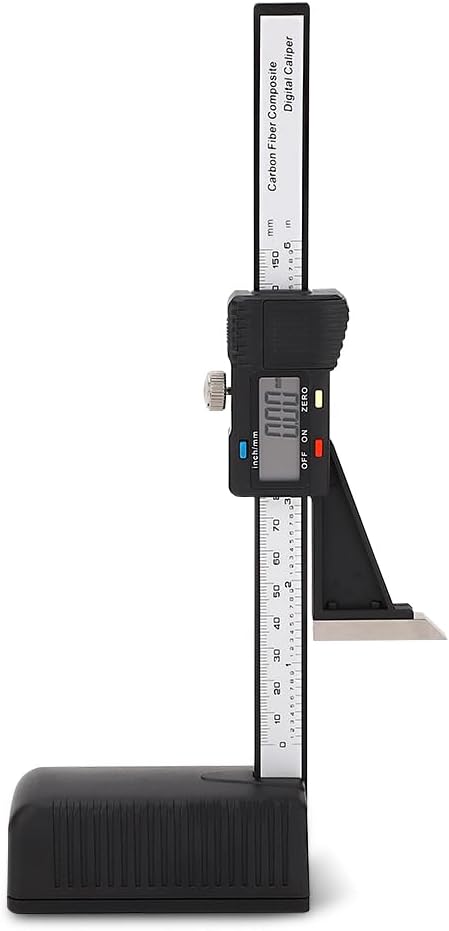

The iGaging Digital Electronic Height Gauge with Magnetic Base is a compact, well-regarded option with a 4.5 customer rating. Its six-inch capacity, 0.0005-inch accuracy increment, and fractional display make it suitable for common woodworking measurements, including router and table-saw setup. The magnetic base is the defining convenience, allowing the gauge to remain positioned while the machine is adjusted.
We may earn a commission when you buy through this link, at no additional cost to you.
The practical benefits extend beyond the measurement range. A fractional display can make it easier to transfer familiar shop fractions instead of relying exclusively on decimals, while the magnetic base reduces the need to hold the instrument in one hand. The heavy-duty designation suggests that the tool is intended to withstand regular shop use, although the supplied information does not describe its exact material composition.
The main limitation is its six-inch range. That is enough for many blade and cutter-height checks, but it may not cover taller workpieces, taller machine components, or laboratory fixtures. Unlike some competing models, this gauge is not listed with absolute encoding, origin memory, a protective case, or a carbide-tipped scriber. Buyers who require those functions may need to look at the more extensively equipped options in this guide.
Despite those omissions, this is an excellent general-purpose choice for a woodworker who values a magnetic base, fractional readings, and a straightforward electronic display. It is particularly well suited to router tables and table saws where a compact gauge is easier to maneuver than a full-height laboratory instrument. For those priorities, it offers a strong balance of capability and simplicity.
The magnetic base lets the gauge remain attached to a compatible ferrous surface while the user adjusts a cutter, blade, or workpiece. That frees both hands and reduces the chance of shifting the instrument during a critical setup.
A fractional display translates decimal measurements into the language many woodworkers already use for blade offsets and cutter settings. That can reduce conversion errors when transferring a reading to a marked scale.
We may earn a commission when you buy through this link, at no additional cost to you.
The Shars 12"/300mm Electronic Height Gage 303-4460 R] combines a substantial measuring range with a 4.5 customer rating. Its 12-inch or 300mm capacity suits users who need more travel than a compact router-table gauge provides. Resolution of 0.0005 inch or 0.01mm and stated accuracy of plus or minus 0.0016 inch or 0.04mm place it firmly in precision-oriented territory.
We may earn a commission when you buy through this link, at no additional cost to you.
Its switchable inch and metric high-contrast LCD supports international and mixed-unit workflows. A fine-adjustment device helps the user settle on small changes without rushing the carriage, while the included carbide-tipped scriber allows the measured position to be transferred to a workpiece. The hardened steel body and precisely ground, microlapped base are especially relevant to stability and repeatability.
This model does not list a magnetic base, absolute encoding, or automatic zero memory. That means it may require more hands-on positioning than magnetic alternatives, particularly when working on a router table. Buyers should also recognize that the title includes an unusual closing bracket and square mark; those characters belong to the supplied Amazon product name and should not be interpreted as additional gauge features.
The Shars is most appropriate for precision woodworkers, machinists, or inspectors who need a long range, fine adjustments, and both inch and metric readings. Its robust steel construction and included scriber make it a strong all-around instrument for detailed measurement work.
The 12-inch capacity expands the gauge's usefulness beyond blade-height checks. It can handle taller components, deeper references, and inspection work where a compact three- or six-inch instrument would run out of travel.
Fine adjustment is especially valuable when a measurement must be dialed in gradually. Combined with the 0.0005-inch resolution, it supports careful positioning in demanding shop or inspection tasks.
We may earn a commission when you buy through this link, at no additional cost to you.
The Wixey Mini Digital Height Gauge is purpose-built for woodworkers who primarily set router bits and table-saw blades. It holds a 4.4 customer rating and offers a compact alternative to full-height gauges. Its measuring span is 3.2 inches, or 0 to 83mm, which is sufficient for many common cutter-height and blade-offset tasks.
We may earn a commission when you buy through this link, at no additional cost to you.
Powerful magnetic feet allow the WR25 to stand against a ferrous work surface, making it convenient during machine setup. The locking rule improves repeatability, while ABS and INC zero-set modes offer flexibility when establishing a reference. A fractional or millimeter display accommodates different working preferences, and the included CR2032 battery means the tool can be put to use without sourcing a separate power source.
Its most obvious limitation is travel. The 3.2-inch range is generous for many router and saw setups but unsuitable for taller workpieces or applications requiring a six- to twelve-inch measuring span. It also lacks the carbide-tipped scriber and protective case offered by several more expensive models in this list.
For a woodworker seeking an affordable, portable gauge focused on practical table-saw and router-table setup, the Wixey is a compelling choice. Its magnetic base, locking rule, and selectable zero modes make it more specialized and useful than a basic tape measure.
The low profile and magnetic feet suit the confined spaces around router tables and table saws. The gauge can remain upright while the user adjusts a cutter or blade without needing to balance it by hand.
Switching between the preset ABS mode and incremental zero-set mode helps match the reference point to the task. This flexibility is useful when measuring relative movement or comparing several identical setups.
We may earn a commission when you buy through this link, at no additional cost to you.
The iGAGING 0-6"/150mm Electronic Digital Height Gage #35-629 stands out with a 4.6 customer rating and one of the most complete feature sets in this roundup. It combines a six-inch range, a magnetic base, absolute encoding, fractional inch readings, IP54 protection, and an included carbide-tipped scriber. That combination makes it suitable for more than routine woodworking.
We may earn a commission when you buy through this link, at no additional cost to you.
Absolute encoding technology allows the gauge to memorize its origin zero, reducing the need to reestablish a reference every time the tool is used. Resolution reaches 0.0005 inch, 0.01mm, and 1/128 inch, with a stated accuracy of 0.001 inch. The CNC-machined magnetic base is designed for flatness, while the IP54 rating provides protection against dust and moisture in active shops, laboratories, and inspection environments.
The 6-inch range remains the central constraint. It is appropriate for machine setup and moderate-height references but not as capable as the 12-inch Shars, CME, and iGAGING models for taller work. Although the product is marketed for shop, lab, inspection, school, and research use, the supplied information does not list a data-output port, so buyers needing digital records should verify compatibility separately.
Overall, this iGAGING model is the strongest general recommendation for someone who wants more than a basic height gauge without moving to a large dual-beam instrument. Its memory function, protective rating, magnetic base, protective case, and precision resolution make it especially versatile for regular professional use.
Remembering the origin zero allows the user to return to a known reference without manually resetting it each time. This is valuable during repetitive inspections, production checks, and machine adjustments.
The IP54 rating indicates resistance to dust and moisture, making the gauge better suited to variable shop environments. The included protective case also simplifies storage and transport between work areas.
We may earn a commission when you buy through this link, at no additional cost to you.
The iGAGING Digital 5-Inch Height Gauge EZ-Check is a woodworking-focused instrument with a 4.6 customer rating. Its five-inch range, 0.0005-inch resolution, and magnetic base target common router and table-saw adjustments. The anodized-aluminum body and compact format distinguish it from larger, more general-purpose laboratory gauges.
We may earn a commission when you buy through this link, at no additional cost to you.
A standout feature is the set of center steps for common router shank diameters: 1/2 inch, 3/8 inch, 1/4 inch, and 3/32 inch. These steps allow a user to establish a reference from the shank rather than repeatedly measuring from an inconsistent surface. The hold function preserves a reading, which is helpful while transferring a dimension to a workpiece or adjusting a machine until the display matches the target.
The gauge's stated accuracy is 0.0015 inch, which is slightly less exact than several competing products that list 0.001-inch accuracy. It also does not mention absolute zero memory, an IP54 protective rating, or an included protective case. The supplied information does mention a patent-pending design, but it does not provide enough detail to evaluate that design independently.
This is a strong choice for woodworkers who value router-specific conveniences over laboratory features. Its center steps, magnetic base, hold function, and straightforward five-inch capacity make it a practical companion for repeatable cutter and blade setup.
Built-in steps for several common shank sizes let a router bit serve as a consistent reference. That reduces repeated manual measurements and makes identical setups easier to reproduce.
Holding a reading is convenient when the user needs to move between the display and the machine controls. It also makes transferring a selected height to a marked workpiece less error-prone.
We may earn a commission when you buy through this link, at no additional cost to you.
The CME Dual Beam Digital Height Gauge is the premier choice in this guide for buyers who want a substantial, stable instrument. It carries a 4.6 customer rating, offers a 12-inch range, and uses a dual-beam design to provide high stability and reduce potential measurement error. Its listed accuracy is plus or minus 0.0015 inch with a 0.0005-inch increment.
We may earn a commission when you buy through this link, at no additional cost to you.
Construction is a central strength. The cast-iron base and chrome-plated steel beams are intended to resist flexing and maintain consistent readings. A built-in absolute encoder retains the zero position through power cycles, removing the need to reset the gauge after switching it off. These characteristics make the instrument more appropriate for metrology, inspection, and demanding workshop tasks than a lightweight plastic tool.
The included carbide-tipped scriber supports direct workpiece marking, and the plastic container provides storage and transport protection. On the other hand, the dual-beam format is inherently larger than a compact magnetic gauge, and the supplied information does not list an IP54 rating or a magnetic base. Those omissions may matter for users who need portable, hands-free positioning.
The CME is the pick for buyers prioritizing range, structural stability, and retained zero over minimal size. It is especially compelling for inspection, laboratory, production, and woodworking applications where repeatability and reduced measurement error justify a more substantial instrument.
The dual-beam structure and cast-iron base are intended to limit movement under load. Greater stability helps maintain consistency when measuring taller parts or applying the gauge to demanding reference surfaces.
The integrated absolute encoder remembers the origin zero even after the gauge is turned off. That saves setup time and reduces the chance of accidentally measuring from a different reference.
We may earn a commission when you buy through this link, at no additional cost to you.
The Starrett Electronic Height Gage combines traditional workshop-oriented construction with a digital display. It has a 4.3 customer rating, a six-inch range, and 0.0005-inch resolution. The defining feature is its large LCD, whose 0.932-inch-high characters are designed to be read quickly without squinting.
We may earn a commission when you buy through this link, at no additional cost to you.
Its hardened stainless-steel bar is built for durability, while the hardened, ground, and lapped base provides a stable reference surface. Finger grooves in the base assist movement, and the vertical bar is positioned back from the nose edge for improved stability. A manual on/off control is supplemented by an automatic shutdown after five minutes of inactivity, helping conserve battery life.
The listed information does not mention fractional reading, metric conversion, absolute encoding, a magnetic base, or an included scriber. Therefore, buyers who require those specific functions should compare them against the iGAGING and CME options. The absence of absolute-zero memory also means the gauge does not offer the same rapid restart convenience as the premium dual-beam model.
The Starrett is a sensible pick for users who value a clear display, proven metal construction, and straightforward operation. Its 4.3 rating is slightly lower than the leading products, but its physical design and readable display remain compelling for traditional shop use.
The unusually tall LCD characters make a measurement easier to read at a glance or from an awkward angle. That is particularly useful when both hands are occupied during a machine adjustment.
A hardened stainless-steel bar and lapped base offer a substantial feel and stable reference surface. These construction details are reassuring for a tool expected to remain on the shop bench for years.
We may earn a commission when you buy through this link, at no additional cost to you.
The Trend Digital Depth Gauge GAUGE/D60 is a specialized instrument for woodworking tasks involving router fences, rebates, grooves, holes, mortises, and slots. It has a 4.4 customer rating and a distinctive 2 23/64-inch aperture, allowing it to span wider openings than a conventional compact height gauge.
We may earn a commission when you buy through this link, at no additional cost to you.
Its digital readout registers in 0.002-inch increments with stated accuracy of 0.003 inch. That is less exact than the 0.0005-inch resolution offered by several true height gauges, but it remains practical for setting cutter height, backset, and groove depth. Magnetic feet hold the tool to compatible metal surfaces, freeing both hands for adjustment, while the locking option preserves a selected measurement.
A removable pointer can be clipped to the ruler to check holes, mortices, or slots as deep as two inches. The maximum measuring range is 3 5/32 inches. The principal limitation is specialization: this is a depth gauge rather than a conventional height gauge with a tall vertical scale, so it should not be expected to serve general-purpose height measurement tasks.
The Trend is a compelling alternative for woodworkers whose most important measurements concern depth, aperture, and router-table position. Buy it for precise rebate and groove work; choose a true height gauge instead when vertical reach and finer display resolution are the priority.
The broad opening can span fence cheeks and larger router-base openings. That geometry reaches awkward spaces that a narrow gauge body may not be able to bridge.
The clip-on pointer turns the ruler into a practical gauge for holes, mortices, and slots. It broadens the tool's usefulness beyond a single router-height measurement.
We may earn a commission when you buy through this link, at no additional cost to you.
The Ejoyous Height Gauge 0-150mm Digital Height Caliper is a compact, lightweight option with a 3.8 customer rating. It measures from 0 to 150mm and displays results in inches or metric units. A reset button supports relative measurement, while the magnetic base is intended to hold the tool firmly against ferromagnetic surfaces.
We may earn a commission when you buy through this link, at no additional cost to you.
Its engineering-plastic construction makes the gauge easy to carry and comfortable to store in a compact toolbox. The product is specifically described as a woodworking tool for setting saw-blade height, making that application its clearest strength. The dual-unit display is convenient for users who work from metric drawings but need occasional inch readings.
This model has the lowest rating in the roundup, and the supplied specifications provide no numeric accuracy or resolution claim. Its 3V button-cell battery is also not included, so buyers should budget for that additional item. The plastic body and absence of an IP54 rating may make it less appealing for heavy-duty industrial use or exposed shop conditions.
The Ejoyous remains a practical option for a woodworker who prioritizes low weight, portability, and metric capability over premium construction. It is most convincing as an inexpensive secondary gauge for routine blade-height checks, provided the buyer confirms the required accuracy and supplies a compatible battery.
The lightweight engineering-plastic body is easy to carry between a router table, a saw, and a job site. Compact dimensions also simplify storage in crowded tool drawers or mobile toolboxes.
The reset function establishes a temporary zero reference, allowing a user to measure changes relative to an existing position. This is useful for matching blade heights or checking small setup differences.
We may earn a commission when you buy through this link, at no additional cost to you.
The iGAGING 12"/300mm Electronic Digital Height Gage #35-630 offers the largest range in the iGAGING group and a broad collection of advanced features. Its customer rating is 2.8, the lowest in this roundup, so prospective buyers should examine recent customer feedback carefully. On specifications alone, it supports inch, millimeter, and fractional readings with 0.0005-inch resolution.
We may earn a commission when you buy through this link, at no additional cost to you.
Absolute encoding allows the instrument to memorize its origin zero, and the precision-lapped steel base is designed for stability. IP54 protection helps shield the gauge from moisture and dust, while the included carbide-tipped scriber and protective case support marking, storage, and transport. The model is also listed for shop, laboratory, inspection, school, and research environments.
Its most unusual feature is the micro USB data-output port. The port is intended for a separately sold #35-630-USB data-output kit, so it does not provide a complete data workflow out of the box. Accuracy is listed as 0.001 inch over six inches and 0.002 inch over twelve inches, meaning accuracy varies across the longer scale. These factors should be weighed against the low rating before purchase.
The iGAGING 12-inch gauge is worth considering for users who specifically need fractional readings, absolute-zero memory, protective housing, and long travel in one instrument. It is less compelling for buyers who prioritize strong customer feedback, immediate data logging, or a completely self-contained accessory package.
Combining a 12-inch range with fractional inch readings allows the gauge to handle taller references while preserving the fine increments valued by woodworkers. It also displays metric values for mixed-unit workflows.
The micro USB port adds a path to digital data transfer, but the required data-output kit is not included. Buyers should confirm that they need this feature and plan for the extra accessory before deciding.
We may earn a commission when you buy through this link, at no additional cost to you.
Choosing a digital height gauge means balancing range, resolution, accuracy, base stability, display preferences, and the type of work you expect to measure. The following factors help separate specialized depth tools from versatile workshop and inspection instruments.
Range determines the tallest difference the gauge can measure without moving the tool. Compact three-inch models are well suited to router cutters and many table-saw blade heights, while six-inch gauges provide more room for machine components, fixtures, and moderate-height workpieces. Twelve-inch instruments are the better choice for taller assemblies, deeper references, and professional inspection work. Always compare range with the physical dimensions of the machine or workpiece rather than choosing the largest available span by default.
Resolution indicates the smallest increment the display can present, while accuracy describes how closely the result may differ from the true measurement. A resolution of 0.0005 inch is finer than 0.001 inch, and a stated accuracy around 0.001 inch is preferable for demanding setup work. These two figures are related but not interchangeable. Look for a gauge whose accuracy claim remains suitable across the portion of its scale that you will use, particularly when considering longer 12-inch models.
The base establishes the reference plane, so even an excellent display cannot compensate for an unstable or non-flat setup. Magnetic feet are especially convenient on ferrous router tables, saw surfaces, and steel fixtures. Fixed-base designs often use hardened, ground, or lapped steel or cast iron for stability across a wider variety of surfaces. Consider the surface material in your shop, the gauge's footprint, and whether hands-free positioning will improve your workflow.
A clear display can prevent setup errors in awkward shop positions. Large LCD characters are useful when the gauge is viewed from above or while both hands are busy. Inch, millimeter, and fractional readings serve different preferences: decimals suit many machinists, metric supports international specifications, and fractions are familiar to many woodworkers. Consider which combination you use daily and whether switching units creates unnecessary mental effort.
Absolute encoding lets a gauge remember its origin zero, allowing the user to resume from the same reference after switching it off. This is valuable during repetitive inspection, production work, and repeated machine setup. Relative or zero-set modes are also useful when measuring small changes from an existing position. Models without memory require more attention after power cycles, but they may still be entirely adequate for occasional one-off measurements.
Hardened steel, stainless steel, cast iron, and anodized aluminum offer different combinations of rigidity, weight, and corrosion resistance. An IP54 rating adds resistance to dust and moisture, which is useful in active shops and laboratories. Portable plastic models are easier to carry but generally make more sense for light-duty measuring than for demanding metrology. Match the construction to the environment, handling frequency, and risk of accidental knocks.
A carbide-tipped scriber lets a measured position be marked directly on a workpiece, reducing a separate transcription step. Magnetic bases, protective cases, center steps, and data-output interfaces add convenience in different ways. Some accessories are included, while others require separate purchase, so check the supplied contents carefully. A data port without its required cable or kit may not provide immediate practical value.
Woodworking gauges commonly emphasize magnetic positioning, fractional readings, router shank references, and compact footprints. Laboratory and inspection models add protective ratings, carrying cases, retained zeros, and sometimes data output. A depth gauge with a wide aperture can outperform a conventional height gauge for checking router fences or deep grooves. Define the jobs you expect to perform before choosing a design optimized for another workflow.
Begin by placing the gauge on a clean, flat, stable reference surface. If the base is magnetic, confirm that it has full contact with the workpiece or machine table and that the magnetic feet will not slip during adjustment. Turn the display on and check whether it prompts for a zero. For an absolute-memory model, allow the stored origin to load; for a relative model, press the reset or zero control as appropriate.
Move the measuring carriage slowly and watch the display for a stable value. Avoid striking the gauge against a machine component, and do not force the carriage past its stated range. If the job involves transferring a setting, use the hold function when available or write down the reading before removing the gauge. Where marking is appropriate, use the supplied carbide scriber carefully and wear suitable eye protection around rotating machinery.
After use, return the carriage to a relaxed position, switch off the gauge, and store it in its case where one is supplied. Remove batteries from models that use replaceable cells if the tool will remain unused for an extended period. Keep the base and measuring surfaces free of dust, oil, and adhesive residue, and do not immerse the instrument. If a reading appears inconsistent, check zero position, surface contact, battery condition, and whether the measurement lies within the stated accuracy range.
A digital height gauge measures vertical distance with an electronic display, making it useful for setting table-saw blade height, positioning router cutters, checking workpiece height, and performing inspection tasks. Woodworking models often emphasize magnetic bases and fractional readings. Laboratory and industrial models may add absolute zero memory, protective ratings, wider ranges, or data-output options.
It is generally better when precision, repeatability, or easy electronic readings matter. A ruler can be sufficient for rough layout, while a digital gauge is more useful for transferring exact settings and measuring repeatedly in the same position. The additional capability comes at the cost of sensitivity to impact, contamination, and battery or mechanical problems.
For routine woodworking, a resolution around 0.001 inch or finer is generally useful, while finer readings can help with delicate setup and inspection. Resolution does not guarantee equal accuracy, so review the stated accuracy specification too. Choose a gauge whose accuracy remains appropriate for the range and type of measurement you will perform.
A magnetic base improves convenience and can support consistent positioning, but it does not automatically improve the instrument's intrinsic accuracy. Accuracy still depends on flatness, contact, rigidity, calibration, and the measurement technique. A magnetic base is most valuable when it keeps the gauge stable while both hands are needed for machine adjustment.
Relative zero lets the user establish a temporary reference at the current position and measure change from that point. Absolute zero is stored within the gauge and can be restored after it is switched off. Absolute memory is convenient for repetitive work, while relative zero is useful for comparing small adjustments and offsets.
Yes, provided the gauge's range and dimensions suit the saw and the measurement can be made from the correct reference surface. Compact magnetic models are particularly convenient for this task because they can remain positioned as the blade is raised or lowered. Always lock the machine, disconnect power when appropriate, and follow the saw manufacturer's safety procedures.
Choose the format that matches your drawings, machine scales, and normal measuring habits. Woodworkers may favor fractional readings, while metric-capable shops often prefer millimeters. Several models support multiple units, which is convenient but not essential if you consistently work in only one system.
Keep the measuring surfaces clean and free of oil, dust, and adhesive buildup. Avoid dropping the tool or forcing its moving parts, and store it with the carriage returned to a relaxed position. Replace batteries as needed, use the protective case when supplied, and verify the zero and known reference dimension periodically to confirm consistent operation.
The iGAGING 6-Inch Absolute Reading Height Gage is the most versatile all-around choice, combining absolute-zero memory, fractional readings, magnetic positioning, IP54 protection, and a protective case. The CME Dual Beam Digital Height Gauge is the premium option for buyers who want greater range, retained zero, and a rigid cast-iron and steel construction. The Wixey Mini Digital Height Gauge serves as the best budget pick for compact router-table and table-saw setup.
Prioritize the features that match your actual workflow. Woodworkers may value magnetic feet, fractional displays, router shank steps, and a carbide scriber; inspection users may place greater importance on range, protected construction, retained zero, and accuracy. Compact three-inch models are convenient, but a six- or twelve-inch gauge provides more room for taller references and less demanding positioning.
Finally, check the current listing, included accessories, battery requirements, and product specifications before ordering. Prices and availability change over time, and buyer feedback can add useful context beyond the technical specifications. The right digital height gauge is the one that combines the required range, dependable accuracy, stable positioning, and a display your workflow can use confidently.
